Unmistakable: the free logo design book
Unmistakable is a free 188-page logo design book (PDF) by Sushant Singh. It explains how to design a logo, the six types of logo, logo design principles, how to choose and test a logo, what a logo costs and how to trademark it — through 98 short lessons, 19 true brand stories and printable templates.
- Printable · LightPaper pages, for printing a hard copy
- Soft copy · DarkFor reading on screen
Key takeaways
- A good logo identifies first and distinguishes second: it must be recognisable, ownable and reproducible — not explain everything the business does.
- There are six kinds of logo: wordmark, lettermark, pictorial or abstract symbol, combination mark, emblem and mascot. The name, media and budget decide which fits.
- Design in black and white first and test at 16 pixels; a logo that only works large or in colour will fail in real use.
- Choose with a weighted scorecard and blind reviews, not taste, and measure recognition rather than preference.
- Search trademarks before you fall in love with a design, and get a written copyright assignment from whoever made it.
Who it’s for
- Founders making a first logo for a startup or small business who want to know what to buy, what to skip and how to own it
- Graphic and brand designers who want a stronger logo design process, cleaner craft and clients who say yes
- Marketers and brand managers choosing, testing or refreshing a logo, or planning a rebrand
- Students and anyone curious about famous logos and why some become iconic
What’s inside
- 19 true logo stories: Bass’s red triangle, Coca-Cola, FedEx, the Nike Swoosh, I ♥ NY, Starbucks, Instagram, Gap, Tropicana and more
- 98 short lessons on logo design principles: strategy, the brief, perception and colour psychology, the six types of logo, craft, and logo systems
- Twelve ways to find a logo idea, all drawn for one fictional brand you follow from brief to launch
- A founder’s playbook — what a logo costs, naming, hiring a designer, the contract — and a designer’s practice on pricing and presenting
- Testing, trademark clearance, copyright and rebranding, plus 60+ real logos, cheat sheets, a logo design brief template and a scorecard
Sample pages
19 true logo stories, from Coca-Cola to Gap 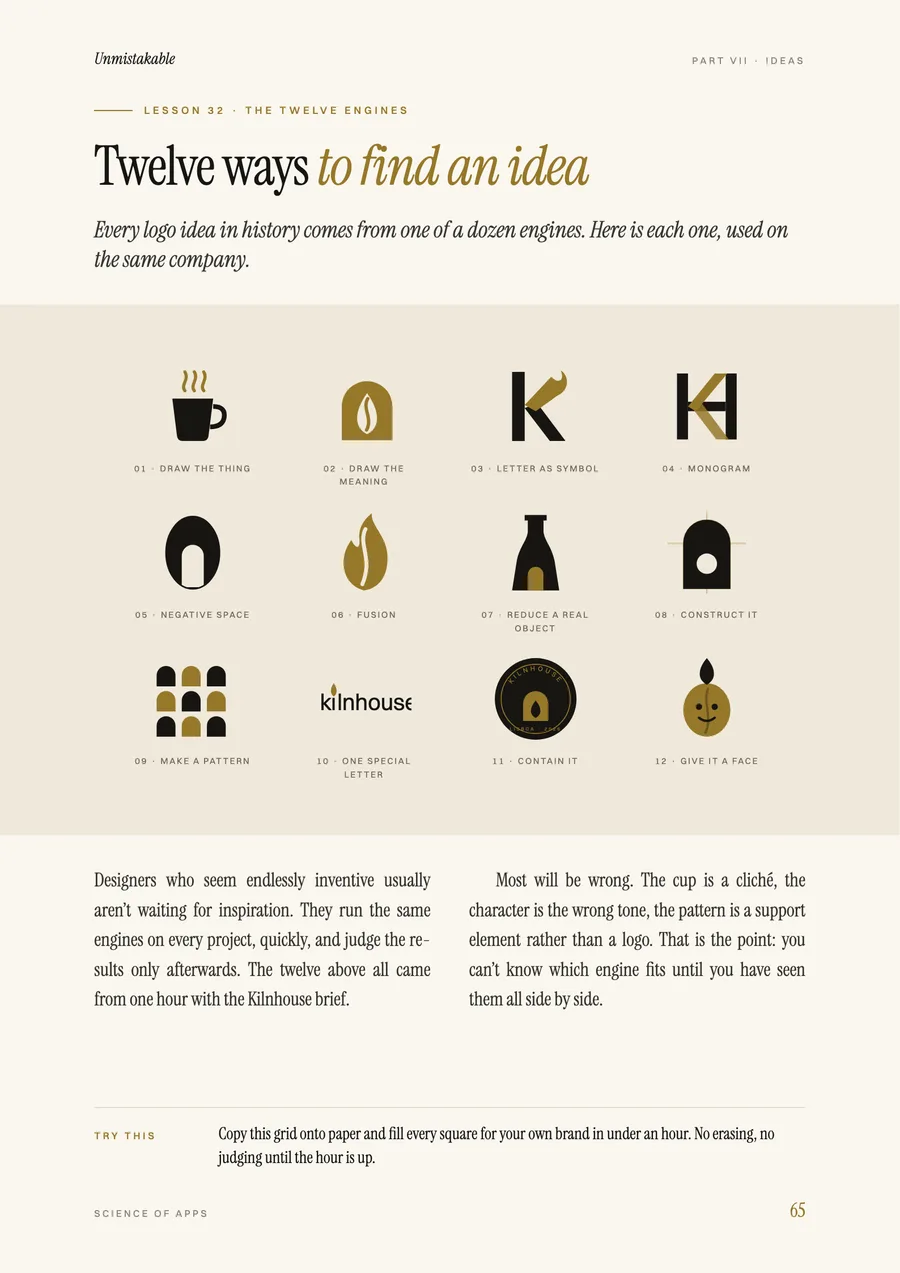
Twelve ways to find a logo idea 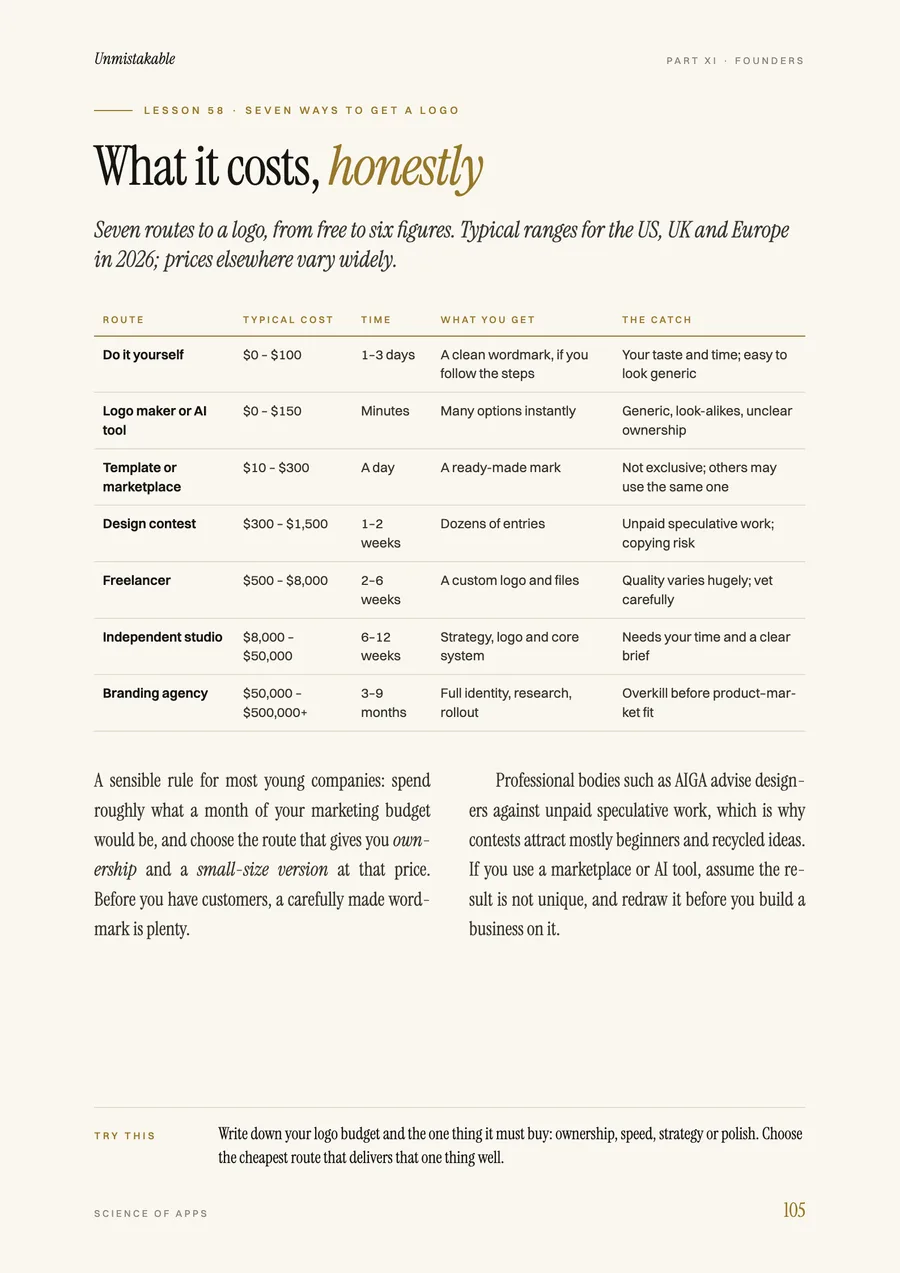
What a logo costs, honestly
Contents: 3 books, 20 parts
Every part opens with a true story from the archive.
01 Book One · The Story of Marksp. 11
Five Thousand Years of Signatures, The Masters, What a Logo Really Is, How Eyes and Minds Read a Mark
02 Book Two · The Makingp. 44
Strategy Before Shapes, The Six Kinds of Mark, Where Ideas Come From, Craft: Geometry, Optics and Ink, From Mark to System, From Blank Page to Three Good Ideas
03 Book Three · Choosing, Owning, Livingp. 100
The Founder’s Playbook, Choosing Without Fooling Yourself, The Logo Meets the World, The Finish: Files, Checks and Handover, Owning It: Trademarks and Rights, Change Without Losing Yourself, The Designer’s Practice, Mistakes, Myths and Case Files, One Brand, Twelve Weeks, The Toolkit
Frequently asked questions
Is this logo design book really free?
Yes. Unmistakable is a free 188-page PDF. You enter your name and email and it is emailed to you straight away, with a download link — no card and no paywall. You also get occasional UX psychology tips by email and can unsubscribe at any time.
How do you design a logo, step by step?
Start with the business, not the drawing: write a brief with the audience, competitors and where the logo will be seen. Generate many rough ideas, narrow to two or three routes, design in black and white, test at small sizes, score the routes against the brief, then search trademarks and produce clean files.
What are the six types of logo?
Wordmarks (the name as the logo, like Coca-Cola), lettermarks (initials, like IBM), pictorial and abstract symbols (Apple, Nike), combination marks (symbol plus name), emblems (everything inside a badge) and mascots (characters like the Michelin Man). The right type depends on the name, where the logo appears and the budget.
What are the principles of good logo design?
A good logo is distinctive, simple without being generic, legible at small sizes, works in one colour, fits the brand’s strategy and is ownable as a trademark. It does not need to explain the business. Consistent use over time is what makes a logo famous.
How much does a logo cost?
Typical 2026 ranges in the US, UK and Europe: $0–100 to do it yourself, $500–8,000 with a freelancer, $8,000–50,000 with an independent studio and $50,000 or more with a branding agency. Most early-stage startups need only a well-made wordmark and a small-size icon.
How do I choose the right logo for my business?
Agree weighted criteria before seeing any design, review options in black and white at the same size, score them independently, and test with real customers for recognition rather than preference. Reject any option that fails at 16 pixels, in one colour, or in a trademark search.
Does the golden ratio make a better logo?
No. The golden ratio is a useful way to pick related proportions, but research finds no reliable preference for it, and many famous “golden ratio” logo overlays were drawn after the fact. Judge a logo by how it looks and works at real sizes.
Do I need to trademark my logo?
You should search for conflicting trademarks before finalising a logo and register it in the countries where you trade. Also get a written copyright assignment from the designer — paying for a logo does not automatically mean you own it. Laws vary by country, so consult a trademark attorney.
Who is this logo book for?
Founders making or choosing a first logo, graphic and brand designers who want a stronger process, marketers planning a rebrand, and students or anyone curious about famous logos. The opening pages suggest a reading path for each.
Which famous logos and stories are in the book?
More than 60 real logos and 19 true stories, including Bass’s red triangle (UK trademark No. 1), the Coca-Cola script, the FedEx arrow, the $35 Nike Swoosh, Milton Glaser’s I ♥ NY, Starbucks, Instagram, Gap’s reversed redesign, Tropicana and London 2012.
What is the difference between the Light and Dark editions?
The content is the same. The Light edition has paper pages and is made for printing. The Dark edition is made for reading on a screen. You can ask for either one or both.
Who wrote Unmistakable?
Sushant Singh, founder of Science of Apps, a behavioral UX consultancy for app and SaaS teams. Unmistakable is the third Science of Apps book, after The Laws of UX field guide and 100+ Subscription Paywalls, Decoded.
Make the mark people remember
Free. No card, no paywall. Enter your email and the PDF arrives straight away, as an attachment and a download link.