AI Skills library

Paste a skill.
Get the result.

200 free, ready-to-run AI skills organised by job. Each one turns ChatGPT, Claude, Gemini or Copilot into a specialist for a single task — copy it, paste it into your assistant, send your input, and the first reply is something you can use.

200 skills16 job profilesFree · no sign-up

What is an AI skill?

An AI skill is a ready-made set of instructions that turns a general AI assistant such as ChatGPT, Claude or Gemini into a specialist for one job — for example writing a cold email, reviewing a pull request or checking an invoice. You paste it in once, send your input, and the assistant follows the same steps and format every time.

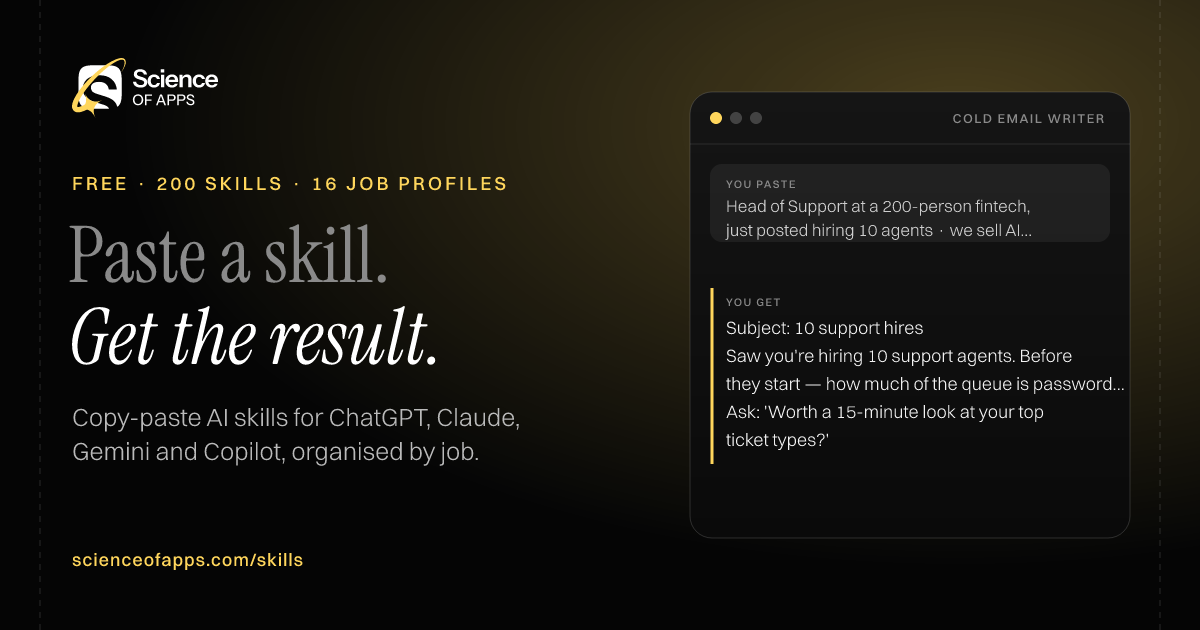
An AI skill in action: the Cold email writer skill pasted into an AI assistant, with the input and the email it writes
What a skill looks like in use: paste it, send your input, get the result in a fixed format.
How it works

One paste, one result

  1. Cold email writerCopy skillCopied ✓01

    Copy the skill

    Press Copy skill on any card to copy its full instructions.

  2. ANY AI ASSISTANTSKILLPaste here, then press Enter02

    Paste it into your AI assistant

    Paste it as the first message of a new chat in ChatGPT, Claude, Gemini or Copilot — or into a Project, Gem or custom GPT to keep it.

  3. ANY AI ASSISTANT03

    Send your input

    Send what the skill asks for (a draft, a table, a transcript). The first reply is the finished result in the skill's format.

Works in ChatGPT, Claude, Gemini, Microsoft Copilot and Any other assistant. Every skill also comes as a ZIP for Claude's Upload skill and a SKILL.md file for agents. See the install guide with screenshots →

By job profile

Skills for 16 jobs, ordered by demand

The most-requested AI work comes first: coding, writing for marketing and sales, data analysis and product work. Each category says which research put it there.

Start here

The first skill to install, by job

Software engineer

Stack trace debugger

ProblemA stack trace points at a line, not at the cause, and searching the error message wastes an hour.

You paste

TypeError: Cannot read properties of undefined (reading 'map') at OrderList.tsx:14

You get

Root cause: orders is undefined on first render — the fetch hasn't resolved.

Fix: const orders = data?.orders ?? []

Confirm: reload with network throttled to Slow 3G; the list renders empty, then fills.

Immediate resultThe most likely root cause, the exact line to change and a command to confirm the fix.

Performance marketer

Ad variant generator

ProblemAd platforms reward testing many variants, but writing them within character limits is slow.

You paste

Google Search · invoicing app for Indian freelancers · free plan, GST-ready invoices

You get

Pain | GST Invoices in 60 Seconds (26) | Stop formatting invoices by hand. Free plan, GST fields built in. (65)

Objection | Free Plan, No Card Needed (25)

Test first: Pain vs Outcome — the clearest contrast.

Immediate resultTen ad variants across five angles, each inside Google or Meta character limits, ready to upload.

SDR / account executive

Cold email writer

ProblemCold emails sound like templates, so reply rates stay in the low single digits.

You paste

Head of Support at a 200-person fintech, just posted hiring 10 agents · we sell AI ticket triage

You get

Subject: 10 support hires

Saw you're hiring 10 support agents. Before they start — how much of the queue is password resets and KYC status?

Ask: 'Worth a 15-minute look at your top ticket types?'

Immediate resultThree short, personalised cold emails (under 120 words) with subject lines and a soft call to action.

Data / business analyst

SQL from plain English

ProblemSimple business questions wait days in the data team's queue because nobody else can write SQL.

You paste

BigQuery · monthly active users for 2026 · events(user_id, event_name, event_ts)

You get

MAU = distinct users with any event in the calendar month (UTC).

SELECT DATE_TRUNC(DATE(event_ts), MONTH) AS month, COUNT(DISTINCT user_id) AS mau FROM events WHERE event_ts >= '2026-01-01' GROUP BY month ORDER BY month;

Sanity check: no month should exceed total sign-ups to date.

Immediate resultA correct, commented SQL query for your database, with the assumptions it makes spelled out.

Product manager

One-page PRD

ProblemPRDs are either a vague paragraph or a 20-page document nobody reads.

You paste

Notes: users forget to pay rent on time in our rental app; add reminders + autopay?

You get

Problem: 31% of rent payments are late (from notes — verify the source).

Metric: on-time payment rate · guardrail: notification opt-outs

Won't (v1): autopay — needs NPCI e-mandate work; reminders first.

Immediate resultA one-page PRD: problem, goal metric, users, scope, requirements, risks and open questions.

Customer support agent

Empathetic reply writer

ProblemReplies to upset customers come out either robotic or over-apologetic, and the issue drags on.

You paste

'Third time my order is late. Useless app.' · policy: ₹100 credit for delays over 30 min

You get

Wants: to be taken seriously, and some compensation.

Reply: 'Three late orders in a row is genuinely frustrating — I'm sorry. I've added a ₹100 credit for today's delay…'

Internal note: tag 'repeat delay', check rider allocation for this pin code.

Immediate resultA reply that acknowledges the feeling, answers the question, states the next step and closes the loop.

All skills

Find a skill for your task

Search by what you need to get done, or pick your job to see its skills.

Marketing

18 skills

Sales

16 skills

Design & UX

12 skills
Future-skills forecast

What people will need next

Skills marked Rising demand come from our forecast of where AI work is heading. The full reasoning and evidence are in AI skills in demand for 2027 and beyond.

Next 6 months

to April 2027

1 to 2 years

2027–2028

Beyond 2 years

2029 and later
Method

Why these categories

Categories are ordered by demand: what people use AI assistants for most (Anthropic Economic Index, the NBER study of ChatGPT use, Microsoft Research), which jobs are growing fastest (WEF Future of Jobs 2025, US BLS projections, LinkedIn Jobs on the Rise 2026) and where employers ask for AI skills (Indeed Hiring Lab). Each category page names its sources.

Demand evidence behind each job profile (sources checked October 2026)
Job profileWhy it's in demandSources
Software engineeringCoding is the single largest use of AI assistants: computer and mathematical tasks are about a third of Claude.ai conversations and nearly half of API traffic, and fixing software errors is the most common task of all. Software developers and security specialists are among the fastest-growing jobs to 2030 and 2034.[1], [3], [4], [5]
MarketingWriting is the most common thing people do with ChatGPT at work, and marketing is one of the functions where companies most often use generative AI. About 15% of marketing job postings already mention AI.[2], [8], [7]
SalesMicrosoft's study of 200,000 Copilot conversations found sales among the occupations where generative AI applies most, because the work is providing and communicating information. Marketing and sales is also one of the functions where companies report the most AI use.[6], [8]
Data & analyticsData scientists are projected to grow 34% by 2034, big data specialists top the WEF's fastest-growing jobs, and nearly 45% of data and analytics job postings now mention AI — more than any other job family.[4], [3], [7]
Product managementAI consultant and strategist is LinkedIn's second fastest-growing US job, product development is one of the areas where leaders already use AI agents, and writing and analysis — most of a PM's week — are the top work uses of AI assistants.[5], [9], [2]
Customer supportCustomer operations is one of the functions where generative AI creates the most value and where leaders already use agents, and customer service is among the occupations with the highest AI applicability in Microsoft's research.[6], [9], [8]
Finance & accountingFintech engineers are the WEF's second fastest-growing job to 2030, and business and financial operations are among the knowledge-work groups where AI assistants are most used for analysis and writing.[3], [1], [6]
Operations & project managementOffice and administrative support is one of the occupation groups with the highest AI applicability and a growing share (13%) of AI API use, and leaders expect to use AI agents to expand team capacity within 18 months.[6], [1], [9]
HR & recruitingAbout 9% of HR job postings already mention AI, and companies increasingly use AI for drafting and knowledge work in people functions. The EU AI Act treats AI used to rank or filter candidates as high-risk, which is why these skills draft and structure rather than decide.[7], [8], [11]
Design & UXUI and UX designers are in the WEF's ten fastest-growing jobs to 2030, and arts, design and media work is a rising share of Claude conversations.[3], [1]
Founders & small businessSmall teams now do work that used to need a department: leaders expect AI agents to expand team capacity within 18 months, and AI consultant and strategist — the job of applying AI to a business — is LinkedIn's second fastest-growing US role.[5], [9]
Legal & complianceIndia's DPDP Rules phase in through May 2027 and the EU AI Act's high-risk duties now start in December 2027, so most companies need compliance reading and drafting they don't have staff for — and weak risk controls are one of the main reasons AI projects get cancelled.[12], [11], [10]
Education & trainingEducation and instruction is the second-largest use of Claude after coding, rising from 9% to 15% of conversations in 2025, and tutoring and teaching are among the most common practical-guidance uses of ChatGPT.[1], [2]
Job seekers & careersSeeking practical guidance is the most common reason people use ChatGPT, and AI skills are now listed in a record share of job postings — so candidates need both better applications and proof they can work with AI.[2], [7], [3]
Healthcare administrationHealthcare reimbursement specialist is LinkedIn's sixth fastest-growing US job, and healthcare occupations dominate the BLS fastest-growing list to 2034 — while office and administrative work is where AI applies most.[5], [4], [6]
Writing & communicationsWriting is the most common work task in ChatGPT, most of it editing text people already have, and arts, design and media is a rising share of Claude conversations.[2], [1]
  1. Anthropic Economic Index — Economic primitives report (January 2026)Computer and mathematical tasks were about a third (34%) of Claude.ai conversations and nearly half (46%) of API traffic in November 2025; education and instruction was second at 15%; office and administrative support was 13% of API use. The single most common task was fixing software errors (6%).
  2. Chatterji et al. — How People Use ChatGPT (NBER Working Paper 34255, September 2025)Practical guidance, seeking information and writing make up nearly 80% of ChatGPT conversations, and writing is the most common use at work, most of it editing and improving text people already have.
  3. World Economic Forum — Future of Jobs Report 2025Employers expect big data specialists, fintech engineers and AI and machine learning specialists to be the fastest-growing jobs to 2030, with software developers, security management specialists and UI/UX designers also in the top ten. AI and big data, networks and cybersecurity and technological literacy are the fastest-growing skills.
  4. US Bureau of Labor Statistics — Employment Projections 2024–34Data scientists (+34%) and information security analysts (+29%) are among the fastest-growing occupations to 2034, against 3% growth for all jobs; healthcare roles such as nurse practitioners are on the same list.
  5. LinkedIn Jobs on the Rise 2026, as reported by Becker's Hospital Review (January 2026)AI engineer is the fastest-growing US job title, with AI consultant/strategist second; healthcare reimbursement specialist is sixth. Built from millions of jobs LinkedIn members started between January 2023 and July 2025.
  6. Tomlinson et al., Microsoft Research — Working with AI: Measuring the Applicability of Generative AI to Occupations (2025)Across 200,000 Bing Copilot conversations, AI applicability is highest for computer and mathematical work, office and administrative support, and sales and other jobs built on providing and communicating information; the authors stress this is not a forecast of job loss.
  7. Indeed Hiring Lab — January 2026 labor market update: jobs mentioning AI are growing4.2% of US job postings mentioned AI in December 2025, a record; nearly 45% of data and analytics postings did, against about 15% in marketing and 9% in HR.
  8. McKinsey — The state of AI in 2025: Agents, innovation and transformation88% of organisations use AI in at least one business function (survey of 1,993 people, mid-2025), but most have not scaled it; AI agent use is most often reported in IT and knowledge management, and no more than 10% scale agents in any one function.
  9. Microsoft — 2025 Work Trend Index: The year the Frontier Firm is born82% of leaders expect to use AI agents to expand workforce capacity in the next 12–18 months, and expect teams to be training and managing agents within five years (the 'agent boss').
  10. Gartner — Over 40% of agentic AI projects will be canceled by end of 2027 (June 2025)Rising costs, unclear business value and weak risk controls will end over 40% of agentic AI projects by the end of 2027.
  11. Gibson Dunn — EU AI Act Omnibus agreement: postponed high-risk deadlines (May 2026)The provisional Digital Omnibus deal moves EU AI Act high-risk obligations to 2 December 2027 (stand-alone systems) and 2 August 2028 (AI in regulated products); transparency duties for AI-generated content stay largely on schedule.
  12. Government of India (PIB) — Digital Personal Data Protection Rules, 2025The DPDP Rules were notified in November 2025 with phased commencement: the Data Protection Board at once, consent managers after 12 months, and notice, breach and children's-data duties after 18 months (May 2027).
  13. Agent Skills — open specification (agentskills.io, December 2025)A skill is a folder with a SKILL.md file (name and description metadata, then instructions) that an AI agent loads when relevant; Anthropic published it as an open standard and other AI tools have adopted the same format.
For builders and AI engines

Plain text, plug and play

SKILL.md for every skill

Each skill page links a plain-text SKILL.md in the open Agent Skills format — a name and description header, then the instructions. Upload it as a Claude Skill, drop it into an agent's skills folder, or load it into your own AI product.

The whole library as text

/skills/llms.txt lists every skill with its SKILL.md link, and /skills/llms-full.txt has all 200 full definitions in one file, for AI search engines and anyone building on the library.

Read it as an article

The same 200 skills, with install text, in one long read: 200 AI skills by job.

FAQs

Questions about AI skills

What is an AI skill?

An AI skill is a ready-made set of instructions that turns a general AI assistant such as ChatGPT, Claude or Gemini into a specialist for one job — for example writing a cold email, reviewing a pull request or checking an invoice. You paste it in once, send your input, and the assistant follows the same steps and format every time.

How do I install an AI skill in ChatGPT, Claude or Gemini?

Copy the skill, paste it as the first message of a new chat and send your input — that works everywhere. To keep a skill, paste it into a ChatGPT Project or custom GPT's instructions, a Claude Project's instructions or a Gemini Gem. In Claude you can also upload the SKILL.md file as a Claude Skill.

Are these AI skills free?

Yes. All 200 skills are free to copy, use and adapt, with no sign-up. They work in the free tiers of ChatGPT, Claude, Gemini and Copilot, though longer inputs such as contracts or large data samples work better in paid plans with bigger context windows.

What is the difference between a prompt and a skill?

A prompt is a one-off request. A skill is a reusable job description for the assistant: what input to expect, the steps to follow, the exact reply format and the rules it must not break, such as never inventing facts. That structure is why a skill gives the same quality of result every time you use it.

Is it safe to paste work data into these skills?

Treat any AI tool as an outside service. Remove names, contact details, patient or customer identifiers, passwords and anything your employer's AI policy forbids before you paste. Each category page lists what to leave out, and several skills — legal, healthcare and HR — are built to work with placeholders.

How were the skill categories chosen?

Categories are ordered by demand: what people use AI assistants for most (Anthropic Economic Index, the NBER study of ChatGPT use, Microsoft Research), which jobs are growing fastest (WEF Future of Jobs 2025, US BLS projections, LinkedIn Jobs on the Rise 2026) and where employers ask for AI skills (Indeed Hiring Lab). Each category page names its sources.

What is a SKILL.md file?

SKILL.md is the file format of the open Agent Skills specification: a short header with the skill's name and description, followed by its instructions. Claude Skills and a growing number of AI agents and coding tools load skills in this format. Every skill here has a SKILL.md you can download or read as plain text.

Building an AI product?

Make sure people trust what it says.

Science of Apps runs behavioural UX audits for apps and SaaS, including AI features: where users hesitate, why they stop trusting answers and what to fix first.

Free PDF · 74 pages · 2 editions

The Laws of UX, in one field guide

60 research-backed principles in 6 categories — what each one means, why it works on the human brain and how to use it on your own screens. Written by Sushant Singh, founder of Science of Apps, who has scaled consumer apps to lacs of users and spent 10+ years leading product across startups and digital businesses in the US, EU & India.

Pick your edition
Free. No card, no paywall — just your email.
Free PDF · 74 pages

Get Laws of UX by email

Choose your edition

You’ll also get occasional UX psychology tips. Unsubscribe anytime. Privacy policy

Free PDF · 90 pages · 2 editions

100+ Subscription Paywalls, decoded

110 real paywalls from top apps, taken apart, rated out of 5 and decoded with the Laws of UX — plus the frameworks, copy and checklists to ship your own. By Sushant Singh, founder of Science of Apps.

  • 110 paywalls rated
  • 34 Laws of UX
  • 12 frameworks

Which paywall scored 4.8 out of 5, and which scored 2.6? It’s all inside.

Pick your edition
Free. No card, no paywall — just your email.
Free PDF · 90 pages

Get 100+ Paywalls, Decoded by email

Choose your edition

You’ll also get occasional UX psychology tips. Unsubscribe anytime. Privacy policy