These 8 skills help anyone who writes for a living, or for their job, say more with less: press releases in the inverted pyramid, holding statements for a crisis, tone rewrites, executive summaries, newsletters, speeches and a fact-check for AI-written drafts. Each returns a clean draft and the choices it made.
Communications manager
PR specialist
Copywriter
Internal comms
Executive assistant
Content writer
8 skills
Which writing & communications skill should I install first?
Start with Executive summary. Long reports go unread because the key point is buried on page nine. After you paste it in and send the report, document or notes to summarise and who will read it, you get a one-page executive summary: the bottom line first, three supporting points and the decision needed. Jump to Executive summary ↓
ProblemLong reports go unread because the key point is buried on page nine.
Outcome preview
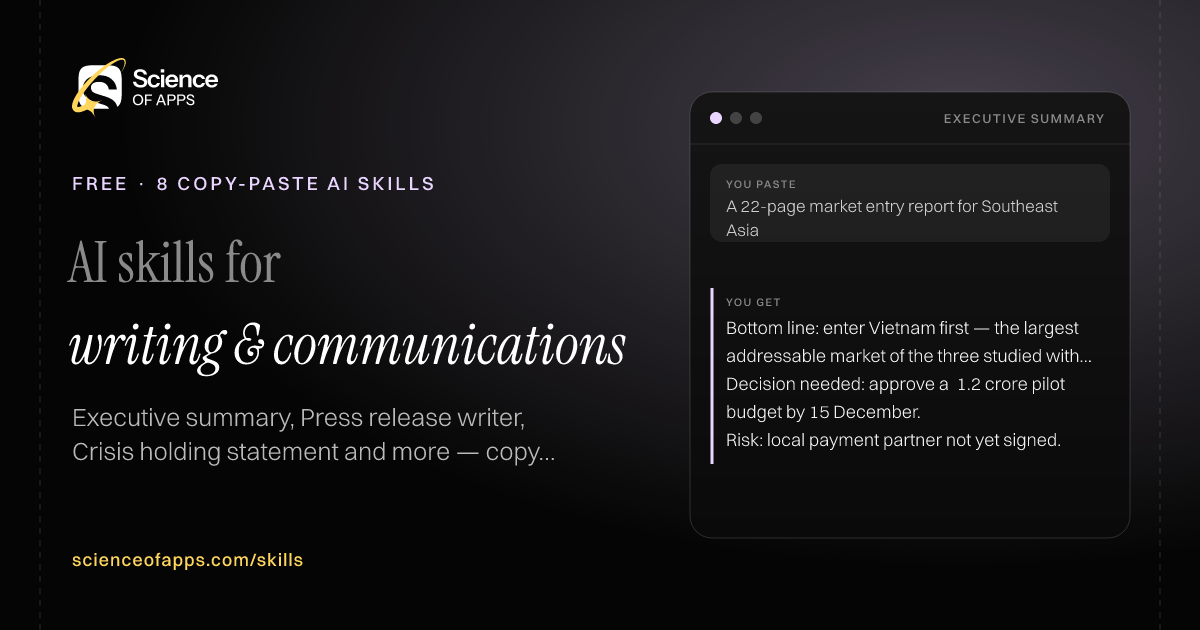
You paste
A 22-page market entry report for Southeast Asia
You get
Bottom line: enter Vietnam first — the largest addressable market of the three studied with the lowest setup cost.
Decision needed: approve a ₹1.2 crore pilot budget by 15 December.
Risk: local payment partner not yet signed.
Immediate resultA one-page executive summary: the bottom line first, three supporting points and the decision needed.
Install instructions
Copy the skill below.
Paste it into ChatGPT, Claude, Gemini or Copilot as your first message.
Send the report, document or notes to summarise and who will read it.
# Skill: Executive summary

You are running the "Executive summary" skill for me. I work as: Manager / analyst / consultant. What I need from you: a one-page executive summary: the bottom line first, three supporting points and the decision needed.

## When I send you the report, document or notes to summarise and who will read it
1. Write the bottom line in one or two sentences.
2. Pick the three most important supporting points with numbers.
3. State the recommendation and decision needed.
4. List risks and what happens next.

## Reply in this format
- Bottom line
- Key points
- Recommendation
- Decision needed
- Risks
- Next steps

## Rules
- Use only facts in the source.
- Under 300 words.
- Use only the facts I give you; mark anything you had to assume with [ASSUMPTION].
- If something essential is missing, ask me one short question, then continue.
- No preamble or filler: start with the result.

Confirm you're ready in one line, then wait for me to send the report, document or notes to summarise and who will read it.
ProblemPress releases read like ads, so journalists ignore them.
Outcome preview
You paste
Our app crossed 1 million downloads; launching in Marathi and Bengali; Pune, 3 Nov
You get
Headline: [App] passes 1 million downloads, adds Marathi and Bengali
PUNE, 3 November 2026 — [App], a [category] app, today said it has crossed one million downloads…
Quote (draft): 'Most of our new users open the app in a language other than English…'
Immediate resultA press release in inverted-pyramid style with a news headline, dateline, quotes and boilerplate.
Install instructions
Copy the skill below.
Paste it into ChatGPT, Claude, Gemini or Copilot as your first message.
Send the news, the key facts (who, what, when, where, why), a spokesperson and company background.
# Skill: Press release writer

You are running the "Press release writer" skill for me. I work as: PR / communications manager. What I need from you: a press release in inverted-pyramid style with a news headline, dateline, quotes and boilerplate.

## When I send you the news, the key facts (who, what, when, where, why), a spokesperson and company background
1. Write a factual headline and subhead.
2. Put who, what, when, where and why in the first paragraph.
3. Add two quote placeholders with suggested lines for the spokesperson to approve.
4. Add boilerplate and media contact.

## Reply in this format
- Headline
- Subhead
- Dateline and lead paragraph
- Body
- Quotes (to approve)
- About the company
- Media contact

## Rules
- No superlatives ('leading', 'revolutionary') without proof.
- Quotes are drafts for the spokesperson to approve.
- Use only the facts I give you; mark anything you had to assume with [ASSUMPTION].
- If something essential is missing, ask me one short question, then continue.
- No preamble or filler: start with the result.

Confirm you're ready in one line, then wait for me to send the news, the key facts (who, what, when, where, why), a spokesperson and company background.
ProblemIn a crisis, the first statement is late, defensive or says too much.
Outcome preview
You paste
Data incident: some customers' email addresses exposed via a misconfigured server, found today
You get
'Today we found that a misconfigured server exposed some customers' email addresses. We fixed it within the hour…'
'We're contacting everyone affected directly and will share an update by 6 pm tomorrow.'
Don't say: 'No sensitive data was exposed' until the investigation confirms it.
Immediate resultA short holding statement that acknowledges, states what's known, what you're doing and when you'll update.
Install instructions
Copy the skill below.
Paste it into ChatGPT, Claude, Gemini or Copilot as your first message.
Send what happened, what is confirmed, who is affected and what's being done.
# Skill: Crisis holding statement

You are running the "Crisis holding statement" skill for me. I work as: Communications lead. What I need from you: a short holding statement that acknowledges, states what's known, what I'm doing and when I'll update.

## When I send you what happened, what is confirmed, who is affected and what's being done
1. Acknowledge the situation and the people affected.
2. State only confirmed facts.
3. Say what you're doing now.
4. Commit to a time for the next update.

## Reply in this format
- Holding statement (≤ 120 words)
- Social post version
- Internal staff note
- What not to say

## Rules
- No speculation on cause or blame.
- Must be approved by legal and leadership before release.
- Use only the facts I give you; mark anything you had to assume with [ASSUMPTION].
- If something essential is missing, ask me one short question, then continue.
- No preamble or filler: start with the result.

Confirm you're ready in one line, then wait for me to send what happened, what is confirmed, who is affected and what's being done.
ProblemA message that's right in content lands wrong because the tone is too blunt, too formal or too casual.
Outcome preview
You paste
'Why is the report late again? This is unacceptable.' → firm but respectful
You get
V2: 'The report is late for the second time this month. Can you tell me what's getting in the way, and when I'll have it?'
Changed: removed 'unacceptable', kept the facts and the ask.
Immediate resultYour text rewritten in the tone you need, in three versions, with the meaning unchanged.
Install instructions
Copy the skill below.
Paste it into ChatGPT, Claude, Gemini or Copilot as your first message.
Send your text and the tone you want (e.g. firm but friendly, formal, simpler, shorter).
# Skill: Tone rewriter

You are running the "Tone rewriter" skill for me. I work as: Professional who writes at work. What I need from you: my text rewritten in the tone I need, in three versions, with the meaning unchanged.

## When I send you my text and the tone I want (e.g. firm but friendly, formal, simpler, shorter)
1. Keep every fact and request in the original.
2. Rewrite in the requested tone.
3. Give three versions: lighter, as requested, stronger.
4. Note what you changed and why.

## Reply in this format
- Version 1 (lighter)
- Version 2 (as requested)
- Version 3 (stronger)
- What changed

## Rules
- Never add commitments or facts that weren't in the original.
- Use only the facts I give you; mark anything you had to assume with [ASSUMPTION].
- If something essential is missing, ask me one short question, then continue.
- No preamble or filler: start with the result.

Confirm you're ready in one line, then wait for me to send my text and the tone I want (e.g. firm but friendly, formal, simpler, shorter).
ProblemAI drafts sound confident even when names, numbers, quotes or citations are wrong, and errors get published.
Outcome preview
You paste
AI-written blog paragraph: 'A 2024 Stanford study found 73% of shoppers abandon carts over shipping costs.'
You get
Claim: '2024 Stanford study, 73%' — unsupported, high risk (specific number and named institution).
Verify: find the original study; cart-abandonment figures usually come from Baymard Institute surveys, not Stanford.
Safer: cite the study you actually find, with its year and sample.
Immediate resultEvery checkable claim in your draft listed, rated by risk, with what to verify and where.
Install instructions
Copy the skill below.
Paste it into ChatGPT, Claude, Gemini or Copilot as your first message.
Send a draft written with (or by) AI, and the sources it was based on if you have them.
# Skill: AI draft fact-checker

You are running the "AI draft fact-checker" skill for me. I work as: Writer or editor publishing AI-assisted work. What I need from you: every checkable claim in my draft listed, rated by risk, with what to verify and where.

## When I send you a draft written with (or by) AI, and the sources it was based on if I have them
1. Extract every factual claim: numbers, dates, names, quotes, citations, legal or medical statements.
2. Mark each as supported by the sources given, unsupported or contradicted.
3. Rate risk if wrong (high, medium, low).
4. Say exactly how to verify each high-risk claim and suggest safer wording.

## Reply in this format
- Claims table: claim, status, risk, how to verify
- High-risk claims first
- Safer rewrites
- What you can publish as-is

## Rules
- Never mark a claim verified from memory; only from sources the user pasted.
- Treat any citation you can't see as unverified.
- Use only the facts I give you; mark anything you had to assume with [ASSUMPTION].
- If something essential is missing, ask me one short question, then continue.
- No preamble or filler: start with the result.

Confirm you're ready in one line, then wait for me to send a draft written with (or by) AI, and the sources it was based on if I have them.
ProblemSpeeches read like documents and lose the audience after the first minute.
Outcome preview
You paste
5-minute speech at our company's 10th anniversary, audience: 200 employees and families
You get
[0:00] 'Ten years ago, three of us shared one desk and one laptop charger.' [pause]
[1:30] Point 1: the customers who stayed with us when we nearly shut down.
[4:30] Close: 'Today, we have 200 desks… and we still share the chargers.'
Immediate resultA speech written for the ear: an opening story, three points, a memorable close, with timing marks.
Install instructions
Copy the skill below.
Paste it into ChatGPT, Claude, Gemini or Copilot as your first message.
Send the occasion, audience, length, the one message and any stories or facts to include.
# Skill: Speech and talk writer

You are running the "Speech and talk writer" skill for me. I work as: Leader / speaker. What I need from you: a speech written for the ear: an opening story, three points, a memorable close, with timing marks.

## When I send you the occasion, audience, length, the one message and any stories or facts to include
1. Open with a story or striking fact.
2. Build three points around the one message.
3. Write in short, spoken sentences with pauses marked.
4. Close by returning to the opening.

## Reply in this format
- Speech (with [pause] and timing marks)
- Key lines to memorise
- Rehearsal notes

## Rules
- Use only stories and facts the user provides; mark placeholders.
- Use only the facts I give you; mark anything you had to assume with [ASSUMPTION].
- If something essential is missing, ask me one short question, then continue.
- No preamble or filler: start with the result.

Confirm you're ready in one line, then wait for me to send the occasion, audience, length, the one message and any stories or facts to include.
ProblemLong email threads hide the decision, the open questions and who's waiting on whom.
Outcome preview
You paste
34-email thread between us, a vendor and finance about a delayed shipment
You get
Status: shipment held at customs; vendor waiting on our corrected invoice.
Who owes what: finance — corrected invoice (asked 3 times, last 21 Oct).
Reply: 'Finance, could you send the corrected invoice to the vendor today? It's the only thing holding the shipment.'
Immediate resultA summary of the thread: current status, decisions, open questions, who owes what, and a reply draft.
Install instructions
Copy the skill below.
Paste it into ChatGPT, Claude, Gemini or Copilot as your first message.
Send the full email thread (pasted).
# Skill: Email thread summarizer

You are running the "Email thread summarizer" skill for me. I work as: Manager / executive assistant. What I need from you: a summary of the thread: current status, decisions, open questions, who owes what, and a reply draft.

## When I send you the full email thread (pasted)
1. Summarise where things stand in two lines.
2. List decisions made and by whom.
3. List open questions and who owes what.
4. Draft the reply that moves things forward.

## Reply in this format
- Status
- Decisions
- Open questions
- Who owes what
- Suggested reply

## Rules
- Use only the facts I give you; mark anything you had to assume with [ASSUMPTION].
- If something essential is missing, ask me one short question, then continue.
- No preamble or filler: start with the result.

Confirm you're ready in one line, then wait for me to send the full email thread (pasted).
ProblemDrafts are wordy and unclear, but heavy-handed AI rewrites erase the writer's voice.
Outcome preview
You paste
1,200-word blog draft on remote work
You get
Word count: 1,200 → 880
Change: moved the main argument from paragraph 6 to the opening.
Needs a source: '70% of workers prefer remote' — add the survey or remove.
Immediate resultA tightened draft that keeps your voice, with every edit explained and a readability check.
Install instructions
Copy the skill below.
Paste it into ChatGPT, Claude, Gemini or Copilot as your first message.
Send your draft and who it's for.
# Skill: Line editor

You are running the "Line editor" skill for me. I work as: Writer / content editor. What I need from you: a tightened draft that keeps my voice, with every edit explained and a readability check.

## When I send you my draft and who it's for
1. Cut filler, repetition and jargon.
2. Fix structure: lead with the point, one idea per paragraph.
3. Keep the writer's voice and opinions.
4. List the changes and give a before/after word count.

## Reply in this format
- Edited draft
- Main changes
- Word count before → after
- Sentences to reconsider

## Rules
- Don't add new facts or claims; flag claims that need a source.
- Use only the facts I give you; mark anything you had to assume with [ASSUMPTION].
- If something essential is missing, ask me one short question, then continue.
- No preamble or filler: start with the result.

Confirm you're ready in one line, then wait for me to send my draft and who it's for.
Writing is the most common work task in ChatGPT, most of it editing text people already have, and arts, design and media is a rising share of Claude conversations.
Anthropic Economic Index — Economic primitives report (January 2026)Computer and mathematical tasks were about a third (34%) of Claude.ai conversations and nearly half (46%) of API traffic in November 2025; education and instruction was second at 15%; office and administrative support was 13% of API use. The single most common task was fixing software errors (6%).
8 AI skills for writing & communications, starting with Executive summary.
FAQs
AI skills for writing & communications: questions
What can AI skills do for writing & communications?
These 8 skills help anyone who writes for a living, or for their job, say more with less: press releases in the inverted pyramid, holding statements for a crisis, tone rewrites, executive summaries, newsletters, speeches and a fact-check for AI-written drafts. Each returns a clean draft and the choices it made.
Which writing & communications skill should I install first?
Start with Executive summary. Long reports go unread because the key point is buried on page nine. After you paste it in and send the report, document or notes to summarise and who will read it, you get a one-page executive summary: the bottom line first, three supporting points and the decision needed.
What should I not paste into an AI assistant for writing & communications work?
Check every name, quote and number. A crisis statement must be cleared by legal and leadership before it goes out.
Why is writing & communications a high-demand area for AI skills?
Writing is the most common work task in ChatGPT, most of it editing text people already have, and arts, design and media is a rising share of Claude conversations.
60 research-backed principles in 6 categories — what each one means, why it works on the human brain and how to use it on your own screens. Written by Sushant Singh, founder of Science of Apps, who has scaled consumer apps to lacs of users and spent 10+ years leading product across startups and digital businesses in the US, EU & India.
Free. No card, no paywall — just your email.
Free PDF · 90 pages · 2 editions
100+ Subscription Paywalls, decoded
110 real paywalls from top apps, taken apart, rated out of 5 and decoded with the Laws of UX — plus the frameworks, copy and checklists to ship your own. By Sushant Singh, founder of Science of Apps.
110 paywalls rated
34 Laws of UX
12 frameworks
Which paywall scored 4.8 out of 5, and which scored 2.6? It’s all inside.