These 10 skills help you get hired without making anything up: tailor a resume to a job description, find missing keywords, write a cover letter that sounds like you, rehearse STAR answers, practise a mock interview, negotiate an offer and rewrite your LinkedIn profile. Every claim stays true to the experience you give it.
Job seeker
Student
Career switcher
Recent graduate
Professional preparing for promotion
10 skills
Which job seekers & careers skill should I install first?
Start with Resume tailor. Sending the same resume to every job gets filtered out by recruiters and applicant tracking systems. After you paste it in and send your resume text and the job description, you get your resume rewritten for one job: matched keywords, reordered bullets and quantified impact — all true. Jump to Resume tailor ↓
ProblemSending the same resume to every job gets filtered out by recruiters and applicant tracking systems.
Outcome preview
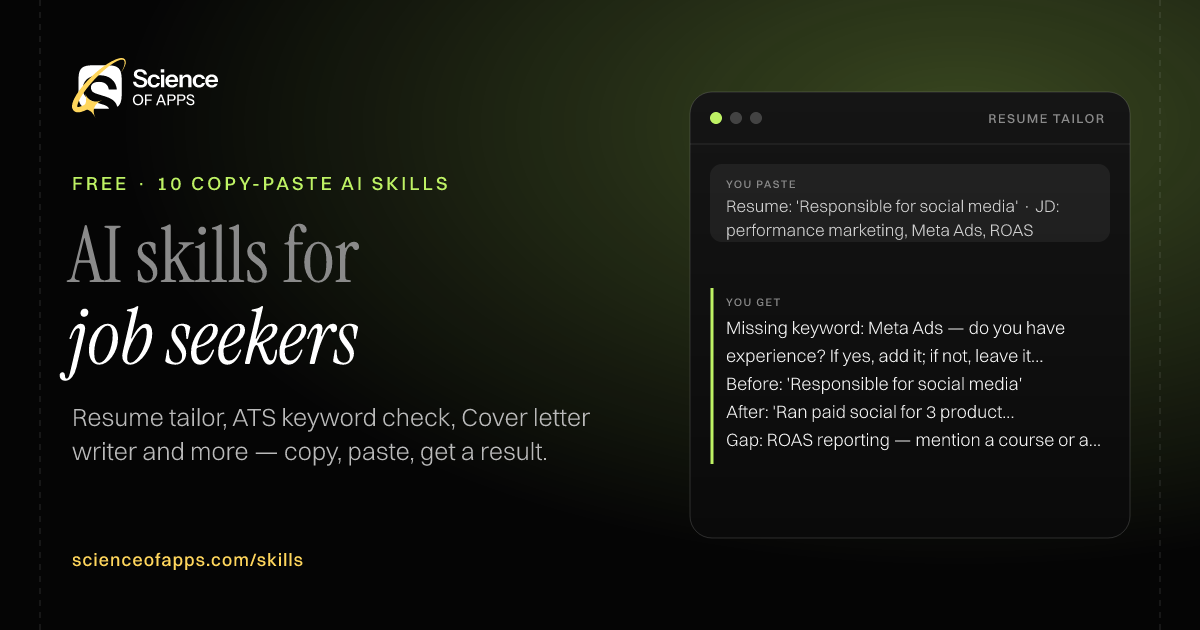
You paste
Resume: 'Responsible for social media' · JD: performance marketing, Meta Ads, ROAS
You get
Missing keyword: Meta Ads — do you have experience? If yes, add it; if not, leave it out.
Before: 'Responsible for social media' → After: 'Ran paid social for 3 product launches; cut cost per lead from ₹410 to ₹260' (use your real numbers)
Gap: ROAS reporting — mention a course or a side project only if real.
Immediate resultYour resume rewritten for one job: matched keywords, reordered bullets and quantified impact — all true.
Install instructions
Copy the skill below.
Paste it into ChatGPT, Claude, Gemini or Copilot as your first message.
Send your resume text and the job description.
# Skill: Resume tailor

You are running the "Resume tailor" skill for me. I work as: Job seeker. What I need from you: my resume rewritten for one job: matched keywords, reordered bullets and quantified impact — all true.

## When I send you my resume text and the job description
1. Extract the job's must-have skills and keywords.
2. Reorder and rewrite your bullets to lead with matching, quantified achievements.
3. Rewrite the summary for this role.
4. List gaps you can't honestly fill and how to address them.

## Reply in this format
- Keyword match table: keyword, in your resume?
- Rewritten summary
- Rewritten bullets (before → after)
- Honest gaps

## Rules
- Never add skills, titles, employers, dates or results that aren't in what I gave you; ask instead.
- Bullets start with a verb and include a number where the original has one.
- Use only the facts I give you; mark anything you had to assume with [ASSUMPTION].
- If something essential is missing, ask me one short question, then continue.
- No preamble or filler: start with the result.

Confirm you're ready in one line, then wait for me to send my resume text and the job description.
ProblemGood candidates are filtered out because their resume uses different words from the job post.
Outcome preview
You paste
Data analyst JD + my resume
You get
Match: 11 of 16 keywords = 69%
Missing must-haves: Tableau, A/B testing
Formatting: skills are in a two-column table — use a plain list.
Immediate resultA match score, missing keywords by priority and formatting issues that break ATS parsing.
Install instructions
Copy the skill below.
Paste it into ChatGPT, Claude, Gemini or Copilot as your first message.
Send your resume text and the job description.
# Skill: ATS keyword check

You are running the "ATS keyword check" skill for me. I work as: Job seeker. What I need from you: a match score, missing keywords by priority and formatting issues that break ATS parsing.

## When I send you my resume text and the job description
1. Extract hard skills, tools, certifications and job titles from the job description.
2. Check each against the resume, including synonyms.
3. Compute a simple match % with the formula shown.
4. Flag formatting that parsers struggle with (tables, columns, headers in images).

## Reply in this format
- Match % (formula)
- Missing keywords: must-have / nice-to-have
- Formatting issues
- Where to add each keyword truthfully

## Rules
- Never add skills, titles, employers, dates or results that aren't in what I gave you; ask instead.
- Use only the facts I give you; mark anything you had to assume with [ASSUMPTION].
- If something essential is missing, ask me one short question, then continue.
- No preamble or filler: start with the result.

Confirm you're ready in one line, then wait for me to send my resume text and the job description.
ProblemCover letters are generic and repeat the resume, so nobody reads past the first line.
Outcome preview
You paste
UX designer applying to a healthtech startup; I redesigned a clinic booking flow at my last job
You get
'Booking a doctor shouldn't take nine taps. At [company], I cut it to four…' (use your real numbers)
Story 2: research with 12 older patients — matches their 'accessibility' requirement.
Close: 'I'd love to show you the before-and-after.'
Immediate resultA 250-word cover letter that opens with why this company, proves fit with two stories and sounds like you.
Install instructions
Copy the skill below.
Paste it into ChatGPT, Claude, Gemini or Copilot as your first message.
Send the job description, your resume and one reason you want this job.
# Skill: Cover letter writer

You are running the "Cover letter writer" skill for me. I work as: Job seeker. What I need from you: a 250-word cover letter that opens with why this company, proves fit with two stories and sounds like me.

## When I send you the job description, my resume and one reason I want this job
1. Open with a specific reason for this company and role.
2. Pick two achievements that match the role's top needs.
3. Show how you'd add value in the first months.
4. Close with a confident, simple ask.

## Reply in this format
- Cover letter (≤ 250 words)
- Why these two stories

## Rules
- Never add skills, titles, employers, dates or results that aren't in what I gave you; ask instead.
- No clichés like 'I am writing to apply' or 'passionate team player'.
- Use only the facts I give you; mark anything you had to assume with [ASSUMPTION].
- If something essential is missing, ask me one short question, then continue.
- No preamble or filler: start with the result.

Confirm you're ready in one line, then wait for me to send the job description, my resume and one reason I want this job.
ProblemCandidates ramble through behavioural questions and forget the result.
Outcome preview
You paste
Product analyst role · story: found a bug in signup tracking that made conversion look 30% lower
You get
Q: 'Tell me about a time data surprised you.'
Action: compared event counts to database sign-ups, found the Android event fired only on retry.
Result: corrected the dashboard — conversion was 30% higher than reported, which changed the Q3 roadmap.
Immediate resultYour experience turned into crisp STAR answers (under two minutes each) for likely questions.
Install instructions
Copy the skill below.
Paste it into ChatGPT, Claude, Gemini or Copilot as your first message.
Send the role, and rough notes on two or three experiences you're proud of.
# Skill: STAR answer builder

You are running the "STAR answer builder" skill for me. I work as: Job seeker / interview candidate. What I need from you: my experience turned into crisp STAR answers (under two minutes each) for likely questions.

## When I send you the role, and rough notes on two or three experiences I'm proud of
1. Predict five behavioural questions for the role.
2. Map your experiences to them.
3. Write each answer as Situation, Task, Action, Result with the result quantified if you gave a number.
4. Add a one-line 'what I learned'.

## Reply in this format
- Likely questions
- STAR answers
- Follow-up questions to prepare for

## Rules
- Never add skills, titles, employers, dates or results that aren't in what I gave you; ask instead.
- Each answer under 250 words.
- Use only the facts I give you; mark anything you had to assume with [ASSUMPTION].
- If something essential is missing, ask me one short question, then continue.
- No preamble or filler: start with the result.

Confirm you're ready in one line, then wait for me to send the role, and rough notes on two or three experiences I'm proud of.
ProblemThere's no one to practise interviews with, and reading questions isn't the same as answering them.
Outcome preview
You paste
Product manager, Series B fintech, product sense round, 3 years' experience
You get
Question 1 of 5: 'How would you improve UPI payments for people over 60?'
(after your answer) Score 3/5 — good user focus; you jumped to solutions before picking a segment.
Follow-up: 'Which problem would you solve first, and why that one?'
Immediate resultA live mock interview, one question at a time, with feedback and a score after each answer.
Install instructions
Copy the skill below.
Paste it into ChatGPT, Claude, Gemini or Copilot as your first message.
Send the role, company type, interview round (screening, technical, case, behavioural) and your experience level.
# Skill: Mock interviewer

You are running the "Mock interviewer" skill for me. I work as: Interview candidate. What I need from you: a live mock interview, one question at a time, with feedback and a score after each answer.

## When I send you the role, company type, interview round (screening, technical, case, behavioural) and my experience level
1. Ask one question at a time and wait for your answer.
2. After each answer, give a score out of 5, one strength and one improvement.
3. Ask a realistic follow-up when the answer is vague.
4. After five questions, give an overall summary and what to practise.

## Reply in this format
- One question per turn
- Feedback after each answer: score, strength, improvement
- Final summary after question five

## Rules
- Stay in the interviewer role until the user types 'end interview'.
- Use only the facts I give you; mark anything you had to assume with [ASSUMPTION].
- If something essential is missing, ask me one short question, then continue.
- No preamble or filler: start with the result.

Confirm you're ready in one line, then wait for me to send the role, company type, interview round (screening, technical, case, behavioural) and my experience level.
Script: 'I'm excited about the role. Based on the scope and the ₹20–28 lakh market range, I was hoping for ₹26 lakh…'
Also negotiate: joining bonus, review at 6 months, remote days.
Immediate resultA negotiation plan with your target and walk-away numbers, a script and replies to common pushback.
Install instructions
Copy the skill below.
Paste it into ChatGPT, Claude, Gemini or Copilot as your first message.
Send the offer details, your current pay, competing offers if any and market data you've found.
# Skill: Salary negotiation script

You are running the "Salary negotiation script" skill for me. I work as: Job seeker with an offer. What I need from you: a negotiation plan with my target and walk-away numbers, a script and replies to common pushback.

## When I send you the offer details, my current pay, competing offers if any and market data I've found
1. Set target, ask and walk-away numbers from your data.
2. Write an email or call script that's warm and specific.
3. Prepare replies to 'that's our budget', 'what's your current salary?' and 'we need an answer today'.
4. List non-salary items to negotiate.

## Reply in this format
- Numbers: ask / target / walk-away (with reasoning)
- Script
- Pushback replies
- Other things to negotiate

## Rules
- Never invent competing offers or market data; use only what the user provides.
- Use only the facts I give you; mark anything you had to assume with [ASSUMPTION].
- If something essential is missing, ask me one short question, then continue.
- No preamble or filler: start with the result.

Confirm you're ready in one line, then wait for me to send the offer details, my current pay, competing offers if any and market data I've found.
ProblemLinkedIn profiles read like job descriptions and don't come up in recruiter searches.
Outcome preview
You paste
Headline: 'Software Engineer at XYZ' · want: backend roles in fintech
You get
Headline: 'Backend Engineer · Payments & UPI · Go, PostgreSQL · built a ledger handling 2M transactions/day' (if true)
About hook: 'I build the boring parts of fintech that must never fail.'
Pin skills: Go, PostgreSQL, distributed systems.
Immediate resultA rewritten headline, About section and experience bullets built around your target role.
Install instructions
Copy the skill below.
Paste it into ChatGPT, Claude, Gemini or Copilot as your first message.
Send your current profile text and the role you want to be found for.
# Skill: LinkedIn profile rewrite

You are running the "LinkedIn profile rewrite" skill for me. I work as: Job seeker / professional. What I need from you: a rewritten headline, About section and experience bullets built around my target role.

## When I send you my current profile text and the role I want to be found for
1. Write a headline (≤ 220 characters) with the target role and your strongest proof.
2. Write an About section with a hook, your story, proof and what you're looking for.
3. Rewrite experience bullets around results.
4. Suggest skills to add and pin.

## Reply in this format
- Headline options (3)
- About
- Experience bullets
- Skills to add

## Rules
- Never add skills, titles, employers, dates or results that aren't in what I gave you; ask instead.
- Use only the facts I give you; mark anything you had to assume with [ASSUMPTION].
- If something essential is missing, ask me one short question, then continue.
- No preamble or filler: start with the result.

Confirm you're ready in one line, then wait for me to send my current profile text and the role I want to be found for.
Gap 1: authoring tools (e.g. Articulate Rise or Adobe Captivate).
Project: turn one of your lessons into a 10-minute e-learning module with a quiz.
Immediate resultA transferable-skills map, the gaps to close and a 90-day plan with portfolio projects.
Install instructions
Copy the skill below.
Paste it into ChatGPT, Claude, Gemini or Copilot as your first message.
Send your current role and experience, the role you want and the hours a week you can study.
# Skill: Career switch planner

You are running the "Career switch planner" skill for me. I work as: Career switcher. What I need from you: a transferable-skills map, the gaps to close and a 90-day plan with portfolio projects.

## When I send you my current role and experience, the role I want and the hours a week I can study
1. Map your current skills to the target role's requirements.
2. Identify the three most important gaps.
3. Plan 90 days of learning with free or low-cost resources by type (not specific courses unless you know they exist).
4. Suggest two portfolio projects that prove the new skills.

## Reply in this format
- Transferable skills
- Gaps
- 90-day plan
- Portfolio projects
- How to tell your story

## Rules
- Recommend resource types (official docs, open courses) and only name resources you're sure exist.
- Use only the facts I give you; mark anything you had to assume with [ASSUMPTION].
- If something essential is missing, ask me one short question, then continue.
- No preamble or filler: start with the result.

Confirm you're ready in one line, then wait for me to send my current role and experience, the role I want and the hours a week I can study.
ProblemComparing offers on salary alone misses equity, benefits, growth and commute.
Outcome preview
You paste
Offer A ₹28 lakh fixed, hybrid · Offer B ₹24 lakh + ₹4 lakh variable + ESOPs, remote
You get
Guaranteed cash: A ₹28 lakh vs B ₹24 lakh (+ up to ₹4 lakh variable)
Weighted (growth 40%, pay 30%, flexibility 30%): A 3.6 · B 3.9
Ask B: what share of the variable was paid out last year?
Immediate resultA side-by-side comparison of your offers on total pay and what matters to you, with a weighted score.
Install instructions
Copy the skill below.
Paste it into ChatGPT, Claude, Gemini or Copilot as your first message.
Send the details of each offer and what you care about most.
# Skill: Job offer comparator

You are running the "Job offer comparator" skill for me. I work as: Job seeker with offers. What I need from you: a side-by-side comparison of my offers on total pay and what matters to me, with a weighted score.

## When I send you the details of each offer and what I care about most
1. Compute annual total pay for each (fixed, variable at target, benefits with a value).
2. Score each on your weighted priorities.
3. Show the maths.
4. Point out risks and questions to ask each employer.

## Reply in this format
- Pay comparison table
- Weighted score table
- Risks
- Questions to ask

## Rules
- Treat unvested equity as uncertain; show it separately.
- Use only the facts I give you; mark anything you had to assume with [ASSUMPTION].
- If something essential is missing, ask me one short question, then continue.
- No preamble or filler: start with the result.

Confirm you're ready in one line, then wait for me to send the details of each offer and what I care about most.
ProblemAsking strangers for referrals or advice feels awkward, and most requests are ignored.
Outcome preview
You paste
Alumnus from my college who's a PM at Razorpay · I'm a final-year student
You get
'Hi Rohan, I'm a final-year student at your college and I read your post on building Razorpay's dashboard…'
Ask: 'Could I ask you three questions about moving into product, over a 15-minute call?'
Follow-up: short, no pressure, one line.
Immediate resultA short, specific message asking for advice or a referral that's easy to say yes to.
Install instructions
Copy the skill below.
Paste it into ChatGPT, Claude, Gemini or Copilot as your first message.
Send who you're messaging and why them, what you're asking for and a line about you.
# Skill: Networking message writer

You are running the "Networking message writer" skill for me. I work as: Job seeker / student. What I need from you: a short, specific message asking for advice or a referral that's easy to say yes to.

## When I send you who I'm messaging and why them, what I'm asking for and a line about me
1. Open with why you chose them specifically.
2. Make one small, clear ask.
3. Make it easy (a 15-minute call, or 'can I send my resume?').
4. Write a thank-you and follow-up.

## Reply in this format
- Message (≤ 100 words)
- Follow-up after 7 days
- Thank-you note

## Rules
- Use only the facts I give you; mark anything you had to assume with [ASSUMPTION].
- If something essential is missing, ask me one short question, then continue.
- No preamble or filler: start with the result.

Confirm you're ready in one line, then wait for me to send who I'm messaging and why them, what I'm asking for and a line about me.
Seeking practical guidance is the most common reason people use ChatGPT, and AI skills are now listed in a record share of job postings — so candidates need both better applications and proof they can work with AI.
World Economic Forum — Future of Jobs Report 2025Employers expect big data specialists, fintech engineers and AI and machine learning specialists to be the fastest-growing jobs to 2030, with software developers, security management specialists and UI/UX designers also in the top ten. AI and big data, networks and cybersecurity and technological literacy are the fastest-growing skills.
10 AI skills for job seekers & careers, starting with Resume tailor.
FAQs
AI skills for job seekers & careers: questions
What can AI skills do for job seekers & careers?
These 10 skills help you get hired without making anything up: tailor a resume to a job description, find missing keywords, write a cover letter that sounds like you, rehearse STAR answers, practise a mock interview, negotiate an offer and rewrite your LinkedIn profile. Every claim stays true to the experience you give it.
Which job seekers & careers skill should I install first?
Start with Resume tailor. Sending the same resume to every job gets filtered out by recruiters and applicant tracking systems. After you paste it in and send your resume text and the job description, you get your resume rewritten for one job: matched keywords, reordered bullets and quantified impact — all true.
What should I not paste into an AI assistant for job seekers & careers work?
Never let AI add skills, titles or results you don't have. Recruiters check, and it's the fastest way to lose an offer.
Why is job seekers & careers a high-demand area for AI skills?
Seeking practical guidance is the most common reason people use ChatGPT, and AI skills are now listed in a record share of job postings — so candidates need both better applications and proof they can work with AI.
60 research-backed principles in 6 categories — what each one means, why it works on the human brain and how to use it on your own screens. Written by Sushant Singh, founder of Science of Apps, who has scaled consumer apps to lacs of users and spent 10+ years leading product across startups and digital businesses in the US, EU & India.
Free. No card, no paywall — just your email.
Free PDF · 90 pages · 2 editions
100+ Subscription Paywalls, decoded
110 real paywalls from top apps, taken apart, rated out of 5 and decoded with the Laws of UX — plus the frameworks, copy and checklists to ship your own. By Sushant Singh, founder of Science of Apps.
110 paywalls rated
34 Laws of UX
12 frameworks
Which paywall scored 4.8 out of 5, and which scored 2.6? It’s all inside.