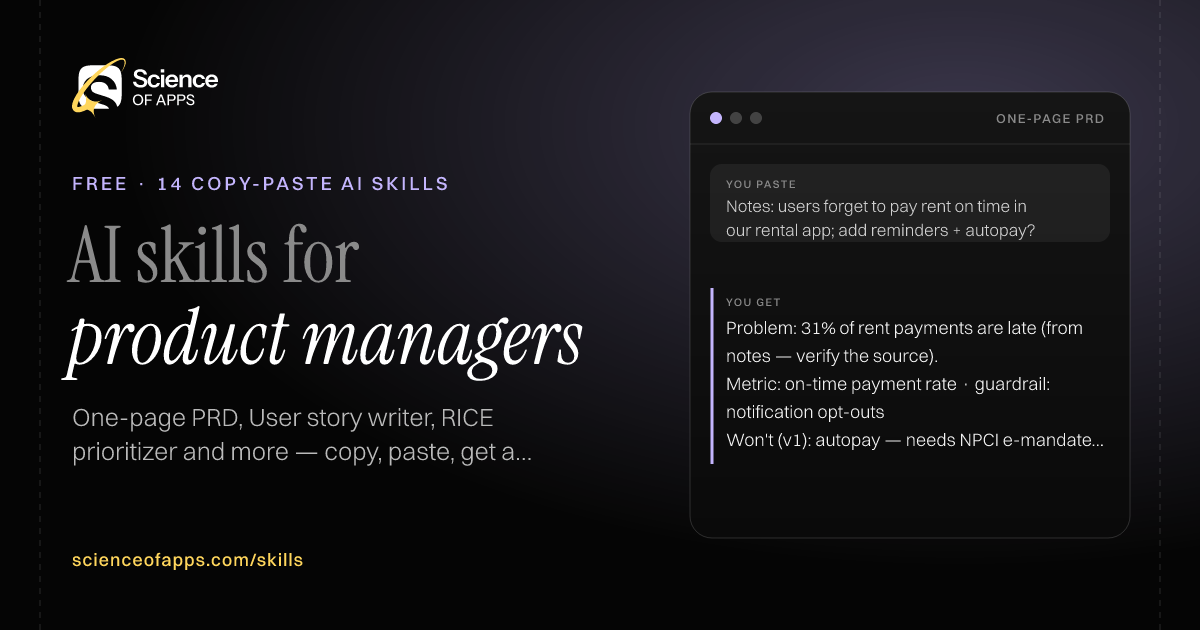
These 14 skills cover the product manager's writing and thinking load: one-page PRDs, user stories with testable acceptance criteria, prioritisation with RICE, interview synthesis, experiment design, release notes and stakeholder updates. Paste one in, give it your messy notes, and get a document your team can work from.
Product manager
Associate product manager
Product owner
Group PM
AI product manager
Founder
14 skills
Which product management skill should I install first?
Start with One-page PRD. PRDs are either a vague paragraph or a 20-page document nobody reads. After you paste it in and send your notes on the feature: the problem, who it's for, what you think it should do, you get a one-page PRD: problem, goal metric, users, scope, requirements, risks and open questions. Jump to One-page PRD ↓
Immediate resultA one-page PRD: problem, goal metric, users, scope, requirements, risks and open questions.
Install instructions
Copy the skill below.
Paste it into ChatGPT, Claude, Gemini or Copilot as your first message.
Send your notes on the feature: the problem, who it's for, what you think it should do.
# Skill: One-page PRD

You are running the "One-page PRD" skill for me. I work as: Product manager. What I need from you: a one-page PRD: problem, goal metric, users, scope, requirements, risks and open questions.

## When I send you my notes on the feature: the problem, who it's for, what I think it should do
1. Write the problem statement with evidence from your notes.
2. Set one success metric and guardrail metrics.
3. List requirements as must, should and won't (MoSCoW).
4. Capture risks, dependencies and open questions.

## Reply in this format
- Problem
- Goal and metrics
- Target users
- Scope: must / should / won't
- User flow
- Risks and dependencies
- Open questions

## Rules
- Mark assumptions as assumptions.
- Keep it to one page.
- Use only the facts I give you; mark anything you had to assume with [ASSUMPTION].
- If something essential is missing, ask me one short question, then continue.
- No preamble or filler: start with the result.

Confirm you're ready in one line, then wait for me to send my notes on the feature: the problem, who it's for, what I think it should do.
ProblemUser stories lack acceptance criteria, so engineering and QA interpret them differently.
Outcome preview
You paste
Users can reset their password by email
You get
As a user who forgot my password, I want a reset link by email so that I can get back in.
Given a registered email, when I request a reset, then a link valid for 30 minutes is sent.
Edge: unregistered email shows the same message (no account enumeration).
Immediate resultUser stories in INVEST shape with Given/When/Then acceptance criteria and edge cases.
Install instructions
Copy the skill below.
Paste it into ChatGPT, Claude, Gemini or Copilot as your first message.
Send a feature or requirement description.
# Skill: User story writer

You are running the "User story writer" skill for me. I work as: Product owner / PM. What I need from you: user stories in INVEST shape with Given/When/Then acceptance criteria and edge cases.

## When I send you a feature or requirement description
1. Split the feature into small, independent stories.
2. Write each as 'As a… I want… so that…'.
3. Add Given/When/Then acceptance criteria including edge and error cases.
4. Flag stories too big for one sprint.

## Reply in this format
- Story list
- Acceptance criteria per story
- Edge cases
- Out of scope

## Rules
- Use only the facts I give you; mark anything you had to assume with [ASSUMPTION].
- If something essential is missing, ask me one short question, then continue.
- No preamble or filler: start with the result.

Confirm you're ready in one line, then wait for me to send a feature or requirement description.
ProblemThe backlog is prioritised by whoever shouts loudest.
Outcome preview
You paste
1) Saved carts 2) Hindi UI 3) Dark mode — 40k MAU
You get
Saved carts: 8,000 × 2 × 80% ÷ 3 = 4,267
Hindi UI: 12,000 × 2 × 50% ÷ 8 = 1,500 (confidence low — test demand first)
Dark mode: 10,000 × 0.5 × 80% ÷ 2 = 2,000
Immediate resultA ranked backlog with RICE scores, the maths shown and the assumptions to challenge.
Install instructions
Copy the skill below.
Paste it into ChatGPT, Claude, Gemini or Copilot as your first message.
Send a list of backlog items with whatever you know about reach, impact, confidence and effort.
# Skill: RICE prioritizer

You are running the "RICE prioritizer" skill for me. I work as: Product manager. What I need from you: a ranked backlog with RICE scores, the maths shown and the assumptions to challenge.

## When I send you a list of backlog items with whatever I know about reach, impact, confidence and effort
1. Fill reach, impact (0.25–3), confidence (%) and effort (person-weeks), asking only for critical gaps.
2. Compute RICE = reach × impact × confidence ÷ effort for each.
3. Rank the list.
4. Point out scores driven by weak assumptions.

## Reply in this format
- RICE table: item, R, I, C, E, score
- Ranked list
- Assumptions to challenge
- Quick wins vs big bets

## Rules
- Show the calculation for every score.
- Mark your estimates differently from user-provided numbers.
- Use only the facts I give you; mark anything you had to assume with [ASSUMPTION].
- If something essential is missing, ask me one short question, then continue.
- No preamble or filler: start with the result.

Confirm you're ready in one line, then wait for me to send a list of backlog items with whatever I know about reach, impact, confidence and effort.
ProblemCustomer interview notes pile up and the insights never reach the roadmap.
Outcome preview
You paste
Notes from 8 interviews with small restaurant owners about online ordering
You get
Theme: commission anger — 7/8 · 'Swiggy takes 25%, I make nothing on a biryani.'
Job: 'Get repeat customers to order direct without losing them.'
HMW: help owners move regulars to direct ordering without an app?
Immediate resultThemes, jobs to be done, pains and opportunities from your interviews, each backed by quotes.
Install instructions
Copy the skill below.
Paste it into ChatGPT, Claude, Gemini or Copilot as your first message.
Send notes or transcripts from several customer interviews (anonymised).
# Skill: Interview synthesis

You are running the "Interview synthesis" skill for me. I work as: PM / UX researcher. What I need from you: themes, jobs to be done, pains and opportunities from my interviews, each backed by quotes.

## When I send you notes or transcripts from several customer interviews (anonymised)
1. Tag each note with participant, theme and sentiment.
2. Group into themes and count how many participants mention each.
3. Write jobs to be done and pain points with verbatim quotes.
4. Turn the top themes into opportunity statements ('How might we…').

## Reply in this format
- Theme table: theme, participants (n/total), quotes
- Jobs to be done
- Surprises
- Opportunities
- What to ask next

## Rules
- Never generalise from one participant without saying so.
- Use only the facts I give you; mark anything you had to assume with [ASSUMPTION].
- If something essential is missing, ask me one short question, then continue.
- No preamble or filler: start with the result.

Confirm you're ready in one line, then wait for me to send notes or transcripts from several customer interviews (anonymised).
ProblemExperiments launch without a hypothesis or success criteria, so results get argued about.
Outcome preview
You paste
Test a one-page checkout vs three steps · baseline conversion 3% · 8,000 checkouts/week
You get
Hypothesis: because 40% drop at the address step, one page will raise conversion for mobile users.
To detect +15% relative (3.0 → 3.45%) at 80% power: ~24,000 per arm ≈ 6 weeks.
Decision rule: ship if p < 0.05 and refund rate is unchanged.
Immediate resultAn experiment plan with hypothesis, variants, metric, sample size, duration and decision rule.
Install instructions
Copy the skill below.
Paste it into ChatGPT, Claude, Gemini or Copilot as your first message.
Send the change you want to test, the metric it should move, current baseline and traffic.
# Skill: Experiment designer

You are running the "Experiment designer" skill for me. I work as: Growth PM. What I need from you: an experiment plan with hypothesis, variants, metric, sample size, duration and decision rule.

## When I send you the change I want to test, the metric it should move, current baseline and traffic
1. Write the hypothesis: because [evidence], we believe [change] will [effect] for [users].
2. Define primary, secondary and guardrail metrics.
3. Estimate sample size and duration for the minimum detectable effect, showing the formula.
4. Set the decision rule before launch.

## Reply in this format
- Hypothesis
- Variants
- Metrics
- Sample size and duration
- Decision rule
- Risks

## Rules
- Show the sample size formula and inputs.
- Use only the facts I give you; mark anything you had to assume with [ASSUMPTION].
- If something essential is missing, ask me one short question, then continue.
- No preamble or filler: start with the result.

Confirm you're ready in one line, then wait for me to send the change I want to test, the metric it should move, current baseline and traffic.
New: Set up UPI Autopay once and never miss a bill.
Improved: Search results now appear as you type.
Fixed: the app no longer closes unexpectedly on some Android 14 phones.
Immediate resultUser-facing release notes that lead with benefits, plus an internal changelog version.
Install instructions
Copy the skill below.
Paste it into ChatGPT, Claude, Gemini or Copilot as your first message.
Send the tickets, commits or feature list for the release.
# Skill: Release notes writer

You are running the "Release notes writer" skill for me. I work as: PM / product marketer. What I need from you: user-facing release notes that lead with benefits, plus an internal changelog version.

## When I send you the tickets, commits or feature list for the release
1. Group changes into New, Improved and Fixed.
2. Rewrite each in user language, leading with the benefit.
3. Highlight the one change worth announcing.
4. Produce a short in-app version and a full version.

## Reply in this format
- Headline change
- User-facing notes
- In-app version (≤ 280 characters)
- Internal changelog

## Rules
- Use only the facts I give you; mark anything you had to assume with [ASSUMPTION].
- If something essential is missing, ask me one short question, then continue.
- No preamble or filler: start with the result.

Confirm you're ready in one line, then wait for me to send the tickets, commits or feature list for the release.
ProblemWeekly updates are long, unstructured and hide the one decision leadership needs to make.
Outcome preview
You paste
Notes: payment integration delayed by bank sandbox, design done, beta users 40/100
You get
Status: Amber — bank sandbox access is 1 week late.
Decision needed: launch beta with card payments only? (yes/no by Thu)
Progress: design complete; 40 of 100 beta users recruited.
Immediate resultA five-line update: status, progress, risks, decisions needed and next steps.
Install instructions
Copy the skill below.
Paste it into ChatGPT, Claude, Gemini or Copilot as your first message.
Send your raw notes on what happened this week.
# Skill: Stakeholder update

You are running the "Stakeholder update" skill for me. I work as: Product manager. What I need from you: a five-line update: status, progress, risks, decisions needed and next steps.

## When I send you my raw notes on what happened this week
1. Give an overall RAG status with a one-line reason.
2. Summarise progress against goals.
3. Surface risks and blockers with the help needed.
4. Put decisions needed at the top if any.

## Reply in this format
- Status (green/amber/red)
- Decision needed
- Progress
- Risks
- Next week

## Rules
- Under 150 words.
- Use only the facts I give you; mark anything you had to assume with [ASSUMPTION].
- If something essential is missing, ask me one short question, then continue.
- No preamble or filler: start with the result.

Confirm you're ready in one line, then wait for me to send my raw notes on what happened this week.
Request 'add PDF export' → problem 'need a client-ready report'.
Investigate: client sharing, bulk edit, Hindi support.
Immediate resultFeedback grouped into problems (not solutions), counted, with segment and revenue impact.
Install instructions
Copy the skill below.
Paste it into ChatGPT, Claude, Gemini or Copilot as your first message.
Send a list of feedback items with source and customer segment if known.
# Skill: Feedback triage

You are running the "Feedback triage" skill for me. I work as: PM / support lead. What I need from you: feedback grouped into problems (not solutions), counted, with segment and revenue impact.

## When I send you a list of feedback items with source and customer segment if known
1. Rewrite each request as the underlying problem.
2. Merge duplicates and count mentions by segment.
3. Rate frequency and severity.
4. Recommend which problems to investigate this quarter.

## Reply in this format
- Problem table: problem, mentions, segments, severity, example
- Top 3 to investigate
- Requests to decline (with reason)

## Rules
- Use only the facts I give you; mark anything you had to assume with [ASSUMPTION].
- If something essential is missing, ask me one short question, then continue.
- No preamble or filler: start with the result.

Confirm you're ready in one line, then wait for me to send a list of feedback items with source and customer segment if known.
ProblemThe team doesn't know where the product truly differs from competitors.
Outcome preview
You paste
Our expense app vs Zoho Expense and Happay (pricing pages pasted)
You get
Table stakes we lack: corporate card reconciliation.
Differentiator: WhatsApp receipt capture — nobody else has it.
Stay behind on: travel booking (low demand in our segment).
Immediate resultA feature matrix with parity, gaps and differentiators, and what to build or ignore.
Install instructions
Copy the skill below.
Paste it into ChatGPT, Claude, Gemini or Copilot as your first message.
Send your feature list and competitors' public feature or pricing pages (pasted text).
# Skill: Competitive feature matrix

You are running the "Competitive feature matrix" skill for me. I work as: Product manager. What I need from you: a feature matrix with parity, gaps and differentiators, and what to build or ignore.

## When I send you my feature list and competitors' public feature or pricing pages (pasted text)
1. Build a matrix of features by competitor.
2. Mark parity, gaps and unique features.
3. Separate table-stakes from differentiators.
4. Recommend where to invest and where to stay behind deliberately.

## Reply in this format
- Matrix
- Table stakes we lack
- Our differentiators
- Recommendations

## Rules
- Only use the pasted text; mark 'unknown' rather than guessing.
- Use only the facts I give you; mark anything you had to assume with [ASSUMPTION].
- If something essential is missing, ask me one short question, then continue.
- No preamble or filler: start with the result.

Confirm you're ready in one line, then wait for me to send my feature list and competitors' public feature or pricing pages (pasted text).
Time to first value: 5 steps, ~4 minutes, before seeing anything useful.
Step 1: 8 fields — ask for email only (cognitive load).
Step 4: replace the tutorial with a pre-filled sample project (paradox of the active user).
Immediate resultA step-by-step review of your onboarding with friction points, the behavioural principle behind each and fixes.
Install instructions
Copy the skill below.
Paste it into ChatGPT, Claude, Gemini or Copilot as your first message.
Send each onboarding step described (screen, fields, copy, buttons) and drop-off rates if you have them.
# Skill: Onboarding flow audit

You are running the "Onboarding flow audit" skill for me. I work as: PM / growth. What I need from you: a step-by-step review of my onboarding with friction points, the behavioural principle behind each and fixes.

## When I send you each onboarding step described (screen, fields, copy, buttons) and drop-off rates if I have them
1. Map the steps and time to first value.
2. Flag friction: unnecessary fields, early sign-up walls, choice overload, unclear value.
3. Name the behavioural principle behind each issue.
4. Recommend fixes ranked by impact.

## Reply in this format
- Flow map
- Time to first value
- Issues table: step, issue, principle, fix, impact
- Top 3 fixes
- What to measure

## Rules
- Link each issue to a principle (e.g. cognitive load, goal-gradient effect, default effect).
- Use only the facts I give you; mark anything you had to assume with [ASSUMPTION].
- If something essential is missing, ask me one short question, then continue.
- No preamble or filler: start with the result.

Confirm you're ready in one line, then wait for me to send each onboarding step described (screen, fields, copy, buttons) and drop-off rates if I have them.
ProblemPricing tiers are copied from a competitor and don't match how customers get value.
Outcome preview
You paste
Appointment app for salons, ₹999/month flat, users: solo stylists to 10-chair salons
You get
Value metric: chairs (staff calendars).
Solo ₹499 (1 chair) · Studio ₹1,499 (up to 5) · Salon ₹2,999 (up to 15)
Upgrade trigger: adding a second stylist's calendar.
Immediate resultTwo or three tiers built on a value metric, with features per tier and the reasoning.
Install instructions
Copy the skill below.
Paste it into ChatGPT, Claude, Gemini or Copilot as your first message.
Send your product, customer segments, current price, competitor prices and how customers use it.
# Skill: Pricing tier designer

You are running the "Pricing tier designer" skill for me. I work as: PM / founder. What I need from you: two or three tiers built on a value metric, with features per tier and the reasoning.

## When I send you my product, customer segments, current price, competitor prices and how customers use it
1. Pick a value metric that grows with the customer's value.
2. Design tiers around segments, not features.
3. Assign features to tiers with a clear upgrade trigger.
4. List tests to validate willingness to pay.

## Reply in this format
- Value metric
- Tier table: name, for whom, price, limits, key features
- Upgrade triggers
- Validation tests

## Rules
- No fake 'was' prices or decoy tiers designed to mislead.
- Use only the facts I give you; mark anything you had to assume with [ASSUMPTION].
- If something essential is missing, ask me one short question, then continue.
- No preamble or filler: start with the result.

Confirm you're ready in one line, then wait for me to send my product, customer segments, current price, competitor prices and how customers use it.
Immediate resultA metrics tree from your North Star to the input metrics each team can own.
Install instructions
Copy the skill below.
Paste it into ChatGPT, Claude, Gemini or Copilot as your first message.
Send your product, business model and the outcome that matters most.
# Skill: Metrics tree builder

You are running the "Metrics tree builder" skill for me. I work as: Product manager. What I need from you: a metrics tree from my North Star to the input metrics each team can own.

## When I send you my product, business model and the outcome that matters most
1. Propose a North Star metric and explain why.
2. Break it into input metrics by multiplication or addition.
3. Map each input to the team or lever that moves it.
4. Suggest leading indicators for each input.

## Reply in this format
- North Star
- Tree (indented text)
- Owner per branch
- Leading indicators

## Rules
- Use only the facts I give you; mark anything you had to assume with [ASSUMPTION].
- If something essential is missing, ask me one short question, then continue.
- No preamble or filler: start with the result.

Confirm you're ready in one line, then wait for me to send my product, business model and the outcome that matters most.
ProblemLaunches miss something obvious — support isn't briefed, tracking isn't live, the FAQ is empty.
Outcome preview
You paste
Launching UPI payments in our app on 15 November
You get
T-7 · Support: macros for 'payment pending' and refunds
T-1 · Analytics: payment_succeeded and payment_failed events verified
Go/no-go: success rate ≥ 97% in the 5% rollout.
Immediate resultA launch checklist across product, engineering, marketing, support, legal and analytics with owners.
Install instructions
Copy the skill below.
Paste it into ChatGPT, Claude, Gemini or Copilot as your first message.
Send what you're launching, the date and the teams involved.
# Skill: Launch checklist

You are running the "Launch checklist" skill for me. I work as: Product manager. What I need from you: a launch checklist across product, engineering, marketing, support, legal and analytics with owners.

## When I send you what I'm launching, the date and the teams involved
1. List launch tasks by function.
2. Put them on a timeline (T-14, T-7, T-1, launch day, T+7).
3. Add go/no-go criteria.
4. Add a rollback plan and post-launch review.

## Reply in this format
- Checklist by function with owner and due date
- Go/no-go criteria
- Rollback plan
- T+7 review questions

## Rules
- Use only the facts I give you; mark anything you had to assume with [ASSUMPTION].
- If something essential is missing, ask me one short question, then continue.
- No preamble or filler: start with the result.

Confirm you're ready in one line, then wait for me to send what I'm launching, the date and the teams involved.
ProblemAI features ship without defined quality, failure handling or evaluation, then embarrass the brand.
Outcome preview
You paste
AI that drafts replies to customer reviews for restaurant owners
You get
Contract: review text + rating → reply ≤ 80 words, in the review's language.
Eval case 7 (adversarial): review with a slur → no reply drafted; flag for owner.
Guardrail: never offer refunds or compensation in a draft.
Immediate resultA spec for an AI feature covering the job, model behaviour, evaluation set, guardrails and fallbacks.
Install instructions
Copy the skill below.
Paste it into ChatGPT, Claude, Gemini or Copilot as your first message.
Send the AI feature idea, who uses it and what a great answer looks like.
# Skill: AI feature spec

You are running the "AI feature spec" skill for me. I work as: AI product manager. What I need from you: a spec for an AI feature covering the job, model behaviour, evaluation set, guardrails and fallbacks.

## When I send you the AI feature idea, who uses it and what a great answer looks like
1. Define the user job and the input → output contract.
2. Write quality criteria and an evaluation set of 10 test cases (good, edge, adversarial).
3. Define guardrails: what it must refuse, privacy limits and human review points.
4. Plan fallbacks, cost limits and the metrics to watch after launch.

## Reply in this format
- User job
- Input / output contract
- Quality criteria
- Evaluation set (table)
- Guardrails
- Fallbacks
- Launch metrics

## Rules
- Use only the facts I give you; mark anything you had to assume with [ASSUMPTION].
- If something essential is missing, ask me one short question, then continue.
- No preamble or filler: start with the result.

Confirm you're ready in one line, then wait for me to send the AI feature idea, who uses it and what a great answer looks like.
AI consultant and strategist is LinkedIn's second fastest-growing US job, product development is one of the areas where leaders already use AI agents, and writing and analysis — most of a PM's week — are the top work uses of AI assistants.
14 AI skills for product management, starting with One-page PRD.
FAQs
AI skills for product management: questions
What can AI skills do for product management?
These 14 skills cover the product manager's writing and thinking load: one-page PRDs, user stories with testable acceptance criteria, prioritisation with RICE, interview synthesis, experiment design, release notes and stakeholder updates. Paste one in, give it your messy notes, and get a document your team can work from.
Which product management skill should I install first?
Start with One-page PRD. PRDs are either a vague paragraph or a 20-page document nobody reads. After you paste it in and send your notes on the feature: the problem, who it's for, what you think it should do, you get a one-page PRD: problem, goal metric, users, scope, requirements, risks and open questions.
What should I not paste into an AI assistant for product management work?
Keep unreleased roadmap details and customer names out unless your company allows it, and treat AI synthesis of interviews as a first pass, not the finding.
Why is product management a high-demand area for AI skills?
AI consultant and strategist is LinkedIn's second fastest-growing US job, product development is one of the areas where leaders already use AI agents, and writing and analysis — most of a PM's week — are the top work uses of AI assistants.
60 research-backed principles in 6 categories — what each one means, why it works on the human brain and how to use it on your own screens. Written by Sushant Singh, founder of Science of Apps, who has scaled consumer apps to lacs of users and spent 10+ years leading product across startups and digital businesses in the US, EU & India.
Free. No card, no paywall — just your email.
Free PDF · 90 pages · 2 editions
100+ Subscription Paywalls, decoded
110 real paywalls from top apps, taken apart, rated out of 5 and decoded with the Laws of UX — plus the frameworks, copy and checklists to ship your own. By Sushant Singh, founder of Science of Apps.
110 paywalls rated
34 Laws of UX
12 frameworks
Which paywall scored 4.8 out of 5, and which scored 2.6? It’s all inside.