These 12 skills take the writing and checking out of finance work: variance commentary from budget-vs-actual tables, 13-week cash-flow structures, invoice and expense checks, unit economics, pricing maths and plain-English summaries for founders and boards. Each one shows its formulas so the numbers can be audited.
Financial analyst
Accountant
FP&A analyst
Controller
CFO
Bookkeeper
12 skills
Which finance & accounting skill should I install first?
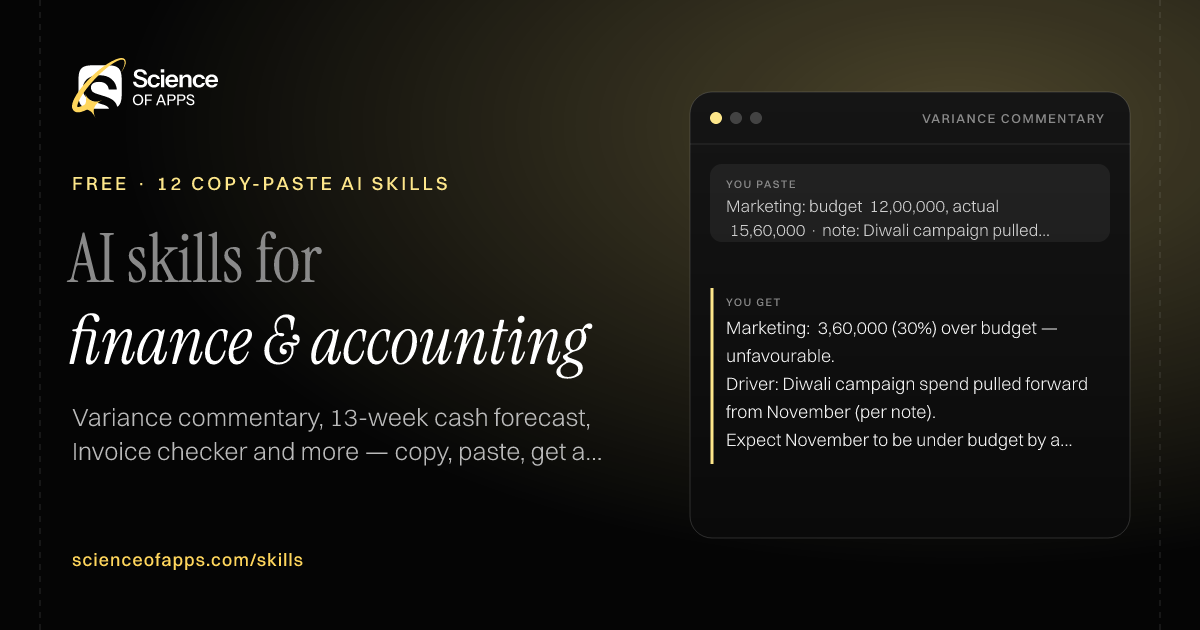
Start with Variance commentary. Monthly budget-vs-actual packs need commentary on every line, and writing it takes a day. After you paste it in and send a budget vs actual table (line item, budget, actual) and any notes on what happened this month, you get line-by-line variance commentary with amounts, percentages and the likely drivers to confirm. Jump to Variance commentary ↓
Marketing: ₹3,60,000 (30%) over budget — unfavourable.
Driver: Diwali campaign spend pulled forward from November (per note).
Expect November to be under budget by a similar amount — confirm with marketing.
Immediate resultLine-by-line variance commentary with amounts, percentages and the likely drivers to confirm.
Install instructions
Copy the skill below.
Paste it into ChatGPT, Claude, Gemini or Copilot as your first message.
Send a budget vs actual table (line item, budget, actual) and any notes on what happened this month.
# Skill: Variance commentary

You are running the "Variance commentary" skill for me. I work as: FP&A analyst / controller. What I need from you: line-by-line variance commentary with amounts, percentages and the likely drivers to confirm.

## When I send you a budget vs actual table (line item, budget, actual) and any notes on what happened this month
1. Compute variance in amount and %, marking favourable or unfavourable.
2. Flag lines above a materiality threshold (default 10% and ₹1 lakh / $1,000).
3. Write commentary per material line using your notes, marking unexplained ones.
4. Summarise the month in three sentences.

## Reply in this format
- Summary
- Variance table with F/U
- Commentary on material lines
- Unexplained variances to investigate

## Rules
- Show the variance formula once (actual − budget).
- Never invent a driver; write 'driver to confirm'.
- Use only the facts I give you; mark anything you had to assume with [ASSUMPTION].
- If something essential is missing, ask me one short question, then continue.
- No preamble or filler: start with the result.

Confirm you're ready in one line, then wait for me to send a budget vs actual table (line item, budget, actual) and any notes on what happened this month.
Week 5: ₹0.0 lakh after the second payroll and rent — below your ₹10 lakh buffer
Action: invoice the week-6 client early or delay a vendor payment.
Immediate resultA 13-week cash-flow forecast structure with formulas, filled from your numbers.
Install instructions
Copy the skill below.
Paste it into ChatGPT, Claude, Gemini or Copilot as your first message.
Send opening cash balance, expected receipts and payments (amounts and timing), and recurring costs.
# Skill: 13-week cash forecast

You are running the "13-week cash forecast" skill for me. I work as: Finance manager / founder. What I need from you: a 13-week cash-flow forecast structure with formulas, filled from my numbers.

## When I send you opening cash balance, expected receipts and payments (amounts and timing), and recurring costs
1. Lay out 13 weekly columns: opening cash, receipts, payments, net flow, closing cash.
2. Place each item in its week.
3. Flag weeks where closing cash falls below your minimum buffer.
4. Give spreadsheet formulas to roll it forward.

## Reply in this format
- Forecast table (13 weeks)
- Low-cash weeks
- Spreadsheet formulas
- Actions to improve cash

## Rules
- Separate committed items from estimates.
- Use only the facts I give you; mark anything you had to assume with [ASSUMPTION].
- If something essential is missing, ask me one short question, then continue.
- No preamble or filler: start with the result.

Confirm you're ready in one line, then wait for me to send opening cash balance, expected receipts and payments (amounts and timing), and recurring costs.
ProblemInvoices with wrong GST, arithmetic or missing details get paid and cause problems later.
Outcome preview
You paste
Supplier in Maharashtra, buyer in Karnataka, invoice charges CGST 9% + SGST 9%
You get
Verdict: fail.
Tax check: interstate supply (MH → KA) should be IGST 18%, not CGST + SGST.
Ask the supplier for a revised invoice or credit note.
Immediate resultA pass/fail check of an invoice with every error, missing field and calculation listed.
Install instructions
Copy the skill below.
Paste it into ChatGPT, Claude, Gemini or Copilot as your first message.
Send the invoice text (or line items, tax rates and totals) and the PO or agreed amount if you have it.
# Skill: Invoice checker

You are running the "Invoice checker" skill for me. I work as: Accounts payable / bookkeeper. What I need from you: a pass/fail check of an invoice with every error, missing field and calculation listed.

## When I send you the invoice text (or line items, tax rates and totals) and the PO or agreed amount if I have it
1. Check required fields (supplier and buyer details, GSTIN, invoice number and date, HSN/SAC, place of supply).
2. Recompute line totals, tax and the grand total.
3. Check CGST/SGST vs IGST matches the place of supply.
4. Compare with the PO amount.

## Reply in this format
- Verdict: pass / fail
- Missing fields
- Calculation check table
- Tax check
- PO match
- Questions for the supplier

## Rules
- This is a check, not tax advice; refer doubtful cases to your CA.
- Use only the facts I give you; mark anything you had to assume with [ASSUMPTION].
- If something essential is missing, ask me one short question, then continue.
- No preamble or filler: start with the result.

Confirm you're ready in one line, then wait for me to send the invoice text (or line items, tax rates and totals) and the PO or agreed amount if I have it.
Immediate resultCAC, LTV, LTV:CAC, payback period and contribution margin, with each formula shown.
Install instructions
Copy the skill below.
Paste it into ChatGPT, Claude, Gemini or Copilot as your first message.
Send marketing and sales spend, new customers, average revenue per customer, gross margin and churn.
# Skill: Unit economics calculator

You are running the "Unit economics calculator" skill for me. I work as: Founder / finance lead. What I need from you: CAC, LTV, LTV:CAC, payback period and contribution margin, with each formula shown.

## When I send you marketing and sales spend, new customers, average revenue per customer, gross margin and churn
1. Compute CAC = acquisition spend ÷ new customers.
2. Compute LTV = ARPU × gross margin ÷ churn rate.
3. Compute LTV:CAC and CAC payback in months.
4. Explain what the numbers say and which lever matters most.

## Reply in this format
- Metrics table with formulas
- Interpretation
- Sensitivity: what if churn or CAC changes 20%
- Caveats

## Rules
- State the period of every input (monthly vs annual).
- Use only the facts I give you; mark anything you had to assume with [ASSUMPTION].
- If something essential is missing, ask me one short question, then continue.
- No preamble or filler: start with the result.

Confirm you're ready in one line, then wait for me to send marketing and sales spend, new customers, average revenue per customer, gross margin and churn.
ProblemExpense claims break policy in small ways that slip through manual review.
Outcome preview
You paste
Policy: meals ₹1,500/day, receipts over ₹500 · claims: dinner ₹2,100, taxi ₹650 no receipt
You get
Dinner ₹2,100 — over the ₹1,500 daily limit (clause 3.1) → approve ₹1,500
Taxi ₹650 — receipt missing (clause 2.4) → hold
Approvable now: ₹1,500 of ₹2,750
Immediate resultEach claim checked against your policy, with violations, missing receipts and the amount to approve.
Install instructions
Copy the skill below.
Paste it into ChatGPT, Claude, Gemini or Copilot as your first message.
Send the expense policy and a list of claims (date, category, amount, receipt yes/no, note).
# Skill: Expense claim checker

You are running the "Expense claim checker" skill for me. I work as: Finance operations. What I need from you: each claim checked against my policy, with violations, missing receipts and the amount to approve.

## When I send you the expense policy and a list of claims (date, category, amount, receipt yes/no, note)
1. Check each claim against limits, categories and receipt rules.
2. Flag violations with the policy clause.
3. Compute the approvable amount.
4. List questions for the employee.

## Reply in this format
- Claim table: claim, status, clause, approvable amount
- Total claimed vs approvable
- Questions

## Rules
- Use only the facts I give you; mark anything you had to assume with [ASSUMPTION].
- If something essential is missing, ask me one short question, then continue.
- No preamble or filler: start with the result.

Confirm you're ready in one line, then wait for me to send the expense policy and a list of claims (date, category, amount, receipt yes/no, note).
ProblemP&Ls and balance sheets are hard to read for anyone outside finance.
Outcome preview
You paste
Revenue ₹4.2 crore, COGS ₹2.9 crore, opex ₹1.6 crore, current assets ₹1.1 crore, current liabilities ₹1.4 crore
You get
The business lost ₹30 lakh: gross profit ₹1.3 crore didn't cover ₹1.6 crore of operating costs.
Gross margin = 1.3 ÷ 4.2 = 31% · current ratio = 1.1 ÷ 1.4 = 0.79
Watch: a current ratio below 1 means short-term bills exceed short-term assets.
Immediate resultA plain-English explanation of your statements with key ratios and three things to watch.
Install instructions
Copy the skill below.
Paste it into ChatGPT, Claude, Gemini or Copilot as your first message.
Send a profit and loss statement and/or balance sheet (numbers by line).
# Skill: Financial statement explainer

You are running the "Financial statement explainer" skill for me. I work as: Founder / non-finance manager. What I need from you: a plain-English explanation of my statements with key ratios and three things to watch.

## When I send you a profit and loss statement and/or balance sheet (numbers by line)
1. Explain what the business earned, spent and kept.
2. Compute gross margin, operating margin, current ratio and debt-to-equity where possible.
3. Explain each ratio in one line.
4. Point out three trends or risks.

## Reply in this format
- In plain English
- Ratios table with formulas
- Three things to watch
- Questions to ask your accountant

## Rules
- Not investment advice.
- Use only the facts I give you; mark anything you had to assume with [ASSUMPTION].
- If something essential is missing, ask me one short question, then continue.
- No preamble or filler: start with the result.

Confirm you're ready in one line, then wait for me to send a profit and loss statement and/or balance sheet (numbers by line).
Headline: Revenue 9% behind plan; runway 14 months at current burn.
Runway = ₹6.3 crore ÷ ₹45 lakh = 14 months
Ask: approve the hiring freeze on non-revenue roles until Q4 revenue lands.
Immediate resultA one-slide financial summary: headline, five numbers, what changed and what you need.
Install instructions
Copy the skill below.
Paste it into ChatGPT, Claude, Gemini or Copilot as your first message.
Send this period's key financials, last period's and the plan.
# Skill: Board finance summary

You are running the "Board finance summary" skill for me. I work as: CFO / founder. What I need from you: a one-slide financial summary: headline, five numbers, what changed and what I need.

## When I send you this period's key financials, last period's and the plan
1. Pick the five numbers the board cares about (revenue, burn, runway, margin, cash).
2. Compare with last period and plan.
3. Write a headline and three bullets on what changed.
4. State any decision or help needed.

## Reply in this format
- Headline
- KPI table: metric, this period, last, plan
- What changed
- Ask

## Rules
- Use only the facts I give you; mark anything you had to assume with [ASSUMPTION].
- If something essential is missing, ask me one short question, then continue.
- No preamble or filler: start with the result.

Confirm you're ready in one line, then wait for me to send this period's key financials, last period's and the plan.
Immediate resultThe selling price for your target margin, with markup, margin and break-even shown.
Install instructions
Copy the skill below.
Paste it into ChatGPT, Claude, Gemini or Copilot as your first message.
Send unit cost (and its parts), target margin or price, fixed costs and tax.
# Skill: Price and margin calculator

You are running the "Price and margin calculator" skill for me. I work as: Small business owner / finance. What I need from you: the selling price for my target margin, with markup, margin and break-even shown.

## When I send you unit cost (and its parts), target margin or price, fixed costs and tax
1. Compute price for the target margin: price = cost ÷ (1 − margin).
2. Show the equivalent markup.
3. Add GST or VAT to get the customer price.
4. Compute break-even units from fixed costs.

## Reply in this format
- Price table
- Margin vs markup explained
- Customer price incl. tax
- Break-even

## Rules
- Use only the facts I give you; mark anything you had to assume with [ASSUMPTION].
- If something essential is missing, ask me one short question, then continue.
- No preamble or filler: start with the result.

Confirm you're ready in one line, then wait for me to send unit cost (and its parts), target margin or price, fixed costs and tax.
ProblemOverdue invoices stay unpaid because reminders are awkward to write.
Outcome preview
You paste
Invoice INV-0142, ₹85,000, due 30 Oct, long-time client
You get
Due date: 'Hi Priya, a quick note that INV-0142 (₹85,000) is due today. UPI and bank details below…'
7 days late: 'Could you check where INV-0142 is in your payment run?'
Final: 'If it's not received by 25 Nov, we'll need to pause work.'
Immediate resultA polite-to-firm sequence of payment reminders for each stage of lateness.
Install instructions
Copy the skill below.
Paste it into ChatGPT, Claude, Gemini or Copilot as your first message.
Send the invoice number, amount, due date, client and your relationship.
# Skill: Payment reminder writer

You are running the "Payment reminder writer" skill for me. I work as: Accounts receivable / freelancer. What I need from you: a polite-to-firm sequence of payment reminders for each stage of lateness.

## When I send you the invoice number, amount, due date, client and my relationship
1. Write reminders for: 3 days before due, due date, 7 days late, 21 days late, final notice.
2. Escalate tone gradually while staying professional.
3. Include payment details and an easy way to pay.
4. Mention late fees only if your contract has them.

## Reply in this format
- Five reminders with subject lines
- Phone script for the 21-day stage

## Rules
- Never threaten legal action unless the user says they will take it.
- Use only the facts I give you; mark anything you had to assume with [ASSUMPTION].
- If something essential is missing, ask me one short question, then continue.
- No preamble or filler: start with the result.

Confirm you're ready in one line, then wait for me to send the invoice number, amount, due date, client and my relationship.
ProblemAnnual budgets start from last year plus 10% instead of what the plan actually needs.
Outcome preview
You paste
Support team: 12 agents now → 18 by July, ₹45,000 per agent/month, helpdesk tool ₹1,800/seat
You get
People: 12 agents Jan–Jun, 18 Jul–Dec → ₹81 lakh for the year
Tools: seats follow headcount → ₹3.2 lakh
Assumption: hires start 1 July; each month of delay saves ₹2.7 lakh.
Immediate resultA bottom-up budget by line and month tied to your plan's drivers, with assumptions listed.
Install instructions
Copy the skill below.
Paste it into ChatGPT, Claude, Gemini or Copilot as your first message.
Send your goals for the year, headcount plan, current costs and known projects.
# Skill: Department budget builder

You are running the "Department budget builder" skill for me. I work as: Department head / FP&A. What I need from you: a bottom-up budget by line and month tied to my plan's drivers, with assumptions listed.

## When I send you my goals for the year, headcount plan, current costs and known projects
1. Derive cost lines from drivers (people, tools, campaigns, projects).
2. Phase each line by month.
3. Separate fixed from variable costs.
4. List assumptions and the three biggest risks.

## Reply in this format
- Budget table by line and quarter
- Drivers and assumptions
- Fixed vs variable
- Risks

## Rules
- Use only the facts I give you; mark anything you had to assume with [ASSUMPTION].
- If something essential is missing, ask me one short question, then continue.
- No preamble or filler: start with the result.

Confirm you're ready in one line, then wait for me to send my goals for the year, headcount plan, current costs and known projects.
ProblemYear-end audits drag on because documents are found one request at a time.
Outcome preview
You paste
Indian private limited company, FY ending 31 March, audit starts 15 May
You get
Cash: bank statements and reconciliations for all accounts as at 31 March — owner: accounts, due 30 April
Tax: GSTR-1/3B vs books reconciliation
Common gap: fixed-asset register not matching invoices.
Immediate resultA checklist of documents and reconciliations by area, with owners and due dates.
Install instructions
Copy the skill below.
Paste it into ChatGPT, Claude, Gemini or Copilot as your first message.
Send your company type, country, year-end date and main accounts.
# Skill: Audit prep checklist

You are running the "Audit prep checklist" skill for me. I work as: Accountant / controller. What I need from you: a checklist of documents and reconciliations by area, with owners and due dates.

## When I send you my company type, country, year-end date and main accounts
1. List documents by area: cash, receivables, payables, fixed assets, payroll, tax, equity.
2. Add the reconciliations auditors expect.
3. Assign owners and due dates working back from the audit start.
4. Flag common gaps.

## Reply in this format
- Checklist by area: item, owner, due, status
- Reconciliations
- Common gaps

## Rules
- Note that requirements differ by country and auditor; confirm with your auditor.
- Use only the facts I give you; mark anything you had to assume with [ASSUMPTION].
- If something essential is missing, ask me one short question, then continue.
- No preamble or filler: start with the result.

Confirm you're ready in one line, then wait for me to send my company type, country, year-end date and main accounts.
ProblemAnnual reports and earnings releases run to hundreds of pages.
Outcome preview
You paste
Q2 FY27 earnings release of a listed IT services company (pasted)
You get
Revenue ₹12,410 crore, +6.2% YoY in constant currency (p. 2)
Guidance unchanged at 5–7% for FY27, 'subject to deal ramp-ups' (p. 4)
Question: why did attrition rise while headcount fell?
Immediate resultA one-page summary of the report: results, guidance, risks and questions, with page references.
Install instructions
Copy the skill below.
Paste it into ChatGPT, Claude, Gemini or Copilot as your first message.
Send the text of an annual report, earnings release or call transcript.
# Skill: Financial report summarizer

You are running the "Financial report summarizer" skill for me. I work as: Analyst / investor relations. What I need from you: a one-page summary of the report: results, guidance, risks and questions, with page references.

## When I send you the text of an annual report, earnings release or call transcript
1. Pull headline results and compare with prior periods.
2. Summarise management guidance and its conditions.
3. List new or changed risks.
4. Write five questions an analyst would ask.

## Reply in this format
- Results table
- Guidance
- Risks
- Notable changes
- Questions
- Page references

## Rules
- Quote numbers exactly as reported with page or section.
- Not investment advice.
- Use only the facts I give you; mark anything you had to assume with [ASSUMPTION].
- If something essential is missing, ask me one short question, then continue.
- No preamble or filler: start with the result.

Confirm you're ready in one line, then wait for me to send the text of an annual report, earnings release or call transcript.
Fintech engineers are the WEF's second fastest-growing job to 2030, and business and financial operations are among the knowledge-work groups where AI assistants are most used for analysis and writing.
World Economic Forum — Future of Jobs Report 2025Employers expect big data specialists, fintech engineers and AI and machine learning specialists to be the fastest-growing jobs to 2030, with software developers, security management specialists and UI/UX designers also in the top ten. AI and big data, networks and cybersecurity and technological literacy are the fastest-growing skills.
Anthropic Economic Index — Economic primitives report (January 2026)Computer and mathematical tasks were about a third (34%) of Claude.ai conversations and nearly half (46%) of API traffic in November 2025; education and instruction was second at 15%; office and administrative support was 13% of API use. The single most common task was fixing software errors (6%).
12 AI skills for finance & accounting, starting with Variance commentary.
FAQs
AI skills for finance & accounting: questions
What can AI skills do for finance & accounting?
These 12 skills take the writing and checking out of finance work: variance commentary from budget-vs-actual tables, 13-week cash-flow structures, invoice and expense checks, unit economics, pricing maths and plain-English summaries for founders and boards. Each one shows its formulas so the numbers can be audited.
Which finance & accounting skill should I install first?
Start with Variance commentary. Monthly budget-vs-actual packs need commentary on every line, and writing it takes a day. After you paste it in and send a budget vs actual table (line item, budget, actual) and any notes on what happened this month, you get line-by-line variance commentary with amounts, percentages and the likely drivers to confirm.
What should I not paste into an AI assistant for finance & accounting work?
These skills explain and draft; they are not tax, audit or investment advice. Check every figure against the ledger and get a qualified accountant to sign off filings.
Why is finance & accounting a high-demand area for AI skills?
Fintech engineers are the WEF's second fastest-growing job to 2030, and business and financial operations are among the knowledge-work groups where AI assistants are most used for analysis and writing.
60 research-backed principles in 6 categories — what each one means, why it works on the human brain and how to use it on your own screens. Written by Sushant Singh, founder of Science of Apps, who has scaled consumer apps to lacs of users and spent 10+ years leading product across startups and digital businesses in the US, EU & India.
Free. No card, no paywall — just your email.
Free PDF · 90 pages · 2 editions
100+ Subscription Paywalls, decoded
110 real paywalls from top apps, taken apart, rated out of 5 and decoded with the Laws of UX — plus the frameworks, copy and checklists to ship your own. By Sushant Singh, founder of Science of Apps.
110 paywalls rated
34 Laws of UX
12 frameworks
Which paywall scored 4.8 out of 5, and which scored 2.6? It’s all inside.