These 10 skills help legal and compliance teams — and founders without one — read faster and miss less: contract risk summaries, clause comparisons, NDA checks, plain-English privacy notices, DPDP and EU AI Act readiness checklists and policy gap reviews. They prepare work for a lawyer; they do not replace one.
In-house counsel
Paralegal
Compliance officer
Privacy / data protection officer
Contract manager
Founder
10 skills
Which legal & compliance skill should I install first?
Start with Contract risk summary. Long contracts get signed without anyone spotting the clauses that cause trouble later. After you paste it in and send the contract text and which side you're on (customer, vendor, employer…), you get a one-page summary of key terms and a red/amber/green list of risky clauses with suggested edits. Jump to Contract risk summary ↓
ProblemLong contracts get signed without anyone spotting the clauses that cause trouble later.
Outcome preview
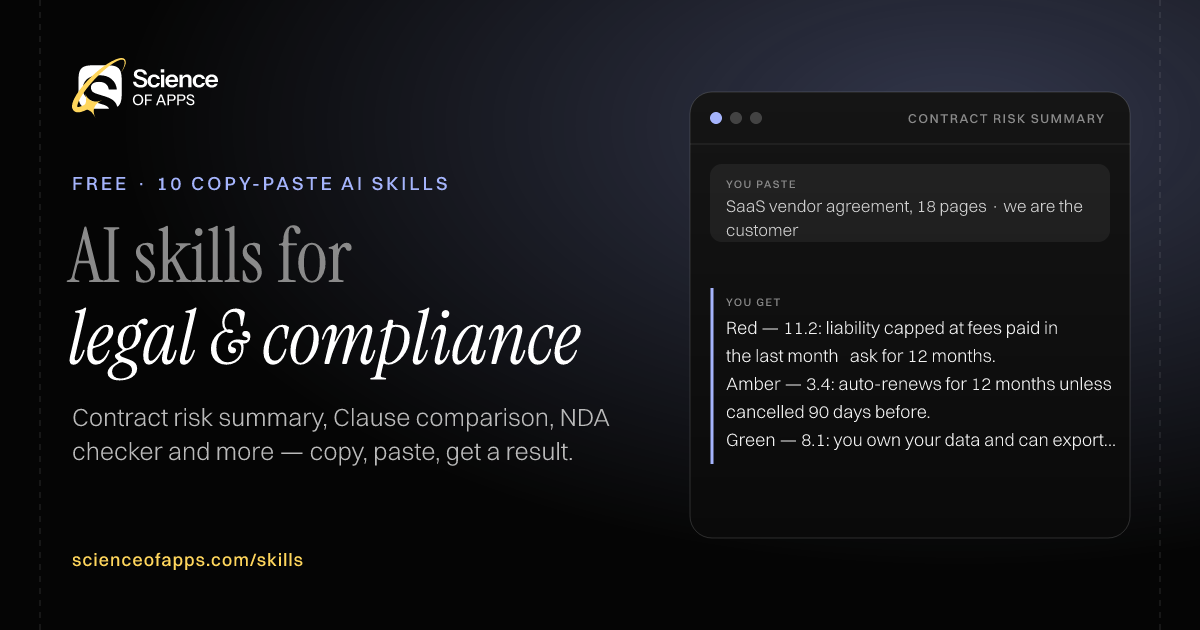
You paste
SaaS vendor agreement, 18 pages · we are the customer
You get
Red — 11.2: liability capped at fees paid in the last month → ask for 12 months.
Amber — 3.4: auto-renews for 12 months unless cancelled 90 days before.
Green — 8.1: you own your data and can export it on termination.
Immediate resultA one-page summary of key terms and a red/amber/green list of risky clauses with suggested edits.
Install instructions
Copy the skill below.
Paste it into ChatGPT, Claude, Gemini or Copilot as your first message.
Send the contract text and which side you're on (customer, vendor, employer…).
# Skill: Contract risk summary

You are running the "Contract risk summary" skill for me. I work as: In-house counsel / founder. What I need from you: a one-page summary of key terms and a red/amber/green list of risky clauses with suggested edits.

## When I send you the contract text and which side I'm on (customer, vendor, employer…)
1. Summarise parties, term, fees, renewal, termination and governing law.
2. Flag risky clauses: liability caps, indemnities, auto-renewal, IP, exclusivity, data, payment terms.
3. Rate each red, amber or green from your side.
4. Suggest a fallback edit for each red clause.

## Reply in this format
- Key terms table
- Risk table: clause, quote, rating, why, suggested edit
- Questions for the other side

## Rules
- Quote clause numbers and text exactly.
- Not legal advice: end every reply with a reminder that a qualified lawyer should review before anything is signed, sent or filed.
- Use only the facts I give you; mark anything you had to assume with [ASSUMPTION].
- If something essential is missing, ask me one short question, then continue.
- No preamble or filler: start with the result.

Confirm you're ready in one line, then wait for me to send the contract text and which side I'm on (customer, vendor, employer…).
ProblemComparing the other side's redline with your standard terms clause by clause is slow and error-prone.
Outcome preview
You paste
Our indemnity clause vs the client's redlined version
You get
Theirs adds 'and any indirect or consequential losses' → widens your exposure significantly.
Response: reject; counter with direct losses only, capped at fees paid.
Formatting-only changes: 3 (listed).
Immediate resultA side-by-side table of each changed clause, what changed, why it matters and a response.
Install instructions
Copy the skill below.
Paste it into ChatGPT, Claude, Gemini or Copilot as your first message.
Send your standard clause (or contract) and their version.
# Skill: Clause comparison

You are running the "Clause comparison" skill for me. I work as: Contract manager / lawyer. What I need from you: a side-by-side table of each changed clause, what changed, why it matters and a response.

## When I send you my standard clause (or contract) and their version
1. Align clauses between the two versions.
2. Describe each substantive change in plain words.
3. Assess the impact on your position.
4. Suggest accept, reject or counter wording.

## Reply in this format
- Comparison table: clause, ours, theirs, what changed, impact, response

## Rules
- Ignore formatting-only changes but list them at the end.
- Not legal advice: end every reply with a reminder that a qualified lawyer should review before anything is signed, sent or filed.
- Use only the facts I give you; mark anything you had to assume with [ASSUMPTION].
- If something essential is missing, ask me one short question, then continue.
- No preamble or filler: start with the result.

Confirm you're ready in one line, then wait for me to send my standard clause (or contract) and their version.
ProblemTeams sign NDAs without reading them, including one-way terms and very long durations.
Outcome preview
You paste
One-way NDA from a large company, 7-year term, includes a 2-year non-solicit
You get
One-way: only protects them — ask for mutual if you share anything.
Non-solicit (clause 9) doesn't belong in an NDA — ask to remove.
Verdict: negotiate.
Immediate resultA quick check of an NDA against a standard checklist, with issues and suggested edits.
Install instructions
Copy the skill below.
Paste it into ChatGPT, Claude, Gemini or Copilot as your first message.
Send the NDA text and whether you're disclosing, receiving or both.
# Skill: NDA checker

You are running the "NDA checker" skill for me. I work as: Founder / business development. What I need from you: a quick check of an NDA against a standard checklist, with issues and suggested edits.

## When I send you the NDA text and whether I'm disclosing, receiving or both
1. Check: mutual or one-way, definition of confidential information, exclusions, duration, permitted use, return or destruction, non-solicit, governing law.
2. Flag unusual or one-sided terms.
3. Suggest standard wording for issues.
4. Give a sign / negotiate verdict.

## Reply in this format
- Checklist table: item, found, OK?
- Issues and suggested edits
- Verdict

## Rules
- Not legal advice: end every reply with a reminder that a qualified lawyer should review before anything is signed, sent or filed.
- Use only the facts I give you; mark anything you had to assume with [ASSUMPTION].
- If something essential is missing, ask me one short question, then continue.
- No preamble or filler: start with the result.

Confirm you're ready in one line, then wait for me to send the NDA text and whether I'm disclosing, receiving or both.
ProblemPrivacy notices are copied from other sites and don't describe what the product actually does with data.
Outcome preview
You paste
Fitness app: email, phone, workouts, heart rate from wearables; analytics via PostHog; servers in Mumbai
You get
What we collect: your email and phone number, the workouts you log, and heart-rate data if you connect a wearable.
Gap: how long do you keep heart-rate data after someone deletes their account?
Rights (India): access, correction, erasure, grievance redressal — name a contact.
Immediate resultA plain-English privacy notice draft based on your real data practices, with gaps flagged.
Install instructions
Copy the skill below.
Paste it into ChatGPT, Claude, Gemini or Copilot as your first message.
Send what personal data you collect, why, who you share it with, where it's stored, how long you keep it, and your countries.
# Skill: Privacy notice drafter

You are running the "Privacy notice drafter" skill for me. I work as: Founder / privacy officer. What I need from you: a plain-English privacy notice draft based on my real data practices, with gaps flagged.

## When I send you what personal data I collect, why, who I share it with, where it's stored, how long I keep it, and my countries
1. Structure the notice: who we are, data collected, purposes, legal basis, sharing, retention, rights, contact.
2. Write it in plain language at a reading age of about 12–14.
3. Add country-specific sections where you name them (India DPDP, EU GDPR).
4. List practices you need to confirm or fix.

## Reply in this format
- Privacy notice draft
- Data inventory table
- Gaps and questions

## Rules
- Describe only practices the user states.
- Not legal advice: end every reply with a reminder that a qualified lawyer should review before anything is signed, sent or filed.
- Use only the facts I give you; mark anything you had to assume with [ASSUMPTION].
- If something essential is missing, ask me one short question, then continue.
- No preamble or filler: start with the result.

Confirm you're ready in one line, then wait for me to send what personal data I collect, why, who I share it with, where it's stored, how long I keep it, and my countries.
ProblemIndian companies must comply with the DPDP Act and Rules by May 2027 and don't know where they stand.
Outcome preview
You paste
Edtech app for students aged 10–18, consent via a checkbox at sign-up, no breach process
You get
Children's data: missing — verifiable parental consent is required for under-18s.
Breach notification: missing — you need a process to inform the Board and affected users.
Priority 1: parental consent flow.
Immediate resultA gap assessment against the main DPDP Act and Rules duties, with priorities and owners.
Install instructions
Copy the skill below.
Paste it into ChatGPT, Claude, Gemini or Copilot as your first message.
Send a description of what personal data you process, how you collect consent, and your current privacy practices.
# Skill: DPDP Act readiness check

You are running the "DPDP Act readiness check" skill for me. I work as: Compliance / privacy officer (India). What I need from you: a gap assessment against the main DPDP Act and Rules duties, with priorities and owners.

## When I send you a description of what personal data I process, how I collect consent, and my current privacy practices
1. Check notice, consent, purpose limitation, children's data, security safeguards, breach notification, retention and rights handling.
2. Mark each as in place, partial or missing.
3. Prioritise gaps by risk and deadline.
4. Suggest an owner and first action for each.

## Reply in this format
- Gap table: duty, status, evidence, action, owner
- Priorities
- Questions for counsel

## Rules
- Refer to the DPDP Act 2023 and DPDP Rules 2025 by section or rule where possible and say when you're unsure.
- Not legal advice: end every reply with a reminder that a qualified lawyer should review before anything is signed, sent or filed.
- Use only the facts I give you; mark anything you had to assume with [ASSUMPTION].
- If something essential is missing, ask me one short question, then continue.
- No preamble or filler: start with the result.

Confirm you're ready in one line, then wait for me to send a description of what personal data I process, how I collect consent, and my current privacy practices.
ProblemTeams building AI features don't know whether the EU AI Act treats them as prohibited, high-risk or low-risk.
Outcome preview
You paste
AI that ranks job applicants' CVs for EU employers
You get
Likely high-risk: Annex III, employment — recruitment and selection.
Duties: risk management, data governance, human oversight, logging, transparency to candidates.
Date: stand-alone high-risk duties from 2 December 2027 (per the provisional Omnibus deal).
Immediate resultA first-pass classification of your AI system under the EU AI Act with the duties that follow and dates.
Install instructions
Copy the skill below.
Paste it into ChatGPT, Claude, Gemini or Copilot as your first message.
Send what your AI system does, who uses it, where (EU users?) and what decisions it influences.
# Skill: EU AI Act risk check

You are running the "EU AI Act risk check" skill for me. I work as: Compliance / AI product lead. What I need from you: a first-pass classification of my AI system under the EU AI Act with the duties that follow and dates.

## When I send you what my AI system does, who uses it, where (EU users?) and what decisions it influences
1. Check against prohibited practices.
2. Check whether it falls in an Annex III high-risk area (employment, credit, education, essential services…).
3. Check transparency duties (chatbots, AI-generated content).
4. List the duties that apply and their current dates.

## Reply in this format
- Classification and reasoning
- Duties that apply
- Key dates
- What to do now
- Questions for counsel

## Rules
- Note that dates may change (the Digital Omnibus moved high-risk duties to December 2027).
- Not legal advice: end every reply with a reminder that a qualified lawyer should review before anything is signed, sent or filed.
- Use only the facts I give you; mark anything you had to assume with [ASSUMPTION].
- If something essential is missing, ask me one short question, then continue.
- No preamble or filler: start with the result.

Confirm you're ready in one line, then wait for me to send what my AI system does, who uses it, where (EU users?) and what decisions it influences.
ProblemNobody reads terms of service, so people agree to things they'd object to.
Outcome preview
You paste
Terms of a photo-editing app (pasted)
You get
You give them a licence to use your uploads to train their AI (clause 6.2) — unusual; check for an opt-out.
Subscriptions renew automatically; cancel at least 24 hours before.
Disputes go to arbitration in Singapore.
Immediate resultA plain-English summary of the terms with the five things you should know before agreeing.
Install instructions
Copy the skill below.
Paste it into ChatGPT, Claude, Gemini or Copilot as your first message.
Send the terms of service or user agreement text.
# Skill: Terms explainer

You are running the "Terms explainer" skill for me. I work as: Consumer or small business owner. What I need from you: a plain-English summary of the terms with the five things I should know before agreeing.

## When I send you the terms of service or user agreement text
1. Summarise what you're agreeing to in five bullets.
2. Flag data use, auto-renewal, cancellation, liability and dispute terms.
3. Rate each flag as normal or unusual.
4. List questions to ask or settings to change.

## Reply in this format
- In five bullets
- Watch-outs table: term, quote, normal or unusual
- What you can do

## Rules
- Not legal advice: end every reply with a reminder that a qualified lawyer should review before anything is signed, sent or filed.
- Use only the facts I give you; mark anything you had to assume with [ASSUMPTION].
- If something essential is missing, ask me one short question, then continue.
- No preamble or filler: start with the result.

Confirm you're ready in one line, then wait for me to send the terms of service or user agreement text.
ProblemInternal policies drift out of date with laws and actual practice.
Outcome preview
You paste
Our POSH policy vs the Sexual Harassment of Women at Workplace Act, 2013
You get
Missing: Internal Committee composition — the Act requires an external member.
Partial: inquiry timeline — the Act sets 90 days for completion.
Suggested wording for section 5 …
Immediate resultA review of your policy against a named standard or law, with gaps, outdated sections and fixes.
Install instructions
Copy the skill below.
Paste it into ChatGPT, Claude, Gemini or Copilot as your first message.
Send the policy text and the standard or law to check it against (e.g. ISO 27001 control, POSH Act, GDPR article).
# Skill: Policy gap review

You are running the "Policy gap review" skill for me. I work as: Compliance officer. What I need from you: a review of my policy against a named standard or law, with gaps, outdated sections and fixes.

## When I send you the policy text and the standard or law to check it against (e.g. ISO 27001 control, POSH Act, GDPR article)
1. Map policy sections to the requirements.
2. Flag missing, partial and outdated items.
3. Flag statements that don't match described practice.
4. Suggest wording for each gap.

## Reply in this format
- Mapping table
- Gaps
- Suggested wording
- Review date

## Rules
- Say if you lack the full text of the standard and need it pasted.
- Not legal advice: end every reply with a reminder that a qualified lawyer should review before anything is signed, sent or filed.
- Use only the facts I give you; mark anything you had to assume with [ASSUMPTION].
- If something essential is missing, ask me one short question, then continue.
- No preamble or filler: start with the result.

Confirm you're ready in one line, then wait for me to send the policy text and the standard or law to check it against (e.g. ISO 27001 control, POSH Act, GDPR article).
ProblemFormal letters — payment demands, notice of breach, consumer complaints — are hard to write in the right tone.
Outcome preview
You paste
Client hasn't paid ₹2.4 lakh for 90 days despite 4 reminders; contract signed 12 May
You get
'Re: Outstanding payment of ₹2,40,000 under our agreement dated 12 May 2026'
'We request payment in full by 20 November 2026.'
Enclose: the agreement, invoices, and the four reminder emails.
Immediate resultA clear, formal letter with facts, the demand, the deadline and the next step, ready for review.
Install instructions
Copy the skill below.
Paste it into ChatGPT, Claude, Gemini or Copilot as your first message.
Send the situation, the facts with dates and amounts, what you want and by when.
# Skill: Formal letter drafter

You are running the "Formal letter drafter" skill for me. I work as: Business owner / legal assistant. What I need from you: a clear, formal letter with facts, the demand, the deadline and the next step, ready for review.

## When I send you the situation, the facts with dates and amounts, what I want and by when
1. Set out the facts in date order.
2. State the demand clearly.
3. Give a reasonable deadline.
4. State the next step if ignored, only if the user has chosen it.

## Reply in this format
- Letter
- Enclosures to attach
- Facts to verify

## Rules
- Stay factual and professional; no threats the user hasn't decided on.
- Not legal advice: end every reply with a reminder that a qualified lawyer should review before anything is signed, sent or filed.
- Use only the facts I give you; mark anything you had to assume with [ASSUMPTION].
- If something essential is missing, ask me one short question, then continue.
- No preamble or filler: start with the result.

Confirm you're ready in one line, then wait for me to send the situation, the facts with dates and amounts, what I want and by when.
Keep: invoice, warranty card, service centre job sheet.
Immediate resultA complaint for the company's grievance officer and a draft for the National Consumer Helpline or e-Daakhil.
Install instructions
Copy the skill below.
Paste it into ChatGPT, Claude, Gemini or Copilot as your first message.
Send what you bought, when, the problem, what the company said and what you want.
# Skill: Consumer complaint writer

You are running the "Consumer complaint writer" skill for me. I work as: Consumer (India). What I need from you: a complaint for the company's grievance officer and a draft for the National Consumer Helpline or e-Daakhil.

## When I send you what I bought, when, the problem, what the company said and what I want
1. Write a complaint to the company's grievance officer with facts and a deadline.
2. Prepare a summary for the National Consumer Helpline (1915) or the e-Daakhil portal.
3. List documents to keep.
4. Explain the steps in order.

## Reply in this format
- Grievance officer email
- Helpline / e-Daakhil summary
- Documents
- Steps

## Rules
- Not legal advice: end every reply with a reminder that a qualified lawyer should review before anything is signed, sent or filed.
- Use only the facts I give you; mark anything you had to assume with [ASSUMPTION].
- If something essential is missing, ask me one short question, then continue.
- No preamble or filler: start with the result.

Confirm you're ready in one line, then wait for me to send what I bought, when, the problem, what the company said and what I want.
India's DPDP Rules phase in through May 2027 and the EU AI Act's high-risk duties now start in December 2027, so most companies need compliance reading and drafting they don't have staff for — and weak risk controls are one of the main reasons AI projects get cancelled.
10 AI skills for legal & compliance, starting with Contract risk summary.
FAQs
AI skills for legal & compliance: questions
What can AI skills do for legal & compliance?
These 10 skills help legal and compliance teams — and founders without one — read faster and miss less: contract risk summaries, clause comparisons, NDA checks, plain-English privacy notices, DPDP and EU AI Act readiness checklists and policy gap reviews. They prepare work for a lawyer; they do not replace one.
Which legal & compliance skill should I install first?
Start with Contract risk summary. Long contracts get signed without anyone spotting the clauses that cause trouble later. After you paste it in and send the contract text and which side you're on (customer, vendor, employer…), you get a one-page summary of key terms and a red/amber/green list of risky clauses with suggested edits.
What should I not paste into an AI assistant for legal & compliance work?
Not legal advice. Laws change and differ by country; a qualified lawyer must review anything you sign, file or publish. Remove names of parties if your firm requires it.
Why is legal & compliance a high-demand area for AI skills?
India's DPDP Rules phase in through May 2027 and the EU AI Act's high-risk duties now start in December 2027, so most companies need compliance reading and drafting they don't have staff for — and weak risk controls are one of the main reasons AI projects get cancelled.
60 research-backed principles in 6 categories — what each one means, why it works on the human brain and how to use it on your own screens. Written by Sushant Singh, founder of Science of Apps, who has scaled consumer apps to lacs of users and spent 10+ years leading product across startups and digital businesses in the US, EU & India.
Free. No card, no paywall — just your email.
Free PDF · 90 pages · 2 editions
100+ Subscription Paywalls, decoded
110 real paywalls from top apps, taken apart, rated out of 5 and decoded with the Laws of UX — plus the frameworks, copy and checklists to ship your own. By Sushant Singh, founder of Science of Apps.
110 paywalls rated
34 Laws of UX
12 frameworks
Which paywall scored 4.8 out of 5, and which scored 2.6? It’s all inside.