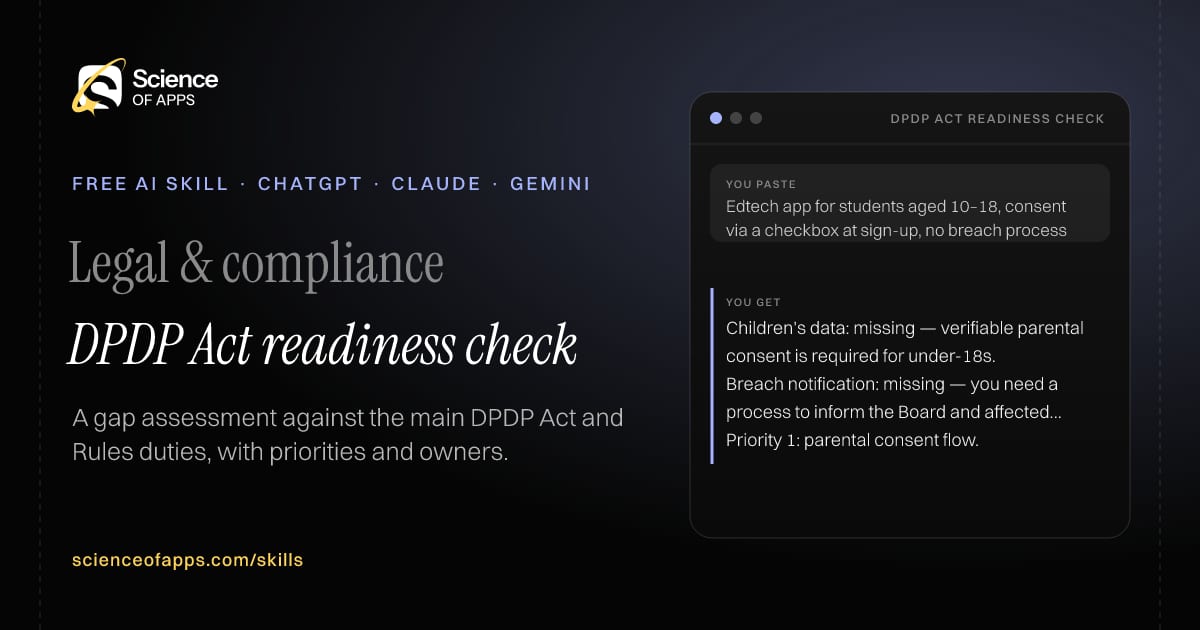
Edtech app for students aged 10–18, consent via a checkbox at sign-up, no breach process
You get
Children's data: missing — verifiable parental consent is required for under-18s.
Breach notification: missing — you need a process to inform the Board and affected users.
Priority 1: parental consent flow.
About this skill
About DPDP Act readiness check
India's Digital Personal Data Protection Rules bring their main duties into force in May 2027, and most startups don't know where they stand. This skill assesses your practices against the core obligations — notice, consent, purpose limitation, children's data, security safeguards, breach notification, retention and handling people's rights — marking each in place, partial or missing. Gaps are prioritised with an owner and first action. It cites sections where it can, says when it's unsure and leaves the final call to counsel. To use it, paste the skill into your assistant and send a description of what personal data you process, how you collect consent, and your current privacy practices.
DPDP Act readiness check — example input and the first lines it returns. Works in ChatGPT, Claude and Gemini.
2 Paste it into a new chatChatGPT, Claude, Gemini or Copilot.
3 Send your inputSend a description of what personal data you process.
The skill — paste this into your AI assistant
# Skill: DPDP Act readiness check

You are running the "DPDP Act readiness check" skill for me. I work as: Compliance / privacy officer (India). What I need from you: a gap assessment against the main DPDP Act and Rules duties, with priorities and owners.

## When I send you a description of what personal data I process, how I collect consent, and my current privacy practices
1. Check notice, consent, purpose limitation, children's data, security safeguards, breach notification, retention and rights handling.
2. Mark each as in place, partial or missing.
3. Prioritise gaps by risk and deadline.
4. Suggest an owner and first action for each.

## Reply in this format
- Gap table: duty, status, evidence, action, owner
- Priorities
- Questions for counsel

## Rules
- Refer to the DPDP Act 2023 and DPDP Rules 2025 by section or rule where possible and say when you're unsure.
- Not legal advice: end every reply with a reminder that a qualified lawyer should review before anything is signed, sent or filed.
- Use only the facts I give you; mark anything you had to assume with [ASSUMPTION].
- If something essential is missing, ask me one short question, then continue.
- No preamble or filler: start with the result.

Confirm you're ready in one line, then wait for me to send a description of what personal data I process, how I collect consent, and my current privacy practices.
Then sendA description of what personal data you process, how you collect consent, and your current privacy practices. For example: Edtech app for students aged 10–18, consent via a checkbox at sign-up, no breach process
ChatGPT
Fastest: paste the skill as your first message in a new chat, then send your input.
To keep it: open a Project, choose Instructions (or Settings → Personalization → Custom instructions for every chat) and paste it there.
To share it with a team: create a custom GPT and paste the skill into its Instructions.
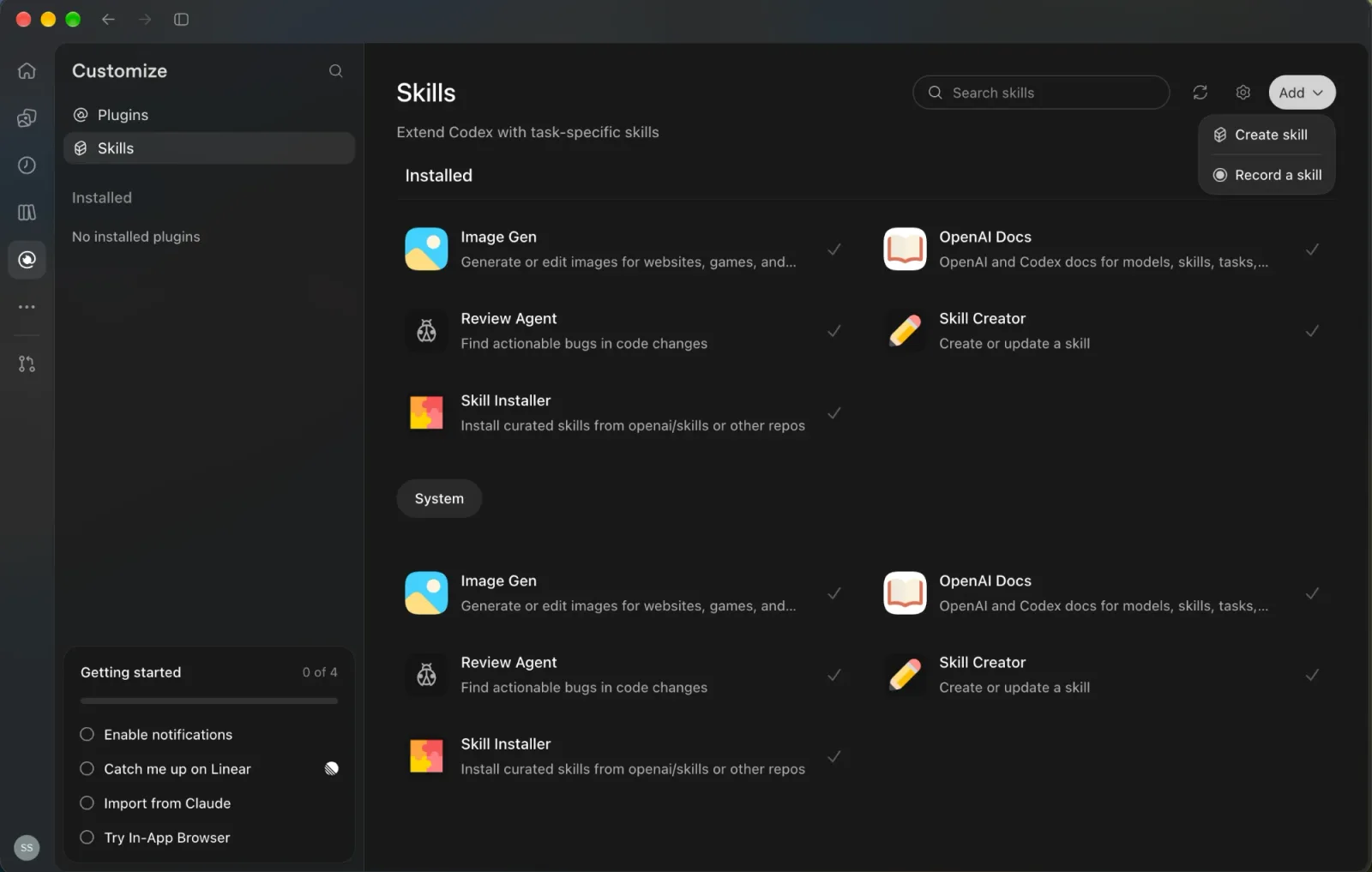
In the Codex app: copy the skill's folder into ~/.codex/skills/ (or Customize → Skills → Add → Create skill).
Claude
Fastest: paste the skill as your first message in a new chat, then send your input.
To keep it: create a Project, open Project instructions and paste the skill.
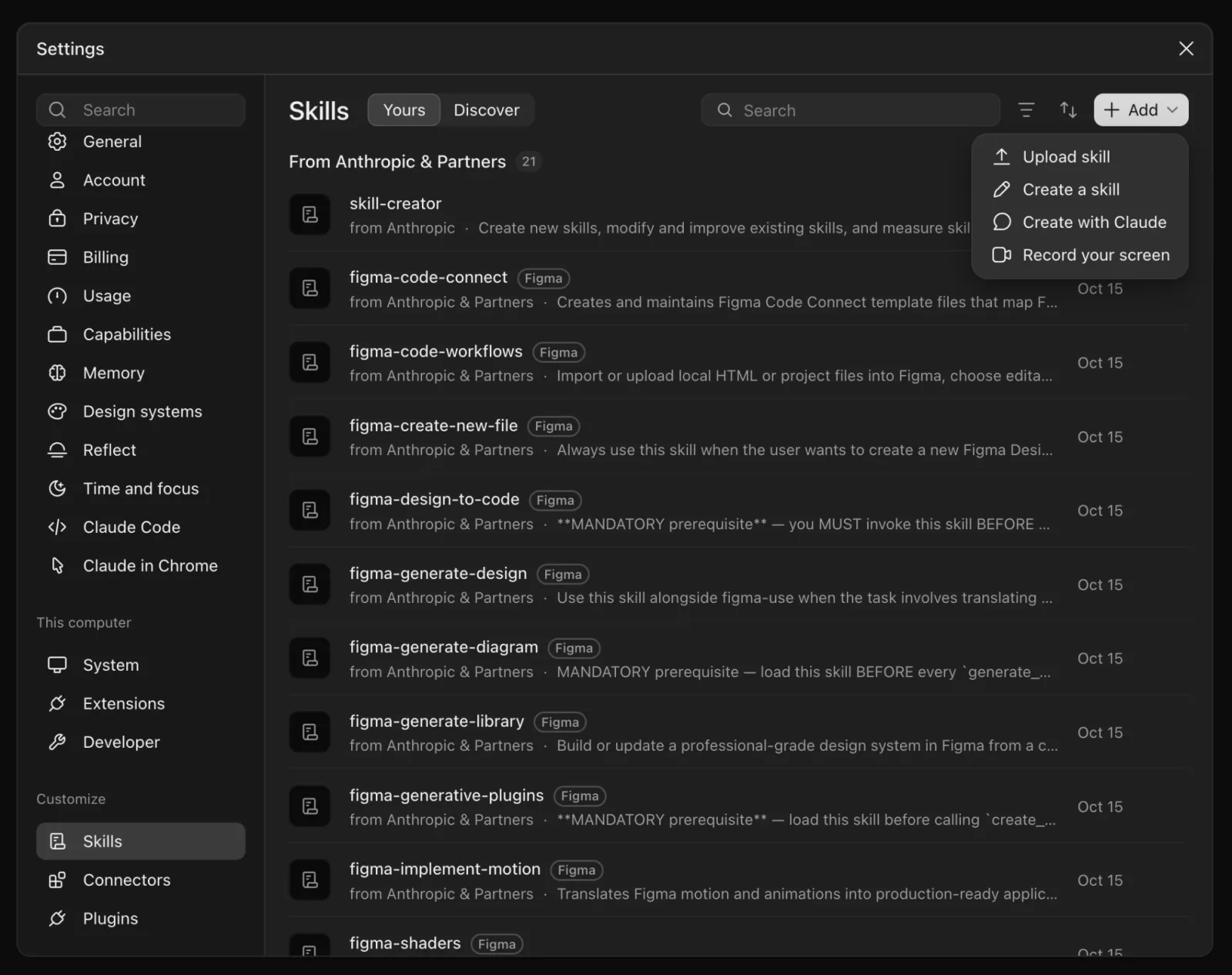
As a Claude Skill: download the skill's ZIP, then in Claude open Settings → Skills → Add → Upload skill and choose the file.
Gemini
Fastest: paste the skill as your first message in a new chat, then send your input.
To keep it: open Gems → New Gem, paste the skill into Instructions and save.
Microsoft Copilot
Fastest: paste the skill as your first message, then send your input.
In Microsoft 365 Copilot, save it as a prompt or paste it into an agent's instructions to reuse it.
Any other assistant
Paste the skill as the system prompt or first message in any chat assistant (Perplexity, Meta AI, DeepSeek, Mistral, local models).
Coding agents that read the Agent Skills format (SKILL.md) can load the downloaded file from their skills folder.
Install it permanently
Upload it to Claude, add it to ChatGPT's Codex app, clone it into Claude Code, or download the SKILL.md for any agent. Full guide with screenshots →
Download the ZIP and upload it in Claude. Claude then uses the skill on its own whenever a request matches.
Claude Code: save it as ~/.claude/skills/dpdp-readiness-checklist/SKILL.md.
Claude apps: use the Claude app tab — it has a ready-made ZIP.
Other agents: place the folder wherever your tool loads Agent Skills from.
Repositoryscienceofapps.com/skills/ai-skills.git · all 200 skills, one folder each, plain git over HTTPS
What it does
The steps it follows
Check notice, consent, purpose limitation, children's data, security safeguards, breach notification, retention and rights handling.
Mark each as in place, partial or missing.
Prioritise gaps by risk and deadline.
Suggest an owner and first action for each.
What you get back
The reply format
Gap table: duty, status, evidence, action, owner
Priorities
Questions for counsel
Rules it never breaks
Refer to the DPDP Act 2023 and DPDP Rules 2025 by section or rule where possible and say when you're unsure.
Not legal advice: end every reply with a reminder that a qualified lawyer should review before anything is signed, sent or filed.
Uses only the facts you give it and marks assumptions.
FAQs
Questions about DPDP Act readiness check
What does the DPDP Act readiness check skill do?
Indian companies must comply with the DPDP Act and Rules by May 2027 and don't know where they stand. The skill fixes that: a gap assessment against the main DPDP Act and Rules duties, with priorities and owners.
How do I install DPDP Act readiness check in ChatGPT, Claude or Gemini?
Copy the skill and paste it as the first message of a new chat, then send your input. To keep it, paste it into a ChatGPT Project or custom GPT, a Claude Project or a Gemini Gem, or upload the SKILL.md file as a Claude Skill.
What do I send DPDP Act readiness check after installing it?
Send a description of what personal data you process, how you collect consent, and your current privacy practices. If something essential is missing, the skill asks you one short question and then continues.
Is the DPDP Act readiness check skill free?
Yes. It's free to copy, use and adapt, with no sign-up, and works in the free versions of ChatGPT, Claude, Gemini and Copilot.
60 research-backed principles in 6 categories — what each one means, why it works on the human brain and how to use it on your own screens. Written by Sushant Singh, founder of Science of Apps, who has scaled consumer apps to lacs of users and spent 10+ years leading product across startups and digital businesses in the US, EU & India.
Free. No card, no paywall — just your email.
Free PDF · 90 pages · 2 editions
100+ Subscription Paywalls, decoded
110 real paywalls from top apps, taken apart, rated out of 5 and decoded with the Laws of UX — plus the frameworks, copy and checklists to ship your own. By Sushant Singh, founder of Science of Apps.
110 paywalls rated
34 Laws of UX
12 frameworks
Which paywall scored 4.8 out of 5, and which scored 2.6? It’s all inside.