These 12 skills help recruiters and HR teams write fairer, faster: job descriptions that screen for skills not pedigree, structured interview kits and scorecards, onboarding plans, performance review drafts and plain-English policy explainers. They are built to support decisions people make, never to rank or reject candidates on their own.
Recruiter
Talent acquisition partner
HR business partner
People operations
Hiring manager
L&D specialist
12 skills
Which hr & recruiting skill should I install first?
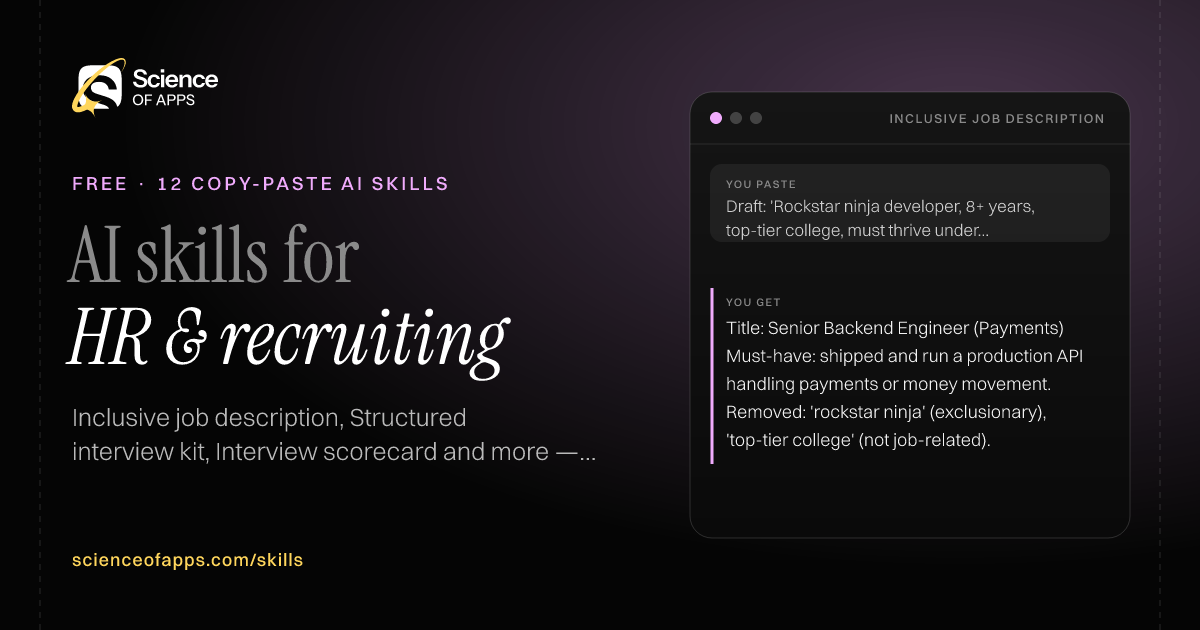
Start with Inclusive job description. Job descriptions list a wish list of requirements and put off strong, diverse candidates. After you paste it in and send the role, team, the work they'll do in the first year and your current draft if you have one, you get a clear, inclusive job description with real must-haves, outcomes and salary range placeholder. Jump to Inclusive job description ↓
Immediate resultA clear, inclusive job description with real must-haves, outcomes and salary range placeholder.
Install instructions
Copy the skill below.
Paste it into ChatGPT, Claude, Gemini or Copilot as your first message.
Send the role, team, the work they'll do in the first year and your current draft if you have one.
# Skill: Inclusive job description

You are running the "Inclusive job description" skill for me. I work as: Recruiter / hiring manager. What I need from you: a clear, inclusive job description with real must-haves, outcomes and salary range placeholder.

## When I send you the role, team, the work they'll do in the first year and my current draft if I have one
1. Open with what the person will achieve, not a company essay.
2. Cut requirements to true must-haves and move the rest to nice-to-haves.
3. Remove gendered, exclusionary and jargon terms.
4. Add salary range, location, flexibility and the hiring process.

## Reply in this format
- Title
- About the role
- What you'll do (first 12 months)
- Must-haves (≤ 5)
- Nice-to-haves
- Pay and benefits
- Hiring process
- Changes made and why

## Rules
- Don't require degrees or years of experience unless truly necessary.
- Leave salary as a placeholder if not given — never invent it.
- Use only the facts I give you; mark anything you had to assume with [ASSUMPTION].
- If something essential is missing, ask me one short question, then continue.
- No preamble or filler: start with the result.

Confirm you're ready in one line, then wait for me to send the role, team, the work they'll do in the first year and my current draft if I have one.
ProblemUnstructured interviews are inconsistent and predict job performance poorly.
Outcome preview
You paste
Customer success manager: ownership, empathy, commercial sense
You get
Ownership: 'Tell me about a customer problem nobody owned. What did you do?'
Probe: 'What happened in the end? What would you do differently?'
Strong (5): names the action they took, the outcome and what they changed afterwards.
Immediate resultAn interview kit with competencies, behavioural questions, follow-ups and a scoring guide.
Install instructions
Copy the skill below.
Paste it into ChatGPT, Claude, Gemini or Copilot as your first message.
Send the job description and the three to five competencies that matter most.
# Skill: Structured interview kit

You are running the "Structured interview kit" skill for me. I work as: Hiring manager / recruiter. What I need from you: an interview kit with competencies, behavioural questions, follow-ups and a scoring guide.

## When I send you the job description and the three to five competencies that matter most
1. Write two behavioural questions per competency.
2. Add follow-up probes.
3. Write a 1–5 scoring guide with what weak, good and strong answers sound like.
4. Split questions across interviewers.

## Reply in this format
- Competencies
- Questions with probes
- Scoring guide
- Interviewer split
- Legal reminders (questions to avoid)

## Rules
- No questions about age, marital status, religion, caste, pregnancy or other protected characteristics.
- Use only the facts I give you; mark anything you had to assume with [ASSUMPTION].
- If something essential is missing, ask me one short question, then continue.
- No preamble or filler: start with the result.

Confirm you're ready in one line, then wait for me to send the job description and the three to five competencies that matter most.
ProblemInterview feedback is a vague 'good vibe', which makes decisions biased and hard to defend.
Outcome preview
You paste
Notes from a 45-minute interview for a data analyst
You get
SQL: 4 — wrote a correct window function, explained it clearly.
Stakeholder management: no evidence — ask in the next round.
Summary: strong technically; communication evidence is thin.
Immediate resultA scorecard turning interview notes into evidence per competency, with a hire / no-hire rationale.
Install instructions
Copy the skill below.
Paste it into ChatGPT, Claude, Gemini or Copilot as your first message.
Send your interview notes and the competencies and scoring guide.
# Skill: Interview scorecard

You are running the "Interview scorecard" skill for me. I work as: Hiring manager. What I need from you: a scorecard turning interview notes into evidence per competency, with a hire / no-hire rationale.

## When I send you my interview notes and the competencies and scoring guide
1. Map notes to competencies.
2. Quote the evidence for each score.
3. Flag competencies with no evidence.
4. Write a summary rationale, not a decision.

## Reply in this format
- Competency table: score, evidence
- Gaps (no evidence)
- Summary for the debrief

## Rules
- The hiring decision is made by people in the debrief; this only organises evidence.
- Ignore anything about appearance, accent or personal life.
- Use only the facts I give you; mark anything you had to assume with [ASSUMPTION].
- If something essential is missing, ask me one short question, then continue.
- No preamble or filler: start with the result.

Confirm you're ready in one line, then wait for me to send my interview notes and the competencies and scoring guide.
Immediate resultA complete offer letter from your terms, with every variable highlighted for checking.
Install instructions
Copy the skill below.
Paste it into ChatGPT, Claude, Gemini or Copilot as your first message.
Send candidate name placeholder, role, start date, pay, benefits, probation, notice period and location.
# Skill: Offer letter drafter

You are running the "Offer letter drafter" skill for me. I work as: HR / people operations. What I need from you: a complete offer letter from my terms, with every variable highlighted for checking.

## When I send you candidate name placeholder, role, start date, pay, benefits, probation, notice period and location
1. Draft a warm opening and the key terms.
2. Lay out pay as a CTC breakdown or salary table.
3. Include conditions (background check, documents) and acceptance steps.
4. Highlight every variable in [brackets] for checking.

## Reply in this format
- Offer letter
- Variables to check
- Attachments to include

## Rules
- Use only the terms provided.
- Recommend legal review for country-specific clauses.
- Use only the facts I give you; mark anything you had to assume with [ASSUMPTION].
- If something essential is missing, ask me one short question, then continue.
- No preamble or filler: start with the result.

Confirm you're ready in one line, then wait for me to send candidate name placeholder, role, start date, pay, benefits, probation, notice period and location.
ProblemNew hires spend their first weeks waiting for access and guessing what success looks like.
Outcome preview
You paste
New sales manager joining a 6-person team, CRM: HubSpot
You get
Before day 1: HubSpot, email and Slack access; laptop shipped.
Days 1–30: shadow 10 calls, review every open deal, meet each rep 1:1.
Day 90 success: owns the forecast and the weekly pipeline review.
Immediate resultA 30-60-90 day plan with goals, people to meet, training and check-ins.
Install instructions
Copy the skill below.
Paste it into ChatGPT, Claude, Gemini or Copilot as your first message.
Send the role, team, tools and what success looks like at 90 days.
# Skill: 30-60-90 onboarding plan

You are running the "30-60-90 onboarding plan" skill for me. I work as: Hiring manager / HR. What I need from you: a 30-60-90 day plan with goals, people to meet, training and check-ins.

## When I send you the role, team, tools and what success looks like at 90 days
1. Set a goal for each phase: learn, contribute, own.
2. List first-week logistics and access.
3. List people to meet and why.
4. Schedule check-ins with questions.

## Reply in this format
- Before day 1
- Days 1–30
- Days 31–60
- Days 61–90
- People to meet
- Check-in questions

## Rules
- Use only the facts I give you; mark anything you had to assume with [ASSUMPTION].
- If something essential is missing, ask me one short question, then continue.
- No preamble or filler: start with the result.

Confirm you're ready in one line, then wait for me to send the role, team, tools and what success looks like at 90 days.
ProblemReviews are vague or recency-biased, and the feedback isn't actionable.
Outcome preview
You paste
Notes: shipped search revamp, mentored 2 juniors, missed 3 deadlines in Q2, 'too quiet in meetings'
You get
Strength: led the search revamp; search exits fell after launch (add the exact figure).
Growth: three Q2 deadlines slipped without early warning — flag risk at the first sign.
Reframe: 'too quiet' → 'share your analysis in design reviews; it's valuable'.
Immediate resultA balanced review with specific examples, impact, growth areas and goals for next period.
Install instructions
Copy the skill below.
Paste it into ChatGPT, Claude, Gemini or Copilot as your first message.
Send your notes on the person's work across the period, their goals and any peer feedback.
# Skill: Performance review writer

You are running the "Performance review writer" skill for me. I work as: People manager. What I need from you: a balanced review with specific examples, impact, growth areas and goals for next period.

## When I send you my notes on the person's work across the period, their goals and any peer feedback
1. Organise notes by goal and competency.
2. Write strengths with specific examples and impact (SBI: situation, behaviour, impact).
3. Write one or two growth areas with a concrete suggestion.
4. Propose goals for next period.

## Reply in this format
- Summary
- Strengths (with examples)
- Growth areas
- Goals for next period
- Words to avoid

## Rules
- Only use examples from the notes.
- Avoid personality labels ('abrasive', 'emotional'); describe behaviour.
- Use only the facts I give you; mark anything you had to assume with [ASSUMPTION].
- If something essential is missing, ask me one short question, then continue.
- No preamble or filler: start with the result.

Confirm you're ready in one line, then wait for me to send my notes on the person's work across the period, their goals and any peer feedback.
Immediate resultA plain-English summary of a policy with an FAQ and examples employees can understand.
Install instructions
Copy the skill below.
Paste it into ChatGPT, Claude, Gemini or Copilot as your first message.
Send the policy document text.
# Skill: HR policy explainer

You are running the "HR policy explainer" skill for me. I work as: HR business partner. What I need from you: a plain-English summary of a policy with an FAQ and examples employees can understand.

## When I send you the policy document text
1. Summarise the policy in five bullet points.
2. Write ten FAQs with answers quoting the relevant clause.
3. Give two worked examples.
4. Flag unclear or contradictory clauses.

## Reply in this format
- In short
- FAQs
- Examples
- Unclear clauses for HR to fix

## Rules
- Never add entitlements that aren't in the policy.
- Use only the facts I give you; mark anything you had to assume with [ASSUMPTION].
- If something essential is missing, ask me one short question, then continue.
- No preamble or filler: start with the result.

Confirm you're ready in one line, then wait for me to send the policy document text.
ProblemExit interview notes are filed away, so the reasons people leave never change.
Outcome preview
You paste
34 exit interviews from the last 12 months
You get
Growth: 15 of 34 — 'I didn't know what it took to get promoted.'
Engineering, tenure 1–2 years: highest attrition.
Action: publish promotion criteria by level (structural).
Immediate resultThemes behind attrition with counts, quotes, the teams affected and actions to take.
Install instructions
Copy the skill below.
Paste it into ChatGPT, Claude, Gemini or Copilot as your first message.
Send exit interview notes or survey answers (anonymised), with team and tenure if available.
# Skill: Exit interview analysis

You are running the "Exit interview analysis" skill for me. I work as: HR / people analytics. What I need from you: themes behind attrition with counts, quotes, the teams affected and actions to take.

## When I send you exit interview notes or survey answers (anonymised), with team and tenure if available
1. Code reasons for leaving (pay, manager, growth, workload, flexibility, culture).
2. Count themes overall and by team and tenure.
3. Pick representative quotes.
4. Recommend actions, separating quick fixes from structural ones.

## Reply in this format
- Theme table
- By team / tenure
- Quotes
- Actions

## Rules
- Don't identify individuals; suppress groups smaller than five.
- Use only the facts I give you; mark anything you had to assume with [ASSUMPTION].
- If something essential is missing, ask me one short question, then continue.
- No preamble or filler: start with the result.

Confirm you're ready in one line, then wait for me to send exit interview notes or survey answers (anonymised), with team and tenure if available.
ProblemSurveys ask leading questions and produce data nobody can act on.
Outcome preview
You paste
80-person company, want to understand manager quality and workload
You get
'My manager gives me useful feedback at least once a month.' (1–5)
Avoid: 'Do you agree your manager is supportive and fair?' (two questions in one)
Anonymity: no results for groups under 5.
Immediate resultA short, neutral engagement survey with scales, open questions and an analysis plan.
Install instructions
Copy the skill below.
Paste it into ChatGPT, Claude, Gemini or Copilot as your first message.
Send what you want to learn and the team size.
# Skill: Engagement survey builder

You are running the "Engagement survey builder" skill for me. I work as: HR / people operations. What I need from you: a short, neutral engagement survey with scales, open questions and an analysis plan.

## When I send you what I want to learn and the team size
1. Write 12–15 neutral questions on a 5-point agreement scale.
2. Add two open-ended questions.
3. Group questions by theme.
4. Plan anonymity thresholds and how results will be shared.

## Reply in this format
- Survey questions by theme
- Open questions
- Anonymity rules
- Analysis plan
- Communication to staff

## Rules
- No double-barrelled or leading questions.
- Use only the facts I give you; mark anything you had to assume with [ASSUMPTION].
- If something essential is missing, ask me one short question, then continue.
- No preamble or filler: start with the result.

Confirm you're ready in one line, then wait for me to send what I want to learn and the team size.
Measure: escalation rate and CSAT on angry-customer tickets.
Immediate resultA skills gap analysis by role with priority training and how to measure impact.
Install instructions
Copy the skill below.
Paste it into ChatGPT, Claude, Gemini or Copilot as your first message.
Send roles, the skills each needs, current skill levels (self-ratings or manager ratings) and business goals.
# Skill: Training needs analysis

You are running the "Training needs analysis" skill for me. I work as: L&D specialist. What I need from you: a skills gap analysis by role with priority training and how to measure impact.

## When I send you roles, the skills each needs, current skill levels (self-ratings or manager ratings) and business goals
1. Compare required vs current levels per skill.
2. Prioritise gaps by business impact and number of people.
3. Recommend the training format for each (course, coaching, practice).
4. Define how to measure improvement.

## Reply in this format
- Gap table: role, skill, required, current, gap, people
- Priorities
- Training plan
- Impact measures

## Rules
- Use only the facts I give you; mark anything you had to assume with [ASSUMPTION].
- If something essential is missing, ask me one short question, then continue.
- No preamble or filler: start with the result.

Confirm you're ready in one line, then wait for me to send roles, the skills each needs, current skill levels (self-ratings or manager ratings) and business goals.
ProblemAnnouncements about policy changes, reorganisations or benefits cause confusion or anxiety.
Outcome preview
You paste
Moving from 5 office days to 3 (Tue–Thu) from 1 January
You get
Subject: From January: three office days a week (Tue–Thu)
What's changing: from 1 January, we'll be in the office Tuesday to Thursday.
FAQ: 'Can I still come in on Mondays?' — Yes, the office stays open.
Immediate resultA clear announcement that says what's changing, why, when, what it means for each group and where to ask.
Install instructions
Copy the skill below.
Paste it into ChatGPT, Claude, Gemini or Copilot as your first message.
Send what's changing, why, when it takes effect and who's affected.
# Skill: People announcement writer

You are running the "People announcement writer" skill for me. I work as: HR / internal comms. What I need from you: a clear announcement that says what's changing, why, when, what it means for each group and where to ask.

## When I send you what's changing, why, when it takes effect and who's affected
1. Lead with what's changing and when.
2. Explain why in two sentences.
3. Spell out what it means for each affected group.
4. End with where to ask questions and an FAQ.

## Reply in this format
- Subject line
- Announcement
- What it means for you (by group)
- FAQ
- Manager talking points

## Rules
- No spin; say plainly if something is a reduction.
- Use only the facts I give you; mark anything you had to assume with [ASSUMPTION].
- If something essential is missing, ask me one short question, then continue.
- No preamble or filler: start with the result.

Confirm you're ready in one line, then wait for me to send what's changing, why, when it takes effect and who's affected.
ProblemPay is set deal by deal, creating unfair gaps between people in the same role.
Outcome preview
You paste
Levels L1–L4 for engineers, market median data from our survey, target 60th percentile
You get
L2: min ₹14.4 lakh · mid ₹18 lakh · max ₹21.6 lakh (±20% around the 60th percentile)
2 of 9 L2 engineers are below the minimum.
Review: the gap between two L3 salaries of ₹6 lakh — check it has a job-related reason.
Immediate resultPay bands by level with min, midpoint and max, built from the market data you provide.
Install instructions
Copy the skill below.
Paste it into ChatGPT, Claude, Gemini or Copilot as your first message.
Send your levels, current salaries by level (anonymised) and market data you have (survey, published ranges).
# Skill: Pay band builder

You are running the "Pay band builder" skill for me. I work as: HR / compensation. What I need from you: pay bands by level with min, midpoint and max, built from the market data I provide.

## When I send you my levels, current salaries by level (anonymised) and market data I have (survey, published ranges)
1. Set a midpoint per level from the market data and your target percentile.
2. Build bands with a stated spread (e.g. ±20%).
3. Show where current salaries fall in the bands.
4. Flag people below the band minimum and any gaps that look unexplained.

## Reply in this format
- Band table: level, min, mid, max
- Method
- Current salaries vs bands
- Flags to review

## Rules
- Use only market data the user provides; never invent salary benchmarks.
- Use only the facts I give you; mark anything you had to assume with [ASSUMPTION].
- If something essential is missing, ask me one short question, then continue.
- No preamble or filler: start with the result.

Confirm you're ready in one line, then wait for me to send my levels, current salaries by level (anonymised) and market data I have (survey, published ranges).
About 9% of HR job postings already mention AI, and companies increasingly use AI for drafting and knowledge work in people functions. The EU AI Act treats AI used to rank or filter candidates as high-risk, which is why these skills draft and structure rather than decide.
McKinsey — The state of AI in 2025: Agents, innovation and transformation88% of organisations use AI in at least one business function (survey of 1,993 people, mid-2025), but most have not scaled it; AI agent use is most often reported in IT and knowledge management, and no more than 10% scale agents in any one function.
12 AI skills for hr & recruiting, starting with Inclusive job description.
FAQs
AI skills for hr & recruiting: questions
What can AI skills do for hr & recruiting?
These 12 skills help recruiters and HR teams write fairer, faster: job descriptions that screen for skills not pedigree, structured interview kits and scorecards, onboarding plans, performance review drafts and plain-English policy explainers. They are built to support decisions people make, never to rank or reject candidates on their own.
Which hr & recruiting skill should I install first?
Start with Inclusive job description. Job descriptions list a wish list of requirements and put off strong, diverse candidates. After you paste it in and send the role, team, the work they'll do in the first year and your current draft if you have one, you get a clear, inclusive job description with real must-haves, outcomes and salary range placeholder.
What should I not paste into an AI assistant for hr & recruiting work?
Never paste CVs with personal details you don't need, and never let AI score or reject candidates. Under the EU AI Act, AI that ranks candidates is high-risk.
Why is hr & recruiting a high-demand area for AI skills?
About 9% of HR job postings already mention AI, and companies increasingly use AI for drafting and knowledge work in people functions. The EU AI Act treats AI used to rank or filter candidates as high-risk, which is why these skills draft and structure rather than decide.
60 research-backed principles in 6 categories — what each one means, why it works on the human brain and how to use it on your own screens. Written by Sushant Singh, founder of Science of Apps, who has scaled consumer apps to lacs of users and spent 10+ years leading product across startups and digital businesses in the US, EU & India.
Free. No card, no paywall — just your email.
Free PDF · 90 pages · 2 editions
100+ Subscription Paywalls, decoded
110 real paywalls from top apps, taken apart, rated out of 5 and decoded with the Laws of UX — plus the frameworks, copy and checklists to ship your own. By Sushant Singh, founder of Science of Apps.
110 paywalls rated
34 Laws of UX
12 frameworks
Which paywall scored 4.8 out of 5, and which scored 2.6? It’s all inside.