 By
Quick facts
- Name in Hindi
- हिन्दी (hindī)
- Language family
- Indo-European › Indo-Aryan
- Writing system
- Devanagari — abugida (syllabic), left to right
- Where it began
- Delhi and the upper Ganges plain
- Main countries
- India, Nepal
- ISO 639-3 code
hin
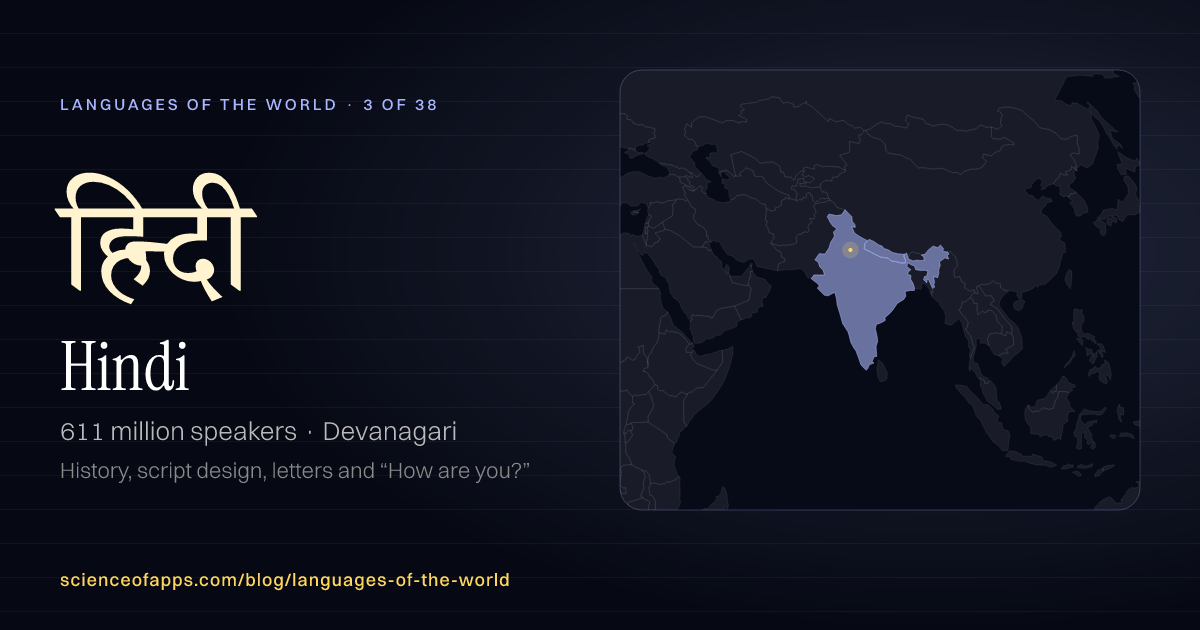
Where Hindi ranks
Hindi is the 3rd most-spoken language in the world by total speakers [1,2]. Here it is among its neighbours in the ranking, on one scale.
- 1English1.5B
- 2Mandarin Chinese1.2B
- 3Hindi611M
- 4Spanish561M
- 5Modern Standard Arabic335M
- 6French334M
- 7Bengali274M
“How are you?” in Hindi
आप कैसे हैं?
āp kaise haĩ?
Formal, to a man; to a woman: आप कैसी हैं? (āp kaisī haĩ?)
How are you?
Phrases: Omniglot — Useful phrases in Hindi [10]. Other languages' phrases come from the sources on their own pages. Synthetic voice (ElevenLabs Eleven v3, voice “Sia”). Pronunciation is approximate and may not match a native speaker; Cantonese and Wu Chinese are not voiced because the model reads Chinese characters with Mandarin sounds.
A short history
Hindi grew out of the Khari Boli speech of the Delhi region, and in everyday speech it is barely distinguishable from Urdu: linguists call the shared spoken base Hindustani, which split into two standards with different scripts and different sources for learned vocabulary — Sanskrit for Hindi, Persian and Arabic for Urdu[3].
Its script, Devanagari, evolved from Brahmi through the Gupta script, has been in use since the 7th century and reached its present form around the 11th[4]. On 14 September 1949 the Constituent Assembly chose Hindi in Devanagari as the official language of the Union, the date India now marks as Hindi Diwas[5], and Article 343 of the Constitution writes that into law, with English continuing alongside it[6].
The design of Devanagari
An abugida: every consonant carries an inherent 'a', other vowels are signs attached around it, and a virama removes the vowel. Consonant clusters fuse into conjuncts, and letters hang from a horizontal headline[7,4]. It descends from Brahmi through the Gupta script[4,8].
Abugida (syllabic). Each consonant carries a vowel, changed by marks attached to it.
- Kind
- Abugida (syllabic)
- Direction
- Left to right
- Took shape
- In use from the 7th century CE and in its present form by about the 11th century
- Line of descent
- Brahmi → Gupta → Nagari → Devanagari
- Traditional surface
- Paper
- Own digits
- ० १ २ ३ ४ ५ ६ ७ ८ ९
- Also writes
- मराठी Marathiभोजपुरी Bhojpuri
- Brahmi
- Gupta
- Nagari
- Devanagari
Ordered by the mouth
Consonants are arranged by where they are made in the mouth, from the throat (क ka) to the lips (म ma), each row running from unvoiced to nasal. The alphabet is a phonetics chart inherited from Sanskrit grammarians[7,9].
Hanging from a line
A horizontal headline, the shirorekha, joins the letters of a word; the letters hang below it rather than standing on a baseline[4].
Written before, said after
The i sign ि is drawn to the left of its consonant but pronounced after it, so कि is ki. Unicode stores text in spoken order and leaves the reordering to the font, which is why early phones showed broken Hindi[7].
Letters that fuse
Clusters join into conjuncts: क + ष makes क्ष (kṣa), and ज + ञ makes ज्ञ (jña), shapes that look nothing like their parts[7].
A dot for borrowed sounds
Hindi adds a dot below some letters, the nukta, to write sounds borrowed from Persian, Arabic and English: क़ (q), ख़ (kh), ग़ (gh), ज़ (z), फ़ (f)[7].
The same speech, two scripts
Write आप कैसे हैं in Nastaliq and you get Urdu's آپ کیسے ہیں: the sentence is identical, only the script and the formal vocabulary differ[3].
Explore the letters
a
The independent vowel; inside words it is silent, built into every consonant
1 / 18 · playing — pick a letter to stop
Numbers in Devanagari
Hindi's relatives among the 38
Hindi belongs to the Indo-European family (Indo-Aryan). These are the other languages with 50 million or more speakers in the same family; the closest — in the same branch — come first.
- বাংলাBengaliSame branch: Indo-Aryan · 274M
- اُردُوUrduSame branch: Indo-Aryan · 246M
- मराठीMarathiSame branch: Indo-Aryan · 99M
- پنجابیWestern PunjabiSame branch: Indo-Aryan · 90M
- ગુજરાતીGujaratiSame branch: Indo-Aryan · 62M
- EnglishEnglishGermanic · 1.5B
- españolSpanishRomance · 561M
- françaisFrenchRomance · 334M
- portuguêsPortugueseRomance · 269M
- русскийRussianBalto-Slavic · 210M
- DeutschGermanGermanic · 133M
- فارسیPersian (Iranian)Iranian · 82M
- italianoItalianRomance · 66M
- भोजपुरीBhojpuriIndo-Aryan (Bihari) · 53M
Hindi across the hub
The main page compares all 38 languages. Each link opens it on Hindi.
- Preview it in the explorer →with all 38 side by side
- Hear it in the voice tour →“How are you?” in every language, spoken in turn
- Trace its script's family tree →from the first alphabets and Chinese oracle bones
- Compare its digits →ten ways to write 0–9
- See its share of speakers →an interactive breakdown by script, family and region
Frequently asked questions
How many people speak Hindi?
About 611 million people speak Hindi: 347 million as a first language and 264 million as a second, according to Ethnologue's 2026 figures. That makes it the 3rd most-spoken language in the world by total speakers.
What script is Hindi written in?
Hindi is written in Devanagari, an abugida: each consonant carries a vowel, changed by marks attached to it. It runs left to right.
How do you say "How are you?" in Hindi?
In Hindi, "How are you?" is आप कैसे हैं? (āp kaise haĩ?). Formal, to a man; to a woman: आप कैसी हैं? (āp kaisī haĩ?)
Where is Hindi spoken?
Hindi is spoken mainly in India and Nepal. It began in Delhi and the upper Ganges plain.
How old is the Hindi script?
Devanagari has been in use since the 7th century CE and reached its present form by about the 11th century. Its family line runs Brahmi → Gupta → Nagari → Devanagari.
Sources
- Ethnologue — What are the top 200 most spoken languages? (2026)
- Wikipedia — List of languages by total number of speakers (Ethnologue 2026 figures, retrieved October 2026)
- Encyclopaedia Britannica — Hindustani language
- Encyclopaedia Britannica — Devanagari
- Vikaspedia (Government of India) — National Hindi Diwas
- Constitution of India, Part XVII — Official Language (Articles 343–351)
- The Unicode Standard 17.0, chapter 12: South and Central Asia-I (Devanagari, Bengali, Gujarati, Tamil, Telugu, Kannada)
- Omniglot — Gupta script
- Omniglot — Devanagari alphabet
- Omniglot — Useful phrases in Hindi
Checked October 25, 2026. Speaker numbers are Ethnologue's 2026 estimates, which count each language separately (Arabic and Chinese varieties are listed one by one). Maps shade whole countries, not regions within them. Found an error? Tell us.
Keep reading
- Career guidesHindi for jobs in 2027: where Hindi is used at work, Devanagari script, workplace and customer Hindi, roles that need it, CEFR levels and how professionals relocating within India can learn itHindi for jobs in 2027: where Hindi is used at work, Devanagari script, workplace and customer Hindi, roles that need it, CEFR levels and how to learn it.
- Career guidesUrdu for jobs in 2027: where Urdu is used at work in India, the Nastaliq script, Urdu and Hindi, workplace and customer Urdu, journalism, translation and teaching roles, CEFR levels and learningUrdu for jobs in 2027: where Urdu is used at work in India, the Nastaliq script, Urdu and Hindi, customer Urdu, journalism, translation and CEFR levels.
- UI/UX designThe best fonts for apps in 2027 — system fonts, open-source picks and Indian-script pairingsThe best fonts for mobile apps: why system fonts often win, strong open-source picks like Inter, Indian-script fonts like Noto, Mukta and Hind.
- HistoryThe world's 38 biggest languages, and the design of how they're writtenAll 38 languages with 50 million+ speakers (Ethnologue 2026): speakers, history, scripts, numerals and 'How are you?' in each — with every figure sourced.
- Everyday design scienceWhy is the keyboard QWERTY? What the patents, telegraphs and typing data actually showKeyboards are QWERTY because of an 1870s typewriter, not a plan to slow typists. What patents, telegraph history and 136 million keystrokes reveal about it.
- Career guidesGreek for careers in 2027: where Greek is used at work, shipping, tourism and trade, translation, classics and heritage, the Greek alphabet, official certificates and CEFR levelsGreek for careers in 2027: shipping, tourism and trade, translation, classics and heritage, the Greek alphabet, official certificates and CEFR levels.



Get the ideas, not the noise.
Sign up with Google and we’ll send you short UX psychology tips by email — why people tap, stall and leave, and what to do about it. Unsubscribe anytime. Prefer something to keep? Get the free Laws of UX guide as a PDF.