 By
Quick facts
- Name in Modern Standard Arabic
- العربية الفصحى (al-ʿarabiyya al-fuṣḥā)
- Language family
- Afro-Asiatic › Semitic
- Writing system
- Arabic script — abjad (consonants), right to left
- Where it began
- The Arabian Peninsula (Hejaz)
- Main countries
- Saudi Arabia, Egypt, Algeria, Morocco, Tunisia, Libya, Sudan, Iraq, Syria, Jordan, Lebanon, Palestine, Yemen, Oman, United Arab Emirates, Qatar, Kuwait, Mauritania, Somalia, Djibouti
- ISO 639-3 code
arb
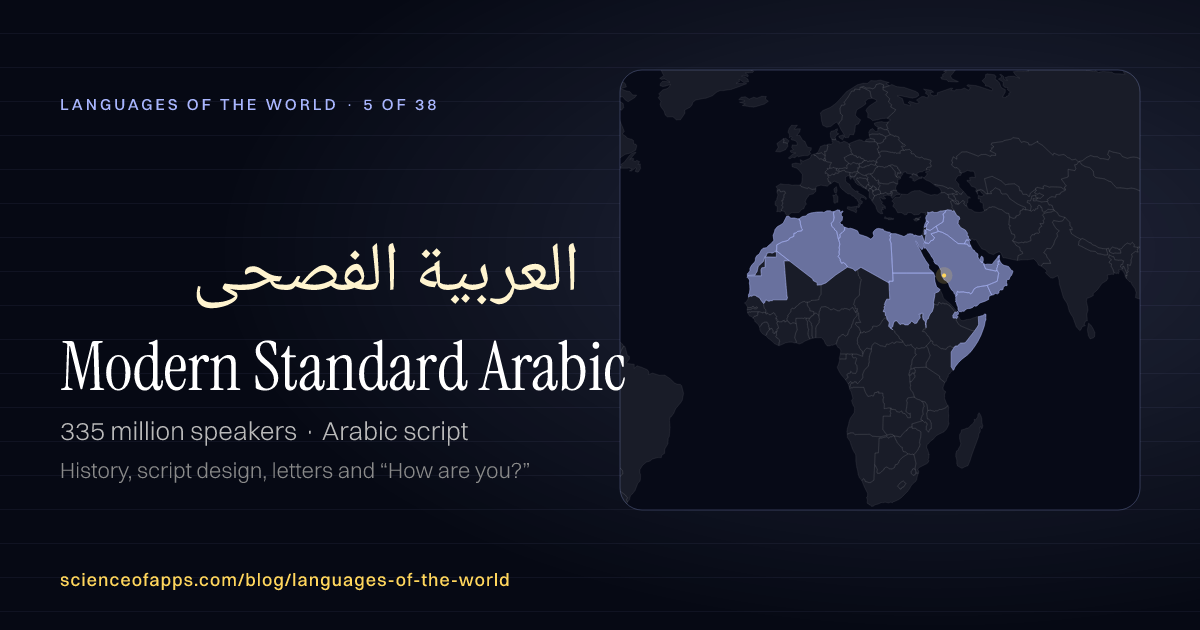
Where Modern Standard Arabic ranks
Modern Standard Arabic is the 5th most-spoken language in the world by total speakers [1,2]. Here it is among its neighbours in the ranking, on one scale.
- 2Mandarin Chinese1.2B
- 3Hindi611M
- 4Spanish561M
- 5Modern Standard Arabic335M
- 6French334M
- 7Bengali274M
- 8Portuguese269M
“How are you?” in Modern Standard Arabic
كيف حالك؟
kayfa ḥāluka?
To a man; to a woman: kayfa ḥāluki?
How are you?
Phrases: Omniglot — Useful phrases in Modern Standard Arabic [10]. Other languages' phrases come from the sources on their own pages. Synthetic voice (ElevenLabs Eleven v3, voice “Sia”). Pronunciation is approximate and may not match a native speaker; Cantonese and Wu Chinese are not voiced because the model reads Chinese characters with Mandarin sounds.
A short history
Arabic is a Semitic language whose classical form is that of the Quran; Modern Standard Arabic is its modern written and formal form, while everyday speech uses regional varieties that can differ widely from each other[3]. Ethnologue lists no first-language speakers of the standard for that reason[2].
The script developed from the Nabataean form of Aramaic[4,5]. On 18 December 1973 the UN General Assembly made Arabic an official language of the United Nations, the date now marked as Arabic Language Day[6].
The design of Arabic script
An abjad: its 28 letters write consonants and long vowels, and short vowels are optional marks above or below. It runs right to left as a cursive in which most letters join their neighbours[8]. It grew out of the Nabataean form of the Aramaic alphabet[4,5].
Abjad (consonants). Letters write consonants; short vowels are optional marks.
- Kind
- Abjad (consonants)
- Direction
- Right to left (numbers left to right)
- Took shape
- By the 6th century CE in the Arabian Peninsula
- Line of descent
- Phoenician → Aramaic → Nabataean → Arabic
- Traditional surface
- Paper
- Own digits
- ٠ ١ ٢ ٣ ٤ ٥ ٦ ٧ ٨ ٩
- Phoenician
- Aramaic
- Nabataean
- Arabic
One letter, four shapes
Most letters change shape depending on whether they stand alone or sit at the start, middle or end of a word, so ه, ـهـ and ـه are one letter[8,9].
Dots tell twins apart
Several letters share one skeleton and differ only in their dots: ب (b), ت (t) and ث (th) are the same stroke with one dot below, two above or three above[5].
Six letters never reach forward
ا, د, ذ, ر, ز and و join the letter before them but never the one after, so many words are written in separate pieces[8].
Calligraphy with a measuring stick
The 10th-century vizier Ibn Muqla is credited with proportioned script: the rhombic dot made by the reed pen became the unit, and the height of alif set the size of every other letter[7].
Nobody's mother tongue
Children grow up speaking Egyptian, Levantine or Gulf Arabic and learn the standard at school, so most Arabic speakers switch between two forms every day — a situation linguists call diglossia[3].
Vowels on demand
Short vowels are usually left unwritten and added as marks only in the Quran, poetry and children's books, where every sound must be exact[8].
Explore the letters
alif (ā)
A single vertical stroke; its height sets the scale in calligraphy
1 / 18 · playing — pick a letter to stop
Numbers in Arabic script
Modern Standard Arabic's relatives among the 38
Modern Standard Arabic belongs to the Afro-Asiatic family (Semitic). These are the other languages with 50 million or more speakers in the same family; the closest — in the same branch — come first.
Modern Standard Arabic across the hub
The main page compares all 38 languages. Each link opens it on Modern Standard Arabic.
- Preview it in the explorer →with all 38 side by side
- Hear it in the voice tour →“How are you?” in every language, spoken in turn
- Trace its script's family tree →from the first alphabets and Chinese oracle bones
- Compare its digits →ten ways to write 0–9
- See its share of speakers →an interactive breakdown by script, family and region
Frequently asked questions
How many people speak Modern Standard Arabic?
About 335 million people speak Modern Standard Arabic: none of them natively — all 335 million learn it as a second language, according to Ethnologue's 2026 figures. That makes it the 5th most-spoken language in the world by total speakers.
What script is Modern Standard Arabic written in?
Modern Standard Arabic is written in the Arabic script, an abjad: letters write consonants; short vowels are optional marks. It runs right to left.
How do you say "How are you?" in Modern Standard Arabic?
In Modern Standard Arabic, "How are you?" is كيف حالك؟ (kayfa ḥāluka?). To a man; to a woman: kayfa ḥāluki?
Where is Modern Standard Arabic spoken?
Modern Standard Arabic is spoken mainly in Saudi Arabia, Egypt, Algeria, Morocco, Tunisia, Libya, Sudan and Iraq and many other countries. It began in the Arabian Peninsula (Hejaz).
How old is the Modern Standard Arabic script?
The Arabic script developed from Nabataean writing by the 6th century CE. Its family line runs Phoenician → Aramaic → Nabataean → Arabic.
Sources
- Ethnologue — What are the top 200 most spoken languages? (2026)
- Wikipedia — List of languages by total number of speakers (Ethnologue 2026 figures, retrieved October 2026)
- Encyclopaedia Britannica — Arabic language
- Omniglot — Nabataean alphabet
- Encyclopaedia Britannica — Alphabet: the Arabic alphabet
- United Nations — Arabic Language Day
- Asian Art Museum, San Francisco — The history of Islamic calligraphy
- The Unicode Standard 17.0, chapter 9: Middle East-I (Arabic)
- Omniglot — Arabic alphabet
- Omniglot — Useful phrases in Modern Standard Arabic
Checked October 25, 2026. Speaker numbers are Ethnologue's 2026 estimates, which count each language separately (Arabic and Chinese varieties are listed one by one). Maps shade whole countries, not regions within them. Found an error? Tell us.
Keep reading
- Career guidesArabic for careers in 2027: where Arabic is used at work, Gulf and global demand, Modern Standard Arabic versus dialects, translation, business and customer roles, pay in India and CEFR levelsArabic for careers in 2027: where Arabic is used at work, Gulf demand, Modern Standard Arabic vs dialects, translation and business roles, pay and CEFR levels.
- Career guidesSwahili for careers in 2027: where Swahili (Kiswahili) is used at work, East African trade, development and NGO roles, tourism and translation, culture and usage, and CEFR levelsSwahili for careers in 2027: East African trade, development and NGO roles, tourism and translation, culture and usage, pay in India and CEFR levels.
- Career guidesGreek for careers in 2027: where Greek is used at work, shipping, tourism and trade, translation, classics and heritage, the Greek alphabet, official certificates and CEFR levelsGreek for careers in 2027: shipping, tourism and trade, translation, classics and heritage, the Greek alphabet, official certificates and CEFR levels.
- Career guidesHebrew for careers in 2027: where Hebrew is used at work, tech, cybersecurity and agritech partnerships, translation, research and tourism, the Hebrew script and CEFR levelsHebrew for careers in 2027: tech, cybersecurity and agritech partnerships, translation, research, tourism, the Hebrew script, pay and CEFR levels.
- HistoryThe world's 38 biggest languages, and the design of how they're writtenAll 38 languages with 50 million+ speakers (Ethnologue 2026): speakers, history, scripts, numerals and 'How are you?' in each — with every figure sourced.
- Career guidesPortuguese for careers in 2027: where Portuguese is used at work, Brazil, Portugal and Africa, Portuguese process jobs in India, translation and teaching, pay in India and CEFR levelsPortuguese for careers in 2027: Brazil, Portugal and Africa, Portuguese process jobs in India, translation and teaching, pay in India and CEFR levels.


Get the ideas, not the noise.
Sign up with Google and we’ll send you short UX psychology tips by email — why people tap, stall and leave, and what to do about it. Unsubscribe anytime. Prefer something to keep? Get the free Laws of UX guide as a PDF.