 By
Quick facts
- Name in Portuguese
- português
- Language family
- Indo-European › Romance
- Writing system
- Latin alphabet — alphabet, left to right
- Where it began
- Northwest Iberia (Galicia and northern Portugal)
- Main countries
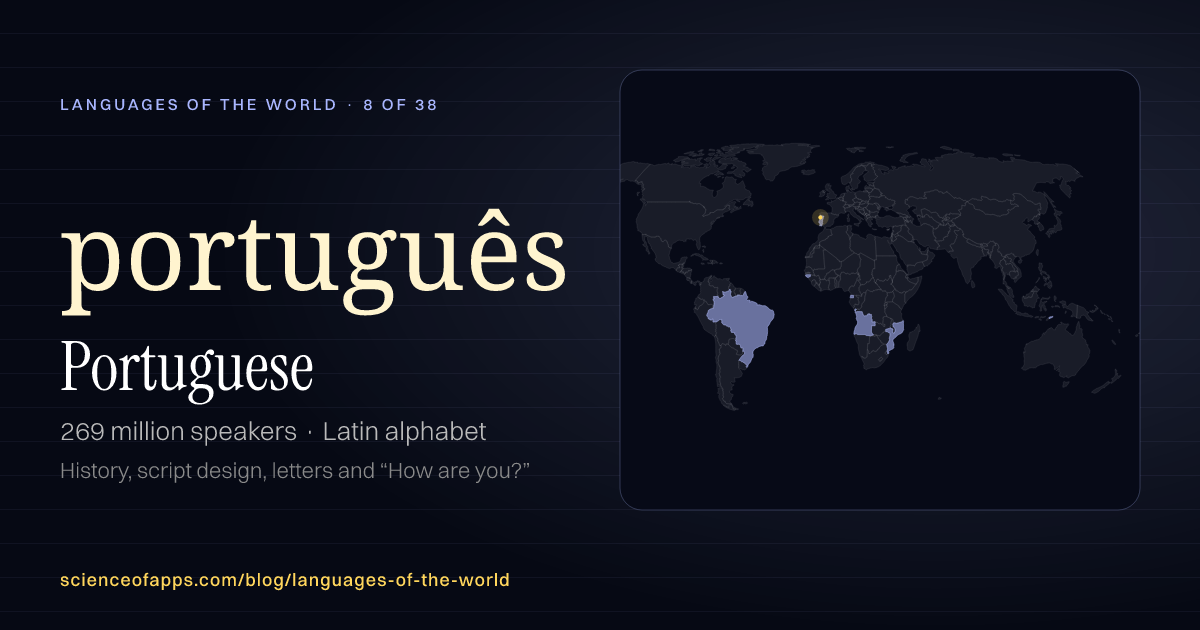
- Portugal, Brazil, Angola, Mozambique, Guinea-Bissau, Timor-Leste, Equatorial Guinea
- ISO 639-3 code
por
Where Portuguese ranks
Portuguese is the 8th most-spoken language in the world by total speakers [1,2]. Here it is among its neighbours in the ranking, on one scale.
- 5Modern Standard Arabic335M
- 6French334M
- 7Bengali274M
- 8Portuguese269M
- 9Indonesian255M
- 10Urdu246M
- 11Russian210M
“How are you?” in Portuguese
Como está?
Formal; informal: Tudo bem?
How are you?
Phrases: Omniglot — Useful phrases in Portuguese [4]. Other languages' phrases come from the sources on their own pages. Synthetic voice (ElevenLabs Eleven v3, voice “Sia”). Pronunciation is approximate and may not match a native speaker; Cantonese and Wu Chinese are not voiced because the model reads Chinese characters with Mandarin sounds.
A short history
Portuguese descends from the Latin of the northwest of the Iberian Peninsula, where it began as one language with Galician, and it spread across the world with Portuguese navigation and empire[3].
Brazil now has by far the most speakers, and its spelling and pronunciation differ from those of Portugal[3].
The design of Latin alphabet
An alphabet: separate letters for consonants and vowels, written left to right. The Romans took it from a Greek alphabet by way of the Etruscans[6], and it is now the most widely used script in the world[7]. Most languages that use it add marks or extra letters for their own sounds[5].
Alphabet. One letter for each consonant and vowel.
- Kind
- Alphabet
- Direction
- Left to right
- Took shape
- By the 7th century BCE in central Italy
- Line of descent
- Egyptian hieroglyphs → Proto-Sinaitic → Phoenician → Greek → Etruscan → Latin
- Traditional surface
- Parchment and vellum
- Own digits
- No — uses the Western 0–9
- Egyptian hieroglyphs
- Proto-Sinaitic
- Phoenician
- Greek
- Etruscan
- Latin
Two alphabets in one
Capitals come from the square capitals the Romans carved in stone[8]; small letters come from Carolingian minuscule, a rounded book hand standardised in Charlemagne's empire in the late 8th century[9]. Writing with both is called case, and software has to know which pairs belong together[5].
Built to be extended
Rather than inventing new letters, most languages bolt marks onto old ones: é, ñ, ç, ş, ọ. Unicode encodes many as single letters and also as a base letter plus a combining mark, so the same word can be stored two ways[5].
Gothic or roman
Through the Middle Ages much of Europe wrote and printed in blackletter. German kept its Fraktur style for everyday print far longer than its neighbours, until the 20th century[10].
Thank you has a gender
Obrigado literally means 'obliged', so it agrees with the speaker: men say obrigado, women obrigada[4].
The nasal tilde
ã and õ mark nasal vowels, as in pão (bread) and põe (puts), a sound Spanish does not have[3,5].
Explore the letters
Portuguese's relatives among the 38
Portuguese belongs to the Indo-European family (Romance). These are the other languages with 50 million or more speakers in the same family; the closest — in the same branch — come first.
- españolSpanishSame branch: Romance · 561M
- françaisFrenchSame branch: Romance · 334M
- italianoItalianSame branch: Romance · 66M
- EnglishEnglishGermanic · 1.5B
- हिन्दीHindiIndo-Aryan · 611M
- বাংলাBengaliIndo-Aryan · 274M
- اُردُوUrduIndo-Aryan · 246M
- русскийRussianBalto-Slavic · 210M
- DeutschGermanGermanic · 133M
- मराठीMarathiIndo-Aryan · 99M
- پنجابیWestern PunjabiIndo-Aryan · 90M
- فارسیPersian (Iranian)Iranian · 82M
- ગુજરાતીGujaratiIndo-Aryan · 62M
- भोजपुरीBhojpuriIndo-Aryan (Bihari) · 53M
Portuguese across the hub
The main page compares all 38 languages. Each link opens it on Portuguese.
- Preview it in the explorer →with all 38 side by side
- Hear it in the voice tour →“How are you?” in every language, spoken in turn
- Trace its script's family tree →from the first alphabets and Chinese oracle bones
- Compare its digits →ten ways to write 0–9
- See its share of speakers →an interactive breakdown by script, family and region
Frequently asked questions
How many people speak Portuguese?
About 269 million people speak Portuguese: 252 million as a first language and 18 million as a second, according to Ethnologue's 2026 figures. That makes it the 8th most-spoken language in the world by total speakers.
What script is Portuguese written in?
Portuguese is written in the Latin alphabet, an alphabet: one letter for each consonant and vowel. It runs left to right.
How do you say "How are you?" in Portuguese?
In Portuguese, "How are you?" is Como está?. Formal; informal: Tudo bem?
Where is Portuguese spoken?
Portuguese is spoken mainly in Portugal, Brazil, Angola, Mozambique, Guinea-Bissau, Timor-Leste and Equatorial Guinea. It began in Northwest Iberia (Galicia and northern Portugal).
How old is the Portuguese script?
The Latin alphabet was in use in central Italy by the 7th century BCE. Its family line runs Egyptian hieroglyphs → Proto-Sinaitic → Phoenician → Greek → Etruscan → Latin.
Sources
- Ethnologue — What are the top 200 most spoken languages? (2026)
- Wikipedia — List of languages by total number of speakers (Ethnologue 2026 figures, retrieved October 2026)
- Encyclopaedia Britannica — Portuguese language
- Omniglot — Useful phrases in Portuguese
- The Unicode Standard 17.0, chapter 7: Europe-I (Latin, Greek, Cyrillic)
- Encyclopaedia Britannica — Alphabet (writing)
- Omniglot — Latin alphabet
- Omniglot — Classical Latin alphabet
- Omniglot — Carolingian minuscule
- Omniglot — Fraktur
- Omniglot — Phoenician alphabet
Checked October 25, 2026. Speaker numbers are Ethnologue's 2026 estimates, which count each language separately (Arabic and Chinese varieties are listed one by one). Maps shade whole countries, not regions within them. Found an error? Tell us.
Keep reading
- Career guidesUX writing for multilingual products in 2027: writing for translation, microcopy patterns, tone across cultures, inclusive and accessible language, and how global product teams hire UX writersUX writing for multilingual products in 2027: writing for translation, microcopy, tone across cultures, inclusive and accessible language, and hiring.
- Career guidesPortuguese for careers in 2027: where Portuguese is used at work, Brazil, Portugal and Africa, Portuguese process jobs in India, translation and teaching, pay in India and CEFR levelsPortuguese for careers in 2027: Brazil, Portugal and Africa, Portuguese process jobs in India, translation and teaching, pay in India and CEFR levels.
- HistoryThe world's 38 biggest languages, and the design of how they're writtenAll 38 languages with 50 million+ speakers (Ethnologue 2026): speakers, history, scripts, numerals and 'How are you?' in each — with every figure sourced.
- Career guidesPunjabi for jobs in 2027: where Punjabi is used at work in Punjab and with the global Punjabi diaspora, the Gurmukhi script, workplace and customer Punjabi, roles that need it, CEFR levels and learningPunjabi for jobs in 2027: where Punjabi is used at work in Punjab and the diaspora, the Gurmukhi script, customer Punjabi, roles, CEFR levels and learning.
- Career guidesInternational SEO skills employers want in 2027: hreflang, site structure for many markets, localisation, multilingual content and Indian languagesInternational SEO skills employers want in 2027: hreflang, ccTLDs vs subfolders, localisation, multilingual keyword research and market launches.
- Career guidesArabic for careers in 2027: where Arabic is used at work, Gulf and global demand, Modern Standard Arabic versus dialects, translation, business and customer roles, pay in India and CEFR levelsArabic for careers in 2027: where Arabic is used at work, Gulf demand, Modern Standard Arabic vs dialects, translation and business roles, pay and CEFR levels.





Get the ideas, not the noise.
Sign up with Google and we’ll send you short UX psychology tips by email — why people tap, stall and leave, and what to do about it. Unsubscribe anytime. Prefer something to keep? Get the free Laws of UX guide as a PDF.