 By
Quick facts
- Name in Japanese
- 日本語 (nihongo)
- Language family
- Japonic › Japanese
- Writing system
- Japanese (kanji, hiragana, katakana) — mixed system, horizontal or vertical
- Where it began
- Yamato (Nara)
- Main countries
- Japan
- ISO 639-3 code
jpn
Where Japanese ranks
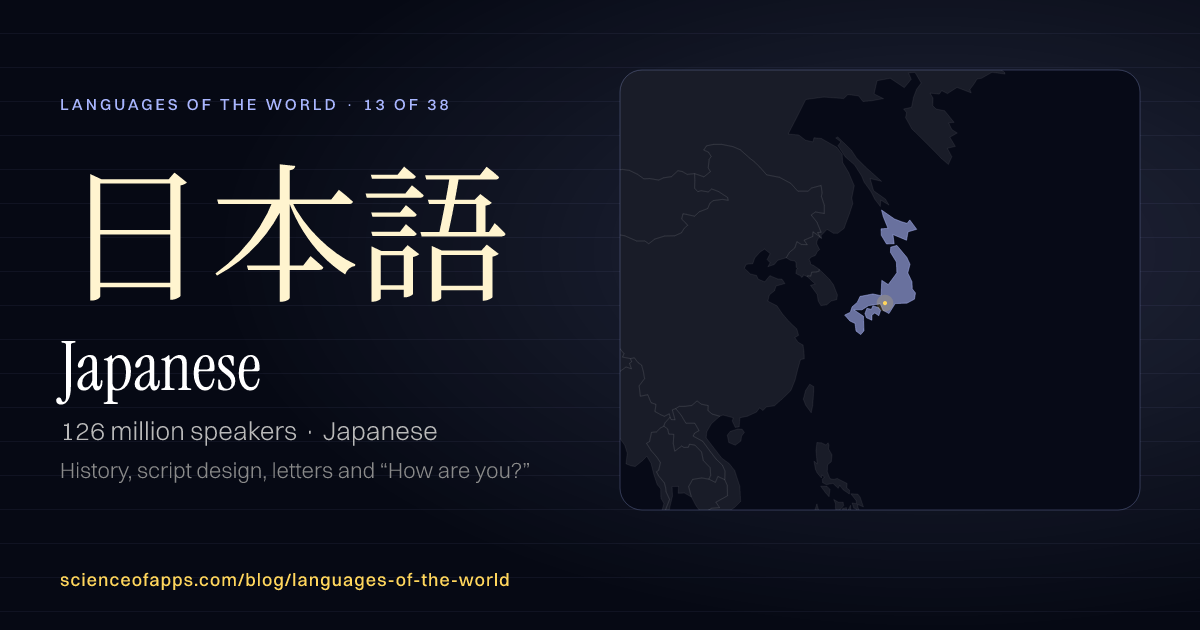
Japanese is the 13th most-spoken language in the world by total speakers [1,2]. Here it is among its neighbours in the ranking, on one scale.
- 10Urdu246M
- 11Russian210M
- 12German133M
- 13Japanese126M
- 14Nigerian Pidgin121M
- 15Egyptian Arabic118M
- 16Marathi99M
“How are you?” in Japanese
お元気ですか?
o-genki desu ka?
How are you?
Phrases: Omniglot — Useful phrases in Japanese [9]. Other languages' phrases come from the sources on their own pages. Synthetic voice (ElevenLabs Eleven v3, voice “Sia”). Pronunciation is approximate and may not match a native speaker; Cantonese and Wu Chinese are not voiced because the model reads Chinese characters with Mandarin sounds.
A short history
Japanese was first written with Chinese characters, used both for their meaning and for their sound; the sound-only usage, man'yōgana, became the source of the two kana syllabaries[3,4].
Hiragana grew from cursive forms of whole characters and katakana from fragments of them[5,6]. Today's official list of characters for everyday use, the jōyō kanji, contains 2,136[7].
The design of Japanese
Japanese mixes three scripts in one sentence: kanji (Chinese characters) for word roots, hiragana for grammar and native words, and katakana for loanwords and emphasis[3]. Both kana syllabaries grew out of Chinese characters used for their sounds[5,6].
Mixed system. Several writing systems are used together in one sentence.
- Kind
- Mixed system
- Direction
- Left to right, or top to bottom in columns
- Took shape
- Kana developed from Chinese characters by the 9th–10th centuries CE
- Line of descent
- Chinese characters → Man'yōgana → Hiragana and katakana
- Traditional surface
- Scrolls
- Own digits
- 〇 一 二 三 四 五 六 七 八 九
- Also writes
- No other language among the 38 is written mainly in Japanese.
- Chinese characters
- Man'yōgana
- Hiragana and katakana
Cursive and fragments
Hiragana are simplified cursive forms of whole Chinese characters; katakana are fragments of characters. あ comes from 安 and ア from part of 阿[5,6].
A list of everyday kanji
Japan's official list of characters for general use, the jōyō kanji, has 2,136 characters[7].
Down or across
Japanese is written vertically in columns from right to left (tategaki) or horizontally from left to right, and many characters change orientation in vertical text[3,8].
Three scripts, one sentence
In 私はコーヒーが好きです (I like coffee), 私 and 好 are kanji, コーヒー (kōhī, from English 'coffee') is katakana, and は, が, き and です are hiragana[3].
Explore the letters
a (hiragana)
From the cursive of 安
1 / 12 · playing — pick a letter to stop
Numbers in Japanese
Japanese's relatives among the 38
Japanese belongs to the Japonic family (Japanese). These are the other languages with 50 million or more speakers in the same family; the closest — in the same branch — come first.
No other language among the 38 belongs to the Japonic family.
Japanese across the hub
The main page compares all 38 languages. Each link opens it on Japanese.
- Preview it in the explorer →with all 38 side by side
- Hear it in the voice tour →“How are you?” in every language, spoken in turn
- Trace its script's family tree →from the first alphabets and Chinese oracle bones
- Compare its digits →ten ways to write 0–9
- See its share of speakers →an interactive breakdown by script, family and region
Frequently asked questions
How many people speak Japanese?
About 126 million people speak Japanese: 124 million as a first language and 2 million as a second, according to Ethnologue's 2026 figures. That makes it the 13th most-spoken language in the world by total speakers.
What script is Japanese written in?
Japanese is written in a mix of kanji, hiragana and katakana, a mixed writing system: several writing systems are used together in one sentence. It runs left to right in lines or top to bottom in columns.
How do you say "How are you?" in Japanese?
In Japanese, "How are you?" is お元気ですか? (o-genki desu ka?).
Where is Japanese spoken?
Japanese is spoken mainly in Japan. It began in Yamato (Nara).
How old is the Japanese script?
Japanese has been written with Chinese characters since at least the 8th century; the kana syllabaries developed by the 9th–10th centuries. Its family line runs Chinese characters → Man'yōgana → Hiragana and katakana.
Sources
- Ethnologue — What are the top 200 most spoken languages? (2026)
- Wikipedia — List of languages by total number of speakers (Ethnologue 2026 figures, retrieved October 2026)
- Omniglot — Japanese writing system
- Encyclopaedia Britannica — Japanese language
- Omniglot — Hiragana
- Omniglot — Katakana
- Omniglot — Kanji
- The Unicode Standard 17.0, chapter 18: East Asia (Han, Hiragana, Katakana, Hangul)
- Omniglot — Useful phrases in Japanese
Checked October 25, 2026. Speaker numbers are Ethnologue's 2026 estimates, which count each language separately (Arabic and Chinese varieties are listed one by one). Maps shade whole countries, not regions within them. Found an error? Tell us.
Keep reading
- HistoryThe world's 38 biggest languages, and the design of how they're writtenAll 38 languages with 50 million+ speakers (Ethnologue 2026): speakers, history, scripts, numerals and 'How are you?' in each — with every figure sourced.
- Career guidesJapanese for careers in 2027: where Japanese is used at work, Japanese companies in India, translation, IT and bridge roles, JLPT levels N5 to N1, pay in India and how to progressJapanese for careers in 2027: Japanese companies in India, translation, IT and bridge roles, JLPT levels N5 to N1, pay in India and how to progress.
- Career guidesJapanese for caregivers and skilled workers in 2027: the Specified Skilled Worker language rules, care communication, body and care vocabulary, safety and workplace rules, daily life in Japan and how to prepareJapanese for caregivers and skilled workers in 2027: SSW language rules, care phrases, body and care vocabulary, safety rules, daily life and how to prepare.
- Career guidesSwahili for careers in 2027: where Swahili (Kiswahili) is used at work, East African trade, development and NGO roles, tourism and translation, culture and usage, and CEFR levelsSwahili for careers in 2027: East African trade, development and NGO roles, tourism and translation, culture and usage, pay in India and CEFR levels.
- Career guidesGreek for careers in 2027: where Greek is used at work, shipping, tourism and trade, translation, classics and heritage, the Greek alphabet, official certificates and CEFR levelsGreek for careers in 2027: shipping, tourism and trade, translation, classics and heritage, the Greek alphabet, official certificates and CEFR levels.
- Career guidesUkrainian for careers in 2027: where Ukrainian is used at work, humanitarian and reconstruction roles, IT, translation and interpretation, Cyrillic script and CEFR levelsUkrainian for careers in 2027: humanitarian and reconstruction roles, IT, translation and interpretation, the Cyrillic script, pay and CEFR levels.





Get the ideas, not the noise.
Sign up with Google and we’ll send you short UX psychology tips by email — why people tap, stall and leave, and what to do about it. Unsubscribe anytime. Prefer something to keep? Get the free Laws of UX guide as a PDF.