Fogg Behavior Model
Also known as B=MAP
A behavior happens when motivation, ability and a prompt come together at the same moment (B = MAP); if one is missing, the behavior doesn't happen.
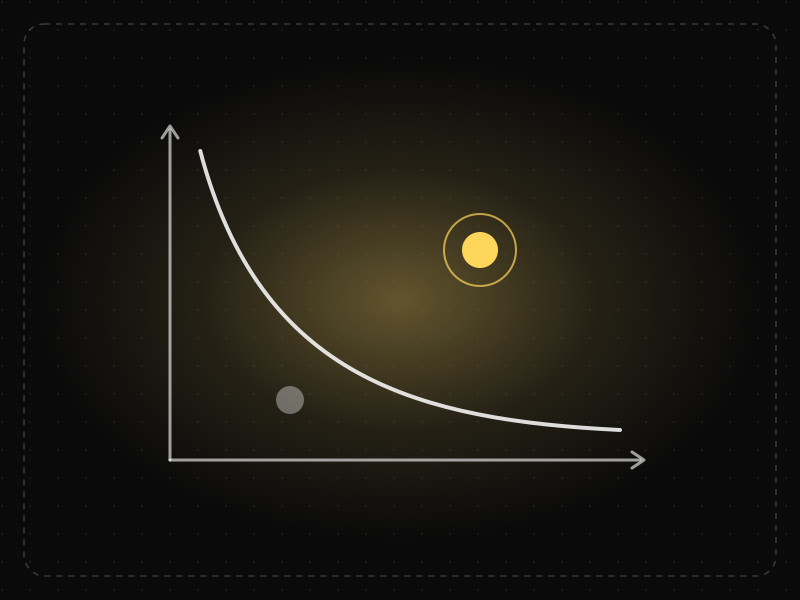
See it in action
The same screen without and with Fogg Behavior Model. Watch both sides play out, then compare the outcome.
Motivated but faced with a hard task, the prompt lands below the action line and fails.
Same motivation, but a one-tap task moves the moment above the line — the prompt now works.
What to watch: the dot crossing the action line when the task becomes easier.
Increase ability first (fewer steps, defaults), then prompt at a moment of motivation.
Fire prompts at people who can't easily act, or try to fix everything with more motivation.
Key takeaways
- When users don't act, ask which is missing: motivation, ability or a prompt.
- Making a behavior easier is usually more reliable than increasing motivation.
- Time prompts for moments when motivation and ability are both high.
Quick facts
- Also known as
- B=MAP
- Described by
- BJ Fogg
- Year
- 2009
- Category
- Motivation & emotion
- Related laws
- Cognitive Load, IKEA Effect, Goal-Gradient Effect
Fogg Behavior Model explained
The Fogg Behavior Model states that a behaviour happens when three elements come together at the same moment: motivation, ability and a prompt. It is often summarised as B = MAP.
If a behaviour is not happening, one of the three is missing. Users may not be motivated enough, the action may be too hard, or there may be no effective prompt at the right time.
Fogg's work suggests that making a behaviour easier is often more reliable than trying to increase motivation, because motivation fluctuates while simplicity is under the designer's control.
Where it comes from
Developed by BJ Fogg, founder of the Behavior Design Lab at Stanford University, and first presented in 2009. He later expanded it in Tiny Habits (2019).
How it shows up in apps
Notifications, onboarding steps and upgrade prompts fail when they arrive at the wrong moment or ask for too much. The model gives a simple diagnosis for why a target behavior isn't happening.
Fogg Behavior Model examples
Instead of prompting new users to invite friends on day one, an app prompts right after they complete a shared task, when motivation is high and inviting takes one tap.
One-tap actions
Making it possible to reorder a previous purchase with one tap increases repeat orders by raising ability, without needing more motivation.
Timely notifications
Fitness apps send reminders at the time users said they want to exercise, prompting action when motivation and ability are likely to be present.
Onboarding small steps
Asking new users to complete one small, easy action first (like following three topics) builds momentum before larger commitments.
How to apply Fogg Behavior Model
- Identify the target behaviour and diagnose which element (motivation, ability or prompt) is missing.
- Make the behaviour as simple as possible: fewer steps, less time, less effort.
- Prompt at moments when users are motivated and able to act.
- Start with tiny behaviours and build up.
- Use motivation boosts sparingly; focus on ability first.
Want Fogg Behavior Model checked in your own product? Our onboarding & activation audit evaluates it alongside the other principles that shape how users decide, onboard and stay.
Common mistakes
- Trying to motivate users to do something that is too hard.
- Sending prompts at times when users cannot act.
- Over-prompting until users ignore or disable notifications.
How to measure it
Track conversion of prompts into actions, completion rates of target behaviours and the effect of reducing steps. Segment results by timing and context to understand when prompts work best.
Frequently asked questions
What is Fogg Behavior Model?
A behavior happens when motivation, ability and a prompt come together at the same moment (B = MAP); if one is missing, the behavior doesn't happen.
Where does Fogg Behavior Model come from?
Developed by BJ Fogg, founder of the Behavior Design Lab at Stanford University, and first presented in 2009. He later expanded it in Tiny Habits (2019).
How does Fogg Behavior Model apply to app design?
Notifications, onboarding steps and upgrade prompts fail when they arrive at the wrong moment or ask for too much. The model gives a simple diagnosis for why a target behavior isn't happening.
What does B = MAP mean?
Behaviour happens when Motivation, Ability and a Prompt converge at the same moment.
Who created the Fogg Behavior Model?
BJ Fogg, a behaviour scientist at Stanford University, introduced the model in 2009.
How do you measure Fogg Behavior Model in a product?
Track conversion of prompts into actions, completion rates of target behaviours and the effect of reducing steps. Segment results by timing and context to understand when prompts work best.
Sources
- Fogg, B. J. (2009). A behavior model for persuasive design. Proceedings of the 4th International Conference on Persuasive Technology. Find on Google Scholar ↗
- Fogg, B. J. (2019). Tiny Habits: The Small Changes That Change Everything. Houghton Mifflin Harcourt. Find on Google Scholar ↗
Related laws
 Memory & attention
Cognitive Load
Cognitive load is the amount of mental effort needed to understand and use an interface; when it exceeds what people can handle, they slow down, make mistakes or give up.
 Motivation & emotion
IKEA Effect
People place disproportionately high value on things they helped create, even when the result isn't perfect.
 Motivation & emotion
Goal-Gradient Effect
People speed up their effort as they get closer to a goal, so visible progress — even artificial head starts — increases completion.
Fogg Behavior Model in practice
- Design historyOld website designs: what Google, Amazon, Yahoo, YouTube and Facebook looked like at launchSee old website designs from the first web page (1991) to Google, Amazon, YouTube and Flipkart at launch, with Wayback Machine links and what each one teaches.
- App marketing & ASOHow to get app reviews and ratings legitimately — timing, prompts and repliesHow to get more app reviews legitimately: ask at the right moment with the official in-app prompts, reply to reviews, fix what users report.
- Architecture & engineeringUNESCO World Heritage Sites in India: all 45, with a map, dates and what makes each one specialIndia has 45 UNESCO World Heritage Sites as of 2026, after Sarnath: 37 cultural, 7 natural, 1 mixed. All of them on one map, with dates and design notes.
- Career guidesUser onboarding and retention skills employers want in 2027: activation and aha moments, onboarding patterns, habit design, churn reduction and win-backUser onboarding and retention skills employers want in 2027: activation, aha moments, onboarding patterns, habit design, cohorts, churn reduction and win-back.
- AI & vibe coding14 copy-paste AI skills for product managers, for ChatGPT, Claude and Gemini14 free copy-paste AI skills for product managers — one-page PRD and user story writer and more — each with an output preview and the exact text to paste.
- How to make an appHow to build an app with AI in one weekendA Friday-to-Sunday plan to build a working app with AI tools — pick the tool, write the brief, prompt in small steps, test with users and check security.






Certifications that test it
- Free certification · UX/UI, Design, Research & CreativeProduct Design CertificationCertifies end-to-end product design: framing problems against business goals, designing and shipping solutions with engineering, and measuring their impact.
- Free certification · UX/UI, Design, Research & CreativeBehavioral Design CertificationCertifies that you can apply behavioral psychology and behavioral economics to product design ethically — motivation, decision architecture, habits and the laws of UX.
- Free certification · Digital Marketing, SEO, AEO & GrowthConversion Rate Optimization (CRO) CertificationCertifies that you can find and fix conversion leaks with evidence — funnel analysis, research, hypothesis design, A/B testing and landing-page and checkout UX.
- Free certification · Product, Project Management & Business AnalysisUser Onboarding & Retention CertificationCertifies that you can turn sign-ups into retained users — activation and aha moments, onboarding patterns, habit and engagement design, and churn reduction and win-back.
- Free certification · Digital Marketing, SEO, AEO & GrowthGrowth Marketing CertificationCertifies that you can grow a product sustainably — acquisition channels and unit economics, lifecycle and retention marketing, growth loops and virality, and experiments and attribution.




Get the ideas, not the noise.
Sign up with Google and we’ll send you short UX psychology tips by email — why people tap, stall and leave, and what to do about it. Unsubscribe anytime. Prefer something to keep? Get the free Laws of UX guide as a PDF.