 By
Quick facts
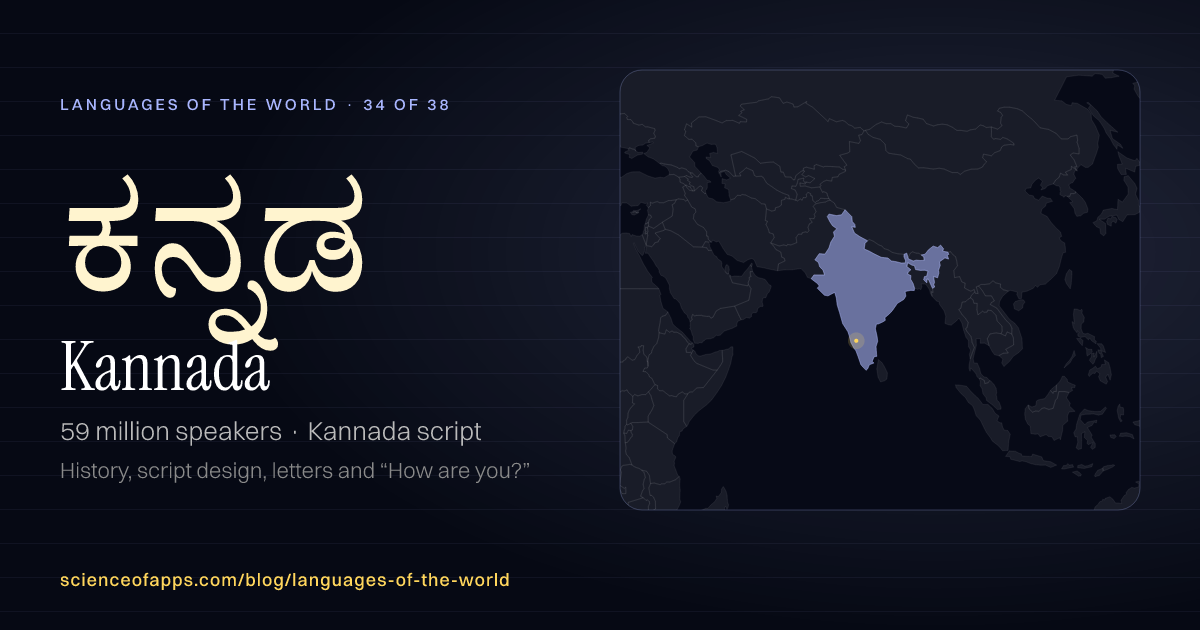
- Name in Kannada
- ಕನ್ನಡ (kannaḍa)
- Language family
- Dravidian › South Dravidian
- Writing system
- Kannada script — abugida (syllabic), left to right
- Where it began
- Karnataka (Halmidi)
- Main countries
- India
- ISO 639-3 code
kan
Where Kannada ranks
Kannada is the 34th most-spoken language in the world by total speakers [1,2]. Here it is among its neighbours in the ranking, on one scale.
- 31Javanese69M
- 32Italian66M
- 33Gujarati62M
- 34Kannada59M
- 35Levantine Arabic58M
- 36Sudanese Arabic54M
- 37Yoruba53M
“How are you?” in Kannada
ಹೇಗಿದ್ದೀರಾ?
hēgiddīrā?
How are you?
Phrases: Omniglot — Useful phrases in Kannada [9]. Other languages' phrases come from the sources on their own pages. Synthetic voice (ElevenLabs Eleven v3, voice “Sia”). Pronunciation is approximate and may not match a native speaker; Cantonese and Wu Chinese are not voiced because the model reads Chinese characters with Mandarin sounds.
A short history
Kannada is a Dravidian language, the official language of Karnataka[3]. The Halmidi inscription, traditionally dated to about 450 CE, is the most cited early Kannada inscription, though scholars place it anywhere from the 5th to the 6th century or later[4].
Kannada and Telugu scripts grew from a common ancestor and still look alike[5,6]. Kannada became a classical language of India on 31 October 2008[7,3].
The design of Kannada script
A Brahmic abugida closely related to Telugu, with rounded letters and a headstroke on many of them[5,8]. The Halmidi inscription, traditionally dated to about 450 CE, is the oldest widely cited Kannada inscription[4].
Abugida (syllabic). Each consonant carries a vowel, changed by marks attached to it.
- Kind
- Abugida (syllabic)
- Direction
- Left to right
- Took shape
- From the Kadamba script; Kannada inscriptions survive from the 5th–6th centuries CE
- Line of descent
- Brahmi → Kadamba → Telugu–Kannada → Kannada
- Traditional surface
- Palm leaves
- Own digits
- ೦ ೧ ೨ ೩ ೪ ೫ ೬ ೭ ೮ ೯
- Also writes
- No other language among the 38 is written mainly in Kannada script.
- Brahmi
- Kadamba
- Telugu–Kannada
- Kannada
Telugu's twin
Kannada and Telugu letters share most of their structure, and a reader of one can often recognise the other's shapes[5].
Vowel signs as attachments
Vowel signs attach to the right of and below consonants, and subscript forms are used for the second consonant in a cluster[8].
Stacked clusters
In a cluster the second consonant is written as a small subscript form under the first, so ಕನ್ನಡ stacks its double n[8].
Explore the letters
a
1 / 15 · playing — pick a letter to stop
Numbers in Kannada script
Kannada's relatives among the 38
Kannada belongs to the Dravidian family (South Dravidian). These are the other languages with 50 million or more speakers in the same family; the closest — in the same branch — come first.
Kannada across the hub
The main page compares all 38 languages. Each link opens it on Kannada.
- Preview it in the explorer →with all 38 side by side
- Hear it in the voice tour →“How are you?” in every language, spoken in turn
- Trace its script's family tree →from the first alphabets and Chinese oracle bones
- Compare its digits →ten ways to write 0–9
- See its share of speakers →an interactive breakdown by script, family and region
Frequently asked questions
How many people speak Kannada?
About 59 million people speak Kannada: 44 million as a first language and 15 million as a second, according to Ethnologue's 2026 figures. That makes it the 34th most-spoken language in the world by total speakers.
What script is Kannada written in?
Kannada is written in the Kannada script, an abugida: each consonant carries a vowel, changed by marks attached to it. It runs left to right.
How do you say "How are you?" in Kannada?
In Kannada, "How are you?" is ಹೇಗಿದ್ದೀರಾ? (hēgiddīrā?).
Where is Kannada spoken?
Kannada is spoken mainly in India. It began in Karnataka (Halmidi).
How old is the Kannada script?
The Kannada script comes from the Kadamba script; Kannada inscriptions survive from the 5th–6th centuries CE. Its family line runs Brahmi → Kadamba → Telugu–Kannada → Kannada.
Sources
- Ethnologue — What are the top 200 most spoken languages? (2026)
- Wikipedia — List of languages by total number of speakers (Ethnologue 2026 figures, retrieved October 2026)
- Encyclopaedia Britannica — Kannada language
- Wikipedia — Halmidi inscription
- Omniglot — Kannada alphabet
- Encyclopaedia Britannica — Telugu language
- Ministry of Culture, Government of India — Status of Classical Language: an explainer (2024)
- The Unicode Standard 17.0, chapter 12: South and Central Asia-I (Devanagari, Bengali, Gujarati, Tamil, Telugu, Kannada)
- Omniglot — Useful phrases in Kannada
Checked October 25, 2026. Speaker numbers are Ethnologue's 2026 estimates, which count each language separately (Arabic and Chinese varieties are listed one by one). Maps shade whole countries, not regions within them. Found an error? Tell us.
Keep reading
- Career guidesKannada for jobs in 2027: where Kannada is used at work in Karnataka and Bengaluru, the Kannada script, workplace and customer Kannada, roles that need it, CEFR levels and learningKannada for jobs in 2027: where Kannada is used at work in Karnataka and Bengaluru, the Kannada script, customer Kannada, roles, CEFR levels and learning.
- HistoryThe world's 38 biggest languages, and the design of how they're writtenAll 38 languages with 50 million+ speakers (Ethnologue 2026): speakers, history, scripts, numerals and 'How are you?' in each — with every figure sourced.
- Career guidesGreek for careers in 2027: where Greek is used at work, shipping, tourism and trade, translation, classics and heritage, the Greek alphabet, official certificates and CEFR levelsGreek for careers in 2027: shipping, tourism and trade, translation, classics and heritage, the Greek alphabet, official certificates and CEFR levels.
- Career guidesThai for careers in 2027: where Thai is used at work, tourism, trade and manufacturing, Thai process roles, the Thai script and tones, pay in India and CEFR levelsThai for careers in 2027: tourism, trade and manufacturing, Thai process roles, the Thai script and tones, pay in India and CEFR levels.
- Career guidesRussian for careers in 2027: where Russian is used at work, translation and interpretation, trade, energy, tourism and diplomacy, the Cyrillic script, pay in India and CEFR levelsRussian for careers in 2027: translation and interpretation, trade, energy, tourism and diplomacy, the Cyrillic script, pay in India and CEFR levels.
- Career guidesMalayalam for jobs in 2027: where Malayalam is used at work in Kerala and with the Kerala diaspora, the Malayalam script, workplace and customer Malayalam, healthcare and Gulf roles, CEFR levels and learningMalayalam for jobs in 2027: where it's used at work in Kerala and the diaspora, the Malayalam script, customer Malayalam, healthcare and Gulf roles, CEFR.




Get the ideas, not the noise.
Sign up with Google and we’ll send you short UX psychology tips by email — why people tap, stall and leave, and what to do about it. Unsubscribe anytime. Prefer something to keep? Get the free Laws of UX guide as a PDF.