 By
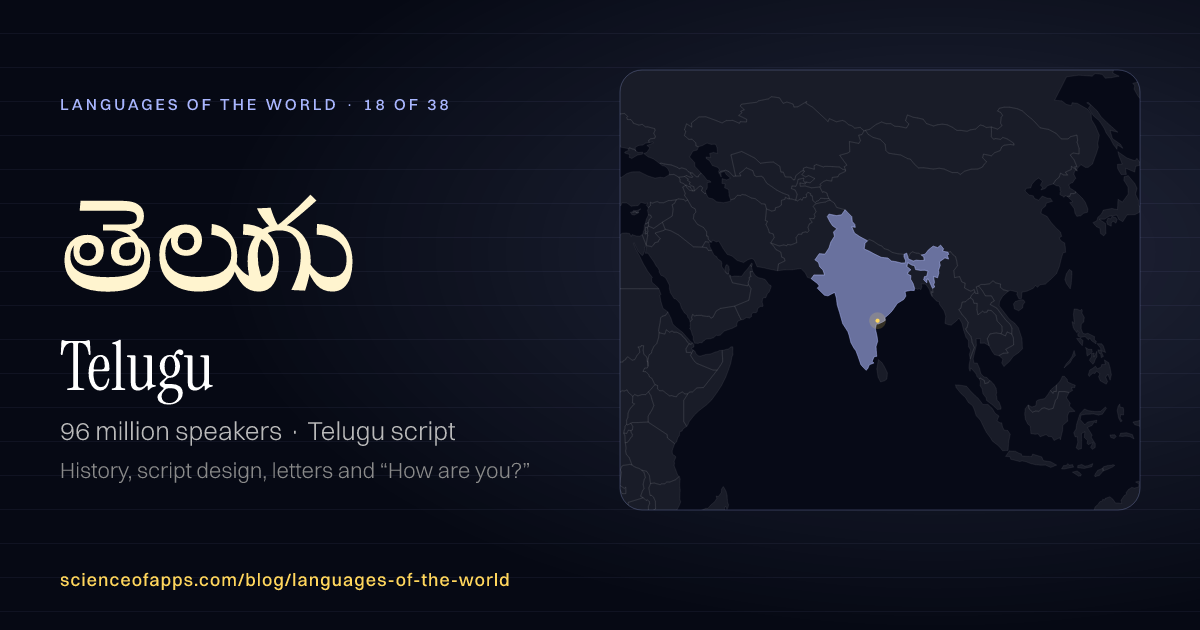
Quick facts
- Name in Telugu
- తెలుగు (telugu)
- Language family
- Dravidian › South-Central Dravidian
- Writing system
- Telugu script — abugida (syllabic), left to right
- Where it began
- The Krishna–Godavari region
- Main countries
- India
- ISO 639-3 code
tel
Where Telugu ranks
Telugu is the 18th most-spoken language in the world by total speakers [1,2]. Here it is among its neighbours in the ranking, on one scale.
- 15Egyptian Arabic118M
- 16Marathi99M
- 17Vietnamese97M
- 18Telugu96M
- 19Swahili95M
- 20Hausa95M
- 21Turkish94M
“How are you?” in Telugu
మీరు ఎలా ఉన్నారు?
mīru elā unnāru?
How are you?
Phrases: Omniglot — Useful phrases in Telugu [10]. Other languages' phrases come from the sources on their own pages. Synthetic voice (ElevenLabs Eleven v3, voice “Sia”). Pronunciation is approximate and may not match a native speaker; Cantonese and Wu Chinese are not voiced because the model reads Chinese characters with Mandarin sounds.
A short history
Telugu is the largest Dravidian language and the official language of Andhra Pradesh and Telangana; its literature begins in the 11th century, and its script derives from that of the 6th-century Chalukya dynasty and is related to Kannada[3].
The oldest long Telugu inscription found so far, at Kalamalla, is dated to about 575 CE, though shorter Telugu labels are much older[4]. Telugu became a classical language of India on 31 October 2008[5].
The design of Telugu script
A Brahmic abugida derived from the script of the 6th-century Chalukya dynasty and closely related to Kannada[3]. Letters are round, and many carry a small tick on top, the talakattu[6].
Abugida (syllabic). Each consonant carries a vowel, changed by marks attached to it.
- Kind
- Abugida (syllabic)
- Direction
- Left to right
- Took shape
- Out of the script of the 6th-century Chalukyas, shared with Kannada
- Line of descent
- Brahmi → Bhattiprolu → Kadamba → Telugu–Kannada → Telugu
- Traditional surface
- Palm leaves
- Own digits
- ౦ ౧ ౨ ౩ ౪ ౫ ౬ ౭ ౮ ౯
- Also writes
- No other language among the 38 is written mainly in Telugu script.
- Brahmi
- Bhattiprolu
- Kadamba
- Telugu–Kannada
- Telugu
Circles and ticks
Telugu letters are built from loops, with a check-mark stroke on top of many consonants, which is removed when a vowel sign takes its place[6,7].
Shaped by leaves?
A widely held explanation for the round letters of South and Southeast Asian scripts is the palm leaf: a stylus pushed along the grain in long straight lines can split the leaf, so curves were safer[8]. It is a plausible hypothesis rather than a proven fact.
Telugu and Kannada, parted
The two scripts share an ancestor and still look alike; they drifted apart over the centuries into today's forms[3,9].
The largest Dravidian language
Telugu has more speakers than any other Dravidian language, Tamil included, and its rounded script is shared in structure with Kannada[3].
Explore the letters
a
1 / 15 · playing — pick a letter to stop
Numbers in Telugu script
Telugu's relatives among the 38
Telugu belongs to the Dravidian family (South-Central Dravidian). These are the other languages with 50 million or more speakers in the same family; the closest — in the same branch — come first.
Telugu across the hub
The main page compares all 38 languages. Each link opens it on Telugu.
- Preview it in the explorer →with all 38 side by side
- Hear it in the voice tour →“How are you?” in every language, spoken in turn
- Trace its script's family tree →from the first alphabets and Chinese oracle bones
- Compare its digits →ten ways to write 0–9
- See its share of speakers →an interactive breakdown by script, family and region
Frequently asked questions
How many people speak Telugu?
About 96 million people speak Telugu: 83 million as a first language and 13 million as a second, according to Ethnologue's 2026 figures. That makes it the 18th most-spoken language in the world by total speakers.
What script is Telugu written in?
Telugu is written in the Telugu script, an abugida: each consonant carries a vowel, changed by marks attached to it. It runs left to right.
How do you say "How are you?" in Telugu?
In Telugu, "How are you?" is మీరు ఎలా ఉన్నారు? (mīru elā unnāru?).
Where is Telugu spoken?
Telugu is spoken mainly in India. It began in the Krishna–Godavari region.
How old is the Telugu script?
The Telugu script descends from the script of the 6th-century Chalukyas, which it shares with Kannada. Its family line runs Brahmi → Bhattiprolu → Kadamba → Telugu–Kannada → Telugu.
Sources
- Ethnologue — What are the top 200 most spoken languages? (2026)
- Wikipedia — List of languages by total number of speakers (Ethnologue 2026 figures, retrieved October 2026)
- Encyclopaedia Britannica — Telugu language
- Epigraphia Indica vol. 27 — Kalamalla inscription of Erikal Mutturaju Dhananjaya
- Ministry of Culture, Government of India — Status of Classical Language: an explainer (2024)
- Omniglot — Telugu alphabet
- The Unicode Standard 17.0, chapter 12: South and Central Asia-I (Devanagari, Bengali, Gujarati, Tamil, Telugu, Kannada)
- Wikipedia — Ola leaf (palm-leaf writing and rounded scripts)
- Omniglot — Kannada alphabet
- Omniglot — Useful phrases in Telugu
Checked October 25, 2026. Speaker numbers are Ethnologue's 2026 estimates, which count each language separately (Arabic and Chinese varieties are listed one by one). Maps shade whole countries, not regions within them. Found an error? Tell us.
Keep reading
- Career guidesTelugu for jobs in 2027: where Telugu is used at work in Andhra Pradesh and Telangana, the Telugu script, workplace and customer Telugu, roles that need it, CEFR levels and learningTelugu for jobs in 2027: where Telugu is used at work in Andhra Pradesh and Telangana, the Telugu script, workplace and customer Telugu, roles and learning.
- Career guidesSanskrit careers in 2027: grammar, vocabulary, reading and translation, Devanagari script and usage, careers in teaching, research, manuscripts and translation, and how to measure your reading levelSanskrit careers in 2027: grammar, vocabulary, reading, translation, Devanagari script, teaching, research, manuscripts and how to measure your level.
- HistoryThe world's 38 biggest languages, and the design of how they're writtenAll 38 languages with 50 million+ speakers (Ethnologue 2026): speakers, history, scripts, numerals and 'How are you?' in each — with every figure sourced.
- Career guidesGreek for careers in 2027: where Greek is used at work, shipping, tourism and trade, translation, classics and heritage, the Greek alphabet, official certificates and CEFR levelsGreek for careers in 2027: shipping, tourism and trade, translation, classics and heritage, the Greek alphabet, official certificates and CEFR levels.
- Career guidesUkrainian for careers in 2027: where Ukrainian is used at work, humanitarian and reconstruction roles, IT, translation and interpretation, Cyrillic script and CEFR levelsUkrainian for careers in 2027: humanitarian and reconstruction roles, IT, translation and interpretation, the Cyrillic script, pay and CEFR levels.
- Career guidesHebrew for careers in 2027: where Hebrew is used at work, tech, cybersecurity and agritech partnerships, translation, research and tourism, the Hebrew script and CEFR levelsHebrew for careers in 2027: tech, cybersecurity and agritech partnerships, translation, research, tourism, the Hebrew script, pay and CEFR levels.





Get the ideas, not the noise.
Sign up with Google and we’ll send you short UX psychology tips by email — why people tap, stall and leave, and what to do about it. Unsubscribe anytime. Prefer something to keep? Get the free Laws of UX guide as a PDF.