Default Effect
Also known as Status quo bias
People tend to stick with the pre-selected option, so defaults strongly shape what most users end up choosing.
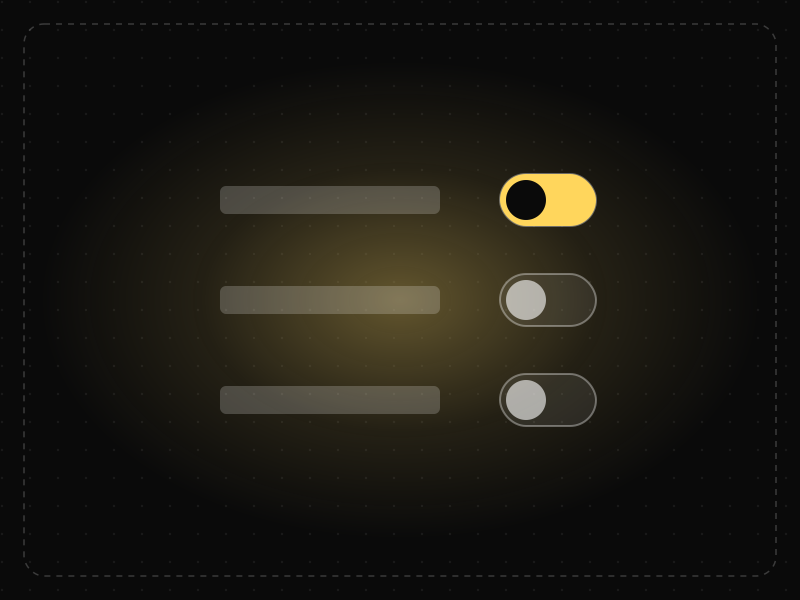
See it in action
The same screen without and with Default Effect. Watch both sides play out, then compare the outcome.
With no default, a quick “Continue” leaves the most important setting off.
The same quick tap now keeps the option that serves most people.
What to watch: the identical tap on Continue — the default decides the outcome.
Pre-select the option that genuinely serves most users, and make changing it effortless.
Use defaults to sneak in add-ons, consent or paid upgrades people didn't ask for.
Key takeaways
- Every default is a design decision — choose the option that's best for most users.
- Pre-select sensible settings to shorten onboarding.
- Never default users into options they wouldn't want, like hidden charges.
Quick facts
- Also known as
- Status quo bias
- Described by
- Eric Johnson & Daniel Goldstein
- Year
- 2003
- Category
- Decision-making
- Related laws
- Choice Overload, Hick's Law, Loss Aversion
Default Effect explained
The default effect describes how people tend to accept pre-selected options. Whatever is set by default is chosen far more often than any alternative, regardless of what that default is.
Defaults work because changing them requires effort, because people assume the default is recommended, and because staying with the status quo feels safer.
This gives product teams great power and responsibility. Thoughtful defaults save users time and lead to better outcomes; self-serving defaults erode trust and may break privacy laws.
Where it comes from
Eric Johnson and Daniel Goldstein's 2003 Science paper 'Do Defaults Save Lives?' showed organ-donor consent rates were far higher in countries where donation was the default (opt-out) than where people had to opt in. Related work on status quo bias dates to Samuelson and Zeckhauser (1988).
How it shows up in apps
Default notification settings, plan selections, privacy options and recommended setups determine behavior for the majority of users who never change them.
Default Effect examples
Defaulting new users to a weekly summary email (with an easy one-tap change) instead of daily alerts reduces unsubscribes and keeps users informed.
Organ donation
A well-known 2003 study by Johnson and Goldstein found that countries with opt-out organ donation had far higher consent rates than countries with opt-in systems.
Notification settings
Most users never change notification defaults, so the default choice effectively determines the experience for the majority.
Annual billing
Pricing pages that default to annual billing see more annual subscriptions, which benefits retention but must be clearly communicated.
How to apply Default Effect
- Set defaults that serve the majority of users and their goals.
- Make defaults visible and easy to change.
- Use privacy-friendly defaults; regulations such as GDPR require privacy by default.
- Test defaults with data and revisit them as user needs change.
- Explain why a default is recommended when it matters.
Want Default Effect checked in your own product? Our saas ux audit evaluates it alongside the other principles that shape how users decide, onboard and stay.
Common mistakes
- Pre-ticking consent boxes for marketing or data sharing.
- Hiding defaults deep in settings so users do not know they exist.
- Choosing defaults that benefit the business at users' expense.
How to measure it
Measure the percentage of users who keep each default and compare outcomes (satisfaction, retention, complaints) across different defaults. A high rate of users changing a default suggests it does not fit their needs.
Frequently asked questions
What is Default Effect?
People tend to stick with the pre-selected option, so defaults strongly shape what most users end up choosing.
Where does Default Effect come from?
Eric Johnson and Daniel Goldstein's 2003 Science paper 'Do Defaults Save Lives?' showed organ-donor consent rates were far higher in countries where donation was the default (opt-out) than where people had to opt in. Related work on status quo bias dates to Samuelson and Zeckhauser (1988).
How does Default Effect apply to app design?
Default notification settings, plan selections, privacy options and recommended setups determine behavior for the majority of users who never change them.
Why are defaults so powerful?
Changing a default takes effort, people infer that defaults are recommended and staying with the status quo feels less risky.
Are pre-selected checkboxes allowed for consent?
Under the EU GDPR and UK GDPR, consent must be given by a clear affirmative act, so pre-ticked boxes are not valid consent.
How do you measure Default Effect in a product?
Measure the percentage of users who keep each default and compare outcomes (satisfaction, retention, complaints) across different defaults. A high rate of users changing a default suggests it does not fit their needs.
Sources
- Johnson, E. J. & Goldstein, D. (2003). Do defaults save lives? Science, 302(5649). Find on Google Scholar ↗
- Samuelson, W. & Zeckhauser, R. (1988). Status quo bias in decision making. Journal of Risk and Uncertainty, 1(1). Find on Google Scholar ↗
Related laws
 Decision-making
Choice Overload
When people face too many options, deciding becomes harder and less satisfying — and they are more likely to choose nothing at all.
 Decision-making
Hick's Law
The time it takes to make a decision increases with the number and complexity of the choices available.
 Decision-making
Loss Aversion
Losses feel more powerful than equivalent gains — in many studies roughly twice as strong — so people work harder to avoid losing something than to gain it.
Default Effect in practice
- Making moneyApp monetization strategies that don't annoy users — designed with behavioural scienceMonetize your app without wrecking retention: value-first paywalls, honest trials, rewarded ads, anchoring and decoy pricing done ethically, and what to avoid.
- Tech explainedApp permissions explained: what each one lets an app see, and which to allowApp permissions explained for Android and iPhone: what camera, location, contacts, SMS and accessibility access allow, which to refuse and how to check them.
- UI/UX designDark patterns examples: 15 tricks apps use on you — and India's rules against them15 dark pattern examples — false urgency, basket sneaking, drip pricing, subscription traps — the psychology behind them and India's 2023 rules.
- Career guidesStrategic decision-making skills employers want in 2027: framing choices, options and criteria, scenarios, reversibility, expected value, pre-mortems and group biasesStrategic decision-making skills for 2027: framing choices, options, criteria, scenarios, reversibility, expected value, pre-mortems and avoiding group bias.
- Career guidesDecision-making skills at work in 2027: framing decisions, setting criteria, weighing options, deciding at the right speed, involving the right people, avoiding bias, committing and learning from decisionsDecision-making skills at work in 2027: framing, criteria, weighing options, right speed, involving people, avoiding bias, committing and learning.
- Career guidesResearch literacy for 2027 careers: reading studies and reports critically, study designs, sample size and bias, correlation vs causation, statistical significance, replication, and using research to make decisionsResearch literacy for 2027 careers: reading studies critically, study designs, samples and bias, correlation vs causation, significance and replication.
Certifications that test it
- Free certification · UX/UI, Design, Research & CreativeProduct Design CertificationCertifies end-to-end product design: framing problems against business goals, designing and shipping solutions with engineering, and measuring their impact.
- Free certification · UX/UI, Design, Research & CreativeDesign Systems CertificationCertifies that you can build, document, govern and scale a design system — tokens, components, documentation, adoption and design–engineering collaboration.
- Free certification · UX/UI, Design, Research & CreativeBehavioral Design CertificationCertifies that you can apply behavioral psychology and behavioral economics to product design ethically — motivation, decision architecture, habits and the laws of UX.
- Free certification · Product, Project Management & Business AnalysisUser Onboarding & Retention CertificationCertifies that you can turn sign-ups into retained users — activation and aha moments, onboarding patterns, habit and engagement design, and churn reduction and win-back.
- Free certification · Digital Marketing, SEO, AEO & GrowthGrowth Marketing CertificationCertifies that you can grow a product sustainably — acquisition channels and unit economics, lifecycle and retention marketing, growth loops and virality, and experiments and attribution.
- Free skill test · 10 minCognitive Bias TestA 10-minute test of cognitive biases: how anchoring, loss aversion, defaults, decoys and framing shape users' choices, and how confirmation bias, sunk costs and the planning fallacy distort team decisions.



Get the ideas, not the noise.
Sign up with Google and we’ll send you short UX psychology tips by email — why people tap, stall and leave, and what to do about it. Unsubscribe anytime. Prefer something to keep? Get the free Laws of UX guide as a PDF.