Hyperbolic Discounting
Also known as Present bias
People prefer smaller rewards now over larger rewards later, and this preference is strongest for rewards that are immediate.
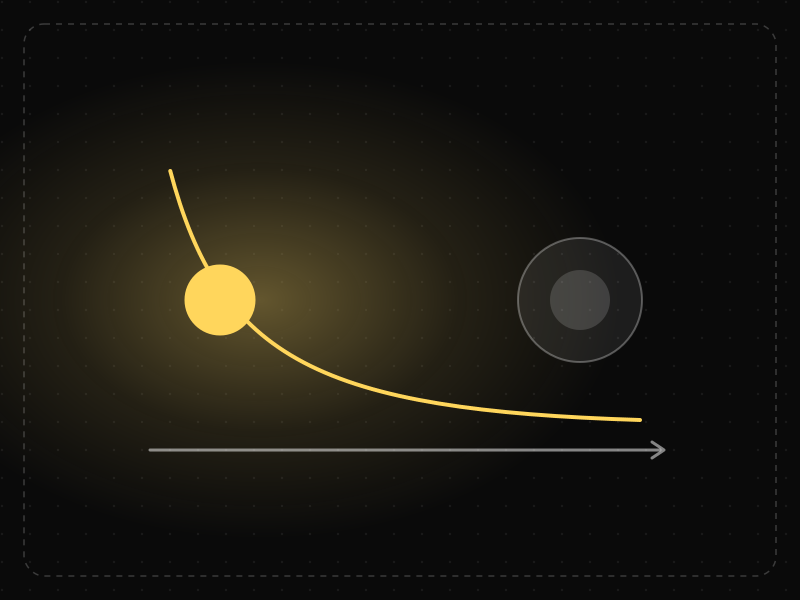
See it in action
The same screen without and with Hyperbolic Discounting. Watch both sides play out, then compare the outcome.
A big but distant payoff is discounted steeply — “Later” wins.
An immediate, concrete win bridges the gap to the long-term benefit — and people act now.
What to watch: the same feature; only when the reward arrives changes the tap.
Pair long-term benefits with an immediate payoff and make the first step tiny.
Sell only future benefits, or exploit present bias with “pay later” traps.
Key takeaways
- Deliver value immediately rather than asking users to wait.
- Make long-term benefits feel concrete and close.
- Reduce upfront costs that delay the reward.
Quick facts
- Also known as
- Present bias
- Described by
- George Ainslie
- Year
- 1975
- Category
- Decision-making
- Related laws
- Goal-Gradient Effect, Loss Aversion, Fogg Behavior Model
Hyperbolic Discounting explained
Hyperbolic discounting means that the value of a reward drops sharply as it moves into the future, especially in the near term. Waiting one day for a reward feels much worse than waiting from day 30 to day 31.
This is why people choose to watch one more episode instead of sleeping, or skip setting up backups because the benefit is far away.
Product design can work with this bias by delivering immediate rewards and making future benefits feel closer and more concrete.
Where it comes from
Economists and psychologists including George Ainslie and Richard Thaler studied hyperbolic discounting in the 1970s and 1980s, showing that people discount future rewards more steeply in the near term than standard economic models predict.
How it shows up in apps
Users abandon onboarding that delays value, ignore long-term benefits like better security and prefer instant gratification. Apps that show immediate results and make future benefits tangible keep people engaged.
Hyperbolic Discounting examples
A budgeting app shows new users how much they could save this month right after connecting their bank, instead of asking them to wait for a monthly report. The immediate insight keeps them using the app.
Instant value in onboarding
Apps that let users accomplish something meaningful in the first minute retain more users than those that require long setup before any reward.
Fitness progress
Fitness apps show immediate feedback such as calories burned or streak progress, compensating for the long wait for physical results.
Buy now, pay later
Payment options that let shoppers receive goods immediately and pay later appeal to present bias, which is why clear information about costs is essential.
How to apply Hyperbolic Discounting
- Deliver a quick win early in every journey.
- Show immediate feedback and progress for long-term goals.
- Make future benefits concrete and personal.
- Reduce upfront effort and cost.
- Help users commit in advance to long-term goals.
Want Hyperbolic Discounting checked in your own product? Our onboarding & activation audit evaluates it alongside the other principles that shape how users decide, onboard and stay.
Common mistakes
- Asking for heavy setup before users see value.
- Relying on abstract long-term benefits to motivate behaviour.
- Exploiting present bias in ways that harm users, such as hidden fees in deferred payments.
How to measure it
Track time to first value and its correlation with retention. Test immediate rewards and quick wins in onboarding and measure activation and long-term engagement.
Frequently asked questions
What is Hyperbolic Discounting?
People prefer smaller rewards now over larger rewards later, and this preference is strongest for rewards that are immediate.
Where does Hyperbolic Discounting come from?
Economists and psychologists including George Ainslie and Richard Thaler studied hyperbolic discounting in the 1970s and 1980s, showing that people discount future rewards more steeply in the near term than standard economic models predict.
How does Hyperbolic Discounting apply to app design?
Users abandon onboarding that delays value, ignore long-term benefits like better security and prefer instant gratification. Apps that show immediate results and make future benefits tangible keep people engaged.
What is the difference between hyperbolic and exponential discounting?
Exponential discounting assumes a constant rate of devaluation over time. Hyperbolic discounting reflects how people devalue rewards much more steeply in the near term.
How can apps counter present bias?
By giving immediate rewards, making future benefits concrete and helping users commit in advance.
How do you measure Hyperbolic Discounting in a product?
Track time to first value and its correlation with retention. Test immediate rewards and quick wins in onboarding and measure activation and long-term engagement.
Sources
- Ainslie, G. (1975). Specious reward: A behavioral theory of impulsiveness and impulse control. Psychological Bulletin, 82(4). Find on Google Scholar ↗
- Thaler, R. (1981). Some empirical evidence on dynamic inconsistency. Economics Letters, 8(3). Find on Google Scholar ↗
Related laws
 Motivation & emotion
Goal-Gradient Effect
People speed up their effort as they get closer to a goal, so visible progress — even artificial head starts — increases completion.
 Decision-making
Loss Aversion
Losses feel more powerful than equivalent gains — in many studies roughly twice as strong — so people work harder to avoid losing something than to gain it.
 Motivation & emotion
Fogg Behavior Model
A behavior happens when motivation, ability and a prompt come together at the same moment (B = MAP); if one is missing, the behavior doesn't happen.
Hyperbolic Discounting in practice
- Product managementWhat is a product roadmap? Types, examples and a free templateWhat a product roadmap is, the main formats (now–next–later, outcome-based, timeline), examples, a free template and how to present one honestly.
- Career guidesDecision-making skills at work in 2027: framing decisions, setting criteria, weighing options, deciding at the right speed, involving the right people, avoiding bias, committing and learning from decisionsDecision-making skills at work in 2027: framing, criteria, weighing options, right speed, involving people, avoiding bias, committing and learning.
- Making moneyApp monetization strategies that don't annoy users — designed with behavioural scienceMonetize your app without wrecking retention: value-first paywalls, honest trials, rewarded ads, anchoring and decoy pricing done ethically, and what to avoid.
- Making moneySubscription vs one-time purchase: which makes more money for your app?Subscription vs one-time purchase for apps: lifetime value maths, when each wins, hybrid models, store fees and what Indian users prefer.
- Career guidesResearch literacy for 2027 careers: reading studies and reports critically, study designs, sample size and bias, correlation vs causation, statistical significance, replication, and using research to make decisionsResearch literacy for 2027 careers: reading studies critically, study designs, samples and bias, correlation vs causation, significance and replication.
- Career guidesProduct design science in 2027: how designers, PMs and founders use the laws of UX and behavioural science to make product decisions employers trustProduct design science in 2027: how designers, PMs, founders and marketers use the laws of UX and behavioural science to make better product decisions.
Certifications that test it
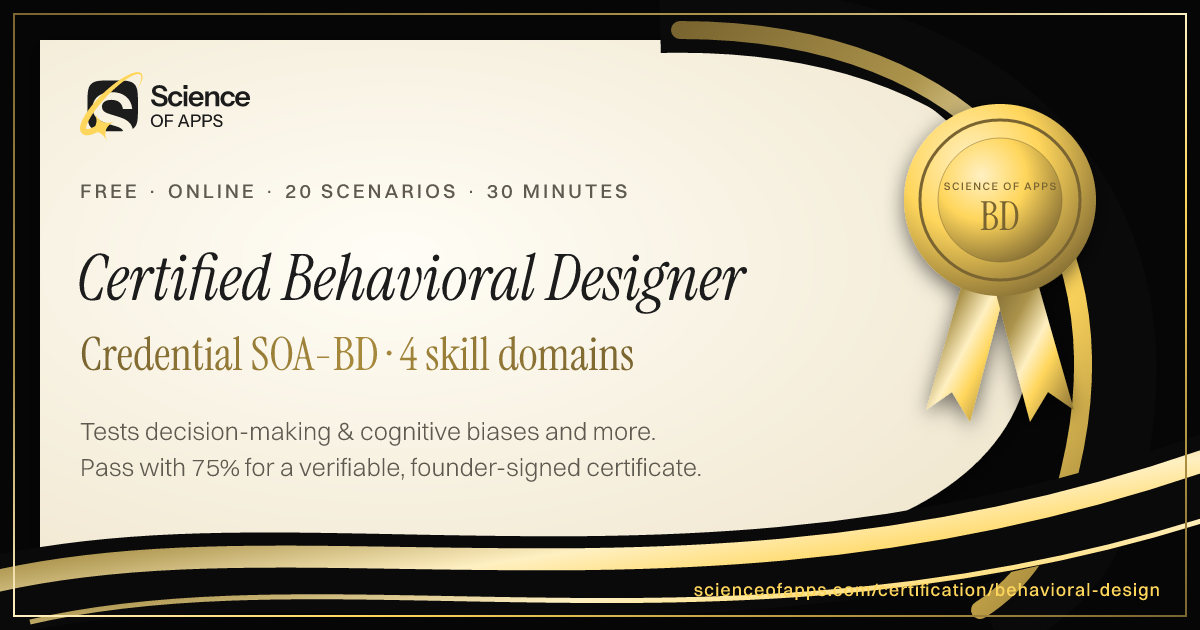
- Free certification · UX/UI, Design, Research & CreativeBehavioral Design CertificationCertifies that you can apply behavioral psychology and behavioral economics to product design ethically — motivation, decision architecture, habits and the laws of UX.
- Free certification · Digital Marketing, SEO, AEO & GrowthConversion Rate Optimization (CRO) CertificationCertifies that you can find and fix conversion leaks with evidence — funnel analysis, research, hypothesis design, A/B testing and landing-page and checkout UX.

Get the ideas, not the noise.
Sign up with Google and we’ll send you short UX psychology tips by email — why people tap, stall and leave, and what to do about it. Unsubscribe anytime. Prefer something to keep? Get the free Laws of UX guide as a PDF.