Scarcity Effect
People value things more when they seem rare, limited or about to become unavailable.
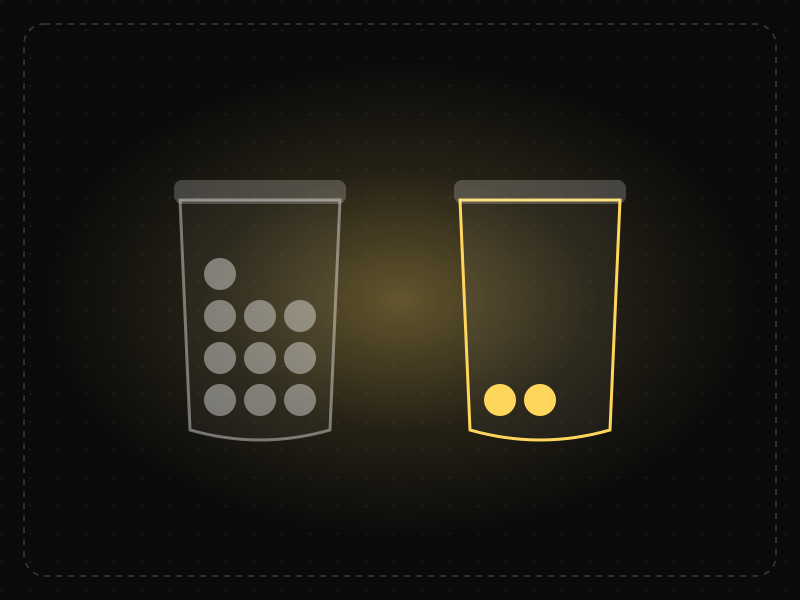
See it in action
The same screen without and with Scarcity Effect. Watch both sides play out, then compare the outcome.
Nothing suggests the room might go, so people keep browsing — and often lose it.
Knowing only two rooms remain at this price, people decide instead of postponing.
What to watch: one true availability cue changes the decision from “later” to “now”.
Surface genuine limits — real stock, real deadlines, real capacity.
Fake countdowns, invented stock levels or “offers” that reset on reload.
Key takeaways
- Genuine limits — time, seats, stock — increase perceived value.
- Use scarcity only when it's true; fake countdowns are a dark pattern.
- Combine with clear information so urgency doesn't cause regret.
Quick facts
- Also known as
- —
- Described by
- Stephen Worchel, Jerry Lee & Akanbi Adewole
- Year
- 1975
- Category
- Decision-making
- Related laws
- Loss Aversion, Social Proof, Framing Effect
Scarcity Effect explained
The scarcity effect describes how people value things more when they appear limited in quantity or time. Scarcity signals that something is in demand and creates a fear of missing out.
Scarcity can be about stock ('only 2 left'), time ('offer ends tonight') or access ('invite only'). Each makes people act faster and value the item more.
Real scarcity helps people make timely decisions. Fake scarcity, such as countdown timers that reset or false stock warnings, is a dark pattern and is targeted by consumer regulators.
Where it comes from
Stephen Worchel, Jerry Lee and Akanbi Adewole's 1975 'cookie jar' study found that identical cookies were rated more desirable when taken from a jar holding two cookies than from a jar holding ten. Robert Cialdini included scarcity among his principles of influence.
How it shows up in apps
Limited-time offers, early-access invites and limited spots for events or cohorts create urgency that moves undecided users to act.
Scarcity Effect examples
A course app shows 'Cohort starts Monday — enrollment closes Friday', a real deadline that prompts users to commit.
Low stock indicators
Travel and retail sites show when only a few seats, rooms or items remain, helping customers understand that waiting might mean missing out.
Limited-time offers
Seasonal discounts with a genuine end date encourage customers to decide rather than postpone indefinitely.
Waitlists and invite-only access
New products sometimes launch with limited access, which can increase perceived value and demand.
How to apply Scarcity Effect
- Communicate genuine limits on availability or time clearly.
- Use scarcity to help users make timely decisions, not to pressure them.
- Be specific and accurate about stock levels and deadlines.
- Avoid fake timers and false scarcity.
- Combine scarcity with clear information so users can decide confidently.
Want Scarcity Effect checked in your own product? Our saas ux audit evaluates it alongside the other principles that shape how users decide, onboard and stay.
Common mistakes
- Countdown timers that reset when the page reloads.
- Exaggerated stock warnings that are not true.
- Overusing urgency messages so users stop believing them.
How to measure it
Test scarcity messaging and measure conversion, but also track returns, refunds, complaints and trust survey results to catch negative effects.
Frequently asked questions
What is Scarcity Effect?
People value things more when they seem rare, limited or about to become unavailable.
Where does Scarcity Effect come from?
Stephen Worchel, Jerry Lee and Akanbi Adewole's 1975 'cookie jar' study found that identical cookies were rated more desirable when taken from a jar holding two cookies than from a jar holding ten. Robert Cialdini included scarcity among his principles of influence.
How does Scarcity Effect apply to app design?
Limited-time offers, early-access invites and limited spots for events or cohorts create urgency that moves undecided users to act.
What is a famous scarcity study?
In a 1975 study by Worchel, Lee and Adewole, people rated cookies from a jar with only two cookies as more desirable than identical cookies from a jar with ten.
Is using scarcity in UX ethical?
It is ethical when the scarcity is real and clearly communicated. Fake scarcity is a deceptive dark pattern and can breach consumer protection laws.
How do you measure Scarcity Effect in a product?
Test scarcity messaging and measure conversion, but also track returns, refunds, complaints and trust survey results to catch negative effects.
Sources
- Worchel, S., Lee, J. & Adewole, A. (1975). Effects of supply and demand on ratings of object value. Journal of Personality and Social Psychology, 32(5). Find on Google Scholar ↗
- Cialdini, R. B. (1984). Influence: The Psychology of Persuasion. William Morrow. Find on Google Scholar ↗
Related laws
 Decision-making
Loss Aversion
Losses feel more powerful than equivalent gains — in many studies roughly twice as strong — so people work harder to avoid losing something than to gain it.
 Decision-making
Social Proof
When people are uncertain, they look to what others like them are doing to decide what's right.
 Decision-making
Framing Effect
The same information leads to different decisions depending on how it is presented — for example, as a gain or as a loss.
Scarcity Effect in practice
- Making moneyApp monetization strategies that don't annoy users — designed with behavioural scienceMonetize your app without wrecking retention: value-first paywalls, honest trials, rewarded ads, anchoring and decoy pricing done ethically, and what to avoid.
- Career guidesProduct design science in 2027: how designers, PMs and founders use the laws of UX and behavioural science to make product decisions employers trustProduct design science in 2027: how designers, PMs, founders and marketers use the laws of UX and behavioural science to make better product decisions.
- Career guidesUX psychology skills employers want in 2027: attention, memory, perception, decision-making and how designers apply them without manipulationUX psychology skills employers want in 2027: attention, memory, perception, decision-making, Hick's and Fitts's laws, cognitive load and ethics.
- Career guidesCognitive bias at work in 2027: anchoring, availability, confirmation bias, overconfidence, sunk cost and groupthink, how they distort hiring, forecasts and decisions, and practical ways to reduce themCognitive bias at work in 2027: anchoring, availability, confirmation bias, overconfidence, sunk cost, groupthink and practical debiasing habits.
- Career guidesBusiness decision-making under uncertainty for 2027: framing decisions, reversible vs irreversible choices, expected value, scenarios and sensitivity, premortems, decision trees, deciding with 70% of the information and learning from outcomesBusiness decision-making under uncertainty in 2027: framing, reversible choices, expected value, scenarios, premortems, decision trees and learning.
- Career guidesStrategic decision-making skills employers want in 2027: framing choices, options and criteria, scenarios, reversibility, expected value, pre-mortems and group biasesStrategic decision-making skills for 2027: framing choices, options, criteria, scenarios, reversibility, expected value, pre-mortems and avoiding group bias.
Certifications that test it
Get the ideas, not the noise.
Sign up with Google and we’ll send you short UX psychology tips by email — why people tap, stall and leave, and what to do about it. Unsubscribe anytime. Prefer something to keep? Get the free Laws of UX guide as a PDF.