 By
Quick answer: What are the Seven Wonders of the World?
- Ancient seven — Great Pyramid, Hanging Gardens, Statue of Zeus, Temple of Artemis, Mausoleum at Halicarnassus, Colossus of Rhodes, Lighthouse of Alexandria.
- Only one survives — the Great Pyramid of Giza, built around 2560 BCE, was already about 2,000 years old when the list was written.
- New Seven (2007) — Great Wall of China, Petra, Christ the Redeemer, Machu Picchu, Chichén Itzá, the Colosseum and the Taj Mahal.
- Who chose them — the ancient list came from Greek writers; the new one from a public vote organised by a Swiss foundation, not by UNESCO.
- India's wonder — the Taj Mahal, built for Shah Jahan between 1631 and 1648, is the only one in South Asia.
Key takeaways
- The ancient list was a Greek traveller's guide to the Mediterranean world around the 2nd century BCE, not a global ranking.
- Most ancient wonders were destroyed by earthquakes, fire or reuse of their stone, not by neglect alone.
- The Hanging Gardens may never have existed in Babylon; no Babylonian text mentions them.
- The 2007 'New Seven Wonders' were chosen by a popular vote; UNESCO was not involved and does not recognise the list.
- Each wonder solved a hard engineering problem with the materials of its age: limestone, bronze, marble, concrete, adobe or granite.
Around the 2nd century BCE, Greek writers drew up lists of theamata, "things to be seen": the sights a well-travelled person of the Mediterranean world should visit. The version that stuck named seven. By the time Renaissance artists drew them, six had already gone. In 2007, a Swiss foundation asked the world to vote on a new seven, and India's Taj Mahal made the list. This guide covers all fourteen: who built them, when, how they were engineered with the tools of their time, and what you can still see.

The Seven Wonders at a glance
Fourteen structures across two lists, three continents and more than 4,000 years of building.
| Wonder | Built | Where | Status |
|---|---|---|---|
| Great Pyramid of Giza | c. 2560 BCE | Giza, Egypt | Standing |
| Hanging Gardens of Babylon | c. 600 BCE (if real) | Babylon, Iraq | Lost; existence debated |
| Temple of Artemis | c. 550 BCE, rebuilt after 356 BCE | Ephesus, Turkey | Ruins (one re-erected column) |
| Statue of Zeus | c. 435 BCE | Olympia, Greece | Lost (5th century CE) |
| Mausoleum at Halicarnassus | c. 350 BCE | Bodrum, Turkey | Ruins; stones in Bodrum Castle |
| Colossus of Rhodes | c. 280 BCE | Rhodes, Greece | Fell in 226 BCE |
| Lighthouse of Alexandria | c. 280 BCE | Alexandria, Egypt | Lost; earthquakes, 14th century |
| Great Wall of China | 7th century BCE–1644 CE | Northern China | Standing (largely Ming) |
| Petra (Al-Khazneh) | c. 1st century CE | Jordan | Standing |
| Colosseum | 70–80 CE | Rome, Italy | Standing, partly ruined |
| Chichén Itzá (El Castillo) | c. 9th–12th century | Yucatán, Mexico | Standing |
| Machu Picchu | c. 1450 | Peru | Standing |
| Taj Mahal | 1631–1648 | Agra, India | Standing |
| Christ the Redeemer | 1922–1931 | Rio de Janeiro, Brazil | Standing |
Table: The ancient and new Seven Wonders, with dates and current status (UNESCO and historical sources)
- Ancient wonders still standing
- 1 of 7
- The Great Pyramid, oldest of all
- c. 2560 BCE
- Great Pyramid's original height
- 146.6 m
- New Seven Wonders announced in Lisbon
- 7 July 2007
The ancient Seven Wonders
The ancient Seven Wonders: a Mediterranean travel list

- Great Pyramid of Giza Giza, Egypt · standing
- Hanging Gardens of Babylon Babylon, Iraq · lost
- Statue of Zeus Olympia, Greece · lost
- Temple of Artemis Ephesus, Turkey · ruins
- Mausoleum at Halicarnassus Bodrum, Turkey · ruins
- Colossus of Rhodes Rhodes, Greece · fell 226 BCE
- Lighthouse of Alexandria Alexandria, Egypt · lost
Great Pyramid of Giza (c. 2560 BCE)
The Great Pyramid was built for the pharaoh Khufu of Egypt's Fourth Dynasty around 2560 BCE, traditionally under his vizier Hemiunu. It rose about 146.6 metres from some 2.3 million limestone blocks and was the tallest human-made structure on Earth for around 3,800 years. Its sides are aligned to the cardinal directions with remarkable precision, and its smooth outer casing of white Tura limestone, now mostly gone, would have made it shine. UNESCO lists it within the "Memphis and its Necropolis" World Heritage Site1.


Hanging Gardens of Babylon (c. 600 BCE?)
The gardens were said to have been built by Nebuchadnezzar II for his wife, terraces of trees and plants watered by machinery lifting water from the Euphrates. The problem is evidence: Greek and Roman accounts were written centuries later, no Babylonian text mentions the gardens, and excavations have not found clear remains. The Oxford Assyriologist Stephanie Dalley has argued that they were real but at Nineveh, built by the Assyrian king Sennacherib, whose inscriptions do describe gardens and a water-raising screw.
Statue of Zeus at Olympia (c. 435 BCE)
The sculptor Phidias made a seated Zeus about 12 metres tall for the temple at Olympia, of ivory over a wooden frame with gold drapery, a technique called chryselephantine. Archaeologists found Phidias's workshop at Olympia, including clay moulds and a cup inscribed with his name. The statue was lost in the 5th century CE, possibly in a fire after being moved to Constantinople.
Temple of Artemis at Ephesus (c. 550 BCE)
The temple, funded in part by King Croesus of Lydia, was one of the first great marble temples, with more than 100 columns. A man named Herostratus burned it in 356 BCE to make himself famous; it was rebuilt on the same scale, damaged by raiders in the 3rd century CE and later quarried for stone. Today a single column has been re-erected from fragments on the marshy site.
Mausoleum at Halicarnassus (c. 350 BCE)
The tomb of Mausolus, a Persian satrap of Caria, was so famous that his name gave us the word mausoleum. Designed by the Greek architects Satyros and Pytheos, it stood about 45 metres tall, a temple-like building on a high base topped by a stepped pyramid and a chariot sculpture. Earthquakes damaged it, and from 1494 the Knights of St John used its stones to build Bodrum Castle, where pieces can still be seen.
Colossus of Rhodes (c. 280 BCE)
After surviving a siege, the people of Rhodes commissioned Chares of Lindos to cast a bronze statue of the sun god Helios, about 33 metres high, the height of a ten-storey building. It took around 12 years and stood for only about 54 before an earthquake in 226 BCE broke it at the knees. The famous image of it straddling the harbour comes from later artists; ancient bronze casting could not have supported that pose.
Lighthouse of Alexandria (c. 280 BCE)
Built on the island of Pharos under the Ptolemies and credited to Sostratus of Cnidus, the lighthouse was a three-stage tower, square, then octagonal, then cylindrical, estimated at about 100 metres or more. A fire at the top, reflected by mirrors according to later accounts, guided ships into one of the busiest ports in the world. Earthquakes in the 14th century brought it down, and in 1477 the Mamluk sultan Qaitbay built a fort from its stones on the same spot.
How 16th-century artists imagined the lost wonders (Philips Galle after Maarten van Heemskerck, 1572)


The New Seven Wonders (2007)
The New Seven Wonders were chosen by a public vote run by the Swiss-based New7Wonders Foundation, founded by Bernard Weber, and announced in Lisbon on 7 July 20079. The organisers reported about 100 million votes cast online and by phone. UNESCO took no part; it said the campaign could not be compared with the scientific process behind its World Heritage List. The Great Pyramid was given honorary status as the only surviving ancient wonder.
The New Seven Wonders, and the surviving ancient one

- Great Wall of China China · largely Ming, 1368–1644
- Petra Jordan · c. 1st century CE
- Christ the Redeemer Rio de Janeiro · 1931
- Machu Picchu Peru · c. 1450
- Chichén Itzá Mexico · 9th–12th century
- Colosseum Rome · 80 CE
- Taj Mahal Agra, India · 1631–1648
- Great Pyramid (honorary) Giza, Egypt · c. 2560 BCE
Great Wall of China (7th century BCE–1644 CE)
The Great Wall is not one wall but many, built and rebuilt by different states and dynasties over about 2,000 years to defend against northern peoples. The brick-and-stone sections most visitors see, such as Badaling and Mutianyu near Beijing, are largely from the Ming dynasty (1368–1644). Earlier walls were often rammed earth: layers of soil pounded hard inside wooden frames. UNESCO inscribed it in 19873. The often-repeated claim that it is visible from the Moon is false; astronauts have said it is hard even to see from low orbit without aid.


Petra (c. 1st century CE)
Petra was the capital of the Nabataeans, Arab traders who controlled incense routes. Its most famous monument, Al-Khazneh ("the Treasury"), probably a royal tomb, was carved directly into the rose-red sandstone cliff, from the top down, around the 1st century CE. The Nabataeans also engineered the desert: dams, cisterns and channels collected flash-flood water for a city in an arid valley. UNESCO inscribed Petra in 19854.


Christ the Redeemer (1922–1931)
The statue on Corcovado mountain above Rio was designed by the French sculptor Paul Landowski with the Brazilian engineer Heitor da Silva Costa, with the face sculpted by Gheorghe Leonida. It was built of reinforced concrete, then a modern material, and covered in a mosaic of thousands of small triangular soapstone tiles. It stands about 30 metres, or 38 metres with its pedestal, with arms spanning 28 metres, and was inaugurated in 1931. It is part of UNESCO's "Carioca Landscapes" World Heritage Site8.

Machu Picchu (c. 1450)
Machu Picchu was built around 1450 as a royal estate, probably for the Inca emperor Pachacuti, on a ridge 2,430 metres above sea level. Its finest walls are ashlar masonry: granite blocks cut to fit so tightly without mortar that a knife blade cannot pass between them, a technique that lets the walls shift and resettle in earthquakes. Hidden engineering does as much work: terraces and around 130 drainage channels keep the city from sliding off its mountain in heavy rain. The American explorer Hiram Bingham publicised it in 1911; local farmers already knew it. UNESCO inscribed it in 19835.


Chichén Itzá (c. 9th–12th century)
Chichén Itzá was one of the largest Maya cities of the Yucatán. Its central pyramid, El Castillo or the Temple of Kukulcán, is a calendar in stone: four stairways of 91 steps plus the top platform make 365. Around the spring and autumn equinoxes, the late-afternoon sun casts a series of triangular shadows down the northern staircase that join a carved serpent head at its base, a "serpent" descending the pyramid. UNESCO inscribed the site in 19886.

Colosseum (70–80 CE)
The Flavian Amphitheatre was begun by the emperor Vespasian around 70–72 CE and opened by his son Titus in 80 CE. It is an engineering system as much as a building: a concrete-and-travertine oval about 189 by 156 metres, with some 80 entrances and stairways designed to fill and empty a crowd of around 50,000 quickly, and a retractable awning, the velarium, worked by sailors. Earthquakes and centuries of stone robbing removed much of its outer ring; it is part of UNESCO's Historic Centre of Rome site7.


Taj Mahal (1631–1648)
The Mughal emperor Shah Jahan built the Taj Mahal in Agra as a tomb for his wife Mumtaz Mahal, who died in childbirth in 1631. UNESCO dates the mausoleum's construction from 1631 to 16482; the wider complex was finished by about 1653. The chief architect is generally identified as Ustad Ahmad Lahori. It is built of white Makrana marble from Rajasthan, inlaid with semi-precious stones in the pietra dura technique, and set at the end of a charbagh, a garden divided into four parts by water channels. Its four minarets lean very slightly outward, which is usually explained as a way to make them fall away from the tomb in an earthquake.


What the wonders have in common
Every wonder on both lists combined three things: a powerful patron, a material pushed to its limit, and a problem of scale solved by organisation as much as by tools.

Materials at their limit
Limestone at Giza, bronze at Rhodes, ivory and gold at Olympia, concrete in Rome and Rio, granite at Machu Picchu, marble at Agra. Each used the most advanced material its builders had.
Engineering you don't see
Drainage at Machu Picchu, crowd flow at the Colosseum, water systems at Petra: the parts that keep a structure working are often the cleverest.
Light and alignment
The pyramid's orientation, El Castillo's equinox serpent and the Taj Mahal's changing colours through the day show builders designing with the sun.
Destruction by reuse
Most lost wonders were not just ruined; their stone was reused, at Bodrum Castle and Qaitbay's fort, or their metal sold for scrap.
These buildings were also designed for people moving through them: the Colosseum's numbered entrances and the Taj Mahal's axial approach, revealed through a gateway, are wayfinding design. The same principles guide people through a well-designed app, a subject we cover across our Laws of UX library.
How we researched this
Dates and descriptions of the surviving and new wonders come from UNESCO's World Heritage Centre records for each site; the 2007 vote from the New7Wonders Foundation. Accounts of the lost ancient wonders follow the standard historical sources and current scholarship, including the debate over the Hanging Gardens; ancient heights are estimates. Images are from Wikimedia Commons and its partner institutions (including the Rijksmuseum, the Library of Congress and the Scottish National Gallery), credited under each. Last reviewed October 2026.
Frequently asked questions
What are the 7 wonders of the world?
There are two lists. The ancient Seven Wonders are the Great Pyramid of Giza, the Hanging Gardens of Babylon, the Statue of Zeus at Olympia, the Temple of Artemis at Ephesus, the Mausoleum at Halicarnassus, the Colossus of Rhodes and the Lighthouse of Alexandria. The New Seven Wonders, announced in 2007, are the Great Wall, Petra, Christ the Redeemer, Machu Picchu, Chichén Itzá, the Colosseum and the Taj Mahal.
Which ancient wonder still exists?
Only the Great Pyramid of Giza, built for the pharaoh Khufu around 2560 BCE. It was the oldest of the seven when the list was compiled and is the only one still standing. It was the tallest human-made structure on Earth for about 3,800 years, at an original height of about 146.6 metres.
Who chose the New Seven Wonders of the World?
The New7Wonders Foundation, set up by Swiss-born filmmaker Bernard Weber, ran a public vote online and by phone and announced the winners in Lisbon on 7 July 2007. The organisers reported around 100 million votes. UNESCO did not take part and said the campaign could not be compared with its World Heritage List.
Is the Taj Mahal one of the Seven Wonders?
Yes, the Taj Mahal is one of the New Seven Wonders chosen in 2007. The Mughal emperor Shah Jahan built it in Agra as a tomb for his wife Mumtaz Mahal, who died in 1631; UNESCO dates its construction from 1631 to 1648. It has been a UNESCO World Heritage Site since 1983.
Did the Hanging Gardens of Babylon really exist?
Historians are unsure. Greek and Roman writers described them centuries after they were supposedly built by Nebuchadnezzar II around 600 BCE, but no Babylonian text mentions them and excavations at Babylon have not found clear remains. The Assyriologist Stephanie Dalley has argued they were actually at Nineveh, built by the Assyrian king Sennacherib.
Did the Colossus of Rhodes stand over the harbour?
Almost certainly not. The bronze statue of the sun god Helios, about 33 metres tall, was completed around 280 BCE and stood for only about 54 years before an earthquake in 226 BCE toppled it. The famous image of it straddling the harbour entrance comes from medieval and Renaissance artists; engineers think it was impossible with ancient bronze casting.
Sources
- UNESCO World Heritage Centre — Memphis and its Necropolis: the Pyramid Fields from Giza to Dahshur
- UNESCO World Heritage Centre — Taj Mahal
- UNESCO World Heritage Centre — The Great Wall
- UNESCO World Heritage Centre — Petra
- UNESCO World Heritage Centre — Historic Sanctuary of Machu Picchu
- UNESCO World Heritage Centre — Pre-Hispanic City of Chichen-Itza
- UNESCO World Heritage Centre — Historic Centre of Rome
- UNESCO World Heritage Centre — Rio de Janeiro: Carioca landscapes between the mountain and the sea
- New7Wonders Foundation — The New 7 Wonders of the World
- Rijksmuseum (via Wikimedia Commons) — Philips Galle after Maarten van Heemskerck, the Eight Wonders of the World (1572)
- Checked October 25, 2026. Figures that change — fees, salaries, prices — are reviewed every six months; if something is out of date, tell us.
Where to go from here
- UNESCO World Heritage Sites in India — all 45, on one map
- Indian temple architecture — the design grammar behind India's monuments
- Architecture & engineeringUNESCO World Heritage Sites in India: all 45, with a map, dates and what makes each one specialIndia has 45 UNESCO World Heritage Sites as of 2026, after Sarnath: 37 cultural, 7 natural, 1 mixed. All of them on one map, with dates and design notes.
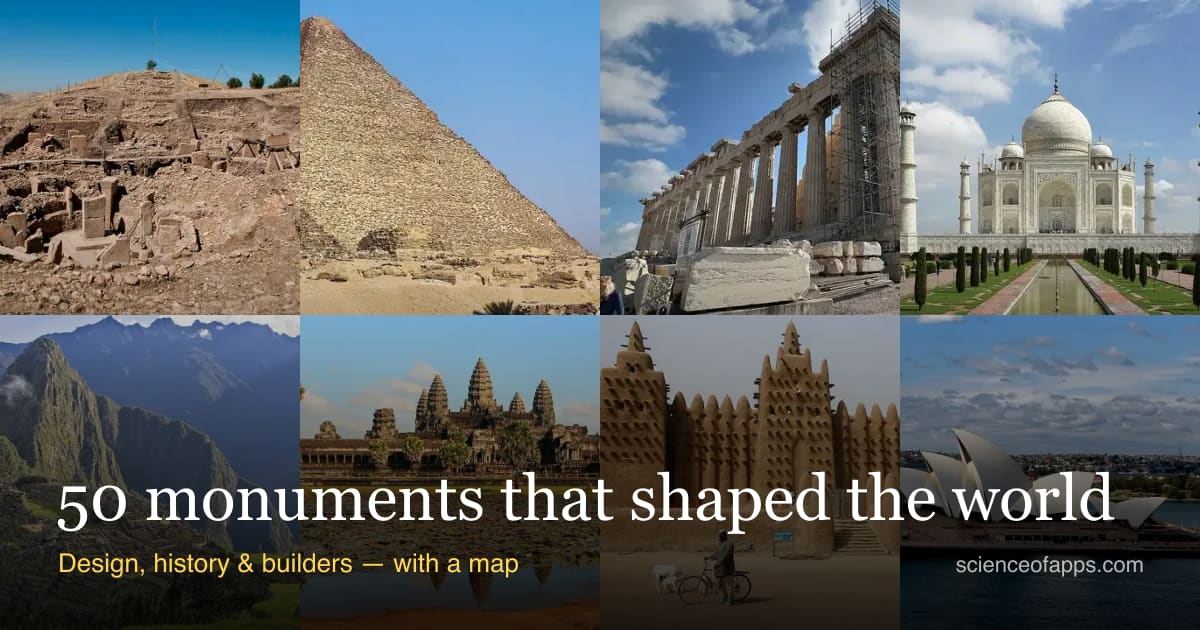
- History50 of the world's greatest monuments: how they were designed, built and changedA design history of 50 famous monuments, from 11,600-year-old Göbekli Tepe to the Burj Khalifa: who built them, when and how they changed, with a map.
- Architecture & engineeringDelhi Metro history: how India's biggest metro was designed and built, phase by phaseDelhi Metro history from its first 8 km in 2002 to a network of more than 370 km: who built it, how each phase grew and the design choices behind it.
- Architecture & engineeringThe best airports in the world in 2026, and the design science that makes them easy to useThe best airports in the world in 2026, led by Singapore Changi, and the design behind them: wayfinding, short walks, daylight and the psychology of waiting.
- UI/UX designThe 7 deadly sins of product design: how great products are built on human desireHow Instagram, Dropbox, Tinder, Netflix, X and Amazon build on pride, greed, lust, envy, gluttony, wrath and sloth — and the virtue that keeps each one ethical.
- HistoryThe world's 38 biggest languages, and the design of how they're writtenAll 38 languages with 50 million+ speakers (Ethnologue 2026): speakers, history, scripts, numerals and 'How are you?' in each — with every figure sourced.


Get the ideas, not the noise.
Sign up with Google and we’ll send you short UX psychology tips by email — why people tap, stall and leave, and what to do about it. Unsubscribe anytime. Prefer something to keep? Get the free Laws of UX guide as a PDF.
Great structures guide people without signs. So can apps.
A behavioral UX audit of your app or SaaS product: why users hesitate, stall and leave, and a prioritized fix list. Fixed price, 2–4 weeks.