 By
Quick answer: What are the fastest-growing jobs in AI?
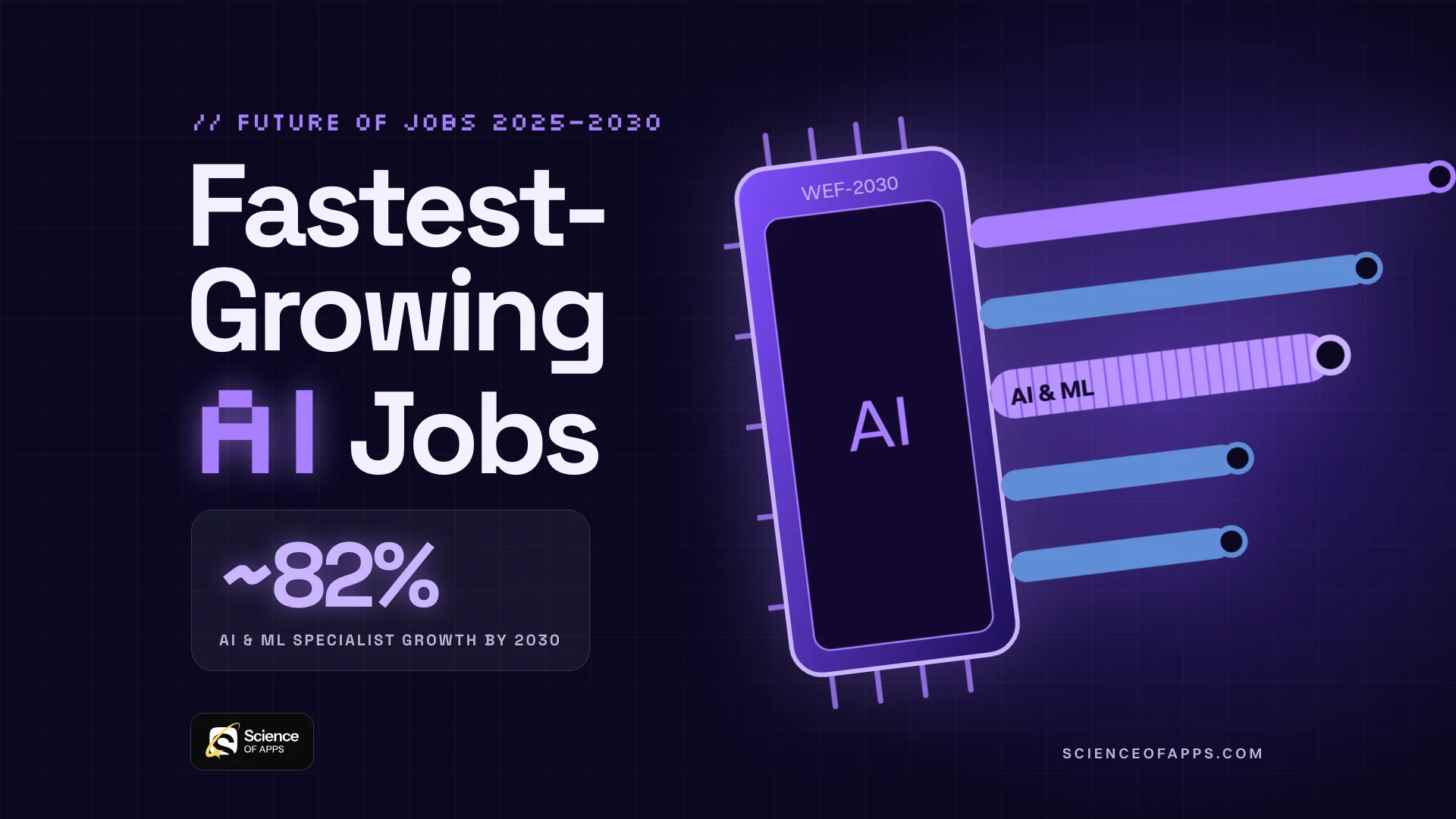
- AI and Machine Learning Specialists are projected to grow ~82% between 2025 and 2030, the third-fastest of any job in the WEF Future of Jobs Report 2025, behind Big Data Specialists (~113%) and FinTech Engineers (~93%).
- Jobs that require AI skills pay an average 62% wage premium, up from 57% a year earlier, per PwC's 2026 Global AI Jobs Barometer (June 2026).
- AI Engineer is the #1 fastest-growing job in the U.S. on LinkedIn Jobs on the Rise 2026, and AI roles fill 4 of the top 5 spots.
Key takeaways
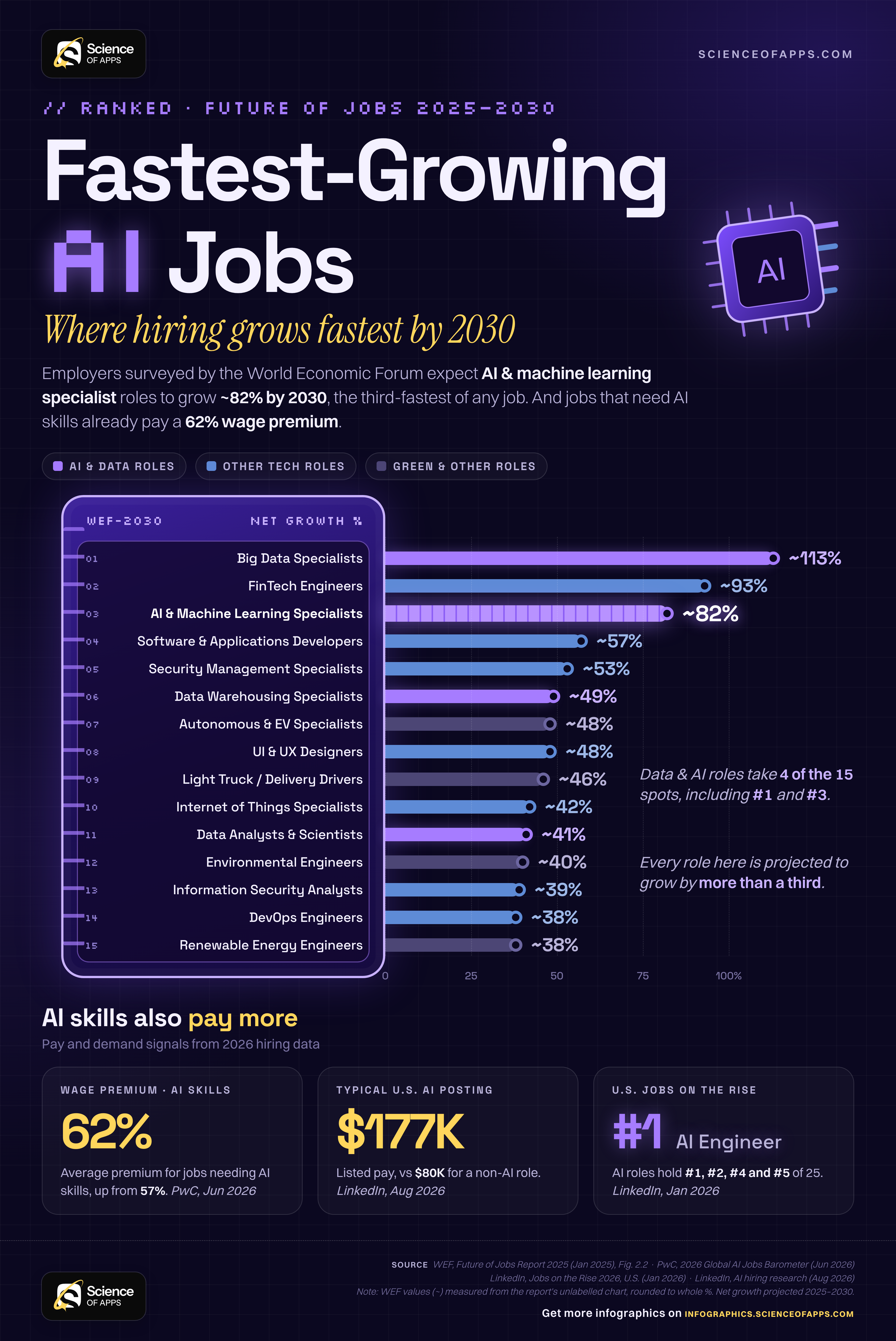
- In the WEF ranking, four of the 15 fastest-growing jobs are AI and data roles: Big Data Specialists (~113%), AI and Machine Learning Specialists (~82%), Data Warehousing Specialists (~49%) and Data Analysts and Scientists (~41%).
- PwC's 2026 Global AI Jobs Barometer, which analysed more than one billion job ads in 27 countries and territories, found that jobs requiring AI skills offer an average 62% wage premium, up from 57% in the previous edition.
- Flexibility is also notable: 26.2% of AI Engineer postings were remote and 27.1% hybrid.
AI jobs are no longer a niche corner of the labour market. Across the three largest datasets on hiring published in the past two years, AI and data roles keep landing at the top: the fastest-growing jobs to 2030, the fastest-growing job titles in the U.S., and the highest-paying skill premium in job ads. This chart pulls those numbers into one place.
The ranking comes from the World Economic Forum's Future of Jobs Report 2025, published in January 2025 and based on a survey of more than 1,000 employers representing over 14 million workers in 55 economies. We paired it with LinkedIn Jobs on the Rise 2026 (January 7, 2026), LinkedIn's AI hiring research (August 18, 2026) and PwC's 2026 Global AI Jobs Barometer (June 15, 2026).
Which AI jobs are growing fastest to 2030?
The table below shows the 15 fastest-growing jobs in the WEF Future of Jobs Report 2025, ranked by the net growth employers expect between 2025 and 2030. Values are approximate because the report charts them without labels; see the methodology note below.
| Rank | Job (WEF) | Group | Net growth, 2025–2030 |
|---|---|---|---|
| 1 | Big Data Specialists | AI & data | ~113% |
| 2 | FinTech Engineers | Tech | ~93% |
| 3 | AI and Machine Learning Specialists | AI & data | ~82% |
| 4 | Software and Applications Developers | Tech | ~57% |
| 5 | Security Management Specialists | Tech | ~53% |
| 6 | Data Warehousing Specialists | AI & data | ~49% |
| 7 | Autonomous and Electric Vehicle Specialists | Green & other | ~48% |
| 8 | UI and UX Designers | Tech | ~48% |
| 9 | Light Truck or Delivery Services Drivers | Green & other | ~46% |
| 10 | Internet of Things Specialists | Tech | ~42% |
| 11 | Data Analysts and Scientists | AI & data | ~41% |
| 12 | Environmental Engineers | Green & other | ~40% |
| 13 | Information Security Analysts | Tech | ~39% |
| 14 | DevOps Engineers | Tech | ~38% |
| 15 | Renewable Energy Engineers | Green & other | ~38% |
The pay and demand figures on the infographic come from 2026 hiring data:
| Metric | Value | Source (date) |
|---|---|---|
| Average wage premium for AI skills | 62% | PwC, 2026 Global AI Jobs Barometer (Jun 15, 2026) |
| Same premium in the previous edition | 57% | PwC (Jun 15, 2026) |
| Growth in jobs requiring AI skills vs all jobs | 69% vs 9% | PwC (Jun 15, 2026) |
| Typical U.S. AI job posting, listed pay | $177,000 | LinkedIn (Aug 18, 2026) |
| Typical U.S. non-AI job posting, listed pay | $80,000 | LinkedIn (Aug 18, 2026) |
| Rank of AI Engineer, U.S. Jobs on the Rise | #1 of 25 | LinkedIn Jobs on the Rise 2026 (Jan 7, 2026) |
| AI roles in the U.S. top 5 | #1, #2, #4, #5 | LinkedIn (Jan 7, 2026) |
Are AI careers growing faster than other tech jobs?
Mostly, yes, though the margin depends on how you define the category. In the WEF ranking, four of the 15 fastest-growing jobs are AI and data roles: Big Data Specialists (~113%), AI and Machine Learning Specialists (~82%), Data Warehousing Specialists (~49%) and Data Analysts and Scientists (~41%). Seven more are other technology roles, led by FinTech Engineers at ~93% and Software and Applications Developers at ~57%. The remaining four are green-transition and logistics jobs.
The WEF report states that AI and information processing technologies are among the top three drivers of growth for all 10 of its fastest-growing jobs. In other words, even the tech roles that are not labelled "AI" are being pulled upward by it.
LinkedIn's U.S. data points the same way from a different angle. Its Jobs on the Rise 2026 list, built from millions of jobs LinkedIn members started between January 1, 2023 and July 31, 2025, ranks AI Engineers #1, AI consultants and strategists #2, data annotators #4 and AI/ML researchers #5. LinkedIn's August 2026 research adds that U.S. AI job postings have roughly doubled since 2023, and that AI Engineer has overtaken Machine Learning Engineer as the most common AI role on the platform.
A caution on comparing these sources: the WEF figures are employer projections for 2025–2030, while LinkedIn ranks observed title growth over the past three years. They agree on direction, not on a single growth number.
What are the highest paying AI jobs worth today?
The clearest pay signal is the premium. PwC's 2026 Global AI Jobs Barometer, which analysed more than one billion job ads in 27 countries and territories, found that jobs requiring AI skills offer an average 62% wage premium, up from 57% in the previous edition. The premium ranges from 118% in some sectors, such as consumer markets, to 16% in government and public sector work.
In dollar terms, LinkedIn reported in August 2026 that the typical U.S. AI job posting lists about $177,000 in compensation, compared with $80,000 for a non-AI role. Demand is rising alongside pay: PwC found jobs requiring specific AI skills grew 69%, against 9% for the overall jobs market.
The entry bar is lower than the salaries suggest. On LinkedIn's 2026 list, AI Engineers had a median of 3.7 years of prior experience and most often moved in from Software Engineer, Data Scientist and Full Stack Engineer roles. AI/ML researchers had a median of 3.0 years. AI consultants and strategists skew senior at 8.2 years, and Product Manager is one of their top three feeder roles.
Which skills do jobs in AI ask for?
LinkedIn lists the most common skills for each role. For AI Engineers they are LangChain, Retrieval-Augmented Generation (RAG) and PyTorch. For AI consultants and strategists they are Large Language Models, MLOps and Computer Vision, and for AI/ML researchers they are PyTorch, Deep Learning and Computer Vision. Flexibility is also notable: 26.2% of AI Engineer postings were remote and 27.1% hybrid.
What this means for app builders
AI talent is now the most expensive line in a product budget, so every AI feature has to earn its keep. With a 62% average wage premium (PwC, 2026), an AI feature that users try once and abandon is costlier than ever. Measure AI features on retention, not launch-day activation.
Design is on the list too. UI and UX Designers are projected to grow ~48% by 2030 (WEF). AI interfaces raise classic behavioural-psychology problems: automation bias (users over-trust confident output) and trust calibration (users need to see when the model is unsure). Show sources, confidence and an easy undo, and let users edit the output rather than only accept or reject it.
Data quality is a product job. Data annotators ranked #4 on LinkedIn's 2026 U.S. list. For app teams this means budgeting for evaluation sets and human review from day one, not after the first bad answer goes viral.
Hire from inside. AI Engineers most often come from software engineering, with a median 3.7 years of prior experience (LinkedIn, 2026). Upskilling your own mobile and backend engineers on RAG and evaluation is usually faster than competing for scarce senior hires.
Methodology and sources
Figures were collected on November 27, 2026 from the primary sources below. The WEF Future of Jobs Report 2025 shows its fastest-growing jobs (Figure 2.2, page 19) as an unlabelled bar chart. We measured each bar's length from the PDF's vector geometry against the chart's 0–100 gridlines and rounded to the nearest whole percent, so these values are marked "~". "Net growth" is employers' projected change in each role between 2025 and 2030. LinkedIn rankings reflect observed growth in job titles between January 2023 and July 2025 and are not comparable with the WEF projections. Pay figures are typical listed compensation in U.S. job postings (LinkedIn) and the average AI-skill wage premium in job ads (PwC).
The full list of sources, with links, is below.
Frequently asked questions
What are the fastest-growing jobs in AI?
In the WEF Future of Jobs Report 2025 (January 2025), AI and Machine Learning Specialists are projected to grow about 82% between 2025 and 2030, the third-fastest of any job. Big Data Specialists (about 113%) top the list. In the U.S., LinkedIn Jobs on the Rise 2026 ranks AI Engineer as the #1 fastest-growing job.
Do AI jobs pay more?
Yes. PwC's 2026 Global AI Jobs Barometer (June 2026) found an average 62% wage premium for jobs requiring AI skills, up from 57%. LinkedIn reported in August 2026 that the typical U.S. AI job posting lists about $177,000, versus $80,000 for a non-AI role.
How much experience do you need for an AI engineer job?
On LinkedIn Jobs on the Rise 2026, U.S. AI Engineers had a median of 3.7 years of prior experience, and most moved in from Software Engineer, Data Scientist or Full Stack Engineer roles. The most common skills were LangChain, RAG and PyTorch.
Why are the WEF growth figures approximate?
The WEF report shows the fastest-growing jobs in a bar chart (Figure 2.2) without value labels. Science of Apps measured each bar from the report PDF's vector geometry against its gridlines and rounded to whole percentages, so values are marked with a tilde (~).
Where does this data come from, and how current is it?
The figures come from World Economic Forum, PwC, LinkedIn News and others, each linked in the sources below. Figures were collected on November 27, 2026 from the primary sources below. The WEF Future of Jobs Report 2025 shows its fastest-growing jobs (Figure 2.2, page 19) as an unlabelled bar chart.
Sources
- World Economic Forum — Future of Jobs Report 2025 (Figure 2.2 (published January 2025; accessed Nov 27, 2026)
- PwC — AI reshapes global labour market into two distinct paths: PwC 2026 Global AI Jobs Barometer
- LinkedIn News — LinkedIn Jobs on the Rise 2026: The 25 fastest-growing roles in the U.S.
- LinkedIn Pressroom — New LinkedIn Research Finds Women Account for Just 26% of AI Hires as AI Jobs Surge
- Checked November 29, 2026. Figures that change — fees, salaries, prices — are reviewed every six months; if something is out of date, tell us.
Where to go from here
- AI Skills in Demand for 2027: What Employers Want Most — Science of Apps Infographics
- The Most Popular AI Tools in 2026, Ranked by Web Traffic — Science of Apps Infographics
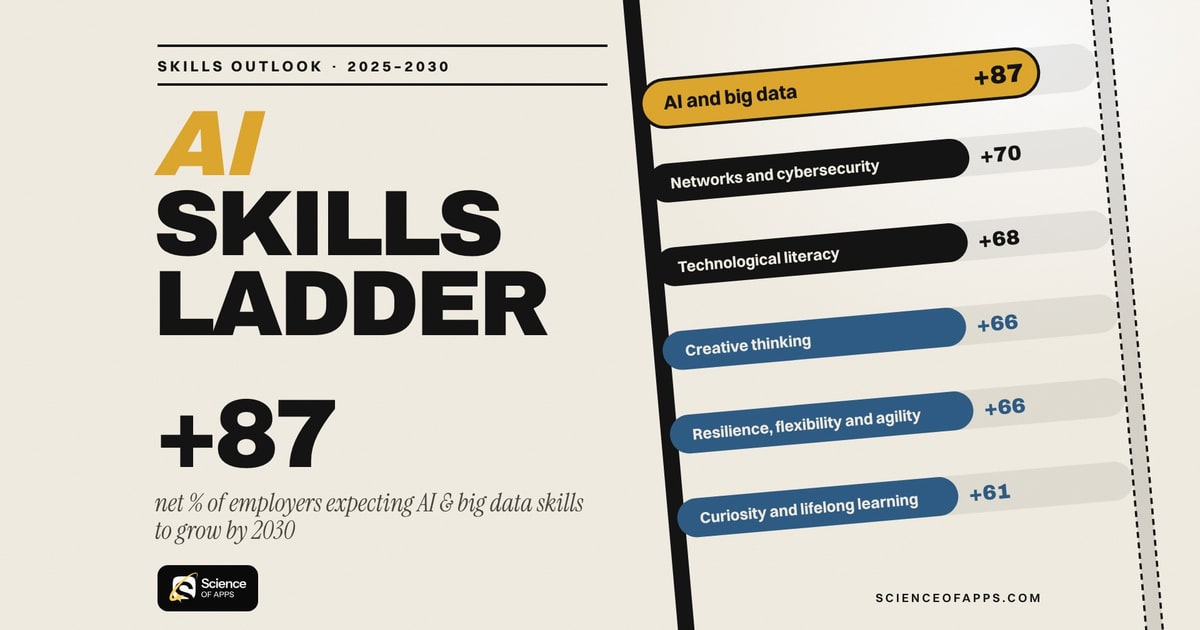
- Science of Apps InfographicsAI Skills in Demand for 2027: What Employers Want MostAI and big data is the fastest-rising skill to 2030 (net +87, WEF), and PwC finds a 62% wage premium for AI skills. The skills employers want most, ranked.
- Career guides by Science of Apps for 2027Is Cybersecurity Still Worth Getting Into in 2027? — answered for 2027Is cybersecurity still worth getting into in 2027? Networks and cybersecurity rank among the WEF's fastest-growing skills. How to start and what to expect.
- Career guides by Science of Apps for 2027Jobs of 2027: certifications for the fastest-growing roles, from AI specialists to security analystsCertifications for the fastest-growing jobs of 2027: AI and ML specialists, data roles, cloud engineers, security analysts and software developers.
- Career guides by Science of Apps for 2027Top 10 certifications and courses for 2027, ranked by what holders earn, and what that number really meansThe top 10 certifications for 2027 ranked by salary: CISSP, CISM, AWS Solutions Architect and CISA lead US pay data. See costs, prerequisites and links.
- Career guides by Science of Apps for 2027Is Data Analytics Still a Good Career in 2027? — answered for 2027Is data analytics still a good career in 2027? AI and big data top the WEF's growing skills. What's changing and the certifications to start.
- Career guides by Science of Apps for 2027The highest-paying AI certifications of 2027: seven tied to the best-paid AI rolesThe 7 AI certifications tied to the best-paid AI roles in 2027: AWS ML Engineer, Google Cloud ML Engineer, Azure AI-102, Databricks GenAI and more.


Get the ideas, not the noise.
Sign up with Google and we’ll send you short UX psychology tips by email — why people tap, stall and leave, and what to do about it. Unsubscribe anytime. Prefer something to keep? Get the free Laws of UX guide as a PDF.
See what your own users' numbers are telling you.
A behavioral UX audit of your app or SaaS product: why users hesitate, stall and leave, and a prioritized fix list. Fixed price, 2–4 weeks.