 By
Quick answer: What is the most popular AI tool in 2026?
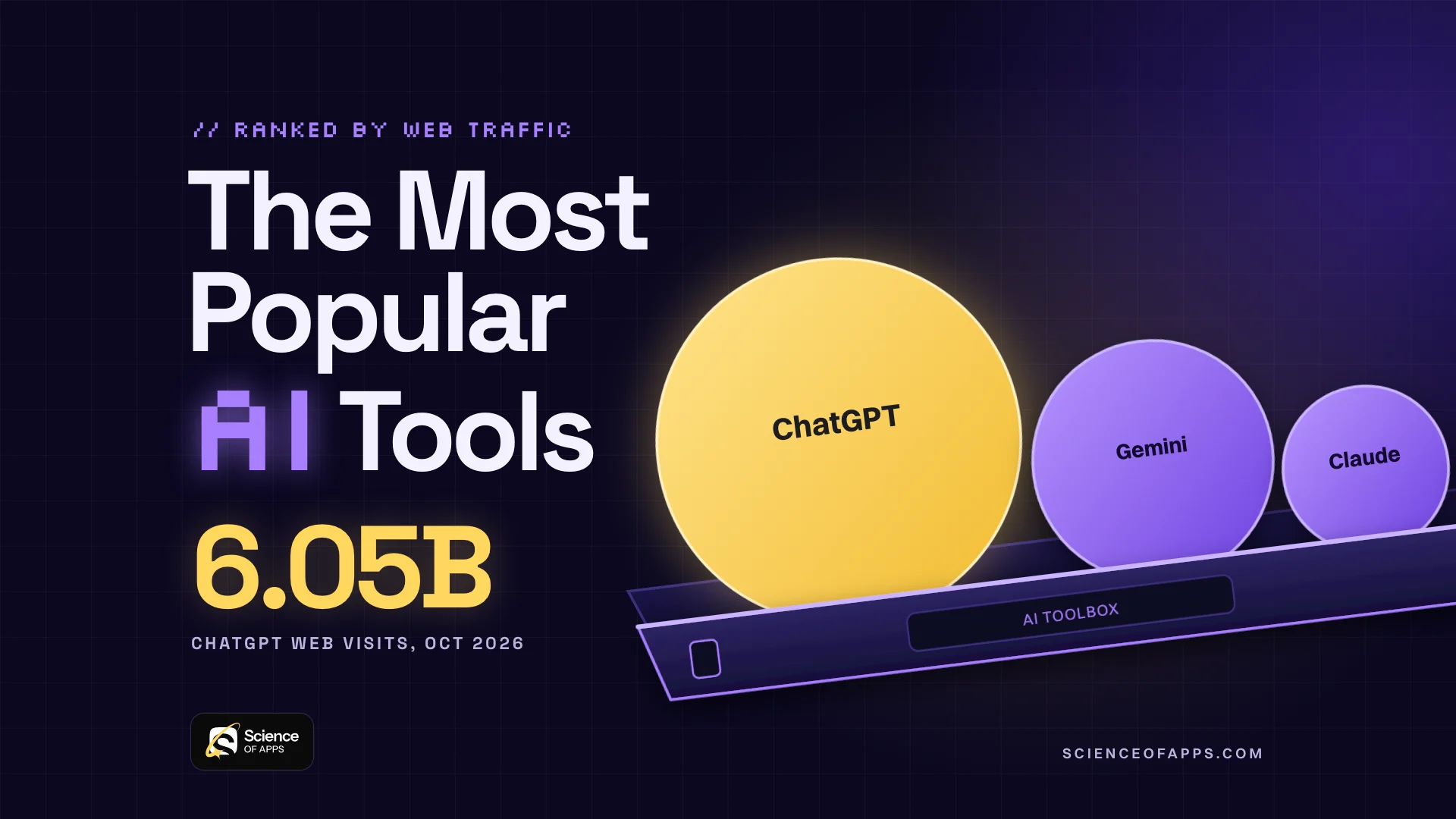
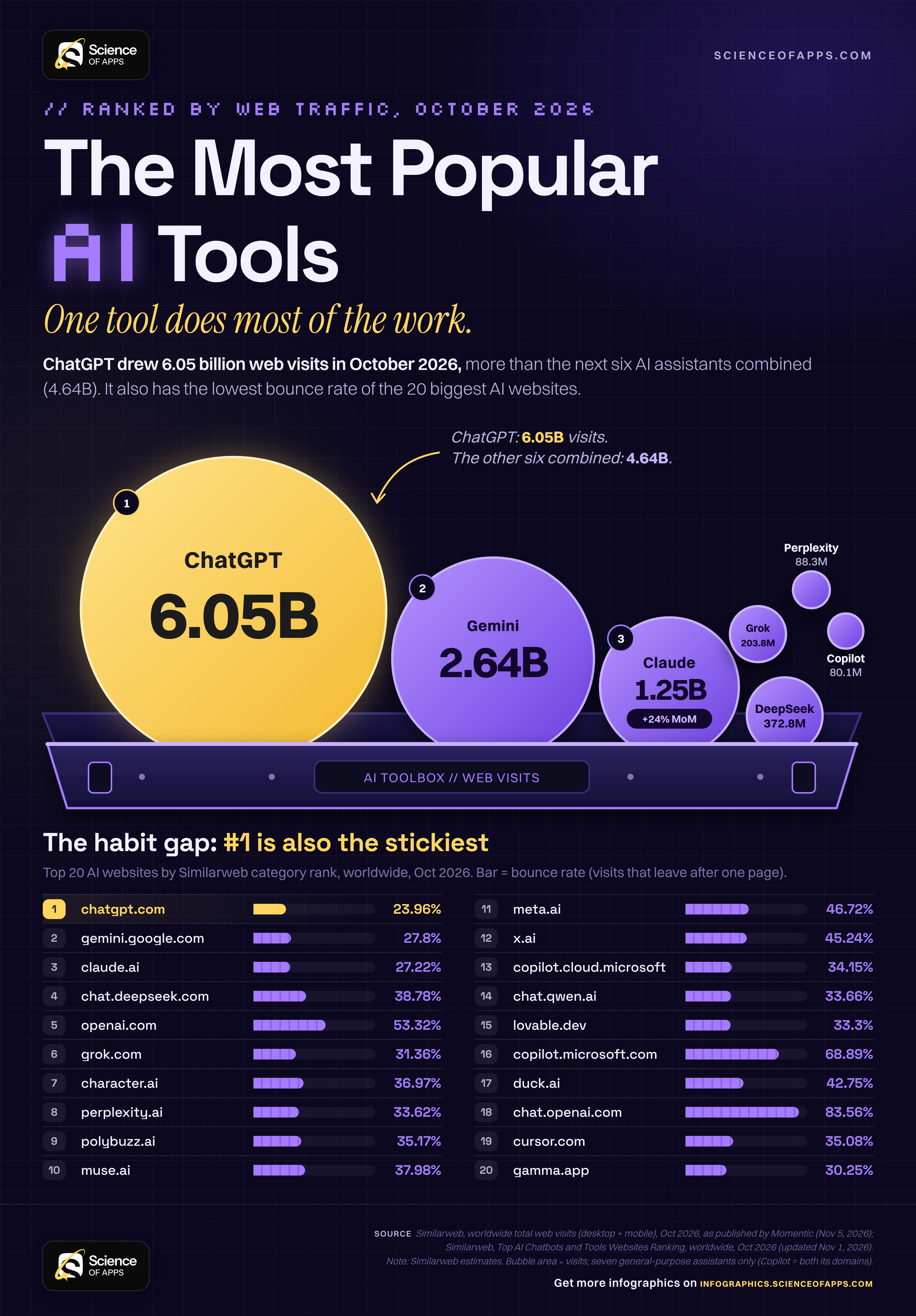
- ChatGPT drew 6.05 billion web visits in October 2026, 56.6% of the visits to the seven largest AI assistants and more than Gemini, Claude, DeepSeek, Grok, Perplexity and Copilot combined (4.64 billion).
- Claude was the fastest riser: web visits grew 24% in one month to 1.25 billion, and are up 536% year over year.
- Among the top 20 AI websites, chatgpt.com had the lowest bounce rate at 23.96%, while companion sites such as character.ai held visitors longest (14:27 per visit).
Key takeaways
- ChatGPT leads with 6.05 billion visits, followed by Gemini with 2.64 billion and Claude with 1.25 billion.
- In Similarweb's October 2026 ranking, chatgpt.com had a bounce rate of 23.96%, the lowest of the top 20, against 27.8% for gemini.google.com and 27.22% for claude.ai.
- Similarweb's ranking shows claude.ai matching ChatGPT on average visit length (6 minutes 31 seconds) with 4.39 pages per visit.
- Gamma visitors view 7.01 pages per visit and Lovable visitors stay 7 minutes 55 seconds on average.
Ask which AI tools people actually use and the answer is lopsided. In October 2026, ChatGPT drew more web visits than the next six AI assistants put together. Gemini and Claude are growing into real challengers, but the best AI tools by traffic still form a steep pyramid with one tool at the top.
This ranking uses Similarweb estimates for October 2026, the latest complete month. Visit counts for the seven general-purpose assistants come from Momentic’s November 2026 market-share report, which publishes Similarweb’s worldwide desktop and mobile web visits. The top 20 list, with engagement metrics, comes from Similarweb’s Top AI Chatbots and Tools ranking for the same month, last updated November 1, 2026.
What are the most popular AI tools in 2026?
The table below shows the seven largest general-purpose AI assistants by worldwide web visits in October 2026. ChatGPT leads with 6.05 billion visits, followed by Gemini with 2.64 billion and Claude with 1.25 billion. Together the seven drew 10.68 billion web visits, the highest monthly total in Momentic's Similarweb series.
| Rank | AI tool | Company | Web visits, Oct 2026 | Share of the seven |
|---|---|---|---|---|
| 1 | ChatGPT | OpenAI | 6.05B | 56.6% |
| 2 | Gemini | 2.64B | 24.7% | |
| 3 | Claude | Anthropic | 1.25B | 11.7% |
| 4 | DeepSeek | DeepSeek | 372.8M | 3.5% |
| 5 | Grok | xAI | 203.8M | 1.9% |
| 6 | Perplexity | Perplexity | 88.3M | 0.8% |
| 7 | Microsoft Copilot | Microsoft | 80.1M | 0.7% |
| Next six combined (Gemini to Copilot) | 4.64B | — |
The 4.64 billion figure for the next six is our sum of the six rounded values. Momentic's own text makes the same point: ChatGPT still serves more web visits than the other six assistants combined.
The wider top 20 comes from Similarweb's AI Chatbots and Tools category, which also counts company sites such as openai.com, companion apps and coding tools. Similarweb publishes rank and engagement for this list but not visit counts, so the second table shows how deeply each site is used rather than how big it is.
| Rank | Website | Avg. visit | Pages / visit | Bounce rate |
|---|---|---|---|---|
| 1 | chatgpt.com | 00:06:31 | 4.75 | 23.96% |
| 2 | gemini.google.com | 00:06:19 | 4.12 | 27.8% |
| 3 | claude.ai | 00:06:31 | 4.39 | 27.22% |
| 4 | chat.deepseek.com | 00:05:12 | 3.25 | 38.78% |
| 5 | openai.com | 00:02:34 | 2.77 | 53.32% |
| 6 | grok.com | 00:10:03 | 9.32 | 31.36% |
| 7 | character.ai | 00:14:27 | 12.30 | 36.97% |
| 8 | perplexity.ai | 00:04:20 | 3.68 | 33.62% |
| 9 | polybuzz.ai | 00:14:40 | 16.37 | 35.17% |
| 10 | muse.ai | 00:06:03 | 5.10 | 37.98% |
| 11 | meta.ai | 00:04:58 | 3.15 | 46.72% |
| 12 | x.ai | 00:02:01 | 2.83 | 45.24% |
| 13 | copilot.cloud.microsoft | 00:04:59 | 3.22 | 34.15% |
| 14 | chat.qwen.ai | 00:05:13 | 3.68 | 33.66% |
| 15 | lovable.dev | 00:07:55 | 5.90 | 33.3% |
| 16 | copilot.microsoft.com | 00:02:09 | 2.06 | 68.89% |
| 17 | duck.ai | 00:04:03 | 2.96 | 42.75% |
| 18 | chat.openai.com | 00:01:26 | 1.14 | 83.56% |
| 19 | cursor.com | 00:04:21 | 4.57 | 35.08% |
| 20 | gamma.app | 00:06:57 | 7.01 | 30.25% |
Why does ChatGPT get more traffic than every other AI tool combined?
Size alone does not explain the gap. ChatGPT is also the stickiest of the big AI websites. In Similarweb's October 2026 ranking, chatgpt.com had a bounce rate of 23.96%, the lowest of the top 20, against 27.8% for gemini.google.com and 27.22% for claude.ai. A visitor who lands on ChatGPT is more likely to keep going than a visitor to any other large AI site.
That stickiness has improved this year. According to Momentic, ChatGPT's worldwide bounce rate fell from 33.5% in April 2026 to 24.0% in October 2026. Its visit count barely moved over the same period, staying between 5.35 billion and 6.17 billion every month from July 2025 to October 2026. The audience is not getting much bigger; it is using the product more deliberately.
Similarweb's own reading of the category points the same way. Average monthly web visits across generative AI platforms grew 70% year over year to 9.5 billion between June 2025 and May 2026, while unique visitors grew 57% to 655 million. Visits are outpacing people. Similarweb says web growth "increasingly looks like habit formation among people who already use these tools."
Which AI tools are growing fastest?
Claude is the fastest-growing major AI assistant on the web. Its worldwide visits rose 24% from September to October 2026 to 1.25 billion, and are up 536% from 197 million in October 2025. Its share of the seven assistants' visits rose 1.9 points in a month to 11.7%. Similarweb's ranking shows claude.ai matching ChatGPT on average visit length (6 minutes 31 seconds) with 4.39 pages per visit.
Gemini is the second-biggest AI tool but has stalled on the web. Momentic reports that ChatGPT's web traffic is now 2.3 times Gemini's, and Gemini's share has fallen for four straight months from a June 2026 peak. Perplexity is shrinking: 88.3 million visits in October 2026, down 60% year over year.
Which AI tools for work make the top 20?
Below the chat assistants, the top 20 AI websites are a mix of companions, coding tools and office tools. Builders' tools rank surprisingly high: lovable.dev is #15, cursor.com #19 and gamma.app #20 in Similarweb's October list, and Microsoft's work Copilot (copilot.cloud.microsoft) is #13. These AI tools for work hold attention well. Gamma visitors view 7.01 pages per visit and Lovable visitors stay 7 minutes 55 seconds on average.
The companion sites behave differently. character.ai (#7) and polybuzz.ai (#9) have the longest visits in the top 20, at 14:27 and 14:40, but bounce rates of 36.97% and 35.17%, well above ChatGPT's. They win long sessions with a smaller, devoted audience. ChatGPT wins the more valuable habit: frequent, purposeful returns.
Traffic is not the same as paying use. In a16z's Top 100 Gen AI Consumer Apps, 7th edition (October 5, 2026), only 25% of U.S. consumers are engaged with AI daily, and just 4.5% had an active paid personal subscription to ChatGPT, Gemini or Claude as of August 2026. Only 13% of people who pay for one AI product pay for any other.
What this means for app builders
The ranking is a lesson in habit formation. ChatGPT does not win because people compare tools each morning. It wins because it became the default: the place a question goes without a decision. Behavioural science calls this a habit loop (cue, routine, reward). Once the routine is automatic, a rival has to beat the habit, not just the product. That is why ChatGPT's visits stayed flat for a year while its bounce rate fell from 33.5% to 24.0%. The habit got stronger even as the novelty faded.
Three things follow for app builders. First, measure frequency and bounce, not only sign-ups: the 9.5 billion monthly visits in Similarweb's category grew faster than unique visitors, so returning users are where growth comes from. Second, the switching cost is the habit itself. With only 13% of AI payers paying for a second tool (a16z), a challenger needs a distinct job to own, as Claude has with work and coding, rather than a slightly better general chat. Third, session length is not loyalty. Companion sites hold visitors for over 14 minutes but lose more than a third after one page. Design for the second visit and the tenth, not just the first long one.
Methodology and sources
All traffic figures are Similarweb estimates for October 2026 (worldwide, desktop and mobile web), accessed November 27, 2026. Visit counts for the seven assistants are as published by Momentic, which reports Similarweb data; Microsoft Copilot counts copilot.microsoft.com and copilot.com together. These figures match Similarweb's own site pages (for example, chatgpt.com "Last Month Change 2.15%" and claude.ai "23.78%"). The top 20 list, visit duration, pages per visit and bounce rate are copied from Similarweb's category ranking page. The "next six combined" figure (4.64B) is our sum of rounded values. No values were read from chart images. The bubble chart includes only the seven general-purpose assistants Momentic tracks; it excludes Meta AI, Character.AI and Chinese-language assistants.
The full list of sources, with links, is below.
Frequently asked questions
What is the most popular AI tool in 2026?
ChatGPT is the most popular AI tool. Similarweb estimates chatgpt.com drew 6.05 billion worldwide web visits in October 2026, 56.6% of the visits to the seven largest AI assistants, followed by Gemini (2.64 billion) and Claude (1.25 billion).
What are the top 10 AI websites?
In Similarweb's October 2026 AI Chatbots and Tools ranking (worldwide), the top 10 are chatgpt.com, gemini.google.com, claude.ai, chat.deepseek.com, openai.com, grok.com, character.ai, perplexity.ai, polybuzz.ai and muse.ai.
Which AI tool is growing fastest?
Claude. Its worldwide web visits rose 24% from September to October 2026, to 1.25 billion, and are up 536% year over year, according to Similarweb data published by Momentic.
Which AI tools for work are most visited?
Beyond the general assistants, the work-focused AI tools in Similarweb's October 2026 top 20 are Microsoft's work Copilot (copilot.cloud.microsoft, #13), Lovable (#15), Cursor (#19) and Gamma (#20).
Is web traffic the same as AI tool usage?
No. Web visits leave out mobile apps and tools built into other products. Gemini, for example, is used heavily through Android and Google apps, which web data does not capture. Treat these rankings as web popularity, not total usage.
Sources
- Similarweb — Top AI Chatbots and Tools Websites Ranking (worldwide, October 2026)
- Momentic — Top AI Chatbots by Market Share, November 2026 (Similarweb data)
- Similarweb — AI Search Stats 2026: Market Share, Referral, and Citation Data
- Andreessen Horowitz — The Top 100 Gen AI Consumer Apps, 7th Edition
- Checked November 29, 2026. Figures that change — fees, salaries, prices — are reviewed every six months; if something is out of date, tell us.
Where to go from here
- The Most Valuable AI Companies in the World (November 2026) — Science of Apps Infographics
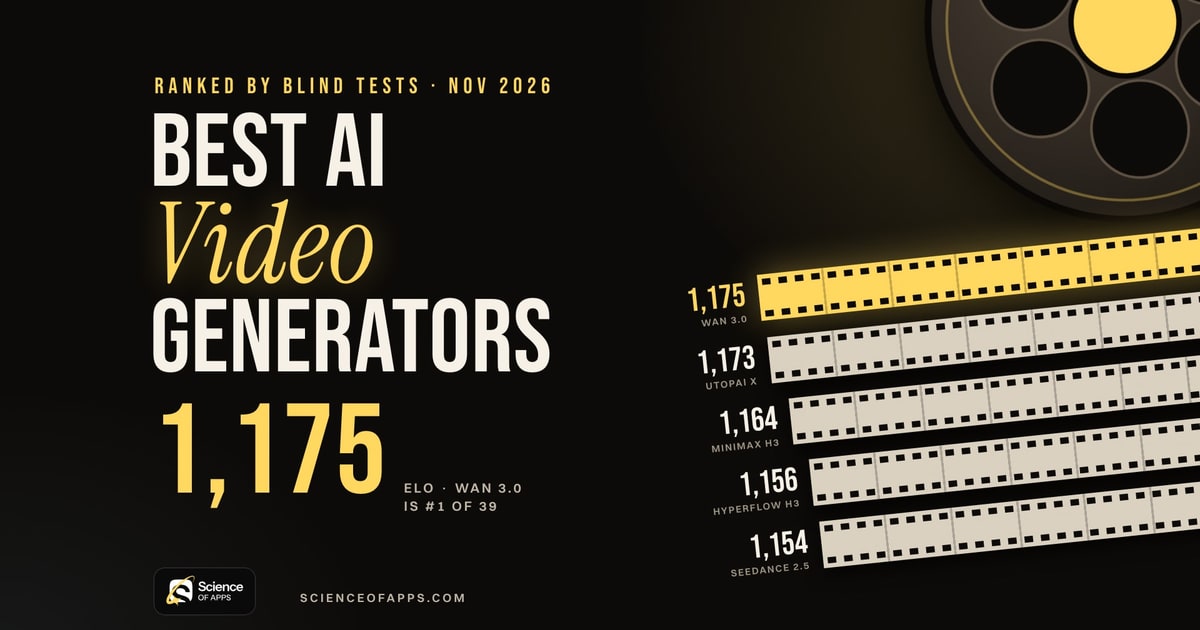
- Best AI Video Generators in 2026, Ranked by Blind Tests — Science of Apps Infographics
- Science of Apps InfographicsBest AI Video Generators in 2026, Ranked by Blind TestsWan 3.0 leads the AI video generator leaderboard at 1,175 Elo in blind tests (27 Nov 2026). See the top models, API prices, and Sora vs Veo.
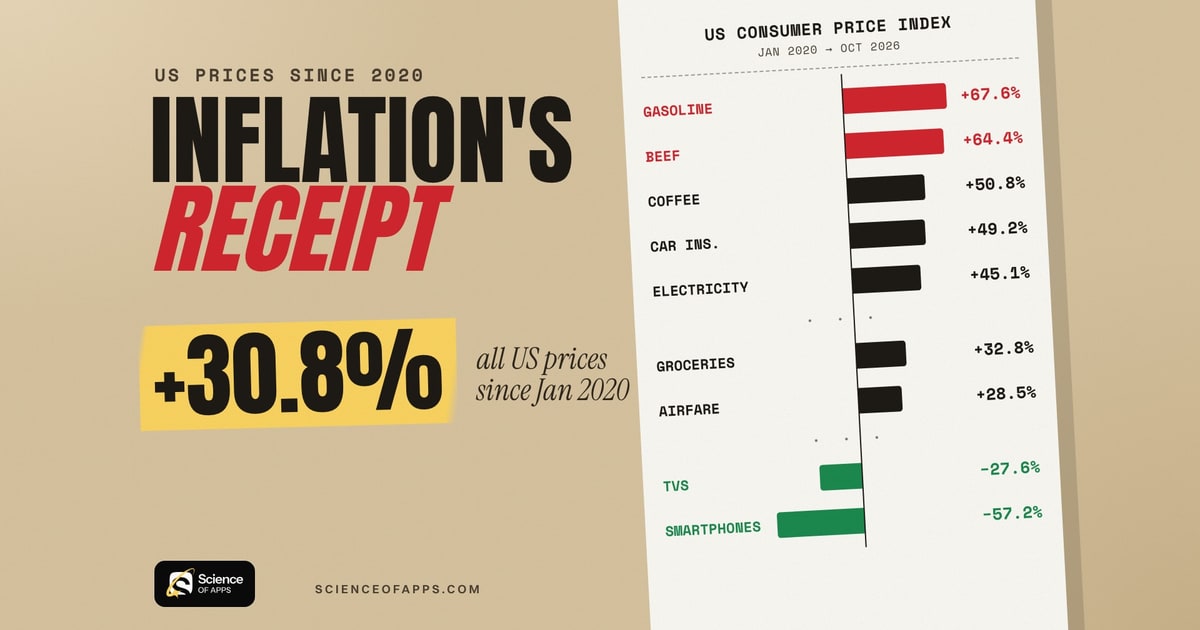
- Science of Apps InfographicsInflation Since 2020: What Got More Expensive and What Got CheaperUS prices rose 30.8% from Jan 2020 to Oct 2026 (BLS CPI). See what got more expensive, from gasoline to beef, and what got cheaper: smartphones and TVs.
- Science of Apps - LaunchpadWebsite traffic checker: how to find website traffic for any site with free traffic checker tools, how accurate the estimates are, and how to get traffic of your ownA website traffic checker estimates any site's visits. Free traffic checker tools compared, how to find website traffic accurately, and how to get your own.
- Science of Apps - LaunchpadCompetitor analysis website tools for startups: how to find competitors' websites, check their traffic, tech and keywords for free, and find every place they list so you can list there tooFree competitor analysis website tools: find competitors, check their traffic, tech, keywords and news, and see where they list so you can list there too.
- Science of Apps - LaunchpadProduct launch marketing that works for startups: the launch strategy, the seven channels, a six-week calendar from three weeks before launch to three weeks after, and how to measure each channelLaunch marketing in one plan: a launch strategy, seven channels ranked for startups, a six-week calendar and one permanent page every channel points to.
- Tech explainedHow does ChatGPT work? Tokens, transformers, training and why it sometimes makes things upHow ChatGPT works, in plain English: it predicts the next token using a transformer trained on vast text, then tuned with human feedback. With diagrams.
Get the ideas, not the noise.
Sign up with Google and we’ll send you short UX psychology tips by email — why people tap, stall and leave, and what to do about it. Unsubscribe anytime. Prefer something to keep? Get the free Laws of UX guide as a PDF.
See what your own users' numbers are telling you.
A behavioral UX audit of your app or SaaS product: why users hesitate, stall and leave, and a prioritized fix list. Fixed price, 2–4 weeks.