 By
Quick answer: What is the most valuable AI company in the world?
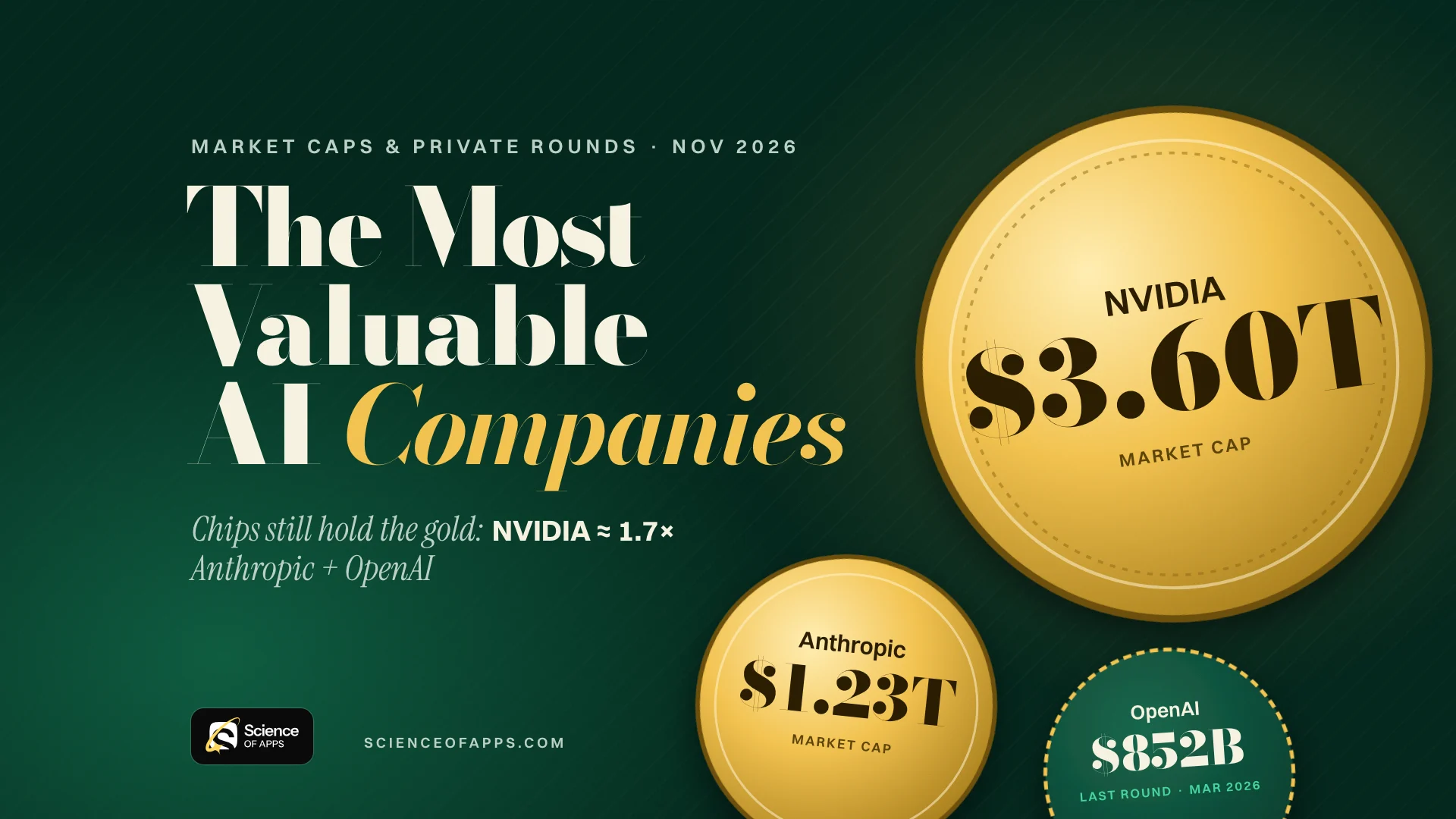
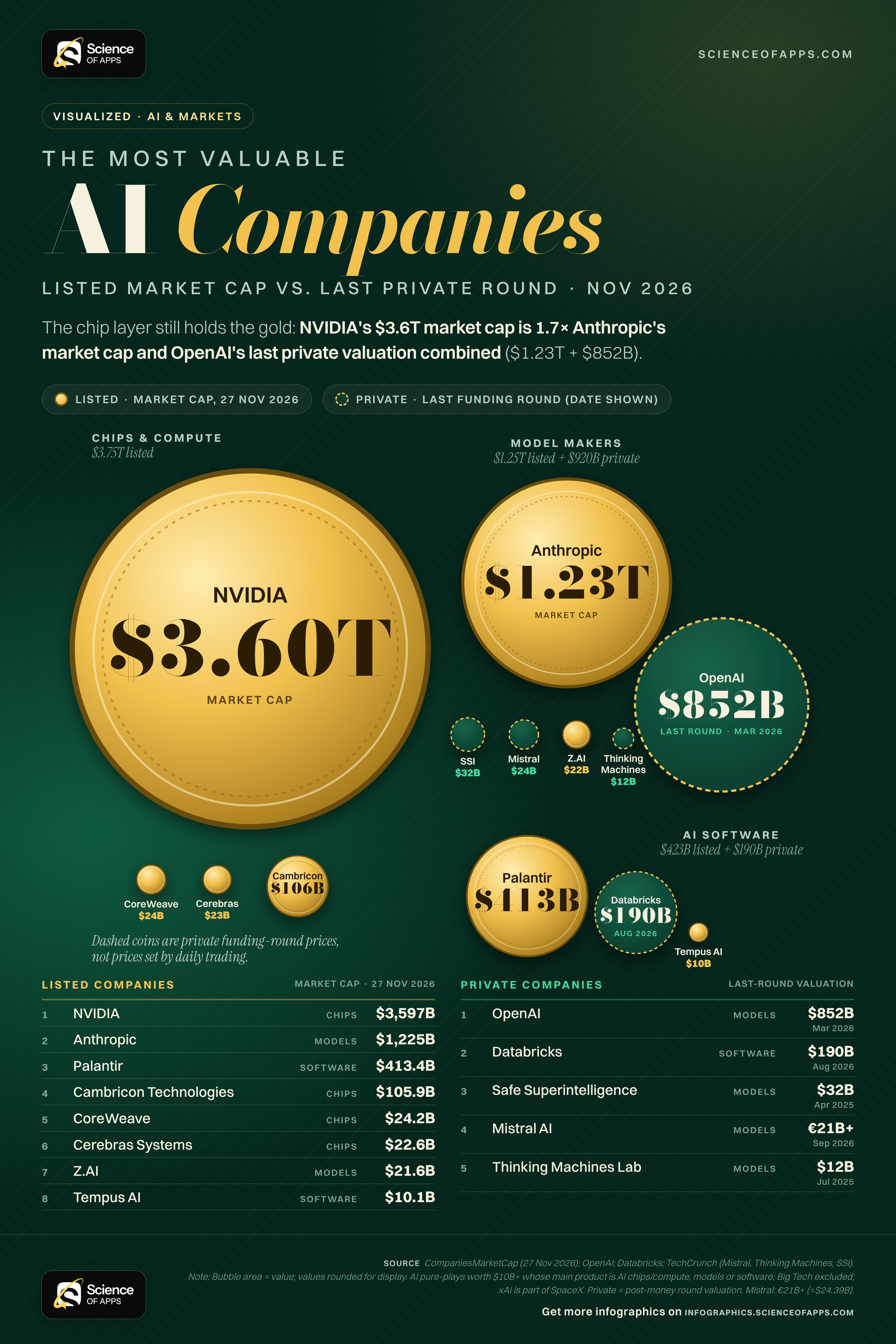
- NVIDIA is worth $3.60T by market cap, about 1.7× Anthropic's $1.23T market cap and OpenAI's $852B private valuation combined.
- The chip and compute layer adds up to $3.75T of listed value, against $1.25T of listed value for model makers plus $920B in private model-maker valuations.
- Databricks ($190B, August 2026) is the largest private AI software company here, and its last round valued it at roughly 27 times its $7B-plus revenue run-rate.
Key takeaways
- CompaniesMarketCap listed NVIDIA at a $3.597 trillion market cap on 27 November 2026, which makes it larger than every other company in this ranking combined (their total is $2.93 trillion, counting market caps and private valuations together).
- Among model labs, France's Mistral AI raised €3 billion at a post-money valuation of more than €21 billion (about $24.39 billion) in September 2026.
- Listed chip and compute companies add up to $3.75 trillion.
The most valuable AI companies in the world are no longer all private start-ups. Anthropic began trading on Nasdaq on 19 November 2026 after pricing its IPO at $83 a share. That puts the two most valuable AI-native companies, NVIDIA and Anthropic, on public markets with daily prices. OpenAI, the other giant, is still valued only by its funding rounds.
This ranking combines two kinds of number, and labels each one. Listed AI companies are ranked by market cap from CompaniesMarketCap's list of the largest AI companies, accessed on 27 November 2026. Private AI companies are ranked by the post-money valuation of their latest announced funding round, and each round's date is shown. We include AI pure-plays worth $10 billion or more: companies whose main product is AI chips or compute, AI models, or AI software.
What are the most valuable AI companies in November 2026?
The table below shows all 13 AI companies in the infographic, split into listed companies (market cap) and private companies (last-round valuation). Market caps move every trading day; private valuations stay fixed until the next round.
| Company | Layer | Status | Value | Value type and date |
|---|---|---|---|---|
| NVIDIA | Chips | Listed | $3,597B | Market cap, 27 Nov 2026 (CompaniesMarketCap) |
| Anthropic | Models | Listed | $1,225B | Market cap, 27 Nov 2026 (CompaniesMarketCap) |
| Palantir | AI software | Listed | $413.39B | Market cap, 27 Nov 2026 (CompaniesMarketCap) |
| Cambricon Technologies | Chips | Listed | $105.91B | Market cap, 27 Nov 2026 (CompaniesMarketCap) |
| CoreWeave | Compute (AI cloud) | Listed | $24.24B | Market cap, 27 Nov 2026 (CompaniesMarketCap) |
| Cerebras Systems | Chips | Listed | $22.60B | Market cap, 27 Nov 2026 (CompaniesMarketCap) |
| Z.AI | Models | Listed | $21.63B | Market cap, 27 Nov 2026 (CompaniesMarketCap) |
| Tempus AI | AI software | Listed | $10.09B | Market cap, 27 Nov 2026 (CompaniesMarketCap) |
| OpenAI | Models | Private | $852B | Last funding round, 31 Mar 2026 (source) |
| Databricks | AI software | Private | $190B | Last funding round, 13 Aug 2026 (source) |
| Safe Superintelligence (SSI) | Models | Private | $32B | Last funding round, 12 Apr 2025 (source) |
| Mistral AI | Models | Private | more than €21B (≈$24.39B) | Last funding round, 8 Sep 2026 (source) |
| Thinking Machines Lab | Models | Private | $12B | Last funding round, 15 Jul 2025 (source) |
Which AI stocks are worth the most?
Among AI stocks, NVIDIA is the largest by a wide margin. CompaniesMarketCap listed NVIDIA at a $3.597 trillion market cap on 27 November 2026, which makes it larger than every other company in this ranking combined (their total is $2.93 trillion, counting market caps and private valuations together). Its customers are the model makers and clouds further down the list, so a large share of AI spending flows to NVIDIA first.
Anthropic is the second most valuable listed AI company at $1.225 trillion, according to the same CompaniesMarketCap list. StockAnalysis also shows a $1.23 trillion market cap as of 27 November 2026, up from $1.10 trillion at IPO pricing. News reports on debut day put the figure near $2 trillion (Al Jazeera, 19 November 2026). Those figures imply a larger share count than the market-data providers use, so we use the provider figure throughout.
Palantir ($413.39B) is the largest listed AI software company. Further down, Chinese companies show up across the stack: chipmaker Cambricon Technologies ($105.91B, listed in Shanghai) and model maker Z.AI ($21.63B, listed in Hong Kong). Two compute businesses, CoreWeave ($24.24B) and Cerebras Systems ($22.60B), are each less than one-fifteenth of Palantir's size.
What are the biggest private AI companies?
OpenAI is the biggest private AI company by a distance. It closed a $122 billion round at an $852 billion post-money valuation on 31 March 2026. Because there is no public market for OpenAI shares, $852 billion is the price that a set of investors agreed to in March, not a price set by daily trading.
Databricks, the data and AI platform, is second. It closed a $5 billion strategic round at a $190 billion valuation on 13 August 2026 and said it had crossed a $7 billion revenue run-rate. Among model labs, France's Mistral AI raised €3 billion at a post-money valuation of more than €21 billion (about $24.39 billion) in September 2026. Safe Superintelligence's latest public mark is $32 billion, from April 2025, and Thinking Machines Lab's is $12 billion, from its July 2025 seed round. Those two figures are more than a year old, which is why each has a date in the table.
xAI is not listed separately. SpaceX acquired it in February 2026 in a deal that valued xAI at $250 billion, so its value now sits inside SpaceX, which we exclude along with other diversified giants.
Where does value accrue in the AI stack: chips, models or apps?
Group the 13 companies by layer and the shape is clear. Listed chip and compute companies add up to $3.75 trillion. Model makers add up to $1.25 trillion in listed market cap plus $920 billion in private round valuations. AI software companies add up to $423 billion listed plus $190 billion private. These are sums of what we include; they leave out Big Tech, which sells chips, models and apps at once.
The pattern follows where the money is spent today. Model makers pay for compute, so chip revenue arrives first. Model makers then charge app builders for tokens. The app layer is valued lowest, even though it is where end users actually spend their time.
What this means for app builders
For app builders, the chart is a map of who has pricing power over you. Your inference bill goes to model makers, whose biggest cost is chips. When the layers below you are worth this much, they can change prices, rate limits and terms, and you will feel it in your gross margin.
Three practical moves follow. First, design for model portability: put a routing layer between your product and any one provider, so switching is a configuration change. Second, compete on the parts of the experience that a model API cannot copy: onboarding, habit loops and the endowment effect of user data and history saved in your app. Users value what they have already built inside a product, and that is why they stay. Third, price on outcomes, not tokens. Users anchor on the value of the job done, not on what it cost you to run, so a plan framed around results protects you from passing every model price change on to customers.
Methodology and sources
Listed companies: market caps were read from the CompaniesMarketCap 'Largest AI companies by market capitalization' list on 27 November 2026 and cross-checked against StockAnalysis for Anthropic, NVIDIA, Palantir and CoreWeave. Private companies: the post-money valuation of the most recent announced round, from the company's own announcement where one was available, otherwise from TechCrunch. Inclusion: AI pure-plays worth $10B or more whose main product is AI chips or compute, AI models or AI software. Diversified Big Tech (Apple, Microsoft, Alphabet, Amazon, Meta, Tesla, SpaceX, which now owns xAI) and companies below $10B (for example MiniMax and SenseTime) are excluded. Infographic bubble labels are rounded (for example $3.60T); the table shows values as published. Mistral's valuation was announced in euros (more than €21B); the dollar figure is TechCrunch's conversion. Layer totals are our own sums. No values were read from charts.
The full list of sources, with links, is below.
Frequently asked questions
What is the most valuable AI company in the world?
NVIDIA, with a market cap of $3.597 trillion on 27 November 2026, according to CompaniesMarketCap. It is the most valuable company in this AI ranking, ahead of Anthropic ($1.225 trillion) and OpenAI ($852 billion private valuation).
Is OpenAI a public company?
No. As of 27 November 2026, OpenAI is private. Its latest valuation is $852 billion, from a $122 billion funding round it closed on 31 March 2026. Anthropic became public on 19 November 2026 under the ticker ANT.
How do you compare a market cap with a private valuation?
With care. A market cap is the share price on a given day multiplied by shares outstanding. A private valuation is the price investors agreed in a single funding round, often with special terms. In this ranking each value is labelled as one or the other and dated.
Why are Microsoft, Alphabet and Meta not on the list?
This ranking covers AI pure-plays whose main product is AI chips or compute, models or software. Diversified Big Tech companies were excluded even though they build AI. For scale, CompaniesMarketCap listed Microsoft at $3.648T, Alphabet at $3.336T and Meta at $1.607T on 27 November 2026.
Where does this data come from, and how current is it?
The figures come from CompaniesMarketCap, StockAnalysis, OpenAI and others, each linked in the sources below. Listed companies: market caps were read from the CompaniesMarketCap 'Largest AI companies by market capitalization' list on 27 November 2026 and cross-checked against StockAnalysis for Anthropic, NVIDIA, Palantir and CoreWeave. Private companies: the post-money valuation of the most recent announced round, from the company's own announcement where one was available, otherwise from TechCrunch.
Sources
- CompaniesMarketCap — Largest AI companies by market capitalization
- StockAnalysis — Anthropic, PBC market cap (accessed 27 Nov 2026)
- OpenAI — OpenAI raises $122 billion to accelerate the next phase of AI
- Databricks — Databricks grows 80% YoY, surpasses $7B revenue run-rate
- TechCrunch — Mistral raises €3B as sovereign AI becomes big business
- TechCrunch — Safe Superintelligence reportedly valued at $32B
- TechCrunch — Thinking Machines Lab is worth $12B in seed round
- Al Jazeera — Anthropic starts trading in the US after blockbuster IPO
- Yahoo Finance — Elon Musk merges SpaceX with xAI at $1.25tn valuation
- Checked November 29, 2026. Figures that change — fees, salaries, prices — are reviewed every six months; if something is out of date, tell us.
Where to go from here
- The Most Popular AI Tools in 2026, Ranked by Web Traffic — Science of Apps Infographics
- AI Jobs: The Fastest-Growing Careers Through 2030, Charted — Science of Apps Infographics
- Science of Apps - LaunchpadThe highest valued startups in the world as of November 2026: OpenAI at $1 trillion, Anthropic at $965 billion and the rest of the top 25 by valuation, with the highest valued startup in each country and what a valuation really meansThe highest valued startups in the world: OpenAI ($1T) and Anthropic ($965B) lead the top 25, per Crunchbase (17 Nov 2026). Plus the leader in each country.
- Science of Apps - LaunchpadThe top 100 startup companies in the world by valuation, from the Crunchbase Unicorn Board as of 17 November 2026: the top 10 startups, the full top 100 list, what the ranking shows, and the new startups rising on the Science of Apps LaunchpadThe top 100 startup companies in the world by valuation (Crunchbase, 17 Nov 2026): the top 10 startups, the full list, and new startups rising on the Launchpad.
- Science of Apps - LaunchpadList of unicorn companies and unicorn startups as of November 2026: how many unicorns there are, the top 25 by valuation, unicorns by country, how the Crunchbase and CB Insights unicorn lists differ, and tomorrow's unicornsA list of unicorn companies as of 17 Nov 2026: 1,931 startups worth $1B+, the top 25, unicorns by country, and how the CB Insights unicorn list differs.
- HistoryThe world's 38 biggest languages, and the design of how they're writtenAll 38 languages with 50 million+ speakers (Ethnologue 2026): speakers, history, scripts, numerals and 'How are you?' in each — with every figure sourced.
- Science of Apps - LaunchpadAverage Series A valuation: what Carta's State of Private Markets Q3 2026 data shows, how it compares with seed and Series B, why medians mislead, and the traction a startup needs to showThe median Series A valuation in 2026 was $63.3 million through Q3, per Carta's data on US startups. What sits behind it and the traction investors expect.
- Career guides by Science of Apps for 2027Top 10 generative AI courses online in 2027: from your first prompt to shipping an LLM appThe top 10 generative AI courses online for 2027, from beginner to builder: DeepLearning.AI, Google, Anthropic, OpenAI, NVIDIA, Microsoft and Databricks.

Get the ideas, not the noise.
Sign up with Google and we’ll send you short UX psychology tips by email — why people tap, stall and leave, and what to do about it. Unsubscribe anytime. Prefer something to keep? Get the free Laws of UX guide as a PDF.
See what your own users' numbers are telling you.
A behavioral UX audit of your app or SaaS product: why users hesitate, stall and leave, and a prioritized fix list. Fixed price, 2–4 weeks.