 By
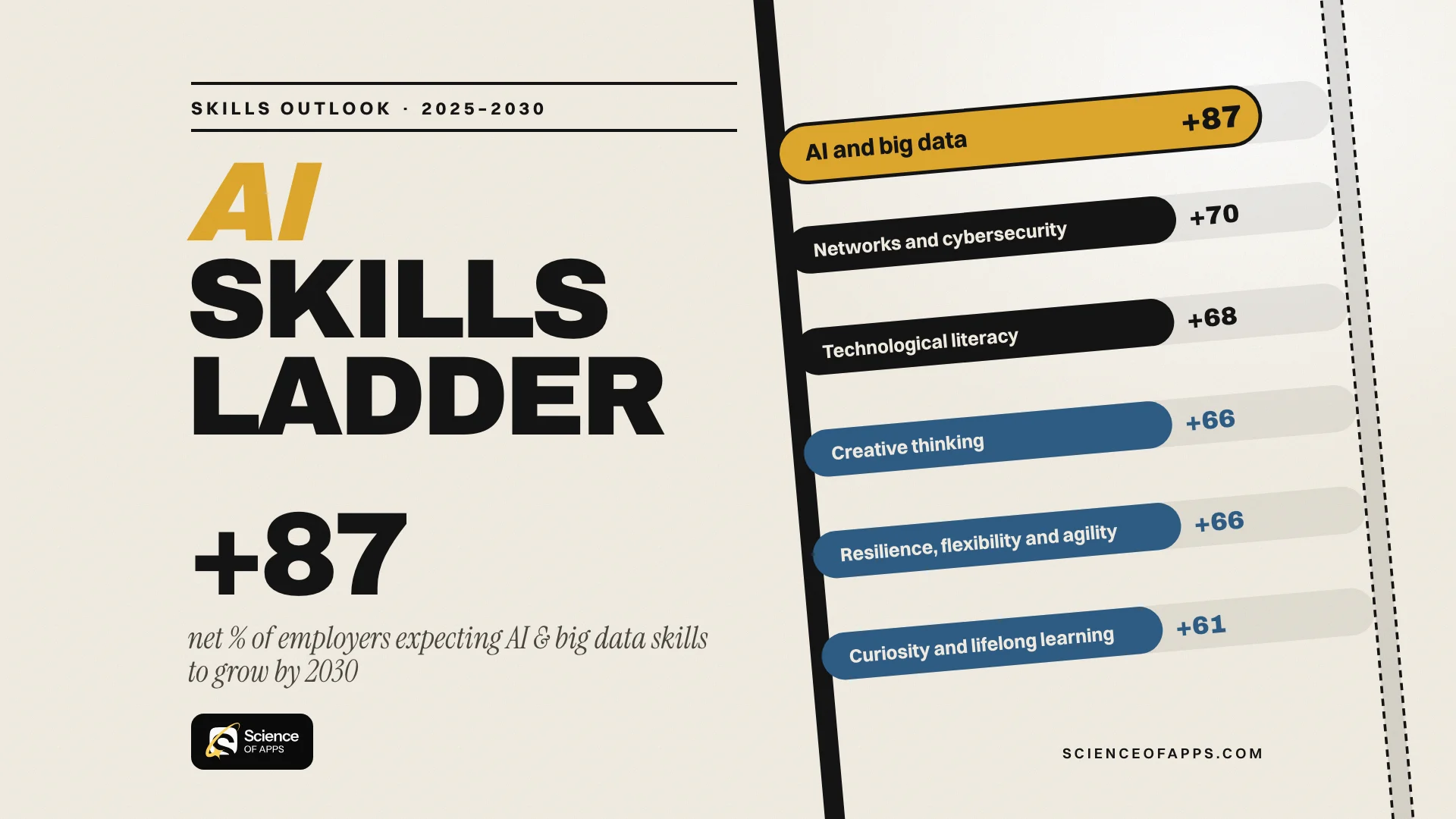
Quick answer: What are the most in-demand AI skills for 2027?
- AI and big data is the fastest-growing skill to 2030, with a net increase of +87 in the WEF Future of Jobs Report 2025. Programming ranks 17th of 26, at +27.
- Workers with AI skills earn an average 62% wage premium, up from 57%, according to PwC's 2026 Global AI Jobs Barometer.
- Jobs requiring AI skills grew 69%, against 9% for all jobs, and the skills needed for the most AI-exposed jobs are changing more than twice as fast (PwC, 2026).
Key takeaways
- The WEF also reports that in its top 10 industries, more than 90% of respondents expect use of AI and big data skills to increase.
- PwC's 2026 Global AI Jobs Barometer puts the average wage premium for workers with AI skills at 62%, up from 57% the year before.
- PwC's AI Jobs Barometer 2026 finds that the skills needed for the most AI-exposed jobs are changing more than twice as fast as those for the least exposed jobs, and that this gap is 75% wider than the year before.
- 45% of employers consider AI and big data a core skill for their workforce, compared with 17% for programming.
- Design and user experience ranks 14th in the WEF ranking (+45), and 25% of employers call it a core skill today.
AI skills now sit at the top of employers' wish lists. In the World Economic Forum's Future of Jobs Report 2025, AI and big data is the fastest-growing skill to 2030, with a net increase of 87. Behind it come networks and cybersecurity and technological literacy, then a run of human skills. Programming, the skill most people associate with AI careers, ranks 17th out of 26.
The ranking comes from the WEF's Future of Jobs Survey of over 1,000 employers, which together employ more than 14 million workers in 22 industry clusters and 55 economies. It was published in January 2025 and covers 2025 to 2030. We set it beside two newer sources: PwC's 2026 Global AI Jobs Barometer (15 June 2026), which analysed more than one billion job ads in 27 countries and territories, and LinkedIn's Skills on the Rise 2026 (24 February 2026), which tracks the fastest-growing skills across 12 markets.
Which AI skills are most in demand?
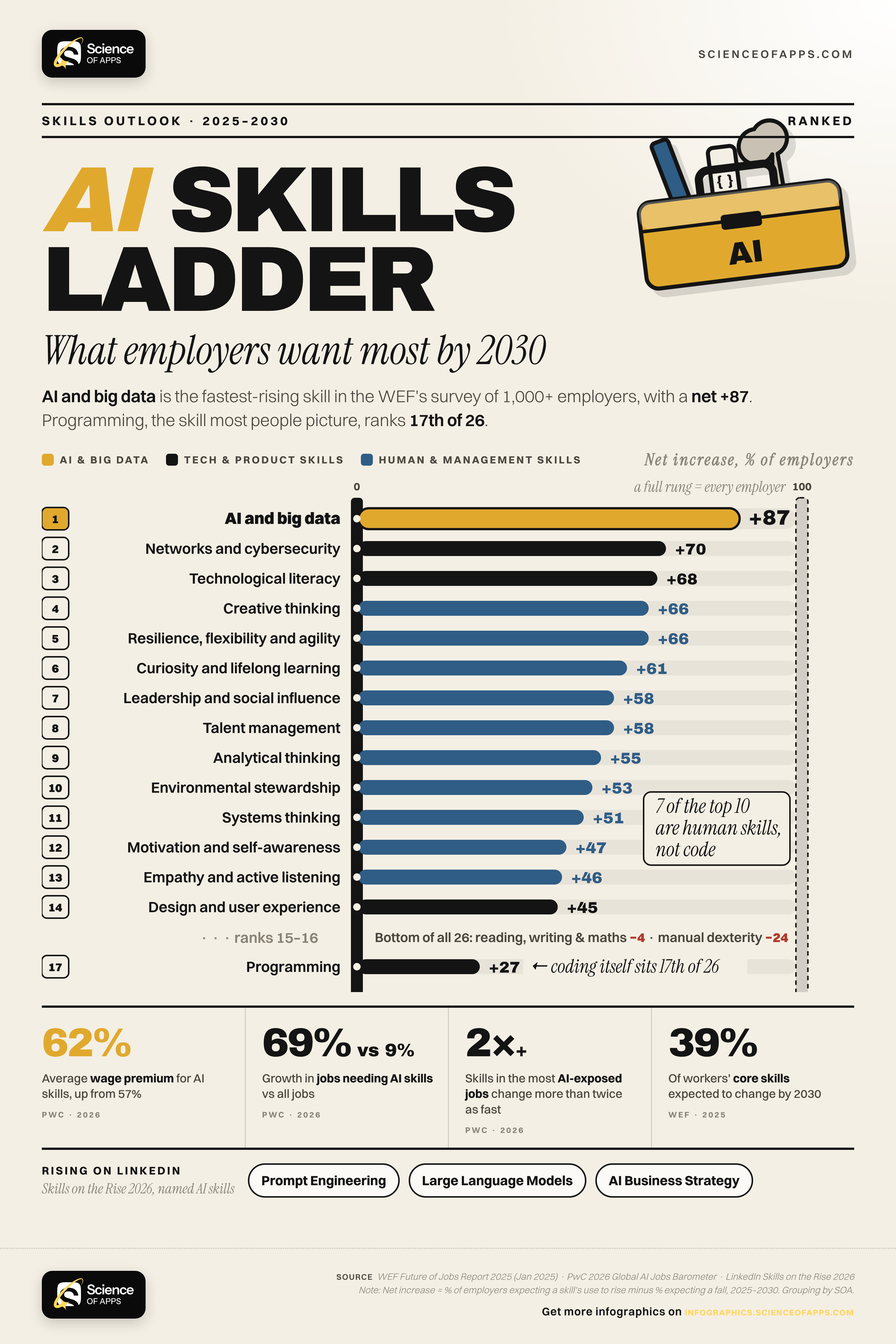
The table below shows the World Economic Forum's ranking of skills on the rise for 2025 to 2030. The score is a net increase: the share of employers who expect a skill to be used more, minus the share who expect it to be used less. Ranks 1 to 14 appear on the infographic, along with programming (17th) and the two skills at the bottom of the list.
| Rank | Skill | Net increase, 2025–2030 |
|---|---|---|
| 1 | AI and big data | +87 |
| 2 | Networks and cybersecurity | +70 |
| 3 | Technological literacy | +68 |
| 4 | Creative thinking | +66 |
| 5 | Resilience, flexibility and agility | +66 |
| 6 | Curiosity and lifelong learning | +61 |
| 7 | Leadership and social influence | +58 |
| 8 | Talent management | +58 |
| 9 | Analytical thinking | +55 |
| 10 | Environmental stewardship | +53 |
| 11 | Systems thinking | +51 |
| 12 | Motivation and self-awareness | +47 |
| 13 | Empathy and active listening | +46 |
| 14 | Design and user experience | +45 |
| 17 | Programming | +27 |
| 25 | Reading, writing and mathematics | −4 |
| 26 | Manual dexterity, endurance and precision | −24 |
The WEF says technology skills are projected to grow in importance faster than any other type of skill. AI and big data leads at +87, followed closely by networks and cybersecurity (+70) and technological literacy (+68). The WEF also reports that in its top 10 industries, more than 90% of respondents expect use of AI and big data skills to increase.
The rest of the top 10 is mostly human. Creative thinking and resilience, flexibility and agility tie at +66, with curiosity and lifelong learning at +61. Leadership and social influence and talent management both score +58, and analytical thinking scores +55. In the WEF's ranking, 7 of the 10 fastest-growing skills are not technical.
The other figures in this article come from PwC and LinkedIn:
| Indicator | Value | Source |
|---|---|---|
| Average wage premium for AI skills | 62% (57% a year earlier) | PwC, 2026 Global AI Jobs Barometer |
| Growth in jobs requiring specific AI skills | 69% | PwC, 2026 Global AI Jobs Barometer |
| Growth in the total jobs market | 9% | PwC, 2026 Global AI Jobs Barometer |
| Speed of skill change, most vs least AI-exposed jobs | more than 2× | PwC, AI Jobs Barometer 2026 |
| Share of workers' core skills expected to change by 2030 | 39% | WEF, Future of Jobs Report 2025 |
| Rising AI skills named by LinkedIn | Prompt Engineering, Large Language Models, AI Business Strategy | LinkedIn, Skills on the Rise 2026 |
How much do AI skills for jobs pay?
A lot more than other skills, and the gap is widening. PwC's 2026 Global AI Jobs Barometer puts the average wage premium for workers with AI skills at 62%, up from 57% the year before. The premium varies widely by industry: as high as 118% in some sectors, such as consumer markets, and 16% in government and the public sector.
Demand is rising too. According to the same June 2026 release, jobs that require specific AI skills, such as prompt engineering or machine learning, grew 69%, almost eight times the 9% growth of the jobs market as a whole. PwC also reports that the number of AI jobs is almost twice what it was in 2024.
How fast are the skills for the future changing?
Faster where AI is involved. PwC's AI Jobs Barometer 2026 finds that the skills needed for the most AI-exposed jobs are changing more than twice as fast as those for the least exposed jobs, and that this gap is 75% wider than the year before.
Across the whole labour market, the WEF expects 39% of workers' core skills to change or become outdated between 2025 and 2030, down from 44% in the 2023 edition of the report. The report suggests one reason may be that more workers have now been trained: 50% have completed training as part of long-term learning strategies, up from 41% in 2023. Even so, the WEF reckons that if the world's workforce were 100 people, 59 would need training by 2030. 63% of employers identify skill gaps as a major barrier to transforming their business over 2025–2030, the barrier cited most often.
LinkedIn's Skills on the Rise 2026 shows the same shift in hiring data. The release says demand for Technical and Strategic AI skills, such as Prompt Engineering and Large Language Models, is growing, and that AI Business Strategy skills are also on the rise as companies build AI into their products, services and processes. LinkedIn's methodology compares profile skill additions and the skills of hired members from December 2024 to November 2025 with the same period a year earlier. LinkedIn's press page names these skills without giving a numeric rank. CIO Dive reported on 3 March 2026 that AI engineering, operational efficiency and AI business strategy top LinkedIn's list.
Is prompt engineering enough, or do you need to code?
For most people, using AI well matters more than coding. In the WEF data, programming has a net increase of +27, which is less than a third of the +87 for AI and big data. It also trails technological literacy (+68), a skill about using technology rather than building it.
The WEF's core-skills ranking for 2025 says the same thing. 45% of employers consider AI and big data a core skill for their workforce, compared with 17% for programming. Analytical thinking is the most common core skill, at 69%. In practice, the skills employers value are framing a problem, judging what a model produces and turning that into a decision, rather than writing the model.
Which AI skills should app teams build?
Design and user experience ranks 14th in the WEF ranking (+45), and 25% of employers call it a core skill today. That skill becomes more important as AI moves into products. Automation bias is the documented tendency of people to over-trust automated output. The job of an app team is to calibrate trust: show confidence levels, make sources visible, and design an easy way to correct the model. That is design work, not model work.
For product and app teams, the data points to three skills to build. First, AI and big data literacy across the whole team, not just among ML engineers, so that product managers can judge model quality and data needs. Second, networks and cybersecurity (+70): AI features add new attack surfaces and privacy risks, and trust is part of the product. Third, the human skills employers rank near the top, creative thinking (+66) and analytical thinking (+55). Teams need these to decide what not to automate. PwC found, in a US analysis of 2.4 million entry-level jobs, that the most AI-exposed entry-level roles are seven times more likely to require traditionally senior skills such as leadership and creativity. That means junior designers and PMs should be trained in judgement early, not just in tools.
Methodology and sources
All figures were read on 27 November 2026 from the primary documents listed below. WEF values are taken from Figure 3.4 of the Future of Jobs Report 2025 (page 37), which ranks skills by net increase: the share of employers expecting a skill to be used more minus the share expecting it to be used less, from 2025 to 2030. They are survey expectations, not measured hiring. PwC figures are taken from its 15 June 2026 press release and its AI Jobs Barometer 2026 web page. LinkedIn's press page names rising skills but publishes no numeric values, so no LinkedIn figure is charted. The "more than 70%" growth in job postings that require AI literacy is reported by CIO Dive and was not verified on a LinkedIn page. The grouping of skills into tech and human categories on the infographic is Science of Apps' own. No values were read from chart images or rounded.
The full list of sources, with links, is below.
Frequently asked questions
What are the most in-demand AI skills for 2027?
In the World Economic Forum's Future of Jobs Report 2025, AI and big data is the fastest-growing skill to 2030, with a net increase of 87 points. LinkedIn's Skills on the Rise 2026 names prompt engineering, large language models and AI business strategy among its rising AI skills.
Is prompt engineering still a valuable skill?
Yes, by current evidence. LinkedIn's February 2026 Skills on the Rise release names prompt engineering among the Technical and Strategic AI skills in growing demand, and PwC's 2026 Global AI Jobs Barometer cites prompt engineering as an example of the specific AI skills whose job postings grew 69%, against 9% for all jobs.
How much more do people with AI skills earn?
PwC's 2026 Global AI Jobs Barometer, published 15 June 2026, puts the average wage premium for AI skills at 62%, up from 57% a year earlier. The premium ranges from 118% in some sectors, such as consumer markets, to 16% in government and public sector work.
Do I need to learn programming to work with AI?
Not necessarily. In the WEF's ranking of 26 skills, programming sits 17th with a net increase of 27, far behind AI and big data (+87) and technological literacy (+68). Employers expect to need people who can use and direct AI tools more than people who write code.
Which skills should app and product teams build first?
Start with AI and big data, technological literacy and design and user experience (net +45 in the WEF ranking), then add the human skills employers rank highly: creative thinking (+66), analytical thinking (+55) and empathy and active listening (+46).
Sources
- World Economic Forum — The Future of Jobs Report 2025
- PwC — AI reshapes global labour market into two distinct paths, rewarding human skills: PwC 2026 Global AI Jobs Barometer
- PwC — AI Jobs Barometer 2026 (web page; accessed Nov 2026)
- LinkedIn — Skills on the Rise: The Fastest-Growing Skills in 2026
- CIO Dive — AI engineering tops list of in-demand skills: LinkedIn
- Checked November 29, 2026. Figures that change — fees, salaries, prices — are reviewed every six months; if something is out of date, tell us.
Where to go from here
- AI Jobs: The Fastest-Growing Careers Through 2030, Charted — Science of Apps Infographics
- The Most Popular AI Tools in 2026, Ranked by Web Traffic — Science of Apps Infographics
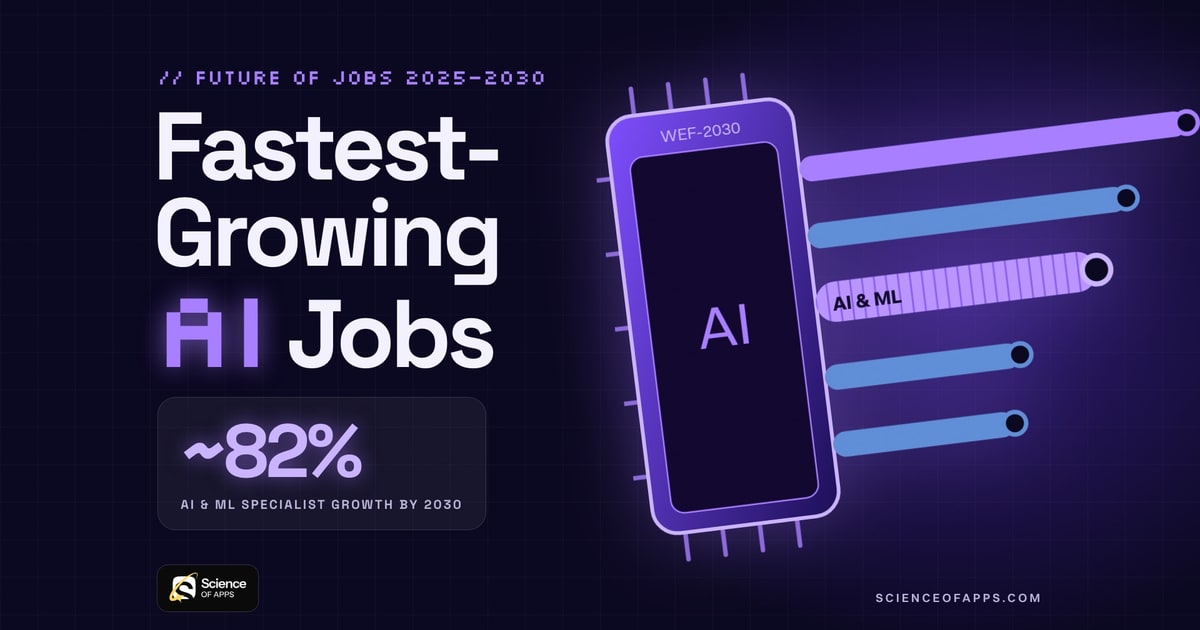
- Science of Apps InfographicsAI Jobs: The Fastest-Growing Careers Through 2030, ChartedAI jobs lead the WEF's fastest-growing list: AI and ML specialist roles are set to grow ~82% by 2030, and AI skills earn a 62% wage premium (PwC, 2026).
- CertificationsSkills for the futureThe top skills to learn by 2030 according to the WEF: AI and big data, cybersecurity, analytical and creative thinking, resilience and lifelong learning.
- Career guides by Science of Apps for 2027Is Data Analytics Still a Good Career in 2027? — answered for 2027Is data analytics still a good career in 2027? AI and big data top the WEF's growing skills. What's changing and the certifications to start.
- Career guides by Science of Apps for 2027Is Cybersecurity Still Worth Getting Into in 2027? — answered for 2027Is cybersecurity still worth getting into in 2027? Networks and cybersecurity rank among the WEF's fastest-growing skills. How to start and what to expect.
- CertificationsMost in-demand skills 2027–2030The most in-demand skills for 2027 to 2030, based on the World Economic Forum's Future of Jobs Report 2025, and the certifications that prove them.
- Career guides by Science of Apps for 2027The top skills to learn in 2027, with ten certifications that prove themThe top skills to learn in 2027, from WEF data: AI, data, cybersecurity, cloud, tech literacy and more, with 10 certifications that prove each one.




Get the ideas, not the noise.
Sign up with Google and we’ll send you short UX psychology tips by email — why people tap, stall and leave, and what to do about it. Unsubscribe anytime. Prefer something to keep? Get the free Laws of UX guide as a PDF.
See what your own users' numbers are telling you.
A behavioral UX audit of your app or SaaS product: why users hesitate, stall and leave, and a prioritized fix list. Fixed price, 2–4 weeks.