 By
Quick answer: What online startup can I start?
- 30 e-commerce startup ideas, most of them tools or services for online sellers.
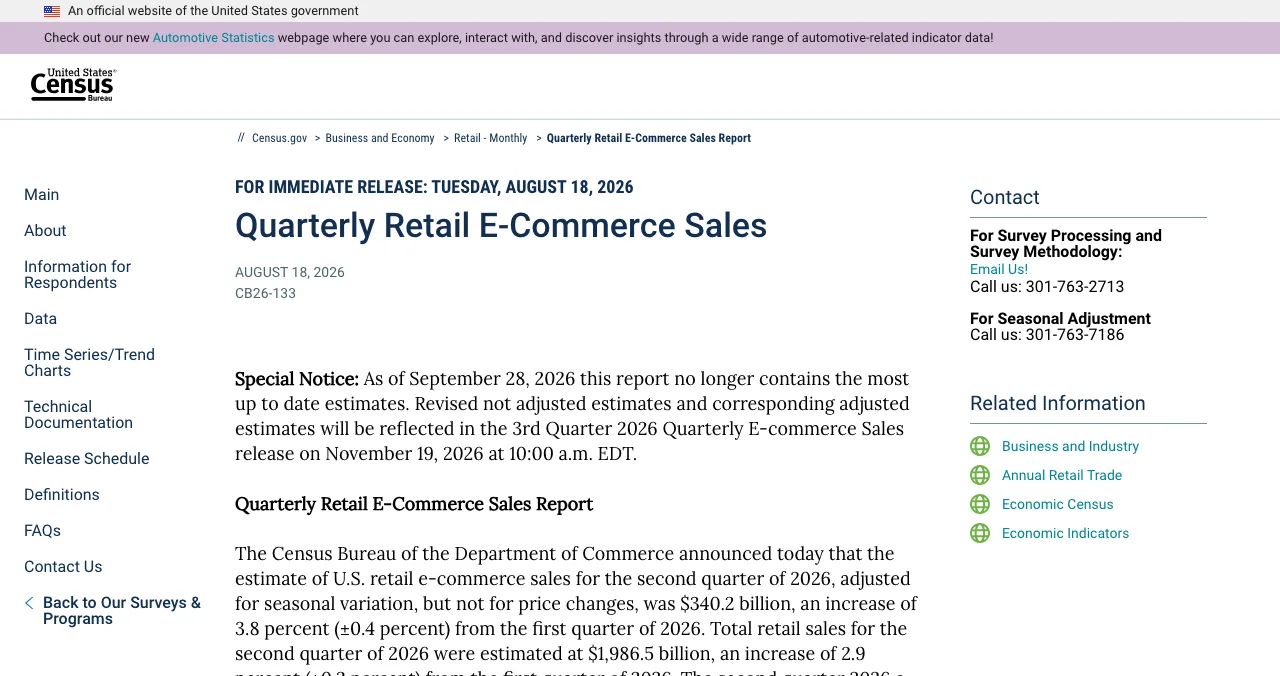
- Market: US retail e-commerce was $340.2bn in Q2 2026, 17.1% of all retail (Census).
- Signals: real r/ecommerce threads on 3PL bills, fraud, counterfeits and AI answers.
- Laptop-friendly: no inventory needed for most ideas.
- Launch free: a permanent listing plus a test of your store or app.
Key takeaways
- Selling to sellers is often easier than becoming one: they already spend money to fix problems.
- Fees, fraud and fulfilment are where sellers lose the most money and post the most complaints.
- Most ideas here need no inventory, warehouse or ad budget to start.
- AI assistants are a new channel sellers can't yet monitor well.
- Start as a service for five sellers; build software for what you repeat.
Running an online store is one way into e-commerce. Building for the people who run online stores is another, and often a safer one: sellers already spend money on the problems that cost them most, and they post about those problems in detail. This guide gives 30 e-commerce startup ideas you can run from a laptop, mostly tools and services for sellers, each tied to a real r/ecommerce thread (with its date) or official data from the US Census Bureau. Sources were checked on 18 November 2026. For freelance and digital-product income, see our online business ideas with low investment. Jump to the market, the 30 ideas or launching free.
- US retail e-commerce, Q2 2026 (seasonally adjusted)
- $340.2bn
- Share of all US retail sales
- 17.1%
- Year-on-year growth
- +12.2%
- E-commerce startup ideas in this guide
- 30
How big is e-commerce, and where are the problems?
The US Census Bureau estimated retail e-commerce at $340.2 billion in the second quarter of 2026, up 3.8% on the first quarter and 12.2% on a year earlier, making up 17.1% of total retail sales. Its next release, for Q3 2026, is scheduled for 19 November 2026.
Growth brings back-office pain. These r/ecommerce threads show where sellers are losing money:
| Problem | What the seller described | Thread date |
|---|---|---|
| Fulfilment fees | A 3PL bill doubled to $9k, eight pages of coded line items | 28 Jan 2026 |
| Triangulation fraud | Products relisted on eBay and fulfilled with stolen cards; seven listings found | 18 Mar 2026 |
| Counterfeits | Fakes without the key feature; buyers blaming the original brand | 31 Dec 2025 |
| AI answers | An AI assistant described a store as a scam, citing complaints the owner says were invented | 29 Mar 2026 |
| Warehouse software | A ~$35M multi-channel seller found WMS upgrades too costly | 21 Dec 2025 |
| Catalogue accuracy | A printed lookbook out of date by print day; a switch to data-driven catalogues | 14 Feb 2026 |
Table: Where e-commerce sellers are losing money (r/ecommerce threads, read 18 Nov 2026)
Notice what these have in common. Each is a problem a seller already pays for, in fees, chargebacks, lost sales or staff time, and each is too small or too specialised for the big platforms to prioritise. That's the sweet spot for an online startup: a clear cost, a buyer who feels it monthly, and room for a focused product. The AI-answers thread is the newest of the six, and arguably the least served: as more shoppers ask assistants about stores, a wrong answer becomes a recurring cost that few tools yet measure.
30 e-commerce startup ideas
Each idea lists the customer and a first test you can run from a laptop. They're editorial suggestions, not proven businesses.
Fees and fulfilment
| # | Idea | Customer | Laptop test |
|---|---|---|---|
| 1 | 3PL invoice auditor that checks charges against the contract | Brands using a 3PL | Audit one invoice for a share of savings |
| 2 | Marketplace fee reconciler (fees charged vs fees expected) | Multi-channel sellers | Reconcile one month for one seller |
| 3 | Shipping-rate benchmarks by lane and weight | Small importers | Collect quotes for three lanes |
| 4 | Mid-market warehouse software for two-location sellers | Growing brands | Interview five ops leads |
| 5 | Returns-cost calculator by product | Apparel and home brands | Model one store's returns |
| 6 | Supplier lead-time tracker | Importers | Track ten suppliers for a month |
Table: E-commerce startup ideas for fees and fulfilment (signals: r/ecommerce, 28 Jan 2026 and 21 Dec 2025)
Fraud, fakes and trust
| # | Idea | Customer | Laptop test |
|---|---|---|---|
| 7 | Listing-copy monitor for marketplaces (triangulation alerts) | Independent stores | Search eBay for ten stores' products |
| 8 | Counterfeit detection and takedown service | Brands with a hit product | File takedowns for one brand |
| 9 | Chargeback evidence packs | Small online stores | Assemble one store's last dispute |
| 10 | Supplier verification reports | First-time importers | Verify three suppliers |
| 11 | Fake-review detection for product pages | Marketplace sellers | Audit 200 reviews for one product |
| 12 | Brand-impersonation ad finder | DTC brands | Search ad libraries for five brands |
Table: Trust and fraud e-commerce startup ideas (signals: r/ecommerce, 18 Mar 2026 and 31 Dec 2025)
AI answers and discoverability
| # | Idea | Customer | Laptop test |
|---|---|---|---|
| 13 | Monitor what AI assistants say about a store | DTC brands | Run 20 prompts for five stores |
| 14 | Correction service: fix the sources behind wrong AI answers | Stores with bad answers | Fix one brand's sources |
| 15 | Product structured-data generator from catalogues | Online stores | Mark up one store's top ten products |
| 16 | Comparison-page builder for niche categories | Category leaders | Write one comparison page |
| 17 | Marketplace search-rank tracker for one niche | Marketplace sellers | Track 20 keywords weekly |
| 18 | Review-response assistant | Sellers with many reviews | Draft responses for one store |
Table: Discoverability e-commerce startup ideas (signal: r/ecommerce, 29 Mar 2026)
Catalogues and content
| # | Idea | Customer | Laptop test |
|---|---|---|---|
| 19 | Spreadsheet-to-wholesale-catalogue tool that stays current | Wholesale brands | Build one catalogue by hand |
| 20 | Product-photo consistency checker | Marketplaces, big catalogues | Review 100 listings |
| 21 | Size-chart standardiser for apparel | Clothing stores | Rewrite one store's charts |
| 22 | Product-description translation with local units | Cross-border sellers | Translate ten listings |
| 23 | Out-of-stock and price-change alerts for retailers | Wholesale buyers | Monitor one supplier |
| 24 | Ingredient and compliance label checker | Food and cosmetics sellers | Check one store's labels |
Table: Catalogue e-commerce startup ideas (signal: r/ecommerce, 14 Feb 2026)
Online startup ideas beyond tools
Not every online startup needs to sell to sellers. These are store and service models that suit a laptop, each with a lesson from sellers' own posts. A July 2026 r/ecommerce thread asking how people would start an e-commerce business from $0 today drew 350+ replies worth reading before choosing.
| # | Idea | Customer | Laptop test |
|---|---|---|---|
| 25 | Event passes instead of subscriptions for one-off life events | Couples, movers, families | Pre-sell ten passes |
| 26 | Curated store for one underserved need (e.g. adaptive clothing) | A specific community | Pre-orders from a waitlist |
| 27 | Refurbished goods for one category, with inspection reports | Value buyers | Sell five inspected items |
| 28 | Digital products for one profession | Trades, clinics | Sell one template pack |
| 29 | Subscription refills for one consumable | Repeat buyers | Run ten subscriptions by hand |
| 30 | B2B reorder portal for local wholesalers | Cafés, salons | Take reorders by form for one supplier |
Table: Online startup ideas for stores and services (signals: r/Entrepreneur, 18 Mar 2026; r/ecommerce, 15 Jul 2026)
Idea 25 comes from a March 2026 r/Entrepreneur post by wedding-tech founders who said switching from monthly pricing to one-time event passes lifted conversions, because couples think in events, not subscriptions.
Build a store or build for stores?
| Run an online store | Build tools or services for stores | |
|---|---|---|
| Upfront money | Stock, samples, photography | Mostly your time |
| Main risk | Unsold inventory, ad costs | Finding the first five sellers |
| Who you sell to | Consumers, one at a time | Businesses with budgets for the problem |
| Proof of demand | Pre-orders, repeat purchases | Money saved or recovered for a seller |
| Competition | Other stores, marketplaces, counterfeiters | Agencies, freelancers, existing software |
| Best for | Founders who know a community and its products | Founders who've worked in e-commerce operations |
Table: Running an online store vs building for stores (Science of Apps editorial)
A hypothetical example. Say you spent two years handling disputes for an online retailer. You message ten small store owners offering to prepare evidence for their next three chargebacks at no cost, in exchange for honest feedback. Six reply; four send disputes. You win some and lose some, but you learn which evidence each payment provider asks for and how long each pack takes you. You charge the next five stores a flat fee per dispute, keep a checklist of the documents you always gather, and only then automate the collection of order, delivery and customer-contact records. That's the shape of most ideas in this list: a skill, a handful of sellers, a repeated task, then software.
Which e-commerce startup idea fits you?
| Your background | Start with | Why |
|---|---|---|
| E-commerce operations | Fees and fulfilment | You've read the invoices |
| Fraud, payments or risk | Fraud, fakes and trust | Knowledge sellers lack |
| SEO or marketing | AI answers and discoverability | A new channel few understand |
| Data or spreadsheets | Catalogues and content | Accuracy is the product |
| A community you belong to | Online startup ideas beyond tools | You know what they buy |
Table: Matching e-commerce startup ideas to founder backgrounds (Science of Apps editorial)
How to test an e-commerce startup idea

- Find five sellers — in r/ecommerce, seller communities or your network.
- Ask for the artefact — the invoice, the chargeback, the return report.
- Fix it by hand — and measure the money saved or recovered.
- Charge the next five — a flat fee or a share of savings.
- One page, one free listing — describe the result in sellers' words.
- Automate the most repeated check — that's your first version.
Launch on the Science of Apps Launchpad
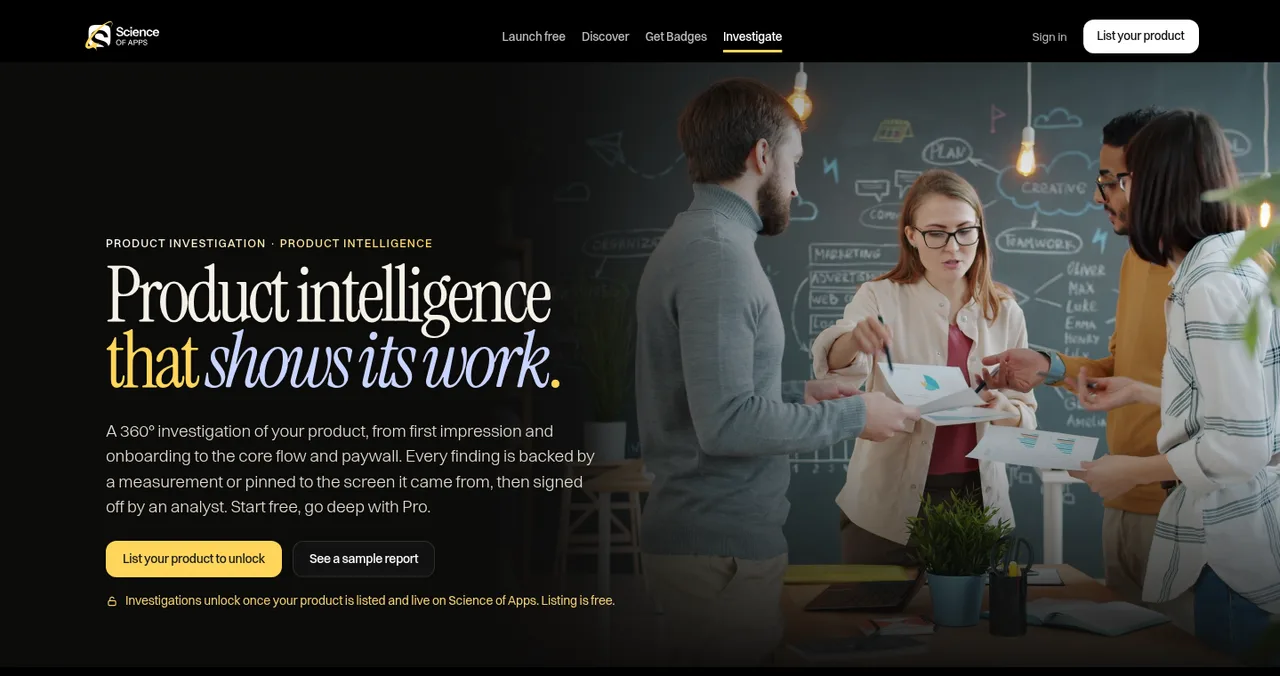
List your store, app or seller tool free, forever: six short steps, automated checks and a human moderator, ranked by relevance, editorial picks and community interest, never payment. Going live unlocks a free baseline diagnosis of your landing page, discoverability and speed. A full investigation tests the journey end to end in a real browser on desktop and mobile, including the Pay stage (paywall, checkout and payments), with every finding approved by an analyst.
Arrive
First impression
Discoverability on Google, AI and social; landing page, pricing, trust and speed.
Join
The first minutes
Sign-up, sign-in and onboarding.
Use
The everyday job
Browsing, search, product pages and error states.
Pay
Value into revenue
Cart, checkout and payments.
Stay
Coming back
Notifications, account, orders and help.
Every screen
Throughout
Accessibility to WCAG 2.2, visual design and consistency.
See your store the way a first-time buyer does
List free, then order the report that fits your stage.

 Economy
See what new customers see
- Store listing and homepage, screen by screen
- Scorecard against 60 Laws of UX
- The fixes worth most
PremiumThe full diagnosis and the plan
- Every screen, every finding, every flow
- All 60 laws with evidence and fixes
- 8 strategy chapters and a 90-day roadmap
Private to your team. Never affects ranking.
A 30-day plan
- Week 1
Pick and ask
Choose one idea; ask five sellers for the relevant artefact.
- Week 2
Fix by hand
Deliver results for two sellers; measure savings.
- Week 3
Charge
Sign three paying sellers; log every step you repeat.
- Week 4
Launch
One page, a free Launchpad listing, and a post in communities that allow it.
Mistakes

- Buying inventory to test demand — pre-orders and waitlists come first
- Selling software before the service — sellers buy results
- Copying a trending product — counterfeiters and resellers move faster
- Ignoring checkout friction — every extra field costs orders; see Hick's law
- Forgetting AI answers — buyers ask assistants about stores; check what they say
Ready to launch?
How we chose
We read the top r/ecommerce posts of the past year (as of 18 November 2026) and grouped the recurring problems; each idea maps to one. Market figures come from the US Census Bureau's Q2 2026 e-commerce release. Thread dates are post dates; posters' claims are their own and paraphrased. Ideas are editorial suggestions. Science of Apps runs the Launchpad.
Key terms, defined
- 3PL: a third-party logistics provider that stores, packs and ships goods for sellers.
- Triangulation fraud: relisting a seller's product elsewhere and fulfilling the order from the seller with stolen payment details.
- Chargeback: a payment reversed by the buyer's bank after a dispute.
- WMS: warehouse management system, software for stock, picking and shipping.
- DTC: direct-to-consumer, a brand selling through its own store.
Frequently asked questions
What online startup can I start?
One that solves a problem online sellers already pay to fix, delivered from a laptop: auditing 3PL invoices, finding copies of a store's listings on marketplaces, assembling chargeback evidence, keeping wholesale catalogues accurate, or monitoring what AI assistants say about a brand. Each can start as a service for a few sellers with no inventory or upfront spend.
What are good e-commerce startup ideas for 2027?
Good e-commerce startup ideas for 2027 target the back office of online retail, which keeps growing: US e-commerce reached $340.2 billion in Q2 2026, up 12.2% on a year earlier, per the US Census Bureau. Strong signals on r/ecommerce include unreadable 3PL invoices, triangulation fraud, counterfeits and AI assistants misdescribing stores.
Is it better to start an online store or build tools for stores?
It depends on your skills. A store needs product sourcing, inventory risk and marketing. Tools and services for stores need knowledge of one painful process and access to sellers. If you've worked in e-commerce operations, selling to sellers is usually lower risk: your customers already know the problem and have budgets.
Do I need inventory for an e-commerce startup?
Not for most ideas in this guide. Audits, monitoring, data and software for sellers need no stock. If you want to sell physical products yourself, you can test demand with pre-orders or small batches before committing to inventory, and compare platforms first; our Shopify vs WooCommerce guide covers the trade-offs.
How do I find e-commerce problems worth solving?
Read the top posts of the past year in r/ecommerce and the subreddits for each marketplace, and note the problems that cost sellers money. Ask five sellers to show you their last invoice, chargeback or return report. Look for problems they're already paying an agency, a freelancer or an employee to handle badly.
How do I launch an e-commerce tool or store for free?
Deliver the first version by hand, build a one-page site with a free form, and list it on the Science of Apps Launchpad, which is free, forever, and ranks by relevance, not payment. Going live unlocks a free baseline check of your landing page, discoverability and speed; a full product test is available when you want it.
Sources
- US Census Bureau — Quarterly Retail E-Commerce Sales, Q2 2026, released 18 Aug 2026 (checked 18 Nov 2026)
- Reddit — r/ecommerce: 3PL costs keep increasing, 28 Jan 2026 (checked 18 Nov 2026)
- Reddit — r/ecommerce: I may have found a solution to the triangulation scam, 18 Mar 2026 (checked 18 Nov 2026)
- Reddit — r/ecommerce: counterfeits after a viral product, 31 Dec 2025 (checked 18 Nov 2026)
- Reddit — r/ecommerce: Gemini is defaming and lying about my business, 29 Mar 2026 (checked 18 Nov 2026)
- Reddit — r/ecommerce: affordable WMS that doesn't compromise on features, 21 Dec 2025 (checked 18 Nov 2026)
- Reddit — r/ecommerce: beautiful catalogs are overrated, accurate ones sell, 14 Feb 2026 (checked 18 Nov 2026)
- Reddit — r/ecommerce: if you had to start an eCommerce business from $0 today, 15 Jul 2026 (checked 18 Nov 2026)
- Reddit — r/Entrepreneur: making money in the wedding industry, 18 Mar 2026 (checked 18 Nov 2026)
- Science of Apps — Launchpad: list your product free (checked 18 Nov 2026)
- Science of Apps — Product investigation: 22 areas (checked 18 Nov 2026)
- Checked November 18, 2026. Figures that change — fees, salaries, prices — are reviewed every six months; if something is out of date, tell us.
Where to go from here
- Online business ideas, low investment — services and digital products
- Shopify vs WooCommerce — pick a store platform
- 100 startup ideas — with a signal for each
- Science of Apps - Launchpad100 startup ideas for 2027, each tied to a real problem signal from YC's Requests for Startups, Reddit threads or official data, and how to test any of them free before you build100 startup ideas for 2027, each tied to a real problem signal: YC's requests, dated Reddit threads and official data. Plus a free way to test yours.
- Science of Apps - Launchpad50 tech startup ideas for 2027, grouped by the technical shift that makes each one newly possible, with the problem signal behind it and how to launch and test a software startup free50 tech startup ideas for 2027, grouped by the shift that makes each possible now, from air-gapped AI to permit software, plus a free way to launch yours.
- Science of Apps - LaunchpadAgriculture startup ideas for 2027: 25 agritech ideas tied to USDA and FAO data and real farmers' posts, what makes an agritech idea profitable, and how to launch and test one free25 agriculture startup ideas for 2027, tied to USDA and FAO data and real farmers' posts, plus what makes agritech pay and how to launch yours free.
- Science of Apps - LaunchpadStartup ideas for women founders in 2027: 30 ideas built on real problem signals, from care tech to deep tech, plus funding programmes for women that are open right now and how to launch free30 startup ideas for women founders, from care tech to deep tech, plus three funding programmes for women open now (checked 18 Nov 2026) and a free launch.
- Science of Apps - LaunchpadStartup ideas from Reddit: where people share them, 20 real threads from the past year (with subreddit and date) describing problems people want solved, and how to turn each into a testable listingStartup ideas from Reddit: where people share them, 20 real threads from the past year by subreddit and date, and how to turn a pain point into a test.
- Science of Apps - LaunchpadHow to validate a startup idea in 7 days: a day-by-day plan to find out whether people will use and pay for itHow to validate a startup idea in 7 days: define the problem, find people who have it, run 10+ interviews, test demand with a page and a price, then decide.
Get the ideas, not the noise.
Sign up with Google and we’ll send you short UX psychology tips by email — why people tap, stall and leave, and what to do about it. Unsubscribe anytime. Prefer something to keep? Get the free Laws of UX guide as a PDF.
Launch day ends. Your listing shouldn't.
Launching an online store or a tool for sellers? List it free on the Science of Apps Launchpad for a permanent, findable profile and a product test of your store or app, with a detailed report.