 By
Quick answer: How do I write a good product listing for directories?
- Name: the product's name only.
- One-liner: what it does, for whom; under 60 characters for taglines.
- Description: problem and outcome first, then three features, then who it's for.
- Categories and competitors: accurate; SaaSHub wants competitors.
- Media: screenshots of the product in use, not just a logo.
- Pricing: honest: Free, Freemium, Paid.
Key takeaways
- Write a master listing once, then trim it to each site's limits.
- Consistency across directories helps people and AI engines trust the facts.
- Screenshots of the core flow sell better than logos and slogans.
- Pick categories buyers browse, not ones that flatter you.
- Keep listings current; stale prices and features cost trust.
Directory listings are tiny landing pages, and most are written like afterthoughts: a slogan, a logo, a wall of features. The listings that get clicked do the opposite: they say what the product does for whom, show it working, and match the facts on every other site. This how-to gives a master template and each major site's field rules, from Product Hunt's, SaaSHub's and AlternativeTo's own pages as read on 17 November 2026. Jump to the template, site rules or images.
The master template
| Field | What to write |
|---|---|
| Name | The product's name only; no tagline, no emoji |
| One-liner | What it does, for whom, in under 60 characters |
| Description | Problem and outcome first; three features; who it's for |
| Categories or tags | What buyers browse, up to each site's limit |
| Competitors | The tools you actually replace |
| Media | Screenshots or a GIF of the product in use |
| Pricing | Free, Freemium, Paid, honestly |
| Platforms and links | Web, iOS, Android, desktop; docs; socials |
Table: A master directory listing (fields common to major directories)
A description that works

- The problem — one sentence your user would say.
- The outcome — what changes with your product.
- Three features — the ones that deliver the outcome.
- Who it's for — name them.
- Proof — a number, a customer type, a standard you meet.
Each site's rules
| Site | Key rules |
|---|---|
| Product Hunt | Name up to 40, tagline up to 60, description up to 500 characters; at least one gallery image; up to 3 launch tags |
| SaaSHub | Website URL, categories, competitors (or you're queued last); domain verification gives priority; released products only |
| AlternativeTo | One entry per product; platforms, licence, description, tags; suggest as an alternative on competitors' pages |
Table: Directory field rules (each site's own pages, checked 17 Nov 2026)
Images

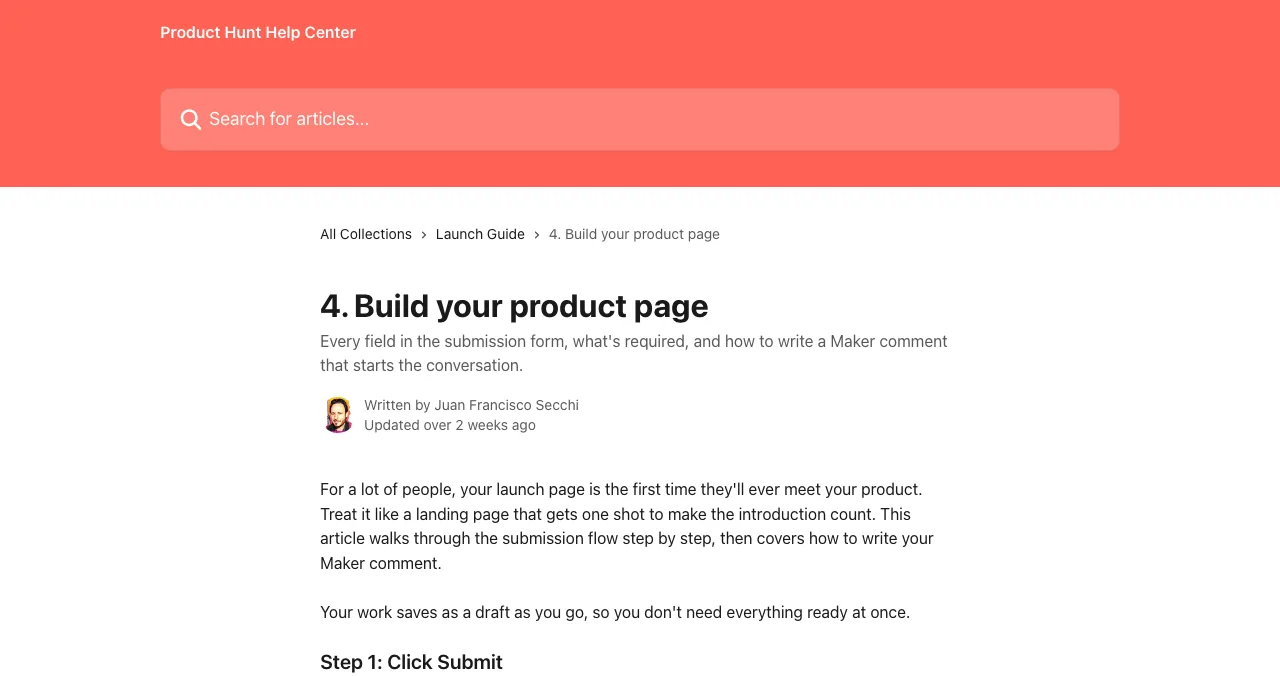
- The product in use — Product Hunt: "not just your logo"
- The core flow — the moment of value
- A before-and-after — where it fits
- A short GIF or video — a screen recording is enough
- Product Hunt size — 1270×760 px recommended
Mistakes

- A different description on every site
- Logo-only galleries
- Wrong categories — chosen for traffic, not fit
- "Freemium" for a trial — AlternativeTo calls that Commercial
- Stale prices and features
Ready to list?
How we know
Field rules come from Product Hunt's "Build your product page" guide, SaaSHub's submission page and AlternativeTo's FAQ, all read on 17 November 2026. The master template is our own.
Key terms, defined
- Directory listing: a product's profile on a directory site.
- Category: a section buyers browse.
- Tag: a keyword describing a feature or use.
- Gallery: the images on a listing.
- Freemium: free with limited functionality.
Frequently asked questions
What should a product directory listing include?
Name, a one-line description, a longer description leading with the problem and outcome, categories or tags, competitors where asked, screenshots of the product in use, pricing, platforms and links.
How long should a directory description be?
Follow each site's limit. Product Hunt allows 60 characters for a tagline and 500 for a description. Write a master version, then trim.
Should I use the same description on every directory?
Use the same name, one-liner and facts everywhere; adapt length and emphasis per site. Consistency helps people recognise you and helps search and AI engines connect the facts.
What images should I use?
Screenshots of the product in use: the core flow, a before-and-after, a short GIF of the key moment. Product Hunt recommends 1270×760 px gallery images and says to show the product, not just your logo.
Why does SaaSHub ask for competitors?
SaaSHub says submissions without listed competitors are slowed down and put at the bottom of the queue; competitors place you among alternatives.
How do I choose the pricing label?
Honestly. On AlternativeTo, Freemium means a free version fully functional for the main purpose; a time-limited trial is Commercial. Product Hunt offers Free, Paid or Free options.
Sources
- Product Hunt Help Center — Build your product page (checked 17 Nov 2026)
- SaaSHub — Submit a Product (checked 17 Nov 2026)
- AlternativeTo — FAQ (checked 17 Nov 2026)
- Science of Apps — Launchpad: launch your product free
- Checked November 17, 2026. Figures that change — fees, salaries, prices — are reviewed every six months; if something is out of date, tell us.
Where to go from here
- How to write a startup one-liner — the line to reuse
- Free startup directories — where to list
- SaaS directories — software-specific
- Science of Apps - LaunchpadSaaSHub vs AlternativeTo: how each lists software, what each accepts and rejects, and how to get listed on bothSaaSHub vs AlternativeTo compared: who each accepts, how submission and approval work, what gets rejected, and how to list your software on both.
- Science of Apps - LaunchpadProduct launch taglines that get clicks: Product Hunt's 60-character rules, patterns that work, examples by product type, and the hype to cutHow to write a product launch tagline: Product Hunt's 60-character rule, patterns that work, examples for SaaS, apps, AI and dev tools, and what to cut.
- Science of Apps - LaunchpadWhere to launch a SaaS in 2027: 14 launch sites and directories, by stage, with fees and rules checkedWhere to launch your SaaS in 2027: 14 launch sites and directories by stage, from Product Hunt and Uneed to SaaSHub and AlternativeTo, with fees checked.
- Science of Apps - LaunchpadSaaS directories worth your time in 2027: 13 checked places to list a SaaS, labelled buyer-intent or launch, free or paid, with their rules13 SaaS directories worth listing on in 2027, each checked: buyer-intent vs launch sites, free vs paid, the rules, and whether directories help SEO.
- Science of Apps - LaunchpadFree startup directories in 2027: 16 checked sites to submit your startup to, grouped by what you want (investors, customers, a launch, India) with each one's rules16 free startup directories checked for 2027, grouped by goal: investors, customers, launch day and India, with each site's rules and the ones to skip.
- Science of Apps - LaunchpadHow to write a startup one-liner: the formula, the test Product Hunt uses, before-and-after examples, and why the same line everywhere helps search and AI enginesHow to write a startup one-liner: a simple formula, Product Hunt's tagline test, before-and-after examples, and why one consistent line helps AI search.
Get the ideas, not the noise.
Sign up with Google and we’ll send you short UX psychology tips by email — why people tap, stall and leave, and what to do about it. Unsubscribe anytime. Prefer something to keep? Get the free Laws of UX guide as a PDF.
Launch day ends. Your listing shouldn't.
Write your listing once and start here: a free, permanent Launchpad profile, ranked by relevance and never by payment, plus your product tested end to end with a detailed report.