 By
Quick answer: How do I write a good product launch tagline?
- Limit: 60 characters on Product Hunt.
- Rule: say exactly what it does; skip 'the best' and '#1'.
- Test: name plus tagline alone explains the product.
- Patterns: 'X for Y', 'Do X without Y', 'The outcome, stated plainly'.
- Clear before clever: people read it on a leaderboard and decide in seconds.
Key takeaways
- The tagline is what people see on the leaderboard before they decide to click.
- Clarity wins: a clever line nobody understands gets scrolled past.
- Name the user or the job; vague category words don't.
- Write ten, test on strangers, keep the clearest.
- Reuse it on every launch site and directory.
On launch day, most people meet your product as two lines on a leaderboard: a name and a tagline. That's the whole pitch, and it has to work in the second it takes to scroll past. Product Hunt's own guide is unusually specific about what works, down to the character limit. This how-to covers its rules (read on 17 November 2026), three patterns that work, examples by product type, and the words to cut. Jump to the rules, patterns or examples.
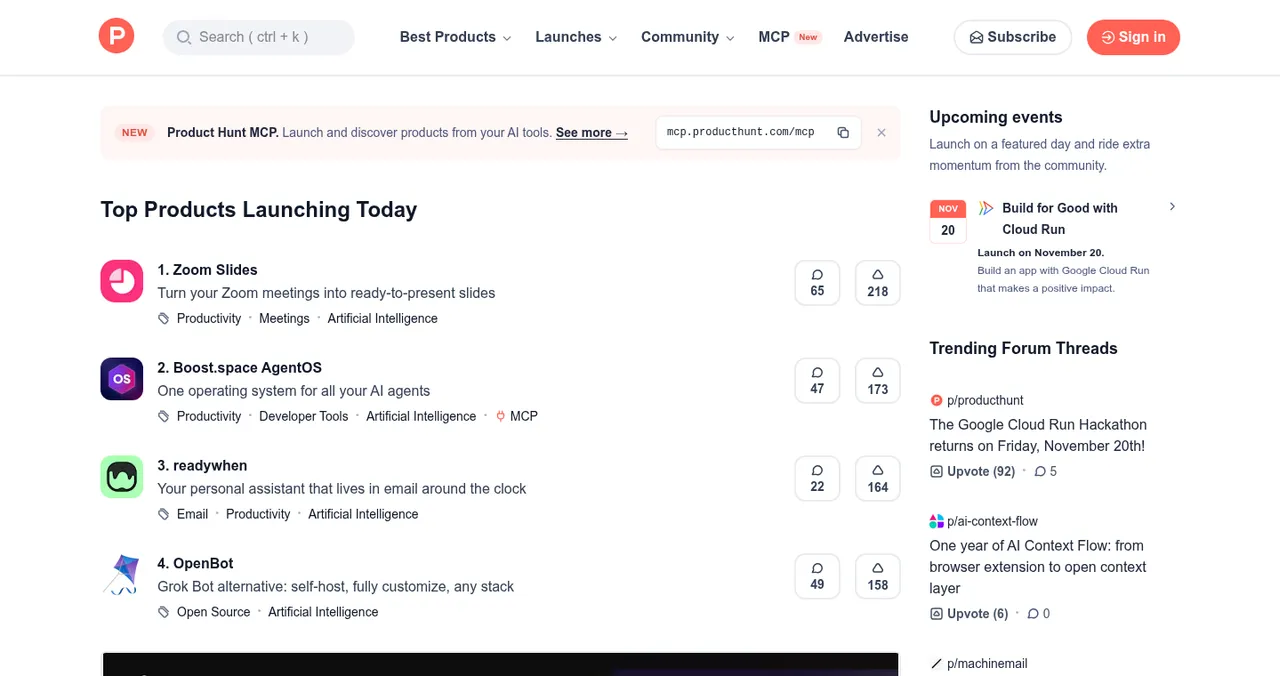
Product Hunt's rules
| Field | Limit | Rule |
|---|---|---|
| Name | 40 characters | Just the name; no taglines or emoji |
| Tagline | 60 characters | Say exactly what it does; skip hype |
| Description | 500 characters | Lead with value, then features |
Table: Product Hunt name, tagline and description rules (help centre, checked 17 Nov 2026)
Three patterns that work
| Pattern | Shape | Illustrative example |
|---|---|---|
| X for Y | The job, for a specific user | Invoicing for Indian freelancers |
| Do X without Y | The job minus the pain | Ship landing pages without a developer |
| The outcome, plainly | What happens for the user | Meeting notes that write themselves (Product Hunt's) |
Table: Tagline patterns (examples are illustrative, except Product Hunt's own)
Examples by product type
| Type | Vague | Clear |
|---|---|---|
| SaaS | The future of work | Shared to-do lists for small teams |
| Mobile app | Your wellness companion | A 5-minute breathing coach for anxious mornings |
| AI tool | AI-powered content magic | Turn a podcast into show notes in one click |
| Developer tool | Next-gen DX | A test database for every pull request |
| Marketplace | Connecting people | Book a verified home tutor in your area |
Table: Vague vs clear launch taglines (illustrative examples)
Words to cut

- "The best", "#1" — Product Hunt says skip them
- "The future of…" — Product Hunt's own example of what doesn't work
- "Platform", "solution", "ecosystem" — category fog
- "Revolutionary", "next-gen", "magic" — unverifiable
- Emoji — not in the name, per Product Hunt
How to choose

- Write ten taglines using the three patterns.
- Cut each to 60 characters.
- Show each with the name to five strangers.
- Keep the one they explain back correctly.
- Use it everywhere — site, launch pages, directories.
Ready to launch it?
How we know
Limits, rules and the "meeting notes" example come from Product Hunt's "Build your product page" guide, read on 17 November 2026. Other examples are illustrative lines we wrote, not real products.
Key terms, defined
- Tagline: a very short line under a product's name.
- Leaderboard: Product Hunt's ranked list of the day's launches.
- Hype: superlatives a visitor can't check.
- Pattern: a reusable shape for a tagline.
- Description: the longer text below the tagline.
Frequently asked questions
How long can a Product Hunt tagline be?
Up to 60 characters. The product name can be up to 40 characters and the description up to 500.
What makes a good launch tagline?
It says exactly what the product does in plain words. Product Hunt's example: 'Meeting notes that write themselves' works; 'The future of productivity' doesn't.
Should my tagline be clever or clear?
Clear. Product Hunt says to make it clear before you make it clever, because people read it on the leaderboard before deciding to click.
Can I use 'the best' or '#1' in my tagline?
Product Hunt tells makers to skip hype like 'the best' or '#1'. They take space and say nothing a visitor can check.
What tagline patterns work?
'X for Y' (the job for a specific user), 'Do X without Y' (the job minus the pain), and the outcome stated plainly. Each tells a stranger what the product does.
Should my tagline match my website?
Yes. The same line on your homepage, launch pages and directories helps people recognise you and keeps your facts consistent.
Sources
- Product Hunt Help Center — Build your product page: name, tagline, description (checked 17 Nov 2026)
- Product Hunt Help Center — What kind of products get featured (checked 17 Nov 2026)
- Science of Apps — Launchpad: launch your product free
- Checked November 17, 2026. Figures that change — fees, salaries, prices — are reviewed every six months; if something is out of date, tell us.
Where to go from here
- How to write a startup one-liner — the longer version
- How to launch on Product Hunt — where the tagline lives
- Product Hunt launch mistakes — a vague tagline is one
- Science of Apps - LaunchpadHow to write a product directory listing: name, one-liner, description, categories, screenshots and the field rules of Product Hunt, SaaSHub and AlternativeToHow to write a directory listing that gets clicks: one-liner, description, categories, screenshots, and the rules of Product Hunt, SaaSHub and AlternativeTo.
- Science of Apps - LaunchpadHow to write a startup one-liner: the formula, the test Product Hunt uses, before-and-after examples, and why the same line everywhere helps search and AI enginesHow to write a startup one-liner: a simple formula, Product Hunt's tagline test, before-and-after examples, and why one consistent line helps AI search.
- Science of Apps - LaunchpadThe Product Hunt launch checklist: every field, size and rule from Product Hunt's own launch guide, in orderA free Product Hunt launch checklist for 2027: required fields, image sizes, character limits, launch-day rules and follow-up, from Product Hunt's own guide.
- Science of Apps - LaunchpadThe Product Hunt launch mistakes that kill your ranking, or your launch, and how to avoid each oneThe Product Hunt launch mistakes that hurt ranking or get launches removed: asking for upvotes, new-account votes, vague taglines, broken flows and more.
- Science of Apps - LaunchpadThe top websites to launch your startup, picked by what you built: SaaS, AI, mobile, dev tool or open sourceThe top websites to launch your startup in 2027, by product type: the three best launch sites for SaaS, AI, mobile apps, dev tools and open source.
- Science of Apps - LaunchpadHow to launch a developer tool: Show HN, DevHunt, Product Hunt and Peerlist in the right order, and what developers need to try it in a minuteHow to launch a developer tool in 2027: make it try-able in a minute, then Show HN, DevHunt, Product Hunt and Peerlist in the right order, with the rules.
Get the ideas, not the noise.
Sign up with Google and we’ll send you short UX psychology tips by email — why people tap, stall and leave, and what to do about it. Unsubscribe anytime. Prefer something to keep? Get the free Laws of UX guide as a PDF.
Launch day ends. Your listing shouldn't.
Use your new tagline on a free, permanent Launchpad profile, ranked by relevance and never by payment, and get your product tested end to end with a detailed report.