 By
Quick answer: How do I write a one-line description of my startup?
- Formula: [Product] helps [who] [do what] [result].
- Test: name plus line alone tells a stranger what it does.
- Avoid: 'the best', '#1', 'the future of', 'AI-powered platform'.
- Length: short enough for a 60-character tagline field.
- Use it everywhere: site, launch pages, directories, Crunchbase, LinkedIn.
Key takeaways
- Clear beats clever: people decide in seconds whether to read more.
- Name the user and the outcome; features can wait.
- One consistent line across sites helps people and AI engines connect the facts.
- Write ten versions, test them on strangers, keep the one they repeat back correctly.
- Product Hunt's own example is the best test: 'Meeting notes that write themselves'.
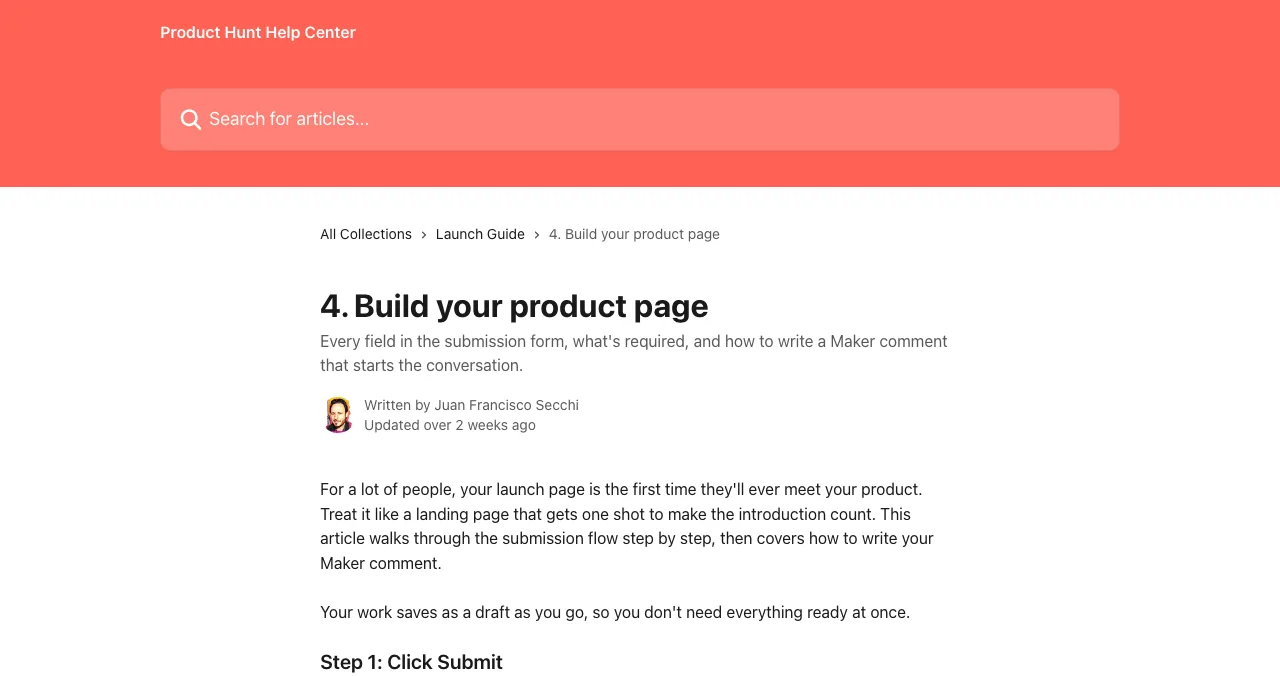
"We're an AI-powered platform that empowers teams to unlock productivity." Every founder has written a sentence like that, and no reader has ever understood one. A one-liner has one job: tell a stranger, in a few seconds, what your product does and for whom. This guide gives a formula, the test Product Hunt uses on taglines (read on 17 November 2026), before-and-after examples, and why the same line everywhere matters for search and AI engines. Jump to the formula, examples or the test.
The formula

- Who — the specific user: "freelance designers", "clinics in tier-2 cities".
- What they do with it — the job: "send invoices", "book appointments".
- The result — what changes: "in a minute", "without no-shows".
- Assemble — "[Product] helps [who] [do what] [result]".
- Cut — remove every word a stranger doesn't need.
Before and after
| Before | After |
|---|---|
| The future of productivity | Meeting notes that write themselves (Product Hunt's own example) |
| An AI-powered invoicing platform | GST-ready invoices for Indian freelancers, in a minute |
| Revolutionising clinic management | Appointment booking and reminders for small clinics |
| The all-in-one workspace for teams | Shared to-do lists for teams of five to fifty |
| Next-gen developer experience | Spin up a test database for every pull request |
Table: One-liners before and after (illustrative examples; the first 'after' is Product Hunt's)
The test
Product Hunt's tagline test: "if someone reads only your name and tagline, do they know what the product does?" Run it on people outside your industry:

- They can say what it does — in their own words
- They can say who it's for
- No hype words — Product Hunt says skip "the best" or "#1"
- Fits 60 characters — Product Hunt's tagline limit, in the short form
- Survives without the logo — text alone does the job
Three lengths to keep
| Version | Length | Where |
|---|---|---|
| Tagline | Up to 60 characters | Product Hunt, app stores, social bios |
| One-liner | One sentence | Homepage hero, directories, Crunchbase |
| Description | Up to 500 characters | Product Hunt description, SaaSHub, AlternativeTo |
Table: One message, three lengths (Product Hunt field limits, checked 17 Nov 2026)
Use it everywhere
Use the same line on your homepage, launch pages, directories, Crunchbase, LinkedIn and pitch deck. Consistent facts help people recognise you and help search and AI engines connect what independent sites say about you. Google's AI guidance stresses helpful, people-first content over tricks; a clear line is exactly that.
Mistakes

- Category jargon — "platform", "solution", "ecosystem"
- Hype — "revolutionary", "the best"
- No user — who is it for?
- Feature lists — the outcome matters more
- A different line on every site
Ready to use it?
How we know
The tagline test, field limits and the "meeting notes" example come from Product Hunt's "Build your product page" guide, read on 17 November 2026. Other before-and-after lines are illustrative examples we wrote, not real companies.
Key terms, defined
- One-liner: one sentence describing what a product does and for whom.
- Tagline: a very short line, often 60 characters or fewer.
- Value proposition: the outcome a product delivers for a user.
- Hype words: vague superlatives that say nothing specific.
- Consistency: the same facts and wording across every site.
Frequently asked questions
What is a startup one-liner?
One sentence that tells a stranger what your product does and for whom, used on your homepage, launch pages, directories and pitch.
What's a good one-liner formula?
'[Product] helps [who] [do what] [result]', for example 'Ledgerly helps freelancers in India send GST-ready invoices in a minute'. Then cut every word that doesn't help a stranger understand.
How long should a startup one-liner be?
Short enough to fit a 60-character tagline (Product Hunt's limit) in its shortest form, with a longer version of around 15–25 words for directories and pitches.
How do I test my one-liner?
Show it with your product name to someone outside your industry and ask what the product does. Product Hunt's test is the same: if someone reads only your name and tagline, do they know what it does?
What words should I avoid?
Hype and vague category words: 'the best', '#1', 'revolutionary', 'the future of', 'all-in-one platform'. Product Hunt tells makers to skip hype in taglines.
Why use the same one-liner everywhere?
Consistency helps people recognise you and helps search and AI engines connect facts about you across your site, directories and profiles.
Sources
- Product Hunt Help Center — Build your product page: name, tagline, description (checked 17 Nov 2026)
- SaaSHub — Submit a Product (checked 17 Nov 2026)
- Google Search Central — Optimizing your website for generative AI features on Google Search (updated 10 Jul 2026)
- Science of Apps — Launchpad: launch your product free
- Checked November 17, 2026. Figures that change — fees, salaries, prices — are reviewed every six months; if something is out of date, tell us.
Where to go from here
- Product launch taglines — for launch pages
- Roast my landing page — where the one-liner lives
- Write a directory listing — reuse it well
- Science of Apps - LaunchpadHow to write a product directory listing: name, one-liner, description, categories, screenshots and the field rules of Product Hunt, SaaSHub and AlternativeToHow to write a directory listing that gets clicks: one-liner, description, categories, screenshots, and the rules of Product Hunt, SaaSHub and AlternativeTo.
- Science of Apps - LaunchpadProduct launch taglines that get clicks: Product Hunt's 60-character rules, patterns that work, examples by product type, and the hype to cutHow to write a product launch tagline: Product Hunt's 60-character rule, patterns that work, examples for SaaS, apps, AI and dev tools, and what to cut.
- Science of Apps - LaunchpadHow to launch an AI product: prove the outputs, describe the task not the model, pick free and paid launch sites, and make sure AI search can find youHow to launch an AI product in 2027: show real outputs, describe the task, launch on Product Hunt and AI directories, and get found by AI search engines.
- Product managementProduct manager resume: examples, bullet formulas and a template that gets interviewsWrite a product manager resume that gets interviews: an outcome-first bullet formula, before-and-after examples, a one-page template and tips.
- Science of Apps - Launchpadllms.txt for startups: what the file is, what Google says about it for Search and AI Overviews, and when it's still worth addingWhat llms.txt is, why Google says Search and AI Overviews don't use it, and when a startup should still add one, with a simple template.
- Science of Apps - LaunchpadThe Product Hunt launch mistakes that kill your ranking, or your launch, and how to avoid each oneThe Product Hunt launch mistakes that hurt ranking or get launches removed: asking for upvotes, new-account votes, vague taglines, broken flows and more.
Get the ideas, not the noise.
Sign up with Google and we’ll send you short UX psychology tips by email — why people tap, stall and leave, and what to do about it. Unsubscribe anytime. Prefer something to keep? Get the free Laws of UX guide as a PDF.
Launch day ends. Your listing shouldn't.
Put your new one-liner to work: a free, permanent Launchpad profile found by the problem you solve, ranked by relevance and never by payment, plus a product test with a detailed report.