 By
Quick answer: How do I launch an AI product?
- Prove outputs: real examples, a short demo, a free try.
- Describe the task: for whom, what result; not the model.
- Free sites: a permanent profile, Future Tools, Uneed, Peerlist.
- Launch day: Product Hunt, with real outputs in the gallery.
- Paid: one AI directory as a measured test.
- AI search: allow OAI-SearchBot, Claude-SearchBot, PerplexityBot, Googlebot.
Key takeaways
- AI buyers are sceptical; real outputs beat promises.
- People search by job ('summarise calls'), not by model name.
- A free try, without a long sign-up, lifts launch-day conversion.
- AI products are often discovered through AI assistants; don't block their search bots.
- Be honest about limits; trust is the product.
AI products have a credibility problem that other launches don't: every visitor has seen a hundred tools promising magic, and most have tried a few that disappointed. An AI launch succeeds when the first ten seconds show a real output that does a real job. This guide covers proving the product, describing it, the launch sites in order, and making sure AI search can find you, with each site's terms read on 17 November 2026. Jump to prove it, describe it, where to launch or AI search.
1. Prove the outputs

- Real examples — actual inputs and outputs, not mock-ups
- A 30–60 second demo — one task, start to finish; Product Hunt says a screen recording can beat a trailer
- A free try — a few runs without a long sign-up
- Honest limits — what it gets wrong and how users fix it
- Example prompts — so new users know what to ask
2. Describe the task, not the model
| Instead of | Write |
|---|---|
| GPT-powered assistant | Turns sales calls into follow-up emails |
| AI-powered content platform | Writes product descriptions from a photo |
| Next-gen AI agent | Books meetings from your inbox |
Table: Describing an AI product (illustrative examples)
3. Where to launch, in order
| Step | Site | Cost |
|---|---|---|
| 1 | Science of Apps Launchpad | Free, permanent |
| 2 | Future Tools | Free submission |
| 3 | Uneed, Peerlist | Free routes |
| 4 | Product Hunt | Free launch day |
| 5 | One paid AI directory | TopAI.tools $47 (refunded if not accepted), TAAFT $49 |
| If for developers | DevHunt, Show HN | Free listing / free |
Table: An AI product launch order (each site's terms, checked 16–17 Nov 2026)
Full list in where to launch an AI product.
4. Make sure AI search can find you
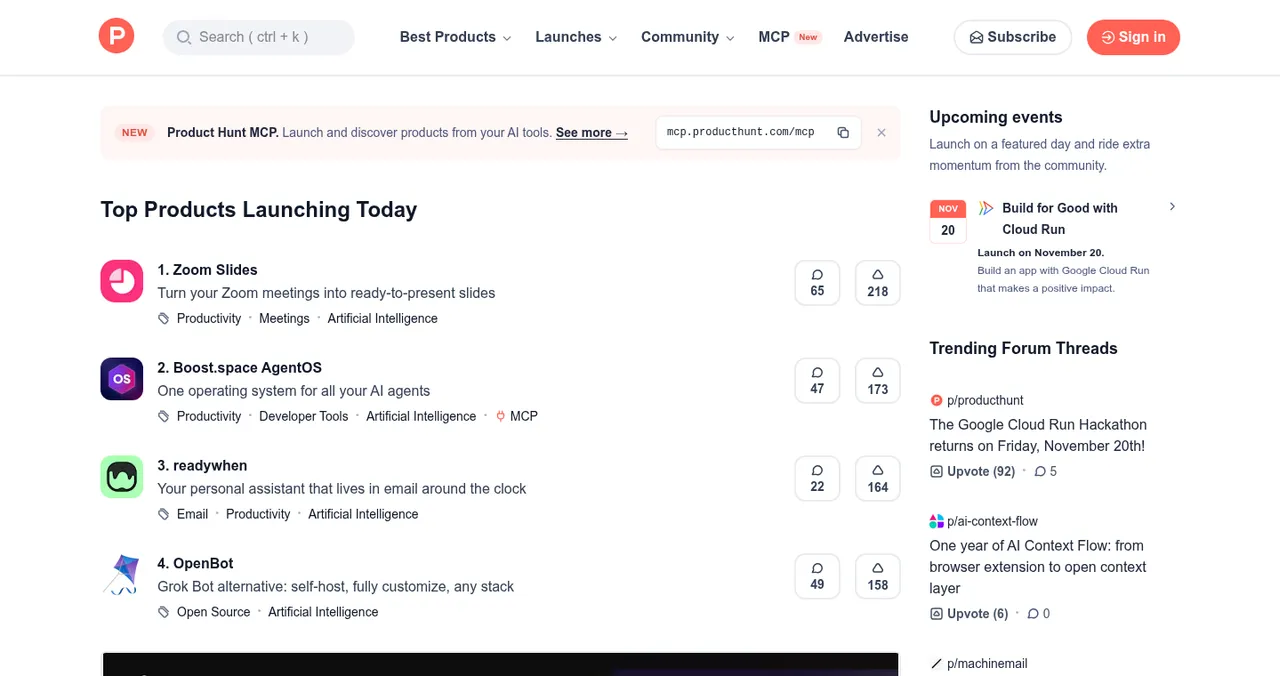
AI products are often discovered by people asking AI assistants. Allow the search bots: Googlebot, OAI-SearchBot, Claude-SearchBot and PerplexityBot, and check your firewall doesn't challenge them. Then publish pages answering the questions buyers ask: cost, comparisons, "best tool for [task]". Details in rank in AI search engines.
Mistakes

- Leading with the model — buyers search for jobs
- Cherry-picked outputs — users find out fast
- A paywall before the first result
- Blocking AI search bots — you vanish from AI answers
- Paying every directory at once — test, measure, decide

Ready to launch?
How we know
Site terms come from Product Hunt's help centre and each directory's submission page; crawler rules from OpenAI's and Perplexity's documentation; all read on 16–17 November 2026. The launch order and examples are our editorial recommendations.
Key terms, defined
- AI product: software whose core value comes from an AI model.
- Output: what the AI produces for a given input.
- Search bot: a crawler fetching pages for AI answers.
- Free try: a way to use the product before paying.
- Prompt: the instruction a user gives an AI.
Frequently asked questions
How do I launch an AI product?
Prove the outputs with real examples and a short demo, describe the task for a specific user, publish a permanent profile, submit to free sites, launch on Product Hunt, test one paid AI directory, and make sure AI search bots can crawl your site.
Where should I launch an AI tool?
Product Hunt (free), Future Tools (free AI directory), Uneed, Peerlist and Science of Apps Launchpad; DevHunt and Show HN for developer AI tools; then paid AI directories like TopAI.tools ($47) or There's An AI For That ($49).
How should I describe an AI product?
By the task and result for a specific user, for example 'Turns sales calls into follow-up emails for SDRs'. Avoid leading with the model or 'AI-powered'.
What should an AI product demo show?
One real task done start to finish in 30–60 seconds, with a real input and the actual output, including what happens when the output needs editing.
How do I get my AI product recommended by ChatGPT or Perplexity?
Allow their search bots (OAI-SearchBot, PerplexityBot), publish pages answering specific buyer questions, and keep consistent facts about you on independent sites. Placement isn't guaranteed.
Should I offer a free tier at launch?
A free way to try it, even a few runs, makes launch-day visitors far more likely to try the product than a paywall or long form.
Sources
- Product Hunt Help Center — Build your product page (checked 17 Nov 2026)
- Future Tools — Submit a tool (checked 17 Nov 2026)
- TopAI.tools — Submit your AI tool (checked 17 Nov 2026)
- OpenAI — Overview of OpenAI crawlers (checked 17 Nov 2026)
- Perplexity — Perplexity crawlers (checked 17 Nov 2026)
- Science of Apps — Launchpad: launch your product free
- Checked November 17, 2026. Figures that change — fees, salaries, prices — are reviewed every six months; if something is out of date, tell us.
Where to go from here
- Where to launch an AI product — every site
- How to market an AI tool — after launch
- Get recommended by ChatGPT — AI search
- Science of Apps - LaunchpadHow to market an AI tool in 2027: positioning by task, AI directories, AI search, demos and the trust that makes people payHow to market an AI tool in 2027: position by task, list in AI directories, get cited by AI search, show real outputs and earn trust that converts.
- Science of Apps - LaunchpadHow to market a SaaS in 2027: positioning, being found by buyers, content that gets cited, launches and a product that convertsHow to market a SaaS in 2027: sharp positioning, alternatives directories, search and AI visibility, launches, founder-led sales and a trial that converts.
- Science of Apps - LaunchpadHow to get your first 100 users without paid ads: a channel-by-channel plan founders can start todayHow to get your first 100 users without paid ads in 2027: your network, communities, launch sites, directories, content and one-to-one outreach, step by step.
- Science of Apps - LaunchpadGenerative engine optimization for startups: what the research shows, and a plan to get cited by AI answersGEO for startups in 2027: what the original GEO research found, how to get cited by ChatGPT, Perplexity, Claude and Google AI, and a 30-day plan.
- Science of Apps - LaunchpadThe best product launch platforms in 2027, matched to what you're launching: SaaS, AI, developer tools, apps and pre-launch, with costs and rulesThe best product launch platforms in 2027 by use case: Product Hunt, Science of Apps Launchpad, DevHunt, Peerlist, Uneed, BetaList, Show HN and more.
- Science of Apps - LaunchpadHow to market a startup with no money: the free channels that work, in the order to use them, and what each costs in time insteadHow to market a startup with no money: direct outreach, communities, free launch sites, directories, content and AI search, in order, with the time each costs.
Get the ideas, not the noise.
Sign up with Google and we’ll send you short UX psychology tips by email — why people tap, stall and leave, and what to do about it. Unsubscribe anytime. Prefer something to keep? Get the free Laws of UX guide as a PDF.
Launch day ends. Your listing shouldn't.
List your AI product free on the Launchpad: a permanent profile found by the task it does, ranked by relevance and never by payment, plus an end-to-end test including prompt and output trust.