 By
Quick answer: How do I get my startup recommended by ChatGPT?
- Eligibility (OpenAI's rule): allow OAI-SearchBot and accept traffic from OpenAI's published search-bot IPs.
- Training is separate: GPTBot controls training; blocking it doesn't remove you from ChatGPT search.
- No guarantee: OpenAI says ChatGPT ranks results by multiple factors and placement isn't guaranteed.
- Be quotable: one plain sentence that says what you do, for whom, and how you're different.
- Be corroborated: the same description on launch sites, directories, reviews and your own pages.
Key takeaways
- ChatGPT can only cite pages its search crawler can reach; many startups block it by accident with a CDN or firewall rule.
- Opting out of training (GPTBot) and appearing in ChatGPT search (OAI-SearchBot) are separate choices.
- Recommendations come from what many sources say about you, so consistent third-party profiles matter as much as your own site.
- Specific, sourced answer pages are what generative engines cite most, according to the GEO research.
- Track it: referrals from chatgpt.com in analytics, and a monthly check of the questions your buyers ask ChatGPT.
A buyer asks ChatGPT "what's a good tool for [your category]?" and gets three names. Yours isn't one of them. ChatGPT SEO is the work of changing that, and it's less mysterious than it sounds. OpenAI publishes the technical rule for being eligible, the research on generative engines shows what kind of content gets cited, and the rest is the same thing that makes people trust a startup: clear, consistent, corroborated information. This guide uses OpenAI's own help centre and crawler documentation, read on 17 November 2026. Jump to eligibility, what makes ChatGPT recommend you or the checklist.
Step 1: Make your site eligible for ChatGPT search
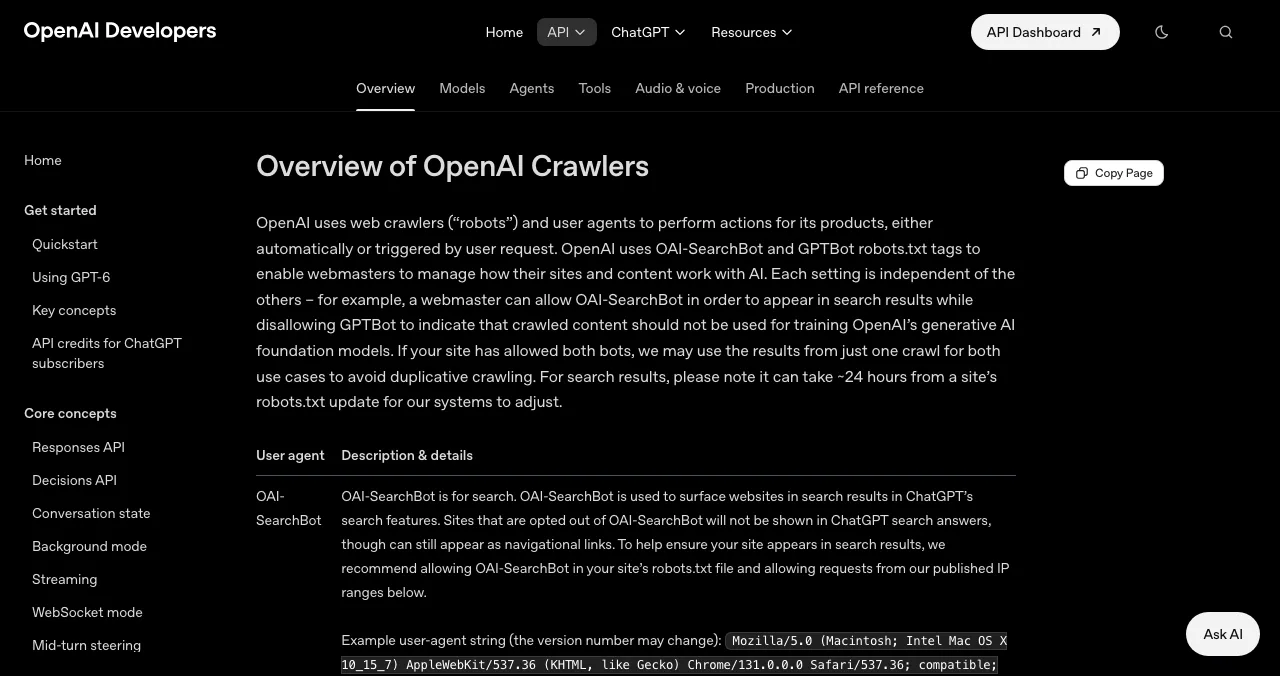
OpenAI's help centre says it plainly: "To make a website eligible for inclusion, allow OAI-Searchbot to crawl the site and confirm that the website host or content delivery network allows traffic from OpenAI's published searchbot IP addresses." And: "Placement is not guaranteed."
| Bot | What it's for | If you block it |
|---|---|---|
| OAI-SearchBot | Surfacing sites in ChatGPT search | You won't be shown in ChatGPT search answers (you may still appear as a navigational link) |
| GPTBot | Collecting content that may train OpenAI's models | Your content is signalled as not for training; search is unaffected |
Table: OpenAI's crawlers and what blocking each does (OpenAI's crawler documentation, checked 17 Nov 2026)
What to check:
- robots.txt allows
OAI-SearchBot(and doesn'tDisallow: /for all bots). - Your CDN or firewall doesn't challenge or block OpenAI's published IP ranges; bot-protection products often do by default.
- Allow time: OpenAI says it can take about 24 hours from a robots.txt update for its systems to adjust.
Step 2: Give ChatGPT a reason to recommend you
Being crawlable makes you eligible. Being recommended depends on whether ChatGPT finds clear, relevant, reliable information about you. OpenAI says ChatGPT "ranks search results using multiple factors intended to help users find relevant, reliable information". In practice that means three things.
Be quotable

- Say what you do in your homepage's first sentence. "Acme turns support tickets into a weekly bug report for product teams." Not "The future of customer intelligence."
- Write one page per buyer question. Pricing, "how it works", "Acme vs [competitor]", "best tool for [job]". Answer in the first two sentences.
- Use numbers and named sources. The GEO study (KDD 2024) found adding statistics, quotations and citations improved visibility in generative engines, while keyword stuffing performed poorly.
Be corroborated
When ChatGPT recommends a product, it leans on what several sources say. A startup's own site is one voice. Add independent ones, all describing you the same way:
- Launch platforms: Product Hunt, Peerlist, Uneed. See our launch site shortlist.
- Software directories: SaaSHub and AlternativeTo, where buyers compare tools.
- A permanent profile: a free Science of Apps Launchpad listing, written to rank and to be quoted.
- Company databases: a complete Crunchbase profile.
- Reviews and comparisons: genuine reviews from users, and honest comparison pages.
Be consistent
Use one name, one one-line description and one URL everywhere. If your site says "AI support analytics" and your listings say "ticket summariser", ChatGPT has two weaker signals instead of one strong one.
Step 3: Track what ChatGPT says about you

- Referrals — sessions from chatgpt.com in your analytics
- Monthly prompt checks — the same ten buyer questions each month, noting if you're mentioned, recommended or linked
- What it says — if ChatGPT describes you wrongly, fix the sources it's likely reading: your homepage and profiles
- Competitors' sources — when a competitor is recommended, look at which pages are cited
The ChatGPT SEO checklist

- OAI-SearchBot allowed in robots.txt — and not blocked by your CDN or firewall
- GPTBot set to your preference — it's separate from search
- Homepage says what you do in one plain sentence — for whom, and how you're different
- One answer page per buyer question — answer first, numbers, sources
- Consistent profiles on 5+ trusted sites — launch platforms, directories, Crunchbase, a permanent Launchpad profile
- Genuine reviews — from real users, on the sites they use
- Monthly tracking — referrals and the same buyer questions
Mistakes that keep startups out of ChatGPT

- Blocking every AI bot to stop training — you also block search; block GPTBot instead if that's your goal
- A bot firewall on by default — it can silently block OAI-SearchBot
- A homepage of slogans — nothing for ChatGPT to quote
- Different descriptions everywhere — splits your signals
- Buying fake reviews or mentions — they damage trust with people and engines
Clear writing helps people too: jargon adds cognitive load, and genuine reviews work as social proof.
Ready to be recommended?
How we know
Eligibility rules come from OpenAI's help article on searching the web with ChatGPT and its crawler overview, read on 17 November 2026; content findings from Aggarwal et al.'s GEO paper (KDD 2024). OpenAI doesn't publish how ChatGPT chooses which products to recommend, so the corroboration and consistency advice is our editorial guidance, not an OpenAI rule. Science of Apps runs the Launchpad mentioned above.
Key terms, defined
- ChatGPT SEO: making a site eligible for, and likely to be cited in, ChatGPT's search answers.
- OAI-SearchBot: OpenAI's crawler for ChatGPT search.
- GPTBot: OpenAI's crawler for content that may be used in model training.
- Corroboration: independent sources agreeing on the same facts about you.
- Citation: a link or attribution to your page inside an AI answer.
Frequently asked questions
How do I get my company to show up on ChatGPT?
Make your site eligible for ChatGPT search, then give it reasons to mention you. OpenAI says to allow OAI-SearchBot to crawl your site and confirm your host or CDN accepts traffic from OpenAI's published search-bot IP addresses. Then publish a clear page about what you do and earn consistent mentions on trusted sites like launch platforms, directories and reviews.
Can I submit my website to ChatGPT?
There's no submission form for ChatGPT search that we could find in OpenAI's documentation. Eligibility comes from allowing OAI-SearchBot and letting it reach your pages. Placement isn't guaranteed; OpenAI says ChatGPT ranks results using multiple factors to help users find relevant, reliable information.
Does blocking GPTBot stop ChatGPT from recommending me?
Not for ChatGPT search. OpenAI says the settings are independent: GPTBot relates to training its models, OAI-SearchBot to search. A site can allow OAI-SearchBot to appear in search results while disallowing GPTBot.
How do I get cited by ChatGPT?
Be the clearest, most specific source on a question your buyers ask: answer it in the first sentences, include numbers and named sources, and keep the page crawlable. Research on generative engines found that adding statistics, quotations and citations raised visibility, while keyword stuffing performed poorly.
How long does it take to appear in ChatGPT after allowing OAI-SearchBot?
OpenAI says it can take about 24 hours from a robots.txt update for its systems to adjust. Being crawled doesn't guarantee being recommended; that depends on relevance and on what other sources say about you.
How can I tell if ChatGPT is sending me traffic?
Look for referrals from chatgpt.com in your analytics, and ask ChatGPT the questions your customers ask once a month, noting whether you're mentioned or linked. Use the same questions each time so changes mean something.
Sources
- OpenAI Help Center — Searching the web with ChatGPT: make your website available (checked 17 Nov 2026)
- OpenAI — Overview of OpenAI crawlers (checked 17 Nov 2026)
- Aggarwal et al. — GEO: Generative Engine Optimization (arXiv 2311.09735, KDD 2024)
- Google Search Central — AI features and your website (checked 17 Nov 2026)
- Science of Apps — Launchpad: launch your product free
- Checked November 17, 2026. Figures that change — fees, salaries, prices — are reviewed every six months; if something is out of date, tell us.
Where to go from here
- How to rank in ChatGPT — brand mentions across AI answers
- GEO for startups — what the research says works
- Organic visibility for startups — the five-step foundation
- Science of Apps - LaunchpadHow to get your startup mentioned by Gemini, Claude and Grok: what each company documents about crawling and search, and the levers that work for all threeHow to get your startup mentioned by Gemini, Claude and Grok: what Google, Anthropic and xAI document about crawling, and the levers that work for all three.
- Science of Apps - LaunchpadGenerative engine optimization for startups: what the research shows, and a plan to get cited by AI answersGEO for startups in 2027: what the original GEO research found, how to get cited by ChatGPT, Perplexity, Claude and Google AI, and a 30-day plan.
- Science of Apps - LaunchpadHow to market an AI tool in 2027: positioning by task, AI directories, AI search, demos and the trust that makes people payHow to market an AI tool in 2027: position by task, list in AI directories, get cited by AI search, show real outputs and earn trust that converts.
- Science of Apps - LaunchpadPerplexity SEO: how to show up in Perplexity answers, from allowing PerplexityBot and fixing your firewall to writing pages it citesHow to show up in Perplexity: allow PerplexityBot and its IP ranges, fix firewall rules, understand Perplexity-User, and write pages Perplexity cites.
- Science of Apps - LaunchpadHow to rank in ChatGPT, Gemini, Claude and Perplexity: each engine's own rules, side by side, and what works across all of themHow to rank in ChatGPT, Gemini, Claude and Perplexity in 2027: each engine's crawler rules side by side, and the content that gets cited by all four.
- Career guidesGenerative engine optimization skills employers want in 2027: getting brands mentioned and cited in ChatGPT, Gemini, Perplexity and AI OverviewsGEO skills employers want in 2027: how AI assistants choose sources, quotable facts, authority and mentions, crawler access and tracking AI citations.


Get the ideas, not the noise.
Sign up with Google and we’ll send you short UX psychology tips by email — why people tap, stall and leave, and what to do about it. Unsubscribe anytime. Prefer something to keep? Get the free Laws of UX guide as a PDF.
Launch day ends. Your listing shouldn't.
A permanent, crawlable profile that says what your product does in quotable words, the kind of independent page ChatGPT search can cite, plus your product tested end to end with a detailed report.