 By
Quick answer: How do I get my website to show up in Perplexity?
- PerplexityBot: surfaces and links websites in Perplexity results; not used to train foundation models.
- Allow it: in robots.txt, and permit its published IP ranges.
- Perplexity-User: fetches pages a user asked about; generally ignores robots.txt.
- Changes: up to 24 hours to take effect.
- Firewalls: allow both bots explicitly; Cloudflare Bot Fight Mode can't be skipped by custom rules.
- Content: specific, sourced answers to real questions.
Key takeaways
- Perplexity separates search crawling (PerplexityBot) from user-requested fetches (Perplexity-User).
- Neither bot is used for training foundation models, so allowing them is a search decision.
- A firewall is the most common silent blocker; verify bots by user agent and IP together.
- Perplexity links its sources, so pages with clear, quotable answers earn the click.
- Corroboration across directories and profiles helps engines trust the facts.
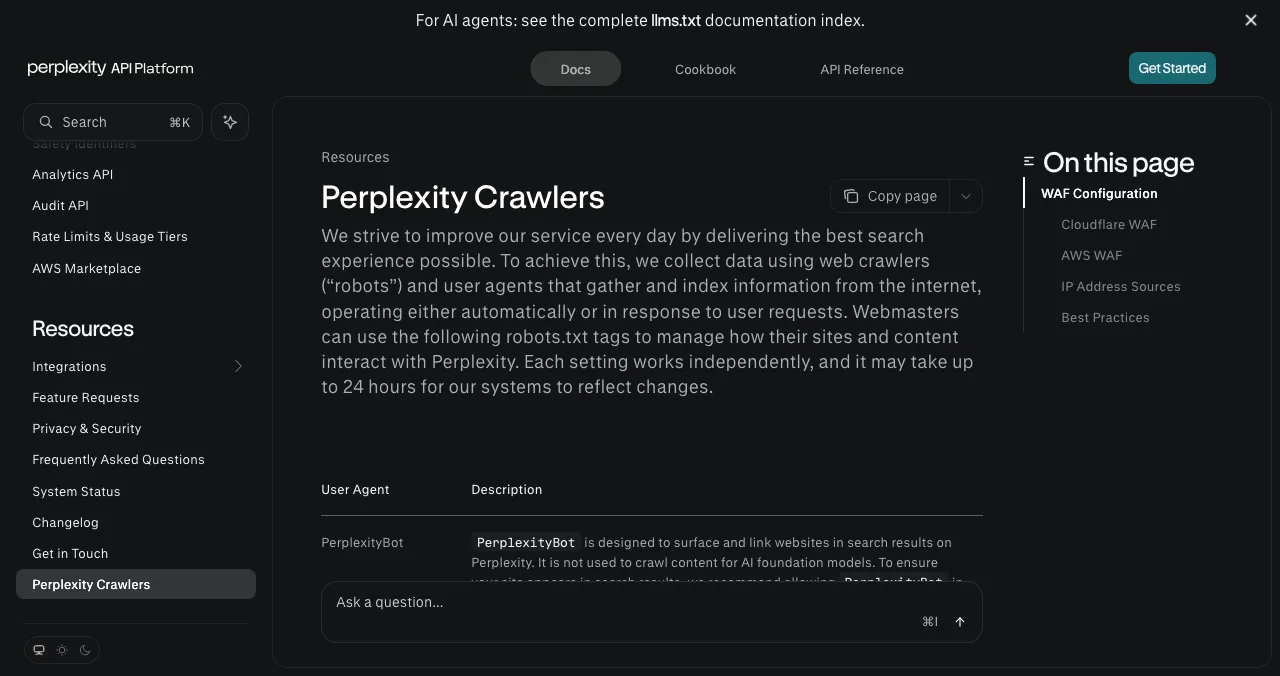
Perplexity is the answer engine that shows its working: every answer comes with numbered sources, and every source is a click. That makes it one of the most valuable AI surfaces for a startup, and one of the easiest to block by accident, usually with a firewall setting nobody remembers switching on. This guide covers Perplexity's two bots, the robots.txt and firewall settings, and the content it can cite, from Perplexity's own crawler documentation, read on 17 November 2026. Jump to the bots, robots.txt, firewalls or content.
Perplexity's two bots
| PerplexityBot | Perplexity-User | |
|---|---|---|
| Job | Surface and link websites in Perplexity search results | Fetch a page when a user asks a question |
| Used for training foundation models? | No | No |
| Follows robots.txt? | Yes; allow it to appear in results | Generally ignores it, since a user requested the fetch |
| IP ranges | perplexity.ai/perplexitybot.json | perplexity.ai/perplexity-user.json |
Table: Perplexity's crawlers (Perplexity documentation, checked 17 Nov 2026)
robots.txt

- Allow PerplexityBot — Perplexity recommends it "to ensure your site appears in search results".
- Permit its published IP ranges — at your host and CDN.
- Wait up to 24 hours — for Perplexity's systems to reflect changes.
- Check the other engines too — OAI-SearchBot, Claude-SearchBot and Googlebot; see rank in AI search engines.
Firewalls: the silent blocker
Perplexity says that with a web application firewall you "may need to explicitly allow" its bots. Its guidance:

- Match user agent and IP together — each bot against its own published ranges
- Cloudflare: a custom rule with the Skip action, placed above blocking rules
- Cloudflare Bot Fight Mode — can't be skipped by custom rules and may still challenge the bots
- AWS WAF: an IP set per bot plus a user-agent match, with an Allow action, evaluated first
- Keep ranges current — fetch the JSON endpoints regularly
- Watch your logs — confirm the bots get through
Content Perplexity can cite
Perplexity doesn't publish how it picks sources. What the evidence supports:

- Answer first — the answer in the first sentence under each question heading
- Specific numbers and dates — the GEO study found statistics, quotations and citations raised visibility
- Named sources — link the primary documents
- One page per question — cost, comparison, how-to, best tool for a job
- Consistent facts elsewhere — directories, Crunchbase, launch sites
- Current — date your figures and update them
Mistakes

- Bot Fight Mode on by default — challenges Perplexity's bots
- Blocking PerplexityBot to avoid training — it isn't used for training
- Answers only in images or PDFs
- Stale IP allow-lists
- Vague marketing copy — nothing to quote
A permanent source about you
Ready to be cited?
How we know
Bot behaviour, robots.txt, timing and firewall guidance come from Perplexity's crawler documentation, read on 17 November 2026. Content advice draws on the GEO paper (KDD 2024). Perplexity doesn't publish ranking rules, so we don't claim any.
Key terms, defined
- PerplexityBot: Perplexity's search crawler.
- Perplexity-User: Perplexity's fetcher for user-requested pages.
- robots.txt: a file telling crawlers what they may fetch.
- WAF: a web application firewall that filters traffic.
- Bot Fight Mode: a Cloudflare feature that challenges automated traffic.
Frequently asked questions
How do I get my website to show up in Perplexity?
Allow PerplexityBot in robots.txt and permit its published IP ranges, make sure your firewall doesn't challenge it, and publish pages that answer specific questions with numbers and sources. Perplexity says changes can take up to 24 hours to apply.
Does Perplexity use my content for training?
Perplexity says PerplexityBot is not used to crawl content for AI foundation models, and Perplexity-User is not used for web crawling or to collect training content.
What is Perplexity-User?
A fetcher that visits a page when a user asks Perplexity a question, to give an accurate answer with a link. Perplexity says that because a user requested it, it generally ignores robots.txt rules.
How do I allow PerplexityBot through Cloudflare?
Create a custom rule matching each bot's user agent and its published IP ranges, set the action to Skip, and place it above blocking rules. Perplexity warns Cloudflare's Bot Fight Mode can't be skipped by custom rules and may still challenge its bots.
How long does it take for Perplexity to see robots.txt changes?
Perplexity says each setting works independently and it may take up to 24 hours for its systems to reflect changes. Firewall changes may take time to propagate too.
What content does Perplexity cite?
Perplexity doesn't publish ranking rules. Research on generative engines (GEO, KDD 2024) found statistics, quotations and citations increased visibility, so specific, sourced answers to real questions are the safest bet.
Sources
- Perplexity — Perplexity crawlers (checked 17 Nov 2026)
- Aggarwal et al. — GEO: Generative Engine Optimization (arXiv 2311.09735, KDD 2024)
- OpenAI — Overview of OpenAI crawlers (checked 17 Nov 2026)
- Google Search Central — AI features and your website (checked 17 Nov 2026)
- Science of Apps — Launchpad: launch your product free
- Checked November 17, 2026. Figures that change — fees, salaries, prices — are reviewed every six months; if something is out of date, tell us.
Where to go from here
- Rank in AI search engines — all four engines' rules
- How to show up in AI Overviews — Google's requirements
- GEO for startups — what gets cited
- Science of Apps - LaunchpadHow to rank in ChatGPT, Gemini, Claude and Perplexity: each engine's own rules, side by side, and what works across all of themHow to rank in ChatGPT, Gemini, Claude and Perplexity in 2027: each engine's crawler rules side by side, and the content that gets cited by all four.
- Science of Apps - LaunchpadGenerative engine optimization for startups: what the research shows, and a plan to get cited by AI answersGEO for startups in 2027: what the original GEO research found, how to get cited by ChatGPT, Perplexity, Claude and Google AI, and a 30-day plan.
- Career guidesGenerative engine optimization skills employers want in 2027: getting brands mentioned and cited in ChatGPT, Gemini, Perplexity and AI OverviewsGEO skills employers want in 2027: how AI assistants choose sources, quotable facts, authority and mentions, crawler access and tracking AI citations.
- AI & vibe codingHow to rank in ChatGPT: getting your brand mentioned and cited in AI answersHow to get your brand mentioned in ChatGPT and other AI answers: crawler access, quotable pages, third-party mentions and tracking.
- Science of Apps - LaunchpadChatGPT SEO for startups: how to get your product recommended and cited by ChatGPT, from OpenAI's own rulesChatGPT SEO for startups in 2027: what OpenAI says makes a site eligible for ChatGPT search, and how to get your product recommended and cited.
- Science of Apps - LaunchpadThe AI search optimization checklist: crawler access, content, corroboration and measurement for Google AI Overviews, ChatGPT, Claude and PerplexityA 2027 AI search optimization checklist: crawler access, answer-first content, corroboration and measurement for AI Overviews, ChatGPT, Claude and Perplexity.
Get the ideas, not the noise.
Sign up with Google and we’ll send you short UX psychology tips by email — why people tap, stall and leave, and what to do about it. Unsubscribe anytime. Prefer something to keep? Get the free Laws of UX guide as a PDF.
Launch day ends. Your listing shouldn't.
A free, crawlable Launchpad profile is another independent page answer engines can cite, and the product test checks how findable you are on Google and AI assistants.