 By
Quick answer: What should be on an AI search optimization checklist?
- Access: Googlebot, OAI-SearchBot, Claude-SearchBot, PerplexityBot allowed; firewall checked.
- Training choices: GPTBot, ClaudeBot, Google-Extended are separate decisions.
- Content: answer first, one question per section, specific facts and sources.
- Corroboration: the same name, one-liner and facts on independent sites.
- Measure: Search Console's Generative AI report, AI referrals, monthly spot checks.
- Skip: llms.txt for Google, chunking, special schema, inauthentic mentions.
Key takeaways
- Most AI visibility problems are access problems: a robots.txt line or a firewall.
- Search bots and training bots are separate; you can allow one and block the other.
- Specific, sourced answers are what engines can quote.
- Independent sites that agree about you make the facts trustworthy.
- Google says SEO best practice is the foundation; hacks aren't needed.
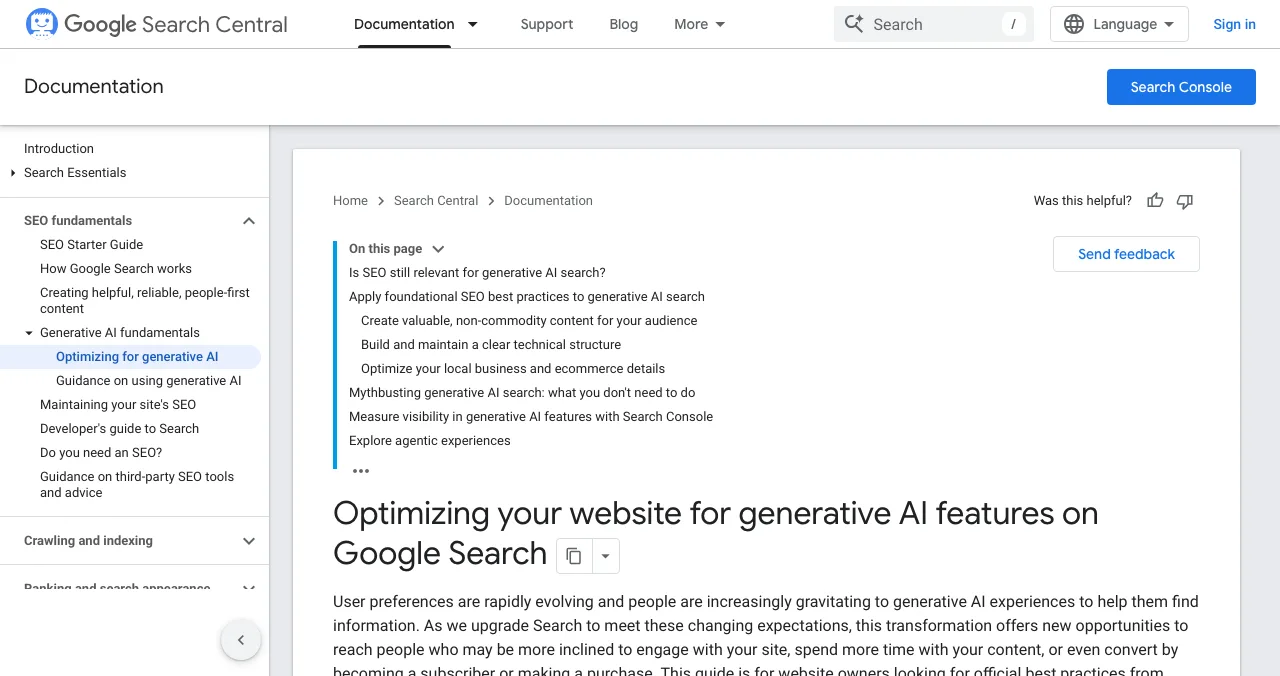
AI search optimization has collected more myths than any SEO topic in years: special files, special schema, chopping content into chunks. The engines' own documentation is far plainer. This checklist keeps only what Google, OpenAI, Anthropic and Perplexity actually publish, plus one peer-reviewed study, all read on 17 November 2026. Work through it top to bottom; most startups find their biggest problem in the first section. Jump to access, content, corroboration, measurement or what to skip.
1. Access

- Googlebot allowed — Google Search, AI Overviews, AI Mode
- OAI-SearchBot allowed — ChatGPT search
- Claude-SearchBot and Claude-User allowed — Claude
- PerplexityBot allowed — Perplexity; its IP ranges permitted
- Firewall and CDN checked — no default challenge for these bots (Cloudflare Bot Fight Mode can still challenge Perplexity's)
- Training bots decided separately — GPTBot, ClaudeBot, Google-Extended (which also covers Gemini grounding)
- Pages indexable — no stray noindex; eligible for a snippet
| Engine | Search bot | Training bot |
|---|---|---|
| Googlebot | Google-Extended (also Gemini grounding) | |
| ChatGPT | OAI-SearchBot | GPTBot |
| Claude | Claude-SearchBot, Claude-User | ClaudeBot |
| Perplexity | PerplexityBot, Perplexity-User | Not used for training |
Table: Search vs training bots (each company's documentation, checked 17 Nov 2026)
2. Content

- Answer first — the answer in the first sentence under each heading
- Question-shaped headings — the way buyers ask
- Specific facts — numbers, dates, named sources; the GEO study found these raise visibility
- Important content as text — not only images or PDFs
- Unique, expert content — Google asks for "non-commodity" content
- Structured data matches the page — no special AI schema needed
- Dated and current — update volatile facts
3. Corroboration

- One name, one one-liner, one logo — everywhere
- Crunchbase profile — current
- Software directories — SaaSHub, AlternativeTo
- A permanent launch profile — not just a one-day launch
- Google Business Profile — if you serve a location; Google says keep it current
- Genuine mentions — Google says inauthentic mentions aren't as helpful as they seem
4. Measurement
| Signal | Where |
|---|---|
| Google generative AI features | Search Console's Generative AI performance report |
| Google search traffic overall | Performance report, Web search type |
| AI referrals | chatgpt.com, perplexity.ai, claude.ai, gemini.google.com in analytics |
| Citations and accuracy | The same ten buyer questions in each engine, monthly |
Table: How to measure AI search visibility
5. What to skip

- llms.txt for Google — Search doesn't use it
- Chunking content — not required
- Rewriting just for AI — no special style needed
- Special schema — not required for generative AI search
- Buying mentions — inauthentic mentions don't help much
- Keyword stuffing — performed poorly in the GEO study
A corroborating profile

Ready to tick the boxes?
How we know
Every item comes from the engines' own documentation (Google's generative AI optimisation guide and AI features page; OpenAI's, Anthropic's and Perplexity's crawler pages; Google's common crawlers) read on 17 November 2026, plus the GEO paper (KDD 2024). Engines don't publish citation rules, so we don't claim any.
Key terms, defined
- Search bot: a crawler that fetches pages for search answers.
- Training bot: a crawler that collects content for model training.
- Corroboration: independent sources agreeing on the same facts.
- Grounding: giving a model fresh content at answer time.
- Generative AI performance report: Search Console's report for Google's AI features.
Frequently asked questions
What is AI search optimization?
Making your site accessible to and quotable by AI search features such as Google AI Overviews and AI Mode, ChatGPT search, Claude and Perplexity: allowing their search crawlers, writing clear answers, keeping facts consistent elsewhere, and measuring the results.
Which bots should I allow for AI search?
Googlebot (Google Search and its AI features), OAI-SearchBot (ChatGPT search), Claude-SearchBot and Claude-User (Claude), and PerplexityBot and Perplexity-User (Perplexity). Training bots such as GPTBot, ClaudeBot and Google-Extended are separate choices.
Do I need llms.txt or special schema for AI search?
Not for Google: its generative AI optimisation guide says Search doesn't use llms.txt or AI text files, structured data isn't required for generative AI search and there's no special schema to add.
How do I measure AI search visibility?
Use Search Console's Generative AI performance report for Google, watch referrals from chatgpt.com, perplexity.ai, claude.ai and gemini.google.com in analytics, and ask the same buyer questions in each engine monthly.
Is AI search optimization different from SEO?
Google says its SEO best practices continue to be relevant because its generative AI features are rooted in its core ranking and quality systems. The extra work is mostly crawler access for other engines and corroboration across sites.
Why would AI engines say something wrong about my startup?
Usually because sources disagree or are out of date. Fix your own pages first, then the profiles and directories engines rely on, so the facts match everywhere.
Sources
- Google Search Central — Optimizing your website for generative AI features on Google Search (updated 10 Jul 2026; checked 17 Nov 2026)
- Google Search Central — AI features and your website (checked 17 Nov 2026)
- OpenAI — Overview of OpenAI crawlers (checked 17 Nov 2026)
- Anthropic (Claude Help Center) — Does Anthropic crawl data from the web, and how can site owners block the crawler?
- Perplexity — Perplexity crawlers (checked 17 Nov 2026)
- Google — Google's common crawlers: Google-Extended (checked 17 Nov 2026)
- Aggarwal et al. — GEO: Generative Engine Optimization (arXiv 2311.09735, KDD 2024)
- Checked November 17, 2026. Figures that change — fees, salaries, prices — are reviewed every six months; if something is out of date, tell us.
Where to go from here
- Rank in AI search engines — the rules side by side
- GEO for startups — what gets cited
- llms.txt for startups — what it does and doesn't do
- Science of Apps - LaunchpadGenerative engine optimization for startups: what the research shows, and a plan to get cited by AI answersGEO for startups in 2027: what the original GEO research found, how to get cited by ChatGPT, Perplexity, Claude and Google AI, and a 30-day plan.
- Science of Apps - LaunchpadHow ChatGPT, Google's AI features, Claude and Perplexity choose which products to recommend, from what they publish, and what that means for your startupHow ChatGPT, Google AI Overviews, Claude and Perplexity recommend products: search, fan-out, sources and corroboration, and how a startup gets included.
- Science of Apps - LaunchpadHow to rank in ChatGPT, Gemini, Claude and Perplexity: each engine's own rules, side by side, and what works across all of themHow to rank in ChatGPT, Gemini, Claude and Perplexity in 2027: each engine's crawler rules side by side, and the content that gets cited by all four.
- Career guidesGenerative engine optimization skills employers want in 2027: getting brands mentioned and cited in ChatGPT, Gemini, Perplexity and AI OverviewsGEO skills employers want in 2027: how AI assistants choose sources, quotable facts, authority and mentions, crawler access and tracking AI citations.
- AI & vibe codingWhat is GEO? Generative engine optimization explained, with what the research foundWhat GEO (generative engine optimization) is, how it differs from SEO and AEO, what the research found, and a checklist to get cited.
- Science of Apps - LaunchpadAnswer engine optimization for startups: how to become the answer in Google's featured snippets, People Also Ask and AI assistantsA practical AEO guide for startups in 2027: how to become the direct answer in featured snippets, People Also Ask and AI assistants, step by step.
Get the ideas, not the noise.
Sign up with Google and we’ll send you short UX psychology tips by email — why people tap, stall and leave, and what to do about it. Unsubscribe anytime. Prefer something to keep? Get the free Laws of UX guide as a PDF.
Launch day ends. Your listing shouldn't.
Tick the corroboration box: a free, crawlable Launchpad profile with consistent facts, ranked by relevance and never by payment, and a product test that checks findability on Google and AI assistants.