 By
Quick answer: What is generative engine optimization, and how can a startup use it?
- What it is: optimising pages to be cited inside AI-generated answers, not just ranked as links.
- What the research found: statistics, quotations and cited sources lifted visibility by up to 40%; keyword stuffing did poorly.
- Who gains most: lower-ranked sites, which the GEO study found benefit significantly more than top-ranked ones.
- Step one: be crawlable by OAI-SearchBot, Claude-SearchBot, PerplexityBot and Googlebot.
- Step two: publish specific, sourced, quotable pages and consistent profiles across the web.
Key takeaways
- GEO isn't a replacement for SEO: Google says its AI features use the same requirements as Search, and most AI assistants rely on search indexes.
- In the KDD 2024 GEO study, Statistics Addition and Quotation Addition performed best; classic keyword stuffing underperformed the unoptimised baseline.
- Lower-ranked sites gained the most from GEO in the study, which is good news for startups competing with big brands.
- Engines cite pages that answer one question clearly, with numbers and named sources, and that other sites corroborate.
- Measure what you can: AI referrals in analytics, impressions in Search Console, and regular spot checks of the questions your customers ask.
A founder asks ChatGPT "what's the best tool for X", and your startup isn't in the answer. Not ranked low: absent. That's the problem generative engine optimization tries to solve. The term isn't marketing jargon; it comes from a 2023 research paper by Pranjal Aggarwal and five co-authors, accepted to KDD 2024, that measured which content changes make a page more likely to appear in AI answers. This guide explains what the research found, what the AI companies themselves say about crawling and citing, and turns both into a plan a small team can run in 30 days. Jump to what works, the checklist or the 30-day plan.
- Visibility lift the GEO study reports for its best methods
- 40%
- Content methods the study tested, from statistics to keyword stuffing
- 9
- Methods that did best: statistics, quotations, cited sources
- 3
- Extra files Google requires for its AI features
- 0
What is generative engine optimization?
Generative engine optimization (GEO) means making your content more likely to be used and cited inside an AI-generated answer, from ChatGPT search, Perplexity, Claude or Google's AI Overviews and AI Mode, rather than only ranked as a blue link.
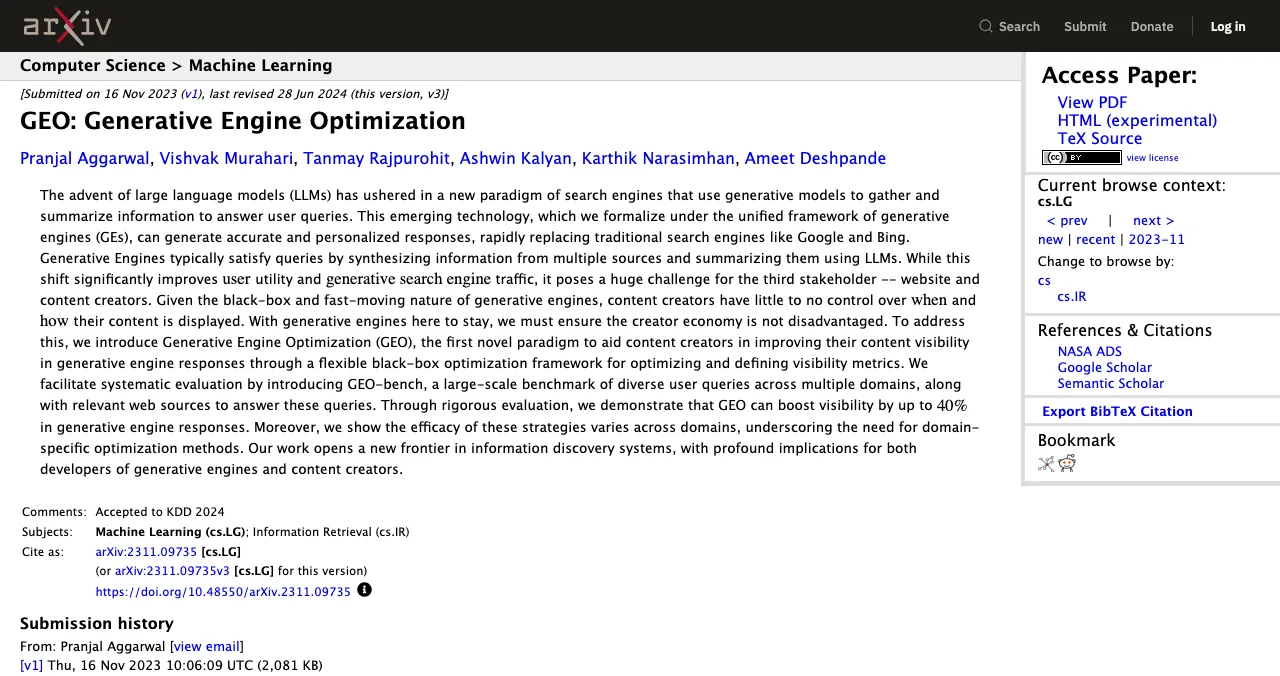
The paper by Aggarwal and colleagues formalised generative engines as systems that gather sources and summarise them with a language model, built a benchmark of queries (GEO-bench), and tested nine ways of rewriting web pages to see which got them cited more.
What the research found
| Method tested in the GEO study | What it does | Result |
|---|---|---|
| Statistics Addition | Replace vague claims with numbers | Among the best performers |
| Quotation Addition | Add relevant quotes from credible sources | Among the best performers |
| Cite Sources | Add citations to credible sources | Strong improvement |
| Easy-to-Understand, Fluency | Simplify and smooth the writing | Modest improvement |
| Authoritative | Make the tone more persuasive | Mixed |
| Keyword Stuffing | Add more query keywords (classic SEO) | Performed poorly |
Table: GEO methods and results, summarised from Aggarwal et al., "GEO: Generative Engine Optimization" (KDD 2024)
Three findings matter most for startups:
- Evidence beats keywords. The paper reports that "simple methods such as Keyword Stuffing traditionally used in SEO often perform worse", while Statistics Addition and Quotation Addition "show strong performance improvements across the board".
- The best methods lifted visibility substantially, by up to about 40% on one of its visibility metrics.
- Smaller sites gain the most. The authors found that "lower-ranked websites, which typically struggle for visibility, benefit significantly more from GEO", because generative engines weigh the content itself, not only backlinks and domain authority.
One caution: the study measured specific engines and a benchmark in 2023–2024. Engines change constantly, so treat these as principles, not a formula.
Step 1: Be crawlable by every AI search engine
No crawl, no citation. Each assistant names its search crawler, and the rules are in their own documentation.
| Engine | Crawler to allow | In their words |
|---|---|---|
| ChatGPT search | OAI-SearchBot | Opted-out sites "will not be shown in ChatGPT search answers" |
| Claude | Claude-SearchBot | Disabling it "may reduce your site's visibility" in search results |
| Perplexity | PerplexityBot | Allow it "to ensure your site appears in search results" |
| Google AI Overviews and AI Mode | Googlebot | "No additional requirements" beyond Search eligibility |
Table: The crawlers behind AI answers (each company's documentation, checked 17 Nov 2026)
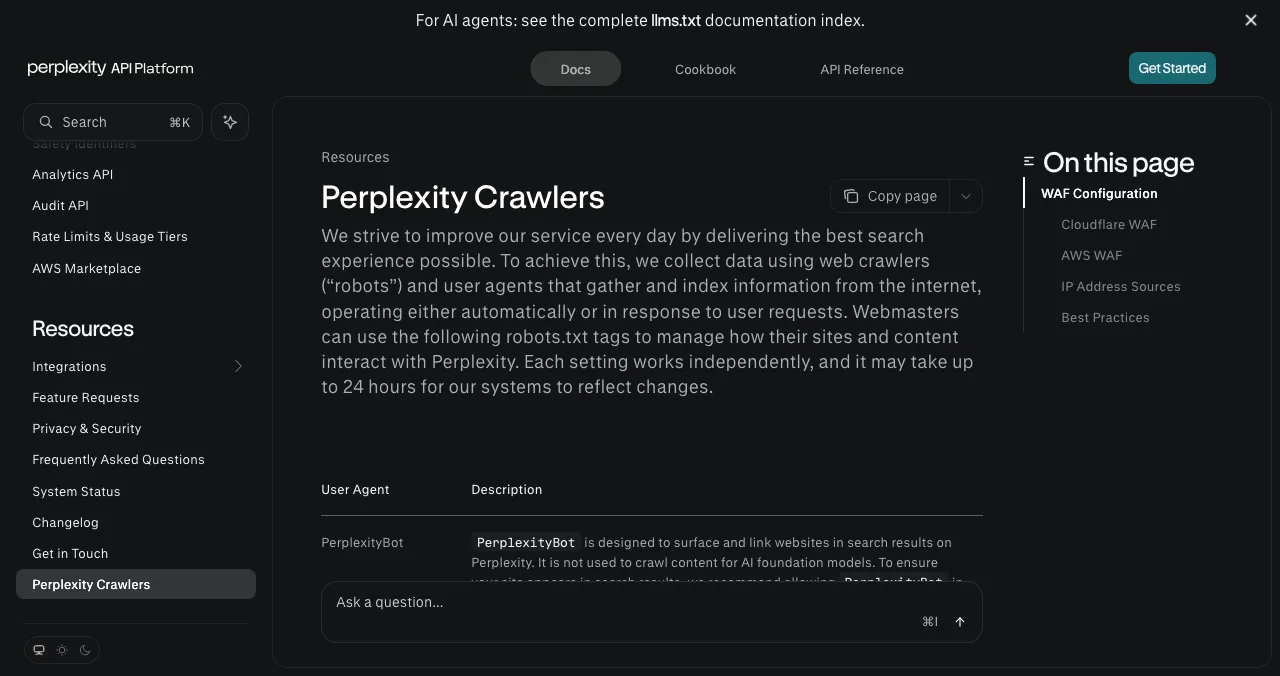
Search and training crawlers are separate (GPTBot, ClaudeBot), so you can be cited in answers while opting out of training if you prefer. Check your CDN or firewall too; Google lists "crawling is allowed in robots.txt, and by any CDN or hosting infrastructure" as a basic requirement. Our organic visibility playbook covers the setup step by step.
Step 2: Write passages engines can lift
AI answers are stitched together from passages. Write passages that stand alone.

- Answer first. Put a one- or two-sentence answer directly under each question heading. "Acme costs $29 a month for up to five users" is quotable; "pricing that scales with you" is not.
- Add numbers. Replace "fast" with "imports 10,000 rows in under a minute (our test, Nov 2026)". The GEO study's best method was adding statistics.
- Quote and cite credible sources. A line from a standard, a regulator, a peer-reviewed study or a well-known practitioner, linked to the original.
- Name things. Integrations, standards, cities, customer types. Specific nouns help engines match you to specific questions.
- Keep it plain. Short sentences and everyday words; the study found simpler, more fluent text helped too.
- Make structured data match the page. Mark up your organisation, product and FAQs, and keep it identical to the visible text.
Step 3: Get corroborated across the web
Engines are more confident citing a claim that several independent pages agree on. For a startup, that means the same name, tagline and description everywhere:
- Launch sites and directories: Product Hunt, Peerlist, Uneed, SaaSHub and AlternativeTo each publish a page about you. See our launch site shortlist.
- A permanent profile: a free Science of Apps Launchpad profile is written to rank and to be quoted, and people find it by the problem you solve.
- Comparisons and reviews: if people ask "X vs Y", publish an honest comparison page yourself, and get listed where people compare tools.
- Founders and experts: podcasts, guest posts and interviews with your name and product described consistently.

Step 4: Measure what you can
GEO measurement is still crude, so combine three signals:
- Referrals: sessions from chatgpt.com, perplexity.ai and claude.ai in your analytics.
- Search Console: Google includes AI Overviews and AI Mode traffic in the Performance report under the Web search type.
- Spot checks: once a month, ask each assistant the ten questions your customers ask, and record whether you're mentioned, cited or linked. Same questions every time, so trends mean something.
Your GEO checklist

- AI search crawlers allowed — OAI-SearchBot, Claude-SearchBot, PerplexityBot, Googlebot; CDN rules checked
- Every key page answers one question first — in one or two plain sentences
- Numbers instead of adjectives — dated, with your method or source
- Credible quotes and citations — linked to the original
- Consistent description everywhere — same name, tagline and link on every profile
- Structured data matches the page — organisation, product, FAQ
- Monthly AI spot checks — the same ten customer questions
A 30-day GEO plan
- Week 1
Open the doors
Check robots.txt and firewall rules for every AI search crawler, verify Search Console and Bing Webmaster Tools, submit your sitemap.
- Week 1
Corroborate
Publish your permanent Launchpad profile and update every directory and launch listing to the same tagline.
- Week 2
Rewrite three key pages
Homepage, pricing and "how it works": answer first, add numbers, cite sources.
- Week 3
Publish three answer pages
The three questions customers ask before buying, each with a direct answer, specifics and sources.
- Week 4
Measure
Run your first AI spot check and note referrals; plan the next pages around questions where you're absent.
GEO mistakes to avoid

- Keyword stuffing — the GEO study found it performed poorly in AI answers
- Blocking AI search crawlers to stop training — block the training bots instead; they're separate
- Vague, adjective-heavy copy — engines can't quote "best-in-class"
- Inventing statistics — unsourced numbers damage trust with people and engines alike
- Chasing a GEO "hack" — Google says there's no special optimisation for its AI features; quality and clarity are the strategy
Plain, specific writing also helps humans: it lowers cognitive load, and named, credible sources work as social proof for readers deciding whether to trust you.
Ready to be cited?
How we know
The research findings come from Aggarwal et al., "GEO: Generative Engine Optimization" (arXiv 2311.09735, version 3, accepted to KDD 2024), which we read on 17 November 2026. Crawler rules come from OpenAI's, Anthropic's and Perplexity's own documentation and Google Search Central, all read the same day. Science of Apps runs the Launchpad mentioned above.
Key terms, defined
- Generative engine: a search system that gathers sources and writes an answer with a language model, such as ChatGPT search or Perplexity.
- GEO (generative engine optimization): making content more likely to be included and cited in those answers.
- Citation: a link or attribution to your page inside an AI answer.
- Search crawler vs training crawler: separate bots for powering answers and for collecting training data.
- Corroboration: independent pages agreeing on the same facts about you.
- AEO (answer engine optimization): a closely related term for optimising content to be the direct answer in search features and assistants.
Frequently asked questions
What is generative engine optimization?
Generative engine optimization (GEO) is the practice of making content more likely to be included and cited in answers written by AI engines such as ChatGPT search, Perplexity, Claude and Google's AI Overviews. The term comes from a 2023 research paper by Aggarwal and colleagues, accepted to KDD 2024, which introduced GEO and a benchmark for measuring it.
What's the difference between GEO and SEO?
SEO aims to rank your page as a link; GEO aims to get your words and facts used and cited inside an AI answer. They overlap heavily: AI engines still need to crawl and index your page, and Google says its AI features have no extra requirements beyond normal Search. GEO adds an emphasis on quotable, specific, sourced passages.
Does GEO work for small startups?
The original study suggests it can work especially well for them: it found lower-ranked websites benefited significantly more from GEO methods than top-ranked ones, because generative engines weigh the content itself, not only signals like backlinks. Specific, well-sourced pages give a small site a real chance of being cited.
Which GEO tactics work best?
In the GEO paper's experiments, adding quantitative statistics, adding relevant quotations from credible sources and citing sources performed best, improving visibility by up to about 40% on some metrics. Keyword stuffing, a classic SEO trick, performed poorly. Simplifying language and improving fluency also helped modestly.
How do I get my startup cited by ChatGPT and Perplexity?
Allow their search crawlers (OAI-SearchBot and PerplexityBot) in robots.txt; OpenAI says sites opted out of OAI-SearchBot won't appear in ChatGPT search answers. Then publish pages that answer your customers' questions with specifics, keep your product described the same way everywhere, and earn mentions on launch sites, directories and relevant publications.
Do I need llms.txt for GEO?
Not for Google, which says no new machine-readable or AI text files are needed for its AI features. llms.txt is a community proposal some tools read; it can help AI tools find your key pages, but it isn't a ranking requirement anywhere we checked.
How do I measure GEO?
There's no single dashboard. Track referrals from chatgpt.com, perplexity.ai and claude.ai in analytics, watch impressions in Google Search Console (AI Overviews and AI Mode traffic is included in the Web search type), and regularly ask the assistants the questions your customers ask, noting whether and how you're cited.
Sources
- Aggarwal et al. — GEO: Generative Engine Optimization (arXiv 2311.09735, KDD 2024)
- Google Search Central — AI features and your website (checked 17 Nov 2026)
- OpenAI — Overview of OpenAI crawlers (checked 17 Nov 2026)
- Anthropic (Claude Help Center) — Does Anthropic crawl data from the web, and how can site owners block the crawler?
- Perplexity — Perplexity crawlers (checked 17 Nov 2026)
- Science of Apps — Launchpad: launch your product free
- Checked November 17, 2026. Figures that change — fees, salaries, prices — are reviewed every six months; if something is out of date, tell us.
Where to go from here
- Organic visibility for startups — the five-step foundation GEO builds on
- How to rank in ChatGPT — the ChatGPT side in depth
- What is AEO? — answer engine optimisation explained
- Science of Apps - LaunchpadThe AI search optimization checklist: crawler access, content, corroboration and measurement for Google AI Overviews, ChatGPT, Claude and PerplexityA 2027 AI search optimization checklist: crawler access, answer-first content, corroboration and measurement for AI Overviews, ChatGPT, Claude and Perplexity.
- AI & vibe codingWhat is GEO? Generative engine optimization explained, with what the research foundWhat GEO (generative engine optimization) is, how it differs from SEO and AEO, what the research found, and a checklist to get cited.
- Career guidesGenerative engine optimization skills employers want in 2027: getting brands mentioned and cited in ChatGPT, Gemini, Perplexity and AI OverviewsGEO skills employers want in 2027: how AI assistants choose sources, quotable facts, authority and mentions, crawler access and tracking AI citations.
- Science of Apps - LaunchpadHow to rank in ChatGPT, Gemini, Claude and Perplexity: each engine's own rules, side by side, and what works across all of themHow to rank in ChatGPT, Gemini, Claude and Perplexity in 2027: each engine's crawler rules side by side, and the content that gets cited by all four.
- Science of Apps - LaunchpadHow to get organic visibility for your startup on Google and in AI search, without paying for adsHow to get organic visibility for your startup in 2027: get indexed, let AI search crawlers in, build profiles and citations, and write pages engines quote.
- Science of Apps - LaunchpadAnswer engine optimization for startups: how to become the answer in Google's featured snippets, People Also Ask and AI assistantsA practical AEO guide for startups in 2027: how to become the direct answer in featured snippets, People Also Ask and AI assistants, step by step.
Get the ideas, not the noise.
Sign up with Google and we’ll send you short UX psychology tips by email — why people tap, stall and leave, and what to do about it. Unsubscribe anytime. Prefer something to keep? Get the free Laws of UX guide as a PDF.
Launch day ends. Your listing shouldn't.
A permanent, crawlable profile that states what you do in quotable words, built to rank on Google and to be cited by AI assistants, plus your product tested end to end with a detailed report.