 By
Quick answer: How can a startup do answer engine optimization?
- What AEO is: making your content the direct answer in featured snippets, People Also Ask and AI assistants.
- The pattern: question heading, 40–60 word answer, then detail, numbers and sources.
- Start with buyer questions: the 20 things people ask before choosing a product like yours.
- Keep it eligible: crawlable, indexed, snippets not blocked, AI search bots allowed.
- You can't mark yourself as the answer: Google says its systems decide.
Key takeaways
- AEO is SEO for questions: the same crawlability and quality, plus answer-first structure.
- Google says you can't mark a page as a featured snippet; its systems decide when a page is a good answer.
- Featured snippets can also appear within People Also Ask, so one well-structured answer can surface in several places.
- Snippet controls (nosnippet, data-nosnippet, max-snippet) can keep you out of featured snippets; check you haven't set them by accident.
- The same answer-first pages are the ones AI assistants quote.
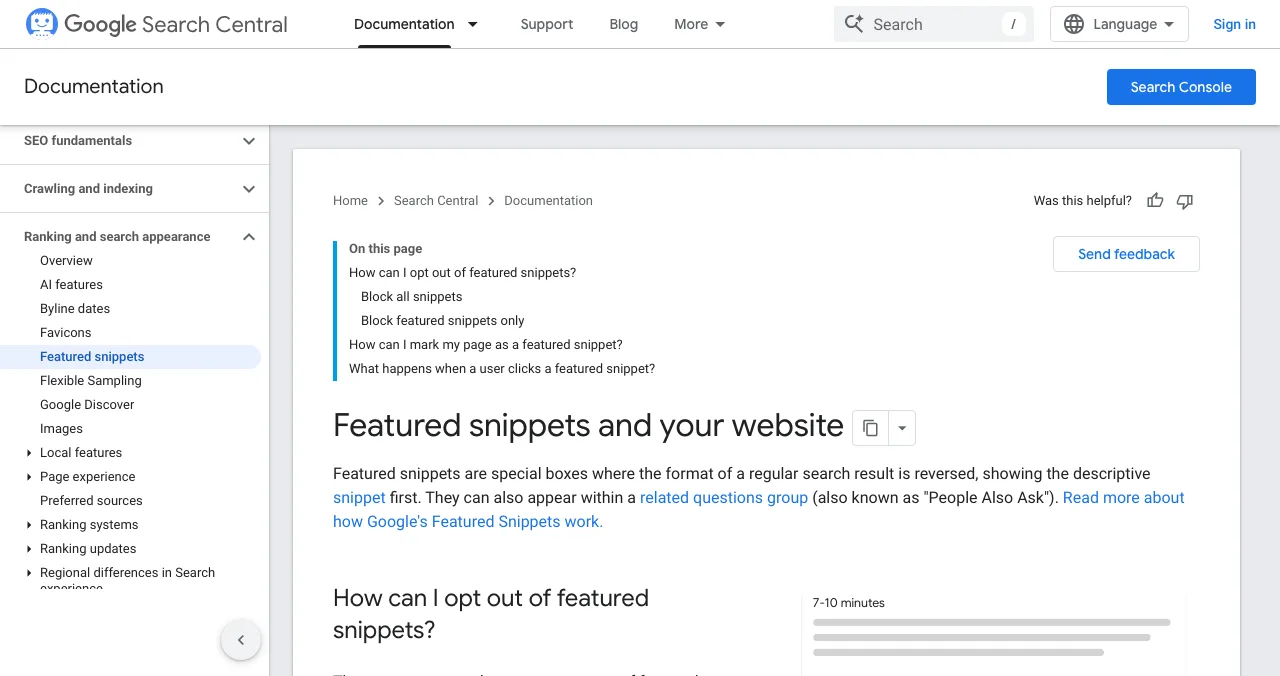
When someone types a question into Google or asks an AI assistant, the best outcome isn't ranking first. It's being the answer. Answer engine optimization (AEO) is how you become it: structure pages so search features and AI assistants can lift your answer directly, and make sure nothing technical stops them. This guide is the practical, startup version; for the definition and background, see what is AEO. Google's rules are from its own documentation, read on 17 November 2026. Jump to the answer pattern, which questions or eligibility.
- Words in a good standalone answer
- 40–60
- Buyer questions to start with
- 20
- Ways to mark your page as a featured snippet (Google decides)
- 0
- Pattern: question, answer, detail
- 1
Where answers appear
| Surface | What it shows | Who decides |
|---|---|---|
| Featured snippet | Your answer first, above the link | Google's systems |
| People Also Ask | Related questions, each with an answer | Google's systems |
| AI Overviews and AI Mode | AI-written answers with supporting links | Google; no extra requirements beyond Search |
| ChatGPT, Claude, Perplexity | AI answers citing sources | Each engine; its search bot must be allowed |
Table: Where answer engine optimization pays off (Google and AI companies' documentation, checked 17 Nov 2026)
Google describes featured snippets as boxes "where the format of a regular search result is reversed, showing the descriptive snippet first", and notes they "can also appear within a related questions group (also known as 'People Also Ask')". It's blunt about control: asked how to mark a page as a featured snippet, its answer is "You can't."
The answer pattern

- The question as a heading — the words people actually type: "How much does X cost?"
- The answer directly under it — 40–60 words that stand alone, with the key number or verdict.
- Then the detail — steps as a list, comparisons as a table, numbers with sources.
- One question per section — so each answer can be lifted without the rest.
- Plain words — the GEO research found simpler, more fluent text and added statistics and citations helped visibility in AI answers.
Which questions to answer first
| Question type | Example | Best format |
|---|---|---|
| What is it? | "What is [category]?" | 40–60 word definition |
| Cost | "How much does [product] cost?" | A number or range, then a table |
| Comparison | "[You] vs [competitor]" | A table, then a verdict |
| How to | "How do I [task] with [product]?" | Numbered steps |
| Best for | "Best tool for [job]" | A short list with who each suits |
| Trust | "Is [product] safe / legit?" | Direct answer plus evidence |
Table: The buyer questions to answer first, and the format engines lift
Collect them from sales calls, support tickets, Google's People Also Ask boxes and Search Console queries. Start with 20.
Keep your pages eligible

- Indexed — verified in Google Search Console; sitemap submitted
- Snippets not blocked — no stray
nosnippet,data-nosnippetor very lowmax-snippet(Google says these can keep you out of featured snippets) - AI search bots allowed — OAI-SearchBot, Claude-SearchBot, PerplexityBot
- Structured data matches the page — FAQ and product markup reflect visible text
- Fast and readable on mobile — answers are often read on phones
Measure AEO

- Search Console queries — questions where you get impressions but few clicks are close to winning
- Featured snippets and People Also Ask — check your top 20 questions monthly
- AI citations — ask ChatGPT, Perplexity, Claude and Gemini the same questions monthly
- AI referrals — chatgpt.com, perplexity.ai, claude.ai in analytics
Your first answer: what you do
The first question any engine needs answered about a startup is "what does it do?". A free Science of Apps Launchpad profile answers it plainly, on a permanent, crawlable page people find by the problem they have. Once it's live, your product is tested end to end, including how findable you are on Google and AI assistants.
AEO mistakes

- Burying the answer — three paragraphs of context before the answer
- Clever headings — "The magic behind the curtain" instead of the question
- Accidental snippet blocks — leftover nosnippet or max-snippet rules
- Answers that don't stand alone — "As mentioned above…"
- Marking up content that isn't on the page — structured data must match visible text
Ready to become the answer?
How we know
Featured snippet behaviour and controls come from Google Search Central's featured snippets page; AI features from its AI features guide; AI crawler rules from OpenAI's and Perplexity's documentation, all read on 17 November 2026. The 40–60 word guideline is our editorial recommendation, not a Google rule; Google doesn't publish a required length. Science of Apps runs the Launchpad mentioned above.
Key terms, defined
- AEO (answer engine optimization): structuring content to be the direct answer in search features and AI assistants.
- Featured snippet: a search result that shows the answer first, above the link.
- People Also Ask: a group of related questions in Google results, each with an answer.
- nosnippet / max-snippet: page rules that stop or limit snippets.
- Answer-first: putting the direct answer immediately under the question.
Frequently asked questions
What is answer engine optimization?
Answer engine optimization (AEO) is structuring content so search features and AI assistants can use it as a direct answer: featured snippets and People Also Ask in Google, and answers in ChatGPT, Perplexity, Claude and Gemini. It builds on SEO with question-shaped headings and short, standalone answers.
How is AEO different from SEO?
SEO aims to rank pages; AEO aims to have your answer shown directly. They share the foundations: crawlable, indexed, helpful pages. AEO adds a focus on specific questions, concise answers near the top, and clear structure that engines can lift.
How do I get a featured snippet?
You can't mark a page as one; Google says its systems decide. You can make a page a good candidate: answer the question directly near a matching heading, add detail below, keep the page indexed, and make sure snippet controls like nosnippet or a low max-snippet aren't blocking it.
How long should an AEO answer be?
Long enough to stand alone as a complete answer, usually 40–60 words for a definition or a direct question, followed by detail. Google doesn't publish a required length; lists and tables work for step and comparison questions.
Does AEO help with ChatGPT and Perplexity?
Yes, the same answer-first pages are easy for AI assistants to quote. You also need their search bots allowed: OAI-SearchBot for ChatGPT, PerplexityBot for Perplexity and Claude-SearchBot for Claude.
What's the first AEO step for a startup?
List the questions buyers ask before choosing a product like yours, from 'what does X cost' to 'X vs Y', and write one page or section per question with the answer in the first two sentences.
Sources
- Google Search Central — Featured snippets and your website (checked 17 Nov 2026)
- Google Search Central — AI features and your website (checked 17 Nov 2026)
- OpenAI — Overview of OpenAI crawlers (checked 17 Nov 2026)
- Perplexity — Perplexity crawlers (checked 17 Nov 2026)
- Aggarwal et al. — GEO: Generative Engine Optimization (arXiv 2311.09735, KDD 2024)
- Science of Apps — Launchpad: launch your product free
- Checked November 17, 2026. Figures that change — fees, salaries, prices — are reviewed every six months; if something is out of date, tell us.
Where to go from here
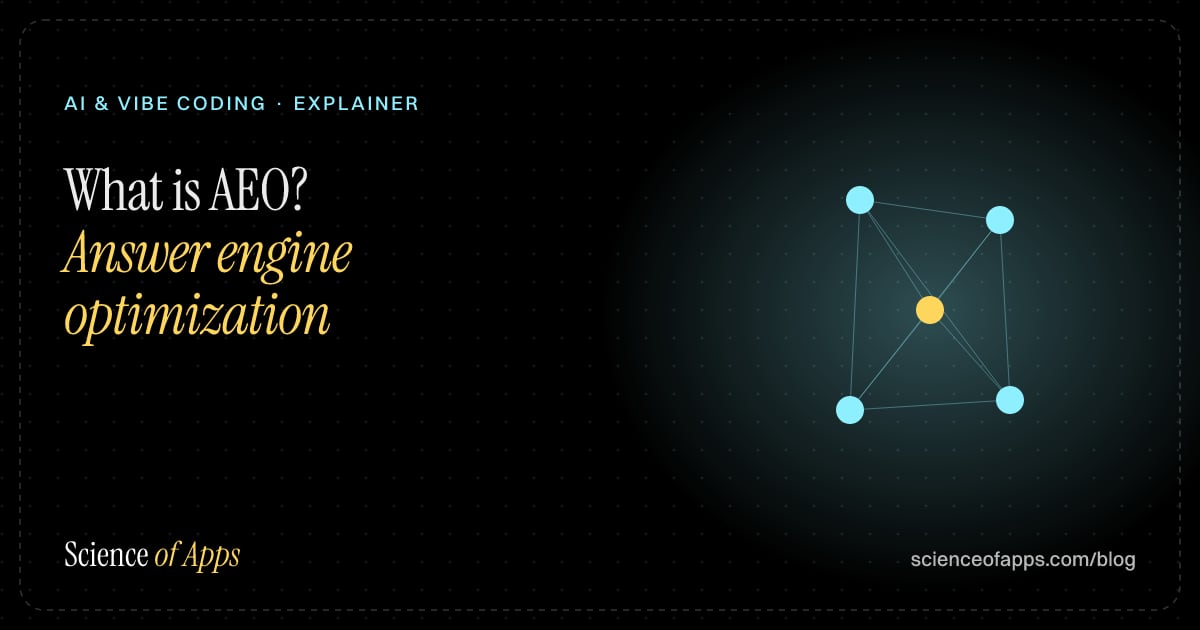
- What is AEO? — the definition and origins
- Rank in ChatGPT, Gemini, Claude and Perplexity — each engine's rules
- GEO for startups — what the research shows
- Science of Apps - LaunchpadGenerative engine optimization for startups: what the research shows, and a plan to get cited by AI answersGEO for startups in 2027: what the original GEO research found, how to get cited by ChatGPT, Perplexity, Claude and Google AI, and a 30-day plan.
- AI & vibe codingWhat is AEO? Answer engine optimization explained, with a checklistWhat AEO (answer engine optimization) is, how it relates to SEO and GEO, how answer surfaces pick content, and a practical checklist.
- Science of Apps - LaunchpadThe AI search optimization checklist: crawler access, content, corroboration and measurement for Google AI Overviews, ChatGPT, Claude and PerplexityA 2027 AI search optimization checklist: crawler access, answer-first content, corroboration and measurement for AI Overviews, ChatGPT, Claude and Perplexity.
- Career guidesAnswer engine optimization skills employers want in 2027: answer-first content, featured snippets, AI Overviews, voice and question researchAEO skills employers want in 2027: question research, answer-first writing, featured snippets, AI Overviews, structured content and new metrics.
- Science of Apps - LaunchpadHow to show up in Google AI Overviews and AI Mode: Google's actual requirements, query fan-out, the controls, and how to measure itHow to show up in Google AI Overviews and AI Mode: be indexed with a snippet, no extra requirements, Google's best practices, controls and how to track it.
- Science of Apps - LaunchpadHow to get organic visibility for your startup on Google and in AI search, without paying for adsHow to get organic visibility for your startup in 2027: get indexed, let AI search crawlers in, build profiles and citations, and write pages engines quote.
Get the ideas, not the noise.
Sign up with Google and we’ll send you short UX psychology tips by email — why people tap, stall and leave, and what to do about it. Unsubscribe anytime. Prefer something to keep? Get the free Laws of UX guide as a PDF.
Launch day ends. Your listing shouldn't.
A permanent, answer-first profile that says what your product does in plain words, the kind of page search features and AI assistants lift from, plus your product tested end to end.