 By
Quick answer: How do I get my website into Google AI Overviews?
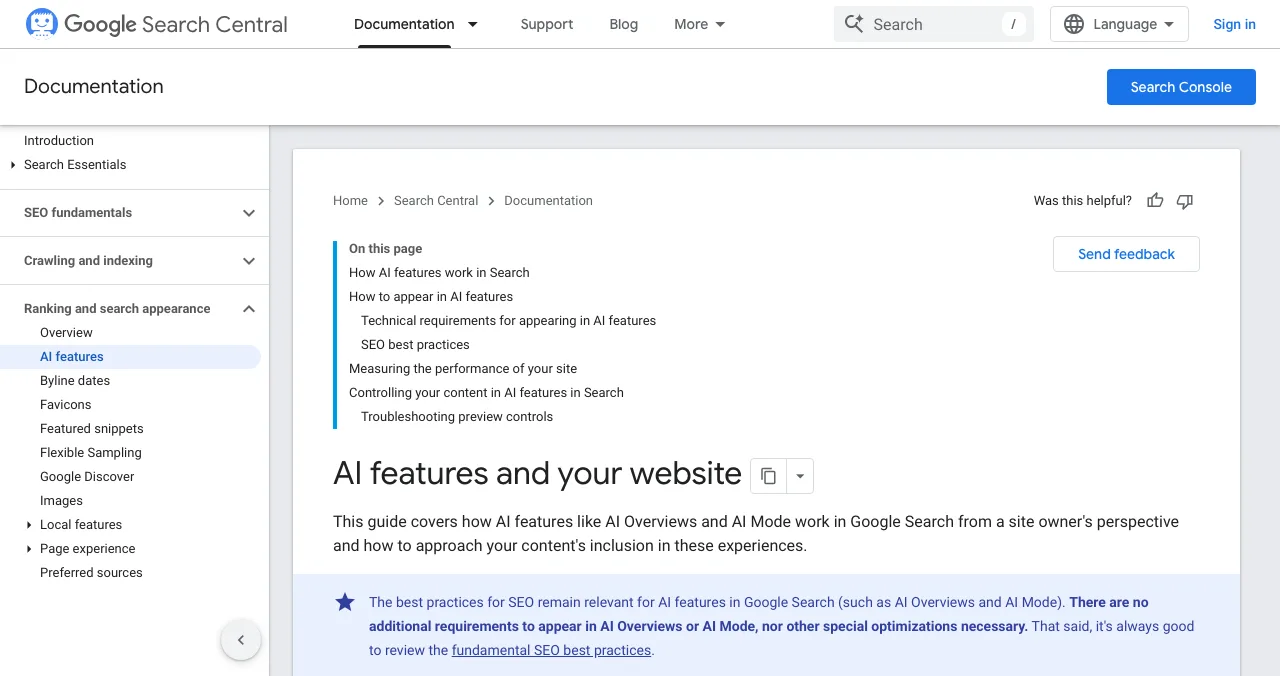
- Requirement: indexed and eligible to show in Google Search with a snippet.
- Extra requirements: none, says Google.
- Query fan-out: AI Overviews and AI Mode may run related searches across subtopics.
- Controls: nosnippet, data-nosnippet, max-snippet and noindex limit what's shown.
- Measure: Search Console's Generative AI performance report, and the Web search type.
- Best practice: crawlable, internally linked, textual content with matching structured data.
Key takeaways
- There's no special AI Overviews markup; ordinary Search eligibility is the requirement.
- Query fan-out rewards pages that answer specific sub-questions clearly.
- Your CDN or bot firewall can quietly block Googlebot; check it.
- Structured data must match the visible text, and Business Profile details must be current.
- Google says to skip llms.txt, chunking, special schema and inauthentic mentions: SEO best practice is the work.
Most "AI Overviews SEO" advice invents requirements Google never wrote. Google's own documentation is short and specific: be indexed, be eligible for a snippet, and there are "no additional technical requirements". What changes is how the answer is assembled, through query fan-out, and that rewards a particular kind of page. This guide follows Google's AI features documentation, read on 17 November 2026. Jump to the requirement, query fan-out, best practices or measuring it.
The requirement
| Question | Google says |
|---|---|
| What makes a page eligible? | Indexed and eligible to show in Google Search with a snippet |
| Any extra technical requirements? | No |
| Special markup? | None; structured data should match the visible text |
| Does Google-Extended affect it? | No; it doesn't affect inclusion in Google Search |
| How is it reported? | Search Console Performance report, Web search type |
Table: AI Overviews and AI Mode eligibility (Google Search Central, checked 17 Nov 2026)
Query fan-out: why specific pages win
Google says AI Overviews and AI Mode may use query fan-out: "issuing multiple related searches across subtopics and data sources" to build a response, and showing "a wider and more diverse set of helpful links" than a classic search. In practice, one broad question becomes several narrow ones. A page that answers one narrow question clearly ("How much does X cost in India?", "X vs Y for small teams") has more chances to be one of those links than a vague overview.

- List the sub-questions behind your main query: cost, comparison, how-to, who it's for.
- Answer each in its own section — a heading phrased as the question, one or two sentences answering it.
- Add the specifics — numbers, dates, named sources.
- Link the sections internally — so Google finds them.
Google's best practices

- Allow crawling — in robots.txt and in your CDN or hosting infrastructure
- Internal links — make content easy to find on your site
- Good page experience — for users, on every device
- Important content as text — not only in images or scripts
- High-quality images and video — supporting the text, where useful
- Structured data that matches the visible text
- Current Merchant Center and Business Profile details
The controls
| Control | Effect |
|---|---|
| nosnippet | No snippet shown from the page |
| data-nosnippet | Excludes a section from snippets |
| max-snippet | Limits snippet length |
| noindex | Keeps the page out of Search |
Table: Controls that apply to AI features (Google Search Central, checked 17 Nov 2026)
Using them limits what Google can show, so use them deliberately.
How to measure it
Google's optimisation guide points to Search Console's Generative AI performance report to see how your content performs in its generative AI features. That traffic is also counted in the Performance report under the Web search type. Track impressions and clicks for your target questions over time, and check by hand which pages are linked for your ten most important buyer questions.
What Google says you don't need
Google's generative AI optimisation guide (updated 10 July 2026) lists tactics to skip for Google Search:

- llms.txt or other AI text files — Google Search doesn't use them
- "Chunking" content — no need to break pages into tiny pieces
- Rewriting just for AI — no special writing style required
- Inauthentic "mentions" — not as helpful as it seems
- Special schema — structured data isn't required for generative AI search
Its summary: SEO best practices "continue to be relevant", because the AI features are rooted in Google's core ranking and quality systems.
Mistakes

- A bot firewall challenging Googlebot — it can't index what it can't fetch
- Answers buried in images or PDFs — keep them in text
- Structured data that doesn't match the page
- One giant page for everything — fan-out favours specific answers
- Blocking Google-Extended to "leave AI Overviews" — it doesn't do that
A permanent page Google can link

Ready to be found?
How we know
Requirements, fan-out, best practices, controls and reporting come from Google's "AI features and your website" documentation and its generative AI optimisation guide; Google-Extended from Google's common crawlers page, both read on 17 November 2026. The sub-question method is our editorial recommendation. Google doesn't publish how it chooses links, so we don't claim to know.
Key terms, defined
- AI Overviews: AI-generated summaries at the top of some Google results.
- AI Mode: Google Search's conversational AI experience.
- Query fan-out: running several related searches to build one answer.
- Snippet: the text Google shows from a page in results.
- Search Console: Google's free tool for site owners to see search performance.
Frequently asked questions
How do I get my website into Google AI Overviews?
Make sure the page is indexed and eligible to appear in Google Search with a snippet. Google says there are no additional technical requirements. Then follow its usual best practices: allow crawling, link the page internally, keep key content in text and make structured data match the page.
Is there special markup for AI Overviews?
No. Google says there are no additional technical requirements beyond being indexed and eligible to show with a snippet. Structured data should simply match the visible text on the page.
What is query fan-out?
Google says AI Overviews and AI Mode may issue multiple related searches across subtopics and data sources to build a response, which lets them show a wider, more diverse set of links than a classic search.
Can I stop my content appearing in AI Overviews?
Use the same controls as Search: nosnippet, data-nosnippet or max-snippet to limit what's shown, or noindex to keep a page out of Search entirely.
How do I measure AI Overviews traffic?
Google points to Search Console's Generative AI performance report for how content performs in its generative AI features. Traffic from AI features is also included in the Performance report under the Web search type.
Does blocking Google-Extended remove me from AI Overviews?
No. Google says Google-Extended doesn't affect inclusion in Google Search. It does control Gemini training and grounding in the Gemini apps, which is separate from AI Overviews.
Sources
- Google Search Central — AI features and your website (checked 17 Nov 2026)
- Google Search Central — Optimizing your website for generative AI features on Google Search (updated 10 Jul 2026; checked 17 Nov 2026)
- Google — Google's common crawlers: Google-Extended (checked 17 Nov 2026)
- Google Search Central — Featured snippets and your website
- Aggarwal et al. — GEO: Generative Engine Optimization (arXiv 2311.09735, KDD 2024)
- Science of Apps — Launchpad: launch your product free
- Checked November 17, 2026. Figures that change — fees, salaries, prices — are reviewed every six months; if something is out of date, tell us.
Where to go from here
- Rank in AI search engines — all four engines' rules
- Answer engine optimization guide — writing answers engines lift
- How to show up in Perplexity — the other big answer engine
- Science of Apps - LaunchpadGenerative engine optimization for startups: what the research shows, and a plan to get cited by AI answersGEO for startups in 2027: what the original GEO research found, how to get cited by ChatGPT, Perplexity, Claude and Google AI, and a 30-day plan.
- Science of Apps - LaunchpadHow ChatGPT, Google's AI features, Claude and Perplexity choose which products to recommend, from what they publish, and what that means for your startupHow ChatGPT, Google AI Overviews, Claude and Perplexity recommend products: search, fan-out, sources and corroboration, and how a startup gets included.
- Science of Apps - LaunchpadPerplexity SEO: how to show up in Perplexity answers, from allowing PerplexityBot and fixing your firewall to writing pages it citesHow to show up in Perplexity: allow PerplexityBot and its IP ranges, fix firewall rules, understand Perplexity-User, and write pages Perplexity cites.
- Science of Apps - LaunchpadThe AI search optimization checklist: crawler access, content, corroboration and measurement for Google AI Overviews, ChatGPT, Claude and PerplexityA 2027 AI search optimization checklist: crawler access, answer-first content, corroboration and measurement for AI Overviews, ChatGPT, Claude and Perplexity.
- Science of Apps - LaunchpadChatGPT SEO for startups: how to get your product recommended and cited by ChatGPT, from OpenAI's own rulesChatGPT SEO for startups in 2027: what OpenAI says makes a site eligible for ChatGPT search, and how to get your product recommended and cited.
- Science of Apps - LaunchpadHow to get organic visibility for your startup on Google and in AI search, without paying for adsHow to get organic visibility for your startup in 2027: get indexed, let AI search crawlers in, build profiles and citations, and write pages engines quote.
Get the ideas, not the noise.
Sign up with Google and we’ll send you short UX psychology tips by email — why people tap, stall and leave, and what to do about it. Unsubscribe anytime. Prefer something to keep? Get the free Laws of UX guide as a PDF.
Launch day ends. Your listing shouldn't.
A free, crawlable Launchpad profile in plain, specific words is one more independent page Google can index and link, and the product test checks how findable you are on Google and AI assistants.