 By
Quick answer: How do I market an AI tool?
- Position by task: 'Turns call recordings into follow-up emails', not 'GPT-powered sales AI'.
- Be where people browse by task: Future Tools (free), There's An AI For That ($49+), a free Launchpad profile.
- Be citable by AI search: allow OAI-SearchBot, Claude-SearchBot and PerplexityBot; publish answer pages.
- Show real outputs: 30–60 second demos of actual results.
- Earn trust: example prompts, honest limits, privacy notes, real reviews.
Key takeaways
- AI buyers search for jobs to be done; marketing that leads with the model loses to marketing that leads with the outcome.
- AI directories bring task-based search traffic; most now charge, so test one before buying several.
- Being cited inside AI answers matters for AI tools more than for most products; make pages specific and crawlable.
- Trust is the conversion problem: users need to know what to ask, what they'll get and what happens when it's wrong.
- Activation, a user getting a useful output, is the metric to watch.
There are tens of thousands of AI tools in directories, and most of them are marketed the same way: a model name, a gradient and a prompt box. The ones that grow are marketed differently. They're positioned by the job they do, found where people search for that job, cited by AI answers, and they earn trust in the first minute. This playbook covers each step, with directory fees and AI search rules checked on their own pages on 17 November 2026. Jump to positioning, where to be listed, AI search or trust.
- Task to position around
- 1
- Range to list in your first AI directories
- $0–$49
- AI search crawlers to allow
- 3
- Time a new user should take to get a useful output
- 1 min
1. Position by the task, not the model
| Model-first (weak) | Task-first (strong) |
|---|---|
| "GPT-powered sales assistant" | "Turns call recordings into follow-up emails" |
| "AI for content" | "Writes product release notes from your Jira tickets" |
| "Next-gen image AI" | "Removes backgrounds from product photos in bulk" |
Table: Positioning an AI tool by task
Product Hunt's own featuring guidance makes the same point: plain language, a clear edge over the obvious alternative, and "say what the product does so someone gets it on the first read".
2. Be listed where people browse by task
| Where | Cost | Why |
|---|---|---|
| Science of Apps Launchpad | Free, forever | Permanent profile found by the task; product tested with a report |
| Future Tools | Free submission | Hand-reviewed AI directory |
| TopAI.tools | $47 (refunded if not accepted) | Task-focused AI directory |
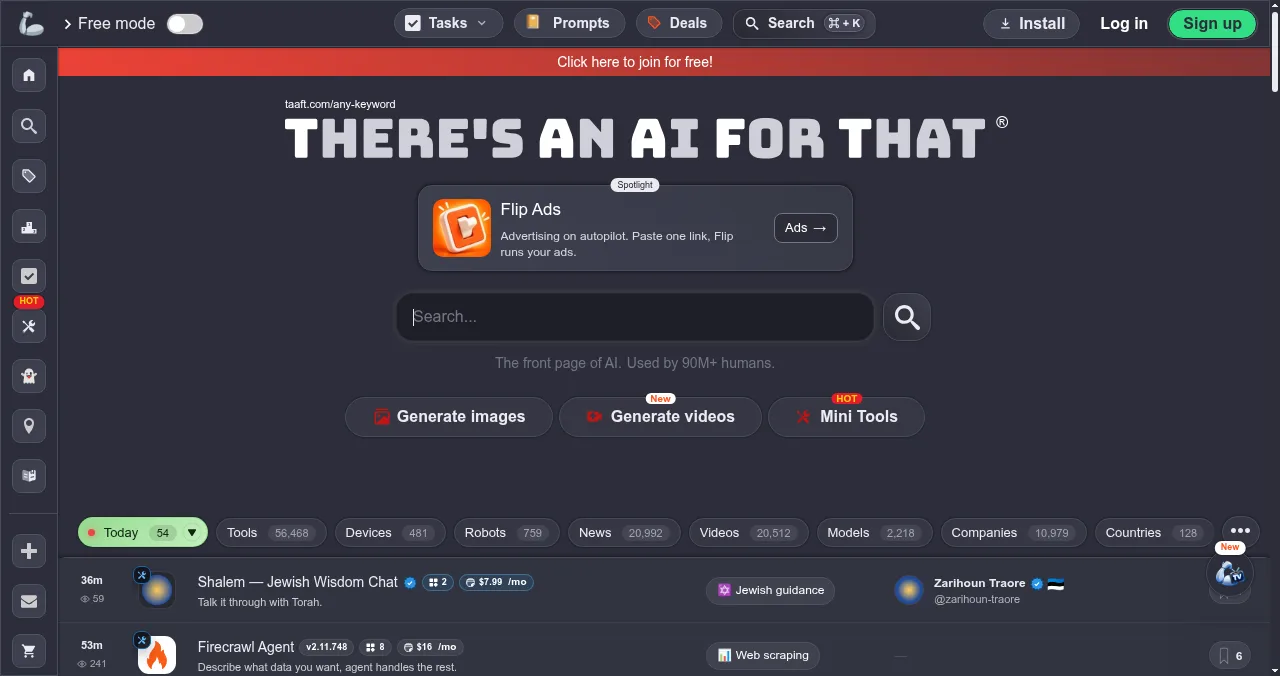
| There's An AI For That | $49 or $437 | The largest task-based AI directory |
| Product Hunt | Free | A launch day; many launches are AI tools |
Table: Where to list an AI tool (each site's own page, checked 16–17 Nov 2026)
Start free, then test one paid directory with a UTM link before buying more. Full comparison in AI tools directories.
3. Be cited by AI search
AI tools are often discovered by asking an AI. Make sure you can be cited:

- Allow the search crawlers — OAI-SearchBot (ChatGPT), Claude-SearchBot, PerplexityBot; OpenAI says opting out of OAI-SearchBot keeps you out of ChatGPT search answers
- Publish one page per task you do — answer first, with a real example output
- Use numbers and sources — the GEO study found statistics, quotations and citations raised visibility in AI answers
- Describe yourself consistently — the same one-liner on every directory and profile
See ChatGPT SEO and GEO for startups.
4. Show real outputs

- A 30–60 second demo per task — input, output, done.
- Real examples on the landing page — before-and-after, not a mock-up.
- A try-it-now box with a sample — so visitors see a result before signing up, where possible.
- Short clips for social — one output per post beats a feature list.
5. Earn trust in the first minute
Trust is the AI conversion problem. New users need to know what to ask, what they'll get and what happens when it's wrong.

- Example prompts — an empty box makes people think; examples lower the effort (Hick's Law, cognitive load)
- Honest limits — say what it can't do yet
- A way to fix bad outputs — regenerate, edit or report
- Privacy in plain words — what you store, whether it trains models, who sees it
- Real reviews and named users — social proof matters more for AI than most software

Once your free Launchpad listing is live, your AI product is tested end to end, and AI products are also tested on prompt and output trust: whether people know what to ask, what they get back and what happens when it's wrong, with a detailed report on what to fix.
6. Measure activation
| Metric | What it tells you |
|---|---|
| Visitors by source (UTM) | Which directories and launches bring people |
| Sign-ups | Interest |
| First useful output | Activation: the metric that predicts paying |
| Return in week two | Whether the tool became a habit |
| Paid conversion | Whether the value is worth money |
Table: AI tool marketing metrics, in order of importance
Mistakes in AI tool marketing

- Leading with the model — buyers choose outcomes
- An empty prompt box — users don't know what to ask
- Paying every directory at once — test, measure, decide
- Hiding limits — users find them anyway, and stop trusting you
- Blocking AI search crawlers — you vanish from AI answers about your own category
Ready to market it?
How we know
Directory fees come from each directory's own submission page, read on 17 November 2026; ChatGPT search eligibility from OpenAI's help centre; GEO findings from Aggarwal et al. (KDD 2024); positioning guidance partly from Product Hunt's featuring guidance. Science of Apps runs the Launchpad and product investigation mentioned.
Key terms, defined
- Task-first positioning: describing a product by the job it does, not the technology behind it.
- AI directory: a site listing AI tools by task or category.
- Activation: a new user getting a first useful output.
- Prompt and output trust: users understanding what to ask, what they'll get and how to handle wrong answers.
- GEO: generative engine optimization, getting cited in AI answers.
Frequently asked questions
How do I market an AI tool?
Lead with the task it does, list it where people browse by task (AI directories and a permanent product profile), make it citable by AI search engines, launch it on Product Hunt, show real outputs in short demos, and earn trust with example prompts, honest limitations and genuine reviews. Measure how many new users get a useful output.
Where should I promote an AI tool?
AI directories (Future Tools free; There's An AI For That, TopAI.tools, Toolify and AIxploria paid), launch sites (Product Hunt, Uneed, Peerlist), a permanent Science of Apps Launchpad profile, communities where your target users discuss the task, and AI search engines themselves.
How do I make my AI tool stand out?
Pick a narrow task and be the best at it, show a real output on the first screen, give example prompts, and be honest about limits. In crowded directories, a specific one-line description of the job beats a list of features.
Should I mention which AI model I use?
In the details, yes, if buyers care (some do for privacy or quality). But not in your headline: buyers choose tools by outcome. 'Writes your product release notes from Jira tickets' beats 'Built on the latest LLM'.
How do I get my AI tool recommended by ChatGPT?
Allow OAI-SearchBot so your site is eligible for ChatGPT search, publish clear pages describing the task you do, and keep consistent listings on trusted sites. OpenAI says placement isn't guaranteed and ChatGPT ranks results by relevance and reliability.
What's the biggest mistake in AI tool marketing?
Getting sign-ups to an empty prompt box. If new users don't know what to ask or get a poor first answer, they leave and rarely return. Fix the first output before spending on promotion.
Sources
- Future Tools — Submit a tool (checked 17 Nov 2026)
- There's An AI For That — Launch your AI tool (checked 17 Nov 2026)
- TopAI.tools — Submit your AI tool (checked 17 Nov 2026)
- OpenAI Help Center — Searching the web with ChatGPT (checked 17 Nov 2026)
- Aggarwal et al. — GEO: Generative Engine Optimization (arXiv 2311.09735, KDD 2024)
- Product Hunt Help Center — What kind of products get featured (checked 17 Nov 2026)
- Science of Apps — Launchpad: launch your product free
- Checked November 17, 2026. Figures that change — fees, salaries, prices — are reviewed every six months; if something is out of date, tell us.
Where to go from here
- Best websites to launch an AI startup — launch sites and directories
- AI tools directories — free and paid submissions
- ChatGPT SEO — getting recommended by ChatGPT
- Science of Apps - LaunchpadHow to launch an AI product: prove the outputs, describe the task not the model, pick free and paid launch sites, and make sure AI search can find youHow to launch an AI product in 2027: show real outputs, describe the task, launch on Product Hunt and AI directories, and get found by AI search engines.
- Science of Apps - LaunchpadHow to market a SaaS in 2027: positioning, being found by buyers, content that gets cited, launches and a product that convertsHow to market a SaaS in 2027: sharp positioning, alternatives directories, search and AI visibility, launches, founder-led sales and a trial that converts.
- Science of Apps - LaunchpadHow to launch an open source project: a README that converts, the launch sites developers read, and how to turn first users into contributorsHow to launch an open source project in 2027: a README that converts, Show HN, DevHunt and Product Hunt, and turning first users into contributors.
- Science of Apps - LaunchpadHow to market a startup with no money: the free channels that work, in the order to use them, and what each costs in time insteadHow to market a startup with no money: direct outreach, communities, free launch sites, directories, content and AI search, in order, with the time each costs.
- Science of Apps - LaunchpadThe best websites to launch an AI startup or AI tool, with what each one really costsWhere to launch an AI tool in 2027: free launch sites, AI directories and their real fees (TAAFT, Toolify, AIxploria), and which to use first.
- Science of Apps - LaunchpadHow to promote your startup for free in 2027: 30 tactics across launches, listings, content, communities and partners30 free ways to promote a startup in 2027: launch sites, listings, search and AI visibility, content, communities, partners and your own users.
Get the ideas, not the noise.
Sign up with Google and we’ll send you short UX psychology tips by email — why people tap, stall and leave, and what to do about it. Unsubscribe anytime. Prefer something to keep? Get the free Laws of UX guide as a PDF.
Launch day ends. Your listing shouldn't.
A permanent, free profile people find by the task your AI does, plus your product tested end to end, including prompt and output trust, with a detailed report on what to fix.