 By
At a glance: Leaning Tower of Pisa
- Location
- Piazza dei Miracoli, Pisa, Italy
- Built
- 1173–1372
- Type
- Bell tower (campanile) · Sacred
- Style
- Pisan Romanesque
- Commissioned by
- City of Pisa, for its cathedral
- Architects & builders
- Disputed: traditionally Bonanno Pisano; Giovanni di Simone and Tommaso Pisano finished it
- Materials
- White and grey marble over a lime-mortar core
- Size
- About 56 m tall; leans about 4 degrees
Tower of Pisa: what it is
The tower is one of four buildings on Pisa's Piazza dei Miracoli, with the cathedral, baptistery and cemetery, all faced in the same white marble with blind arcades. It was designed to stand straight.
Construction stopped for almost a century, largely because of Pisa's wars. That pause probably saved the tower: the soft soil had time to consolidate under the weight before more storeys were added.
Tower of Pisa, then and now
Real images only: an earlier view and a recent photograph, each credited and linked to its original file. Switch between them or compare side by side.
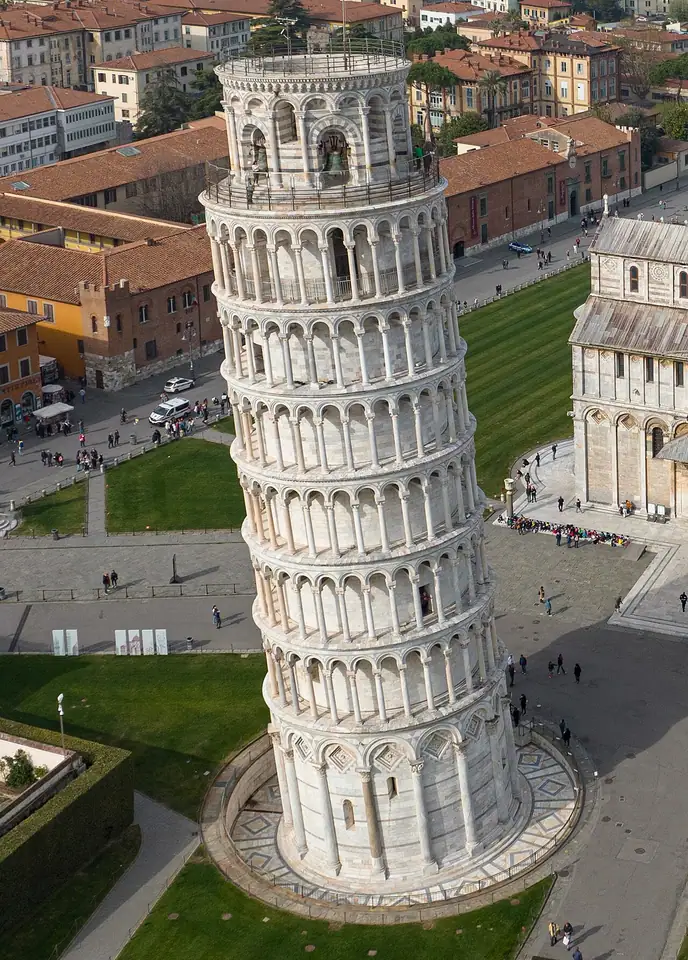
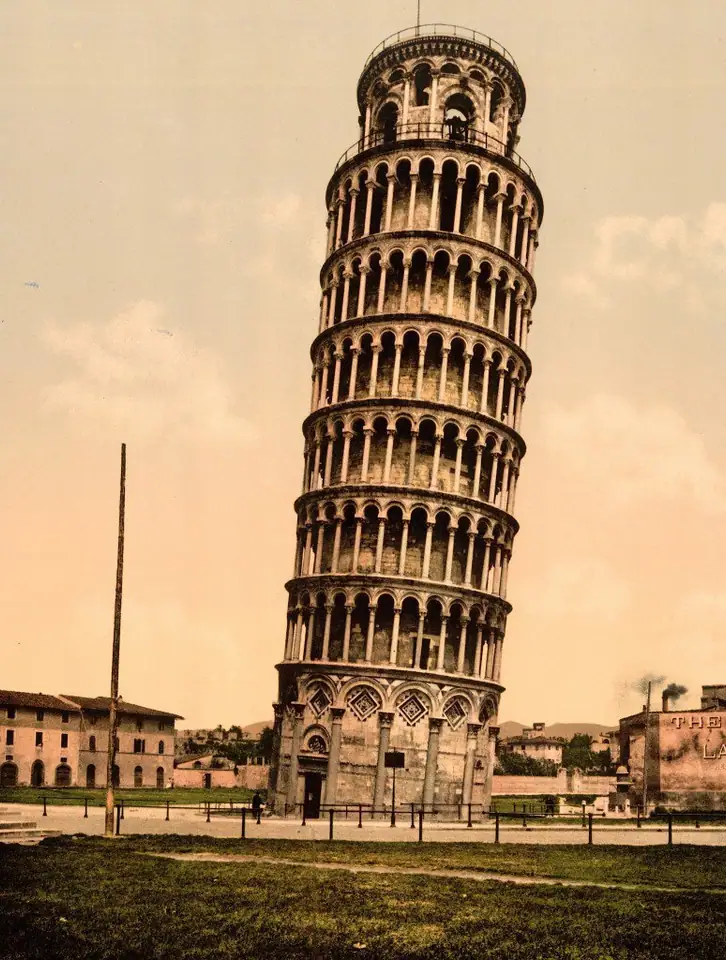 Then · 1890sNow · TodayMove across the image to compare
Tower of Pisa: how it was designed
- 01
A cylinder of arcades
Six open galleries of columns and arches wrap the hollow cylinder between a blind-arcaded base and the bell chamber, repeating the cathedral's arcades in the round.
- 02
Built crooked on purpose
When work resumed in 1272, Giovanni di Simone made the upper storeys taller on the leaning side. The tower bends back toward vertical, like a banana.
- 03
A foundation too shallow
The foundation is only about 3 metres deep, on layers of clay and sand. The south side sank more, starting the tilt.
Construction timeline
Construction begins.
Work stops at the third storey; the tower has already begun to lean.
Giovanni di Simone resumes work, adding four storeys with corrected heights.
Tommaso Pisano completes the bell chamber.
The tower is closed to the public with a lean of about 5.5 degrees.
Engineers led by John Burland extract soil from under the north side, reducing the lean by about 45 cm at the top; it reopens in 2001.
How the design changed
Pulled back to safety
Soil extraction returned the tower to roughly its tilt of the early 1800s. Monitoring since then shows it has stayed stable and even straightened slightly.
Lead and cables, then removed
During the 1990s work, about 900 tonnes of lead counterweights and steel cables were attached temporarily; they were removed once the soil works succeeded.
Who built it
The original architect is uncertain; Bonanno Pisano is the traditional name, and some scholars propose Diotisalvi. Giovanni di Simone led the second phase from 1272 and Tommaso Pisano completed the bell chamber in the 14th century.
Where it is
Piazza dei Miracoli, Pisa, Italy · 43.7230° N, 10.3966° E · Open in OpenStreetMap. Nearest in this guide: St Peter's (263 km), Pantheon (264 km), Colosseum (266 km).
 263 km264 km266 kmTower of Pisa
Drag to pan, use + and − or double-click to zoom, and tap any pin for a preview.
Built around the same time
| Monument | Country | Built | Gap |
|---|---|---|---|
| Rock-Hewn Churches of Lalibela | Ethiopia | Late 12th – early 13th century (traditional dating) | 8 years later |
| Notre-Dame de Paris | France | 1163–c. 1345; restored 1845–1864 and 2019–2024 | 10 years earlier |
| Qutub Minar | India | c. 1199–1220; top rebuilt 1369 | 26 years later |
| Angkor Wat | Cambodia | c. 1113–1150 CE | 60 years earlier |
Tower of Pisa: questions people ask
Why does the Leaning Tower of Pisa lean?
Its foundation is only about 3 metres deep in soft clay and sand. The ground on the south side compressed more under the weight, and the tower began to tilt by 1178, when only three storeys were built.
How much does the Tower of Pisa lean?
About 4 degrees today, after engineers reduced the lean from about 5.5 degrees between 1993 and 2001.
Will the Leaning Tower of Pisa fall?
Engineers expect it to remain stable for at least two centuries after the stabilisation works completed in 2001.
How long did it take to build the Tower of Pisa?
About 199 years, from 1173 to 1372, with long pauses for war.
Sources & image credits
- UNESCO World Heritage Centre — Piazza del Duomo, Pisa
- Wikipedia — Leaning Tower of Pisa
- Opera della Primaziale Pisana — The Tower
- Current photograph: Italy - Pisa - Leaning Tower.jpg by Arne Müseler, CC BY-SA 3.0 de — original on Wikimedia Commons · licence.
- Historic image: Leaning Tower of Pisa in the 1890s.jpg by Unknown author, Public domain — original on Wikimedia Commons.
- Coordinates from Wikidata. Images resized and converted to WebP; otherwise unaltered. Checked October 25, 2026.
More to wander into
- World monument · 1555–1561Saint Basil's CathedralNine chapels in one, painted into a riot of colour a century after it was built.
- World monument · 28 January 1887 – 31 March 1889Eiffel TowerA temporary 1889 iron tower that radio and Parisians decided to keep.
- World monument · 1959–1973Sydney Opera HouseSails that became buildable once every shell was cut from the same sphere.
- Architecture & engineeringDelhi Metro history: how India's biggest metro was designed and built, phase by phaseDelhi Metro history from its first 8 km in 2002 to a network of more than 370 km: who built it, how each phase grew and the design choices behind it.
- World monument · c. 113–125 CEPantheonThe largest unreinforced concrete dome on Earth, open to the sky for 1,900 years.
- World monument · 1869–1886 (never completed)Neuschwanstein CastleA king's medieval fantasy with central heating, designed by a stage painter.




Get the ideas, not the noise.
Sign up with Google and we’ll send you short UX psychology tips by email — why people tap, stall and leave, and what to do about it. Unsubscribe anytime. Prefer something to keep? Get the free Laws of UX guide as a PDF.