 By
At a glance: Pantheon
- Location
- Rome, Italy
- Built
- c. 113–125 CE
- Type
- Temple, later church · Sacred
- Style
- Imperial Roman
- Commissioned by
- Emperor Hadrian (rebuilding Agrippa's earlier temple)
- Architects & builders
- Not recorded; sometimes attributed to Apollodorus of Damascus
- Materials
- Roman concrete with graded aggregates, brick, granite and marble
- Size
- Dome 43.3 m across, with an oculus about 8 m wide
Pantheon: what it is
The portico's inscription credits Marcus Agrippa, who built an earlier temple on the site in about 27 BCE. That building burned, and the present Pantheon was built under Hadrian, who kept Agrippa's name on the front.
Inside, the rotunda is a perfect sphere's worth of space: the height to the oculus equals the diameter of the floor. Light from the open oculus moves around the coffered dome through the day like a sundial.
Pantheon, then and now
Real images only: an earlier view and a recent photograph, each credited and linked to its original file. Switch between them or compare side by side.
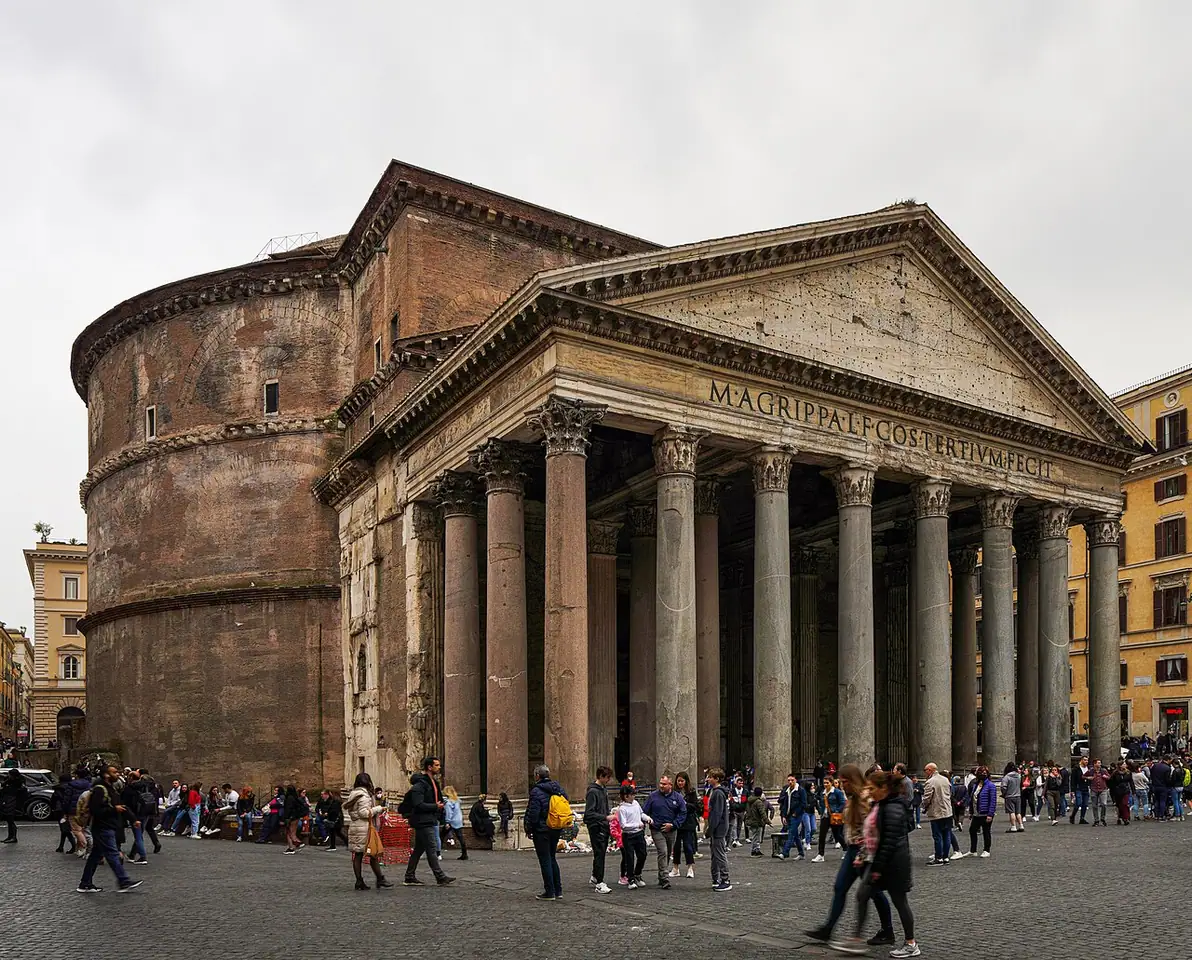
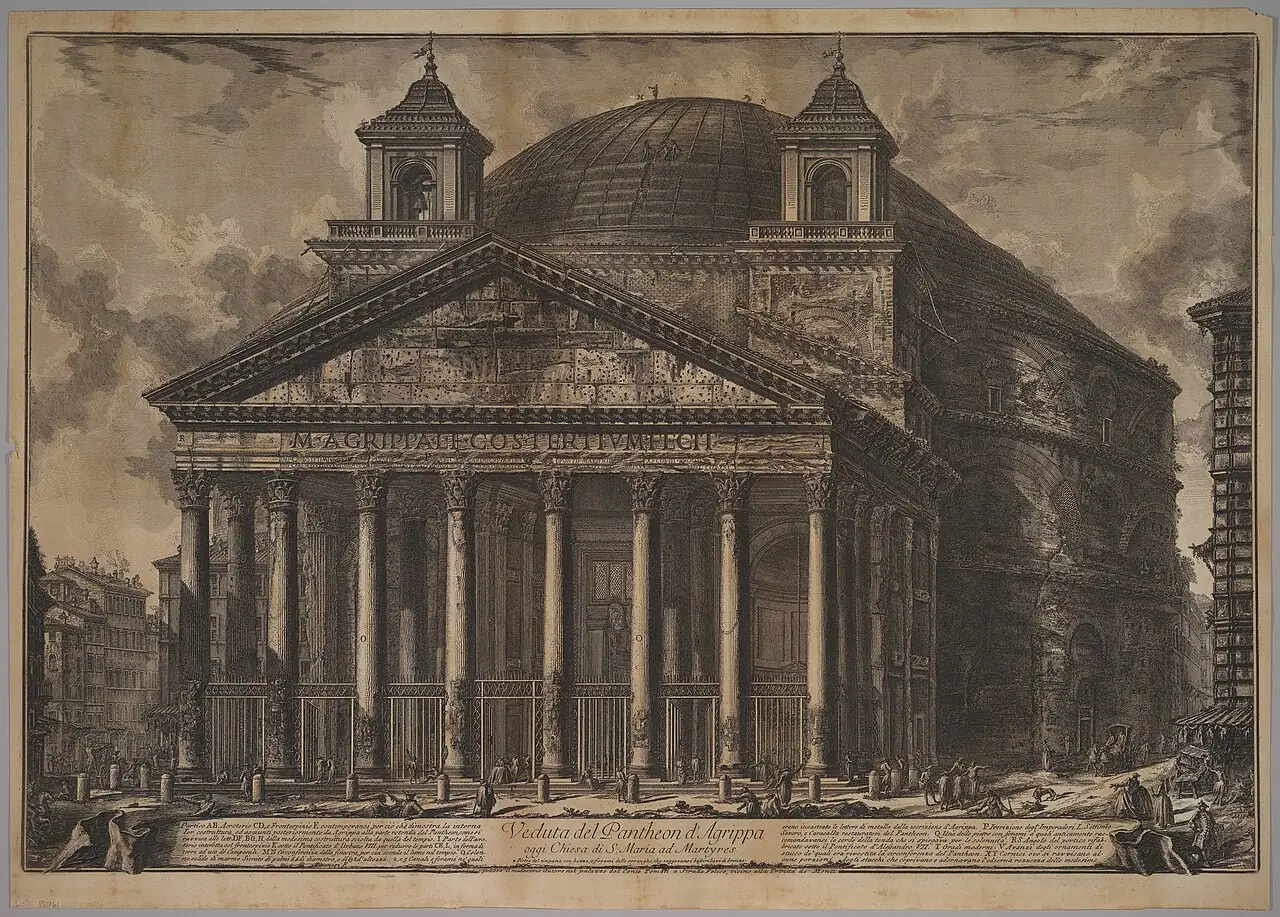 Then · 1700sNow · TodayMove across the image to compare
Pantheon: how it was designed
- 01
Lighter as it rises
The concrete changes with height: heavy basalt and travertine aggregate at the base, then brick and tuff, then light pumice near the oculus. The dome also thins from about 6 metres at its base to about 1.2 metres at the top.
- 02
Coffers that cut weight
Five rings of 28 sunken coffers reduce the dome's mass and, stepping in perspective, make it look even deeper. They were probably once decorated with bronze.
- 03
An open eye
The oculus, about 8 metres wide, is the only light source. Rain falls through it onto a gently sloped floor with drainage holes that still work.
- 04
Two buildings joined
A conventional temple portico of 16 granite columns is attached to the rotunda by an intermediate block — a seam that shows the designers combining two building types.
Construction timeline
Marcus Agrippa builds the first Pantheon on the site.
The present building is constructed under Hadrian, possibly begun under Trajan.
Pope Boniface IV consecrates it as the church of Santa Maria ad Martyres.
Pope Urban VIII strips bronze from the portico ceiling, reportedly for cannon and for St Peter's.
Two bell towers, nicknamed the 'ass's ears', are added above the portico.
The bell towers are removed, restoring the ancient profile.
How the design changed
The 'ass's ears'
For about two centuries, twin bell towers stood above the portico, popularly blamed on Bernini. Piranesi's 18th-century view shows them; they came down in 1883.
A tomb for artists and kings
The painter Raphael was buried here in 1520, and the first two kings of unified Italy were later entombed in the rotunda.
Who built it
No architect is recorded. Some historians suggest Apollodorus of Damascus, Trajan's architect, because brick stamps show the work began around Trajan's reign; others credit Hadrian's own team. The concrete technology behind the dome reflects more than a century of Roman experiment with vaulting.
Where it is
Rome, Italy · 41.8986° N, 12.4769° E · Open in OpenStreetMap. Nearest in this guide: Colosseum (2 km), St Peter's (2 km), Tower of Pisa (264 km).
 2 km2 km264 kmPantheon
Drag to pan, use + and − or double-click to zoom, and tap any pin for a preview.
Built around the same time
| Monument | Country | Built | Gap |
|---|---|---|---|
| Pyramid of the Sun, Teotihuacan | Mexico | c. 100–250 CE | 13 years earlier |
| Colosseum | Italy | c. 70–80 CE | 43 years earlier |
| Petra — Al-Khazneh (the Treasury) | Jordan | Al-Khazneh: about the 1st century CE | 163 years earlier |
Pantheon: questions people ask
How has the Pantheon's dome lasted so long?
Its concrete uses lighter aggregates toward the top, the shell thins as it rises, the coffers reduce weight, and the building has been continuously maintained as a church since 609 CE.
Is the Pantheon's dome the largest in the world?
It is still the largest unreinforced concrete dome. Larger domes, such as those built since the 20th century, use steel reinforcement.
Does rain come through the Pantheon's oculus?
Yes. Rain falls through the 8-metre opening onto a slightly convex marble floor with small drains that carry the water away.
Who built the Pantheon?
The current building was built under Emperor Hadrian around 113–125 CE, on the site of an earlier temple by Marcus Agrippa, whose name appears in the inscription.
Sources & image credits
- UNESCO World Heritage Centre — Historic Centre of Rome
- Wikipedia — Pantheon, Rome
- Pantheon — official site
- Current photograph: Pantheon (Rome) - Right side and front.jpg by NikonZ7II, CC BY-SA 4.0 — original on Wikimedia Commons · licence.
- Historic image: The Pantheon exterior (Veduta del Pantheon d'Agrippa oggi Chiesa di S. Maria ad Martyres) MET DP828229.jpg by Giovanni Battista Piranesi, CC0 — original on Wikimedia Commons · licence.
- Coordinates from Wikidata. Images resized and converted to WebP; otherwise unaltered. Checked October 25, 2026.
More to wander into
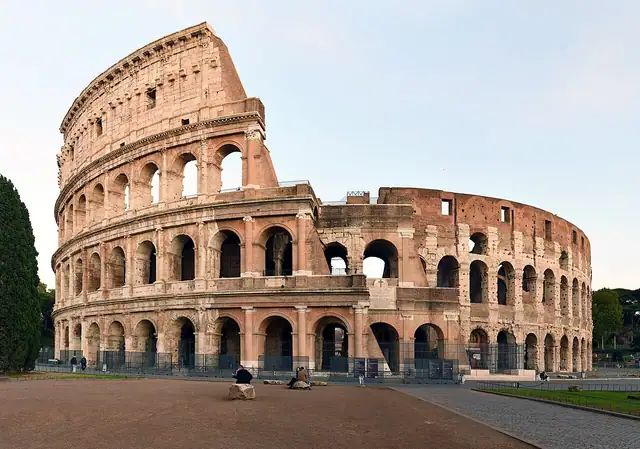
- World monument · c. 70–80 CEColosseumRome's 50,000-seat arena, designed to fill and empty fast.
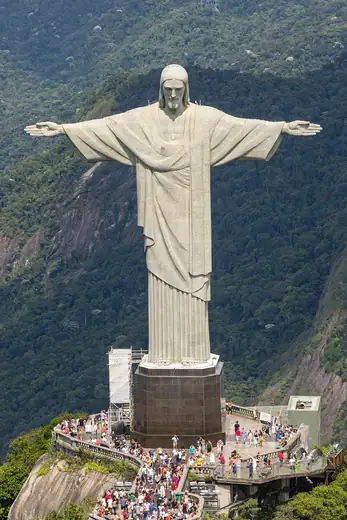
- World monument · 1922–1931Christ the RedeemerA concrete Christ in a coat of soapstone tiles, arms open 700 metres above Rio.
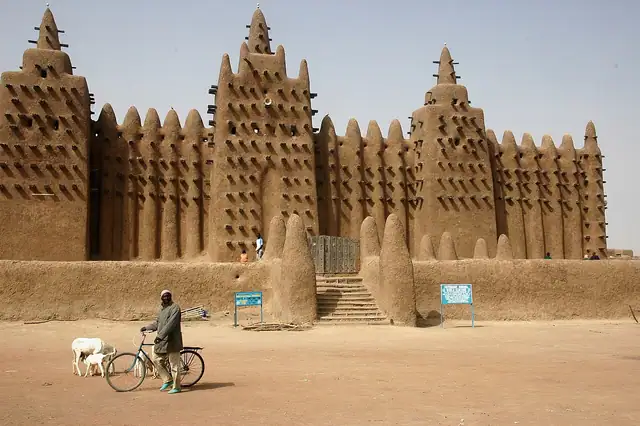
- World monument · 1906–1907 (first mosque on the site 13th century)Great Mosque of DjennéThe world's largest mud building, replastered by the whole town every year.
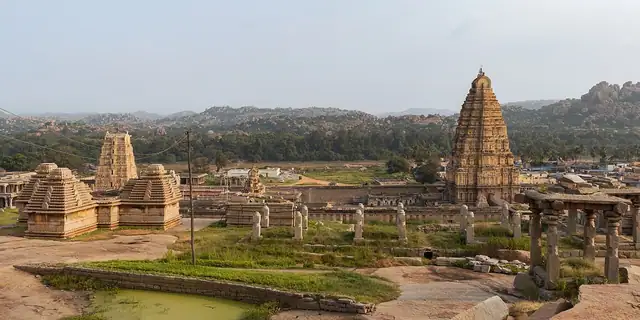
- World monument · Mainly 14th–16th century (Vijayanagara Empire, 1336–1565)Hampi (Group of Monuments)A sacked imperial capital of granite temples, stone chariots and singing pillars.
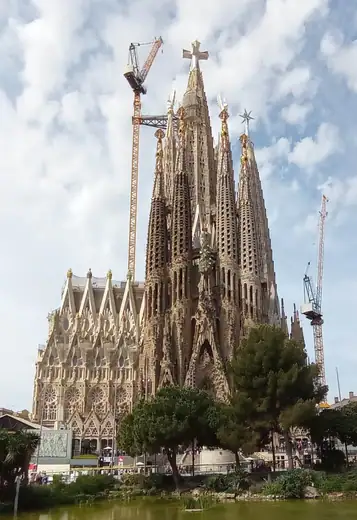
- World monument · 1882 – ongoing (central tower finished 2026)Sagrada FamíliaGaudí's unfinished basilica, now the world's tallest church after 144 years.
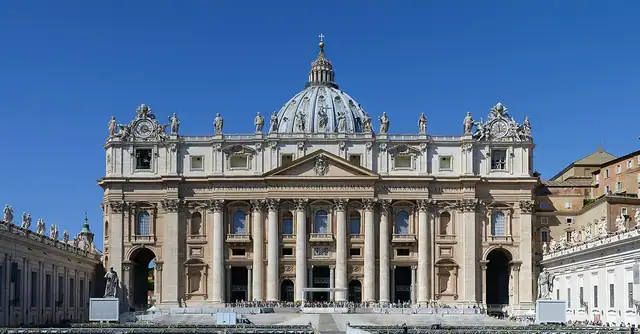
- World monument · 1506–1626 (square completed 1667)St Peter's BasilicaA church redesigned by six great architects over 120 years.
Get the ideas, not the noise.
Sign up with Google and we’ll send you short UX psychology tips by email — why people tap, stall and leave, and what to do about it. Unsubscribe anytime. Prefer something to keep? Get the free Laws of UX guide as a PDF.