 By
Quick answer: How can I promote my startup for free?
- Launch (1–6): Product Hunt, Peerlist, Uneed, Show HN, DevHunt, Fazier.
- List (7–12): Launchpad, SaaSHub, AlternativeTo, Crunchbase, Google Business Profile, Future Tools.
- Get found (13–18): Search Console, Bing Webmaster Tools, AI crawlers allowed, answer pages, comparisons, a free tool.
- Communities (19–24): help first, build in public, Indie Hackers, niche forums, LinkedIn, podcasts.
- Partners and users (25–30): integrations, referrals, reviews, case studies, newsletters, your own list.
Key takeaways
- Free promotion costs time, so pick the five tactics closest to where your users already are.
- Launches bring spikes; listings, search and communities bring steady visitors.
- Every tactic needs one permanent page to send people to.
- Help first in communities; drive-by links get removed and remembered.
- Your existing users are your cheapest promotion channel: ask for reviews, referrals and stories.
"We have no marketing budget" is how most startups begin, and it's not a disadvantage if you spend time instead of money in the right places. The catch is choice: there are hundreds of free tactics, and doing thirty badly beats nobody. This list groups 30 free ways to promote a startup into five channels, with the platform rules that matter (checked on their own pages, 16–17 November 2026). Pick the five closest to your users and do them properly. Jump to launch, list, get found, communities or partners and users.
- Free promotion tactics
- 30
- Channels they fall into
- 5
- Tactics to start with
- 5
- Budget needed
- $0
Launch: tactics 1–6

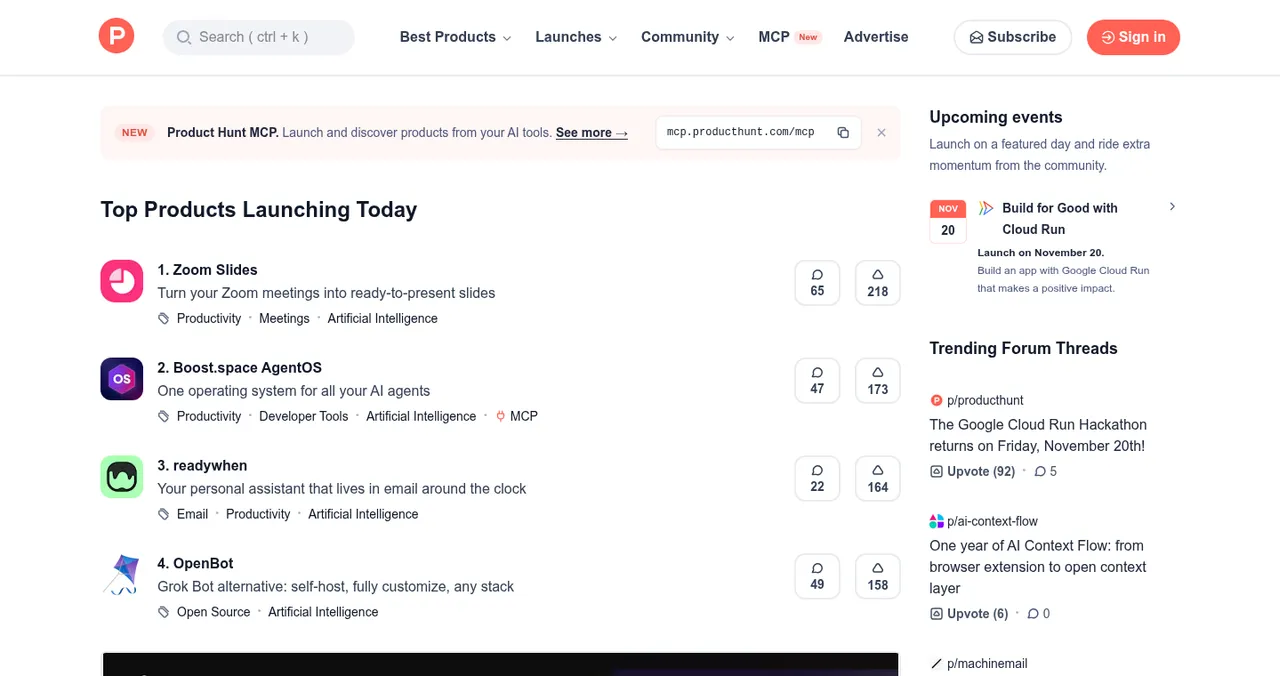
- 1. Product Hunt — free; live at 12:01 AM Pacific; never ask for upvotes
- 2. Peerlist Launchpad — Monday launches for verified builders
- 3. Uneed — free waiting line (50+ days out)
- 4. Show HN — free, for things people can try; no landing pages
- 5. DevHunt — free listing for developer tools
- 6. Fazier — free if you add a link back
List: tactics 7–12

- 7. Science of Apps Launchpad — a permanent, free profile found by the problem you solve
- 8. SaaSHub — free, reviewed software listing; list competitors
- 9. AlternativeTo — be listed as an alternative to the tools you replace
- 10. Crunchbase — a free company profile for investors and press
- 11. Google Business Profile — free, if you serve a location or area
- 12. Future Tools — free AI tool submission, reviewed by hand
Get found: tactics 13–18

- 13. Google Search Console — verify, submit a sitemap, fix indexing problems
- 14. Bing Webmaster Tools — the same for Bing, plus IndexNow for fast updates
- 15. Let AI search crawlers in — OAI-SearchBot, Claude-SearchBot, PerplexityBot
- 16. Write answer pages — one page per question your buyers search, answer first
- 17. Publish honest comparisons — "you vs [competitor]" pages people and AI answers cite
- 18. Build one free tool — a calculator, checker or template people link to
Google says there are no extra requirements to appear in its AI Overviews and AI Mode beyond normal Search eligibility; good SEO is the AI strategy. Details in organic visibility for startups.
Communities: tactics 19–24

- 19. Help first — answer questions where your users talk, with no link, for weeks
- 20. Build in public — share progress, numbers and decisions
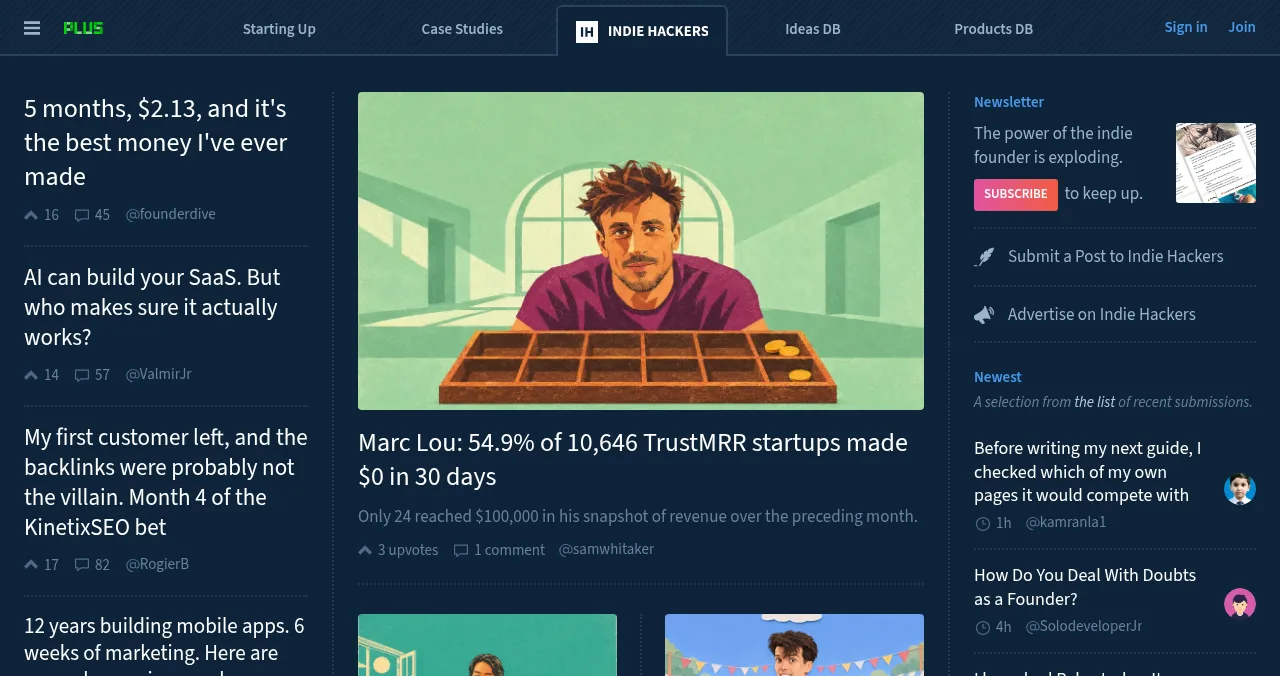
- 21. Indie Hackers — founders who share strategies and revenue numbers
- 22. Niche forums and subreddits — read the rules; most limit self-promotion
- 23. LinkedIn — for B2B, posts about the problem beat product announcements
- 24. Podcasts — small, niche shows are often looking for guests
Partners and users: tactics 25–30

- 25. Integration partners — ask to be listed on the integrations pages of tools you connect to
- 26. A referral loop — give users a reason and an easy way to invite others
- 27. Reviews — ask happy users to review you where buyers look
- 28. Case studies — one customer's real story, with their permission
- 29. Newsletter features — niche newsletters often feature useful new tools
- 30. Your own email list — the one channel you fully control
Reviews and stories from real users are social proof for the next ones.
Start here
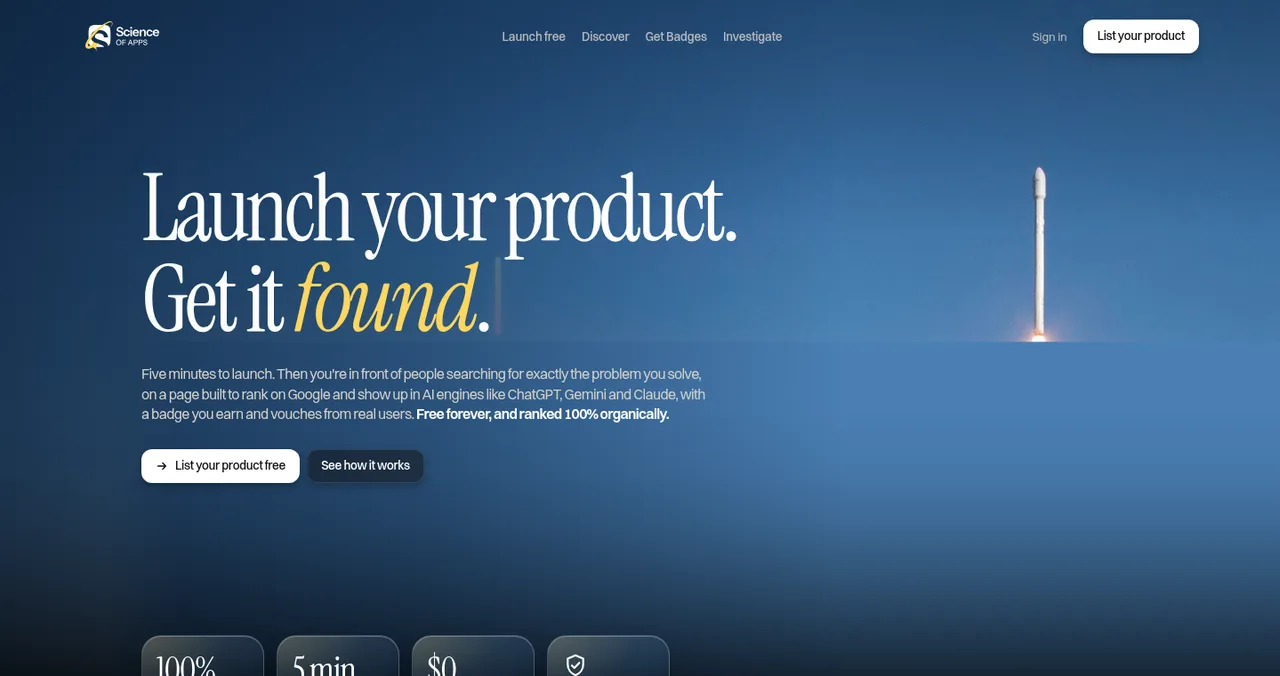
Every tactic on this list sends people somewhere. A free Science of Apps Launchpad profile is a permanent page found by the problem you solve, on the Launchpad, Google and AI answers. Once it's live, your product is tested end to end with a detailed report, so the people your promotion brings don't hit the obvious problems.
Pick your five
| Your product | Start with |
|---|---|
| B2B SaaS | 7, 8, 13, 16, 23 |
| Developer tool | 4, 5, 7, 17, 25 |
| AI tool | 1, 7, 12, 15, 16 |
| Consumer app | 1, 2, 7, 22, 26 |
| Local business | 7, 11, 13, 27, 30 |
Table: Five free promotion tactics to start with, by product type
Mistakes with free promotion
- Doing everything at once — five tactics done well beat thirty done badly
- Dropping links in communities — help first, or you'll be removed
- Asking for upvotes — every launch site bans it
- No place to land — every tactic needs a permanent page
- Not measuring — a UTM link per tactic shows what brings users who stay
Ready to start?
How we know
Platform rules come from each site's own pages, read on 16–17 November 2026; search and AI visibility rules from Google Search Central and OpenAI's crawler documentation. The five-tactic starting sets are our editorial recommendation. Science of Apps runs the Launchpad mentioned above.
Key terms, defined
- Free promotion: marketing that costs time rather than money.
- Build in public: sharing progress and numbers openly as you build.
- Permanent listing: a profile that keeps working after a launch day.
- Referral loop: a built-in way for users to invite others.
- UTM link: a tagged link that shows which tactic sent a visitor.
Frequently asked questions
How can I promote my startup for free?
Launch on free launch sites (Product Hunt, Peerlist, Uneed, Show HN), create permanent listings (Science of Apps Launchpad, SaaSHub, Crunchbase, Google Business Profile), make your site findable on Google and AI assistants, help in communities where your users talk, and turn existing users into reviewers, referrers and case studies.
What's the best free marketing channel for a startup?
The one where your users already are. Developer tools do well on Show HN and DevHunt; B2B SaaS on alternatives directories and LinkedIn; consumer apps on Product Hunt and niche communities. Measure each with a UTM link and double down on what brings users who stay.
Do free launch sites really work?
They bring attention and feedback, and some bring lasting traffic, but results vary and spikes fade. Use them alongside permanent listings and your own channels, and space launches out so you can reply properly on each.
How do I promote my startup on social media for free?
Build in public: share what you're learning, numbers and decisions, not just announcements. Post where your audience is (LinkedIn for B2B, X for tech, niche communities for consumers), reply to others and keep a consistent profile that links to your permanent page.
Is free promotion enough to grow a startup?
It's enough to find early users and learn what works. Many startups reach their first customers with free channels alone; later, paid channels can scale what free ones prove.
How much time does free promotion take?
More than it seems: a launch day is a full day, community participation is daily, and content takes hours. Pick a few tactics, schedule them, and drop what doesn't bring users after a few weeks.
Sources
- Product Hunt Help Center — Launch FAQ and myths (checked 17 Nov 2026)
- Hacker News — Show HN guidelines
- Uneed — How to launch your product on Uneed (launch guide, 2026)
- SaaSHub — Submit a product: guidelines (checked 17 Nov 2026)
- Google Business Profile — Get listed on Google (checked 17 Nov 2026)
- Google Search Central — AI features and your website (checked 17 Nov 2026)
- OpenAI — Overview of OpenAI crawlers (checked 17 Nov 2026)
- Science of Apps — Launchpad: launch your product free
- Checked November 17, 2026. Figures that change — fees, salaries, prices — are reviewed every six months; if something is out of date, tell us.
Where to go from here
- How to get your first 100 users — the free channels in order
- Organic visibility for startups — search and AI visibility in depth
- Top websites to launch a startup — launch sites by product type
- Science of Apps - LaunchpadHow to market a startup with no money: the free channels that work, in the order to use them, and what each costs in time insteadHow to market a startup with no money: direct outreach, communities, free launch sites, directories, content and AI search, in order, with the time each costs.
- Science of Apps - LaunchpadHow to market a SaaS in 2027: positioning, being found by buyers, content that gets cited, launches and a product that convertsHow to market a SaaS in 2027: sharp positioning, alternatives directories, search and AI visibility, launches, founder-led sales and a trial that converts.
- Science of Apps - LaunchpadHow to market an AI tool in 2027: positioning by task, AI directories, AI search, demos and the trust that makes people payHow to market an AI tool in 2027: position by task, list in AI directories, get cited by AI search, show real outputs and earn trust that converts.
- Science of Apps - LaunchpadHow to get your first 100 users without paid ads: a channel-by-channel plan founders can start todayHow to get your first 100 users without paid ads in 2027: your network, communities, launch sites, directories, content and one-to-one outreach, step by step.
- Science of Apps - LaunchpadHow to get your first users for a new app: the store listing, launch sites, communities, direct outreach and a web page that keeps bringing people inHow to get users for a new app, free: fix the store listing, launch on Product Hunt and Peerlist, reach people directly, and add a permanent web page.
- Science of Apps - LaunchpadHow to launch an open source project: a README that converts, the launch sites developers read, and how to turn first users into contributorsHow to launch an open source project in 2027: a README that converts, Show HN, DevHunt and Product Hunt, and turning first users into contributors.


Get the ideas, not the noise.
Sign up with Google and we’ll send you short UX psychology tips by email — why people tap, stall and leave, and what to do about it. Unsubscribe anytime. Prefer something to keep? Get the free Laws of UX guide as a PDF.
Launch day ends. Your listing shouldn't.
The first free tactic: a permanent profile people find by the problem you solve, ranked by relevance, never payment, plus your product tested end to end with a detailed report.