 By
At a glance: Great Stupa at Sanchi
- Location
- Raisen district, Madhya Pradesh, India
- Built
- 3rd century BCE – 1st century CE
- Type
- Buddhist stupa · Sacred
- Style
- Early Buddhist (Mauryan, Shunga and Satavahana phases)
- Commissioned by
- Emperor Ashoka; later Shunga-era donors and Satavahana patrons
- Architects & builders
- Not recorded; gateway carvers include the ivory workers of Vidisha (named in an inscription)
- Materials
- Brick core, sandstone casing, railings and gateways
- Size
- Dome about 36.6 m across and 16.5 m high
Sanchi Stupa: what it is
A stupa is a solid mound built over relics, circled by pilgrims in a clockwise walk called pradakshina. Sanchi's Great Stupa (Stupa No. 1) sits on a hilltop near the ancient city of Vidisha, among later stupas, temples and monasteries built over 1,300 years.
Its gateways are among the masterpieces of early Indian sculpture. Donors recorded their gifts in short inscriptions all over the railings, so the monument is also a record of the merchants, monks, nuns and guilds who paid for it.
Sanchi Stupa, then and now
Real images only: an earlier view and a recent photograph, each credited and linked to its original file. Switch between them or compare side by side.
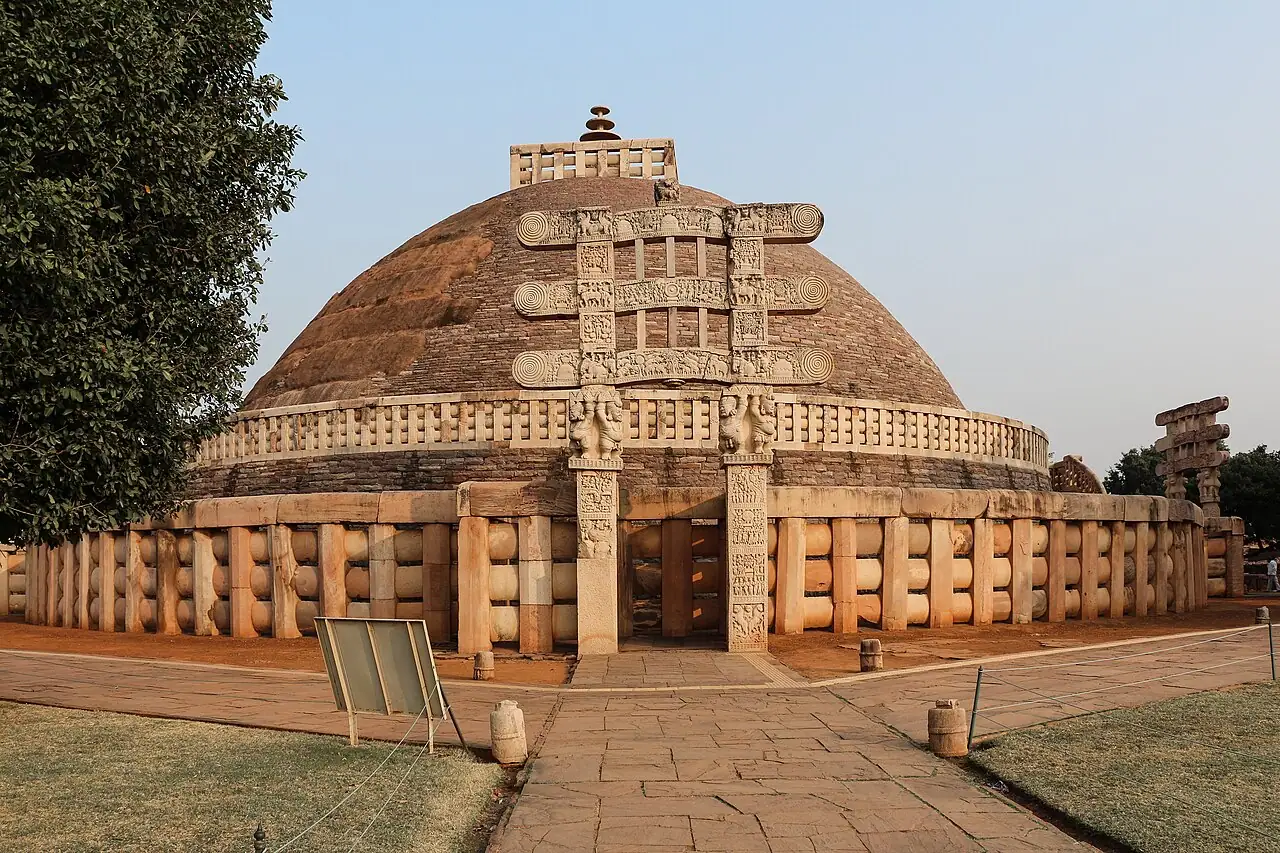
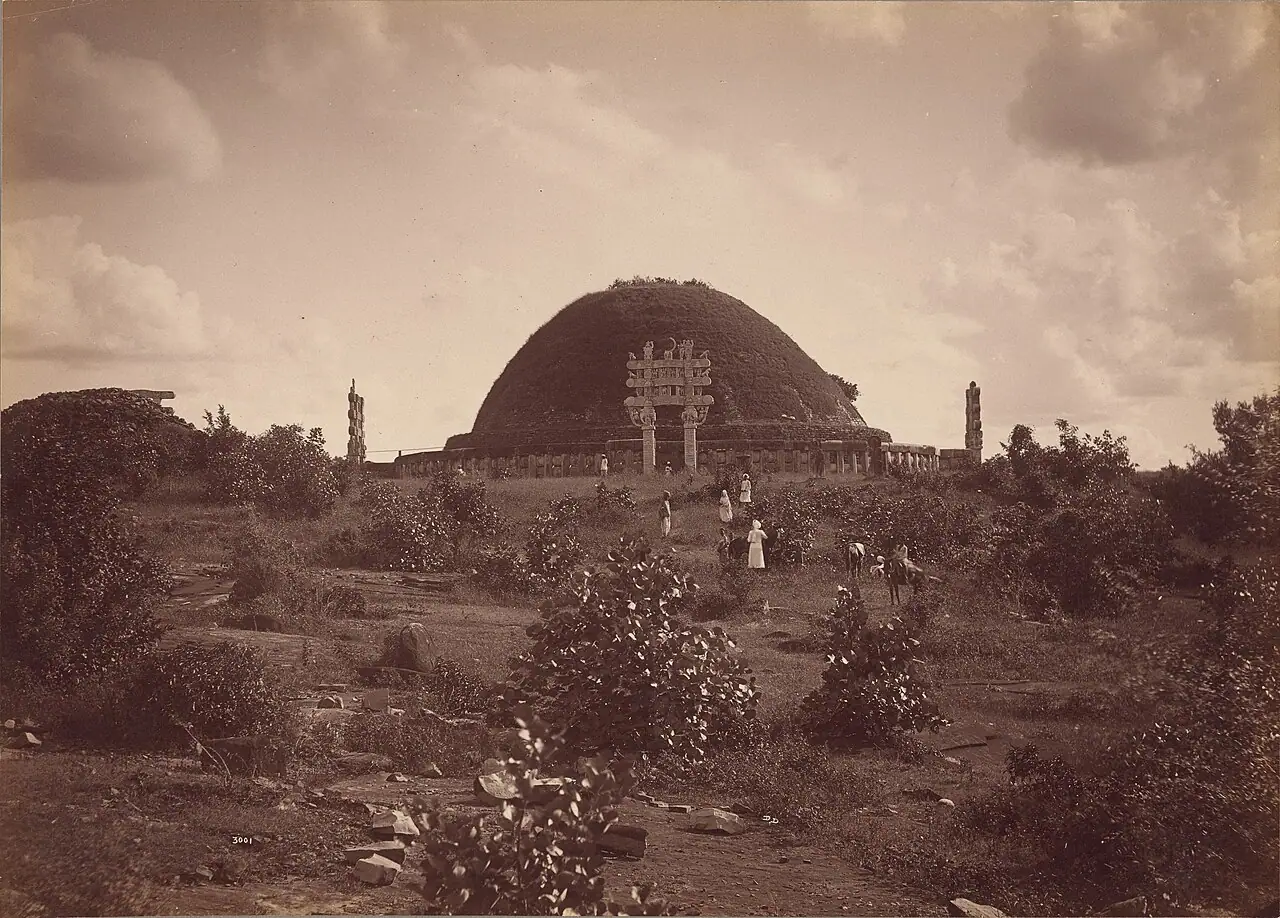 Then · c. 1885Now · TodayMove across the image to compare
Sanchi Stupa: how it was designed
- 01
A cosmic diagram you walk around
The hemispherical dome (anda) stands for the dome of heaven. On top, a square railing (harmika) surrounds a triple umbrella (chhatra), a sign of honour. Two walkways — one at ground level, one on a raised terrace — let pilgrims circle it.
- 02
Stone that imitates wood
The railings and gateways copy timber construction: posts, cross-bars and beams are carved with joints a carpenter would need but stone does not. It shows builders moving from wood to stone.
- 03
The Buddha shown by absence
In the gateway reliefs the Buddha appears only as symbols — an empty throne, footprints, a Bodhi tree, a wheel or a parasol — while the people around him are carved in lively detail.
- 04
Gateways on the four directions
Each torana has two square posts carrying three curved architraves, with bracket figures of tree spirits (yakshis) at the corners. The openings in the railing behind each gateway are offset, so the path into the circuit turns as it enters.
Construction timeline
Ashoka builds a brick stupa about half the present size and erects a polished stone pillar beside it.
Under the Shunga period the stupa is enlarged, cased in stone and surrounded by a stone railing.
The four carved gateways are added; an inscription on the south gateway names an official of the Satavahana king Satakarni.
A British officer, General Taylor, records the site.
Amateur diggers breach the dome; Alexander Cunningham later excavates the smaller stupas and finds relic caskets.
John Marshall of the Archaeological Survey of India restores the stupa and re-erects fallen gateways.
How the design changed
Doubled in size
The Ashokan brick stupa was buried inside the later stone shell, which roughly doubled its diameter. The monument we see is a 2nd-century BCE enlargement wrapped around a 3rd-century BCE core.
Rebuilt from fallen pieces
Before Marshall's work the western and southern gateways had fallen and the dome was breached. Much of today's appearance is a careful 20th-century reassembly of original stones.
Who built it
Ashoka, the Mauryan emperor who spread Buddhism across India, founded the stupa. Hundreds of inscriptions name the later donors — monks, nuns, householders and guilds. One on the south gateway records that it was carved by the ivory workers of Vidisha, which helps explain the gateway's fine, miniature-like detail.
Where it is
Raisen district, Madhya Pradesh, India · 23.4794° N, 77.7397° E · Open in OpenStreetMap. Nearest in this guide: Taj Mahal (412 km), Kailasa Temple (466 km), Qutub Minar (564 km).
 412 km466 km564 kmSanchi Stupa
Drag to pan, use + and − or double-click to zoom, and tap any pin for a preview.
Built around the same time
| Monument | Country | Built | Gap |
|---|---|---|---|
| Terracotta Army | China | c. 246–208 BCE; found 1974 | 4 years later |
| Parthenon | Greece | 447–432 BCE | 197 years earlier |
| Petra — Al-Khazneh (the Treasury) | Jordan | Al-Khazneh: about the 1st century CE | 200 years later |
Sanchi Stupa: questions people ask
Who built the Sanchi Stupa?
Emperor Ashoka built the original brick stupa in the 3rd century BCE. It was enlarged in stone in the 2nd century BCE, and its four gateways were added around the 1st century BCE with support from many donors.
Why is the Buddha not shown at Sanchi?
Early Buddhist art represented the Buddha by symbols — footprints, an empty seat, a tree or a wheel — rather than in human form. Human images of the Buddha became common later.
How old is the Sanchi Stupa?
Its core dates to the 3rd century BCE, making it more than 2,200 years old and one of the oldest stone structures in India.
Is the Sanchi Stupa on the Indian currency?
Yes. The Sanchi Stupa appears on the reverse of the ₹200 note introduced by the Reserve Bank of India in 2017.
Sources & image credits
- UNESCO World Heritage Centre — Buddhist Monuments at Sanchi
- Wikipedia — Sanchi
- Current photograph: Stupa 1, Sanchi 02.jpg by Bernard Gagnon, CC BY-SA 3.0 — original on Wikimedia Commons · licence.
- Historic image: General View of Sanchi Tope from North.jpg by Lala Deen Dayal, CC0 — original on Wikimedia Commons · licence.
- Coordinates from Wikidata. Images resized and converted to WebP; otherwise unaltered. Checked October 25, 2026.
More to wander into
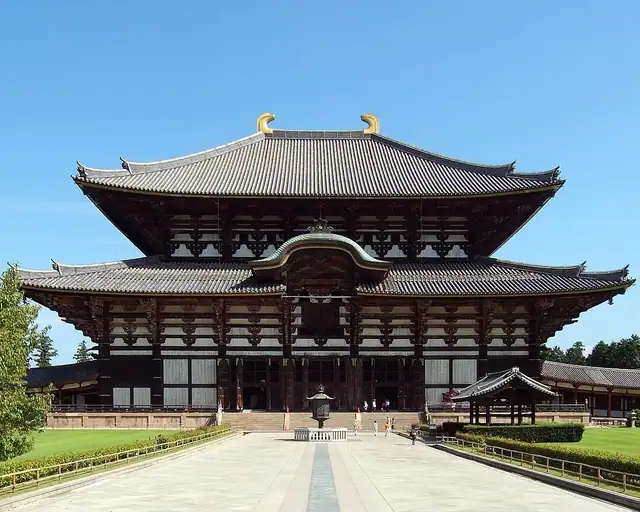
- World monument · 752 CE; hall rebuilt 1195 and 1709Tōdai-ji Great Buddha HallA giant bronze Buddha in a wooden hall rebuilt smaller after two fires.
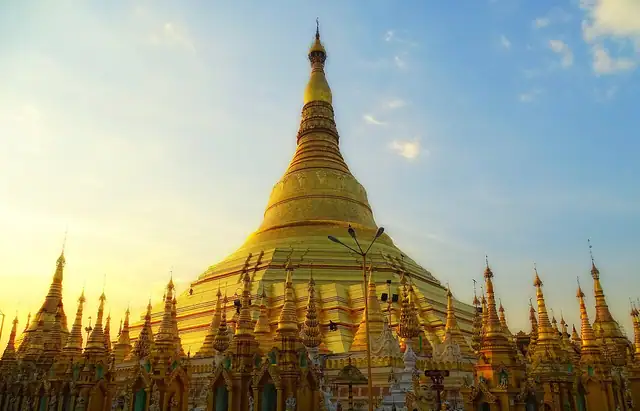
- World monument · Founded c. 6th–10th century CE; present form 1775Shwedagon PagodaA 99-metre stupa wrapped in gold, rebuilt after every earthquake.
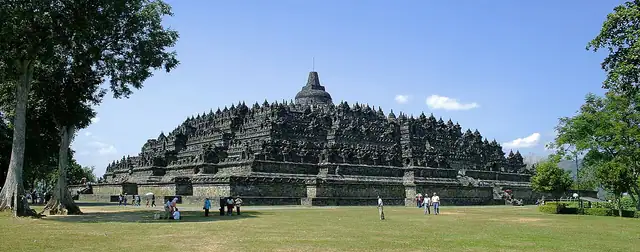
- World monument · c. late 8th – early 9th centuryBorobudurA Buddhist mandala in stone, climbed as a 5-km path to enlightenment.
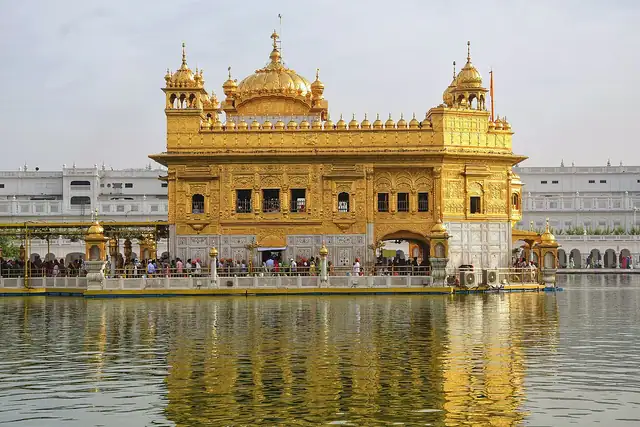
- World monument · 1581–1604; rebuilt 1764; gilded early 19th centuryGolden Temple (Harmandir Sahib)A temple in a pool, with four open doors and steps that lead down, not up.
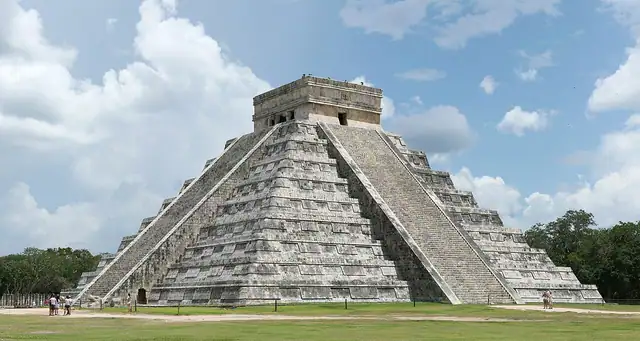
- World monument · c. 9th–11th century CE (outer pyramid)El Castillo, Chichen ItzaA Maya pyramid that counts the year and casts a serpent shadow at the equinox.
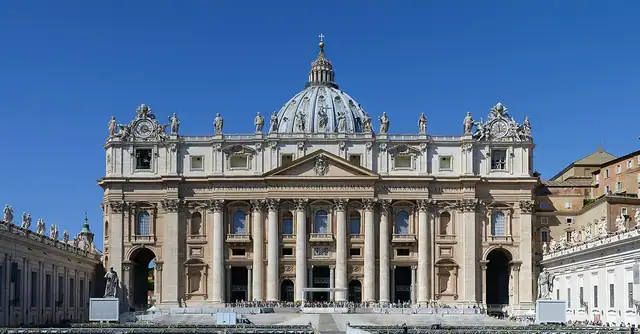
- World monument · 1506–1626 (square completed 1667)St Peter's BasilicaA church redesigned by six great architects over 120 years.
Get the ideas, not the noise.
Sign up with Google and we’ll send you short UX psychology tips by email — why people tap, stall and leave, and what to do about it. Unsubscribe anytime. Prefer something to keep? Get the free Laws of UX guide as a PDF.