 By
Quick answer: What makes employers respect an online certificate?
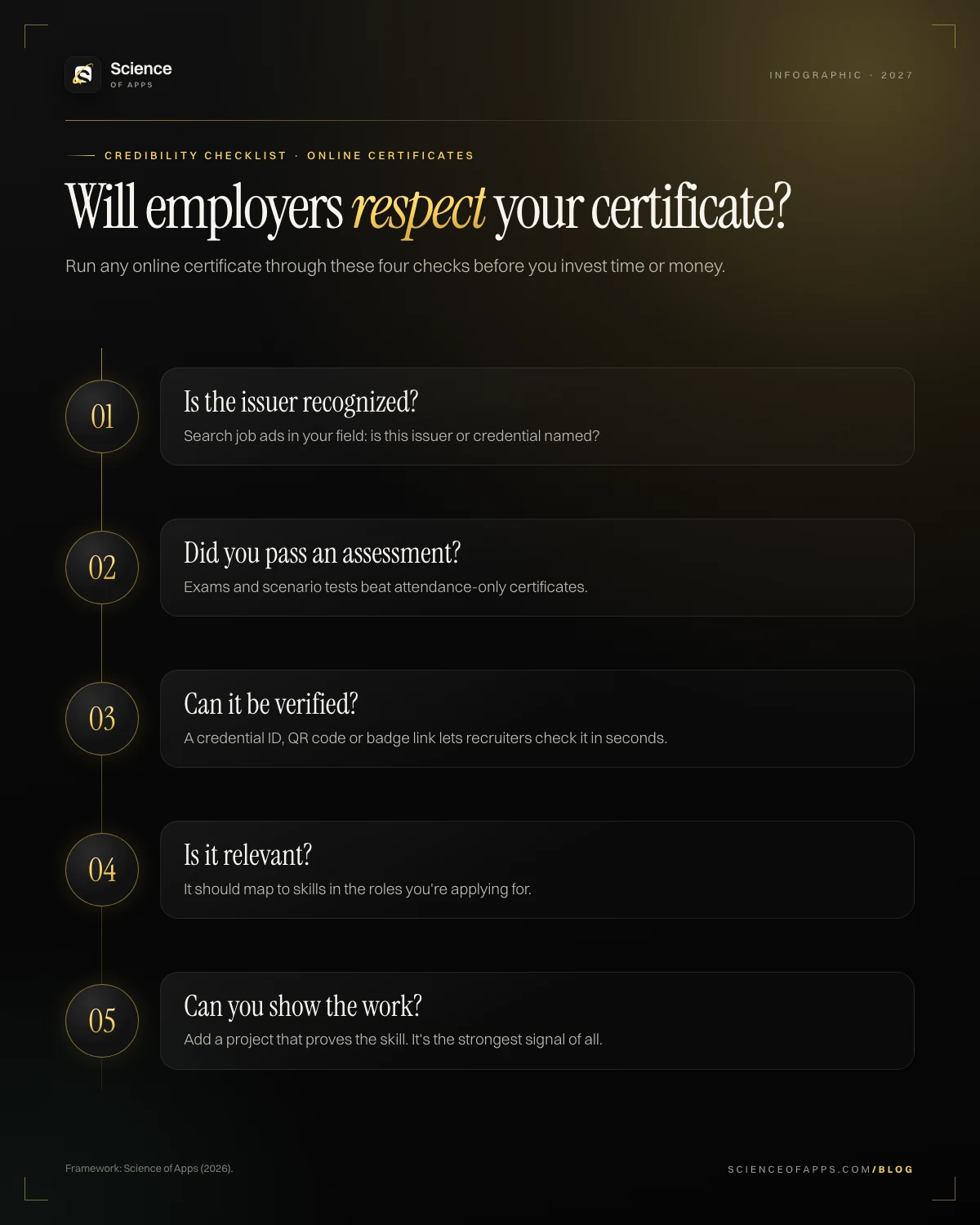
- Recognition — the issuer is known in your industry.
- Assessment — you had to pass, not just attend.
- Verification — a credential ID or link a recruiter can check.
- Relevance — it matches skills named in the job ad.
- Proof of work — a project that shows the skill in action.
Key takeaways
- Employers don't rank platforms; they judge credentials. Recognition, assessment and verification matter most.
- Vendor and professional-body certifications (AWS, Microsoft, PMI, CompTIA) are the most widely requested in job ads.
- University programs on Coursera and edX carry brand weight, but completion certificates prove less than exams.
- Free, verifiable certifications such as Science of Apps are a low-risk way to prove skills fast.
- Pair any certificate with a portfolio project: it's the strongest signal of all.
The four signals employers look for

| Signal | What it means | Strong example | Weak example |
|---|---|---|---|
| Recognition | Known issuer in your field | AWS, PMI, CompTIA, Google | Unknown website, no track record |
| Assessment | You passed a test against a standard | Proctored exam or scenario test | Attendance-only certificate |
| Verification | Recruiter can check it | Credential ID, QR code, badge link | PDF with no ID |
| Relevance | Matches the job ad | Named in the requirements | Unrelated hobby course |
The best online training platforms by credibility
- Vendor academies (AWS Skill Builder, Microsoft Learn, Google, Salesforce Trailhead): learning leads straight to the vendor's own certification exams.
- Professional bodies (PMI, CompTIA, ISC2): industry-standard exams, often listed in job requirements.
- Coursera and edX: university- and company-branded programs; best when they include graded projects.
- LinkedIn Learning: handy for quick skills, and certificates appear directly on your profile.
- Science of Apps: free scenario-based certifications with a credential ID and QR code employers can verify, ideal for proving a skill quickly.
Best online course platforms in India
The same platforms work in India, with a few local additions: NPTEL/SWAYAM for government-backed courses, and employer-recognized global certifications (AWS, Microsoft, Salesforce) that IT services firms ask for. Free certifications from Science of Apps are popular with students who want verifiable proof for placements.
A 30-second credibility checklist
- Can a recruiter verify it online?
- Did you have to pass an assessment?
- Is the issuer named in job ads in your field?
- Can you show a project that uses the skill?
How hiring managers actually read certificates
Recruiters screen quickly. A certificate helps when it answers one question: can this person do the work described in the job ad? That's why a credential named in the requirements, such as "AWS Certified" or "PMP preferred", moves a résumé forward, while an unrelated course certificate is skipped. After screening, interviews test the skill directly, so the certificate's job is to get you to the conversation.
Prove it free: the tests that match this guide
Employers respect proof of skills. These free SOA tests map to the training areas employers fund most. (Disclosure: Science of Apps publishes these tests.)
- AI Tools for Workplace Productivity CertificationAI at work is the top training priority for employers.Start free test →
- Cybersecurity Certification Test (Fundamentals)Security awareness is mandatory training in most companies.Start free test →
- Project Management Fundamentals CertificationProject skills are among the most-funded professional courses.Start free test →
- Leadership Fundamentals CertificationLeadership training is a staple of employer programs.Start free test →
The three types of online credentials
1. Certificates of completion
Issued when you finish a course. Useful as a learning record; weakest as proof.
2. Professional certificates
Multi-course programs from universities or companies (Google, IBM) with graded projects. Stronger, especially for entry-level roles.
3. Certifications
Awarded for passing an assessment against a standard, often maintained through renewal. Examples: PMP, Security+, AWS, and free scenario-based Science of Apps certifications. These carry the most weight.
Red flags that make employers skeptical
- No way to verify the credential.
- "Certified" after a short video with no assessment.
- Pay-to-pass schemes or guaranteed results.
- Issuers that claim accreditation without naming the accrediting body.
The credibility stack that works
The most convincing candidates combine three layers: a recognized certification named in job ads, a verifiable skill credential for adjacent skills, and a portfolio project that shows real output. Learn wherever suits you, then make sure each layer can be checked online.
Frequently asked questions
What are the most respected online certifications?
Vendor certifications (AWS, Microsoft, Google, Salesforce) and professional-body certifications (PMI's PMP and CAPM, CompTIA) are the most widely recognized because employers name them in job ads.
Do employers value Coursera certificates?
They help, especially university- or company-branded programs with graded projects, but employers usually value assessed, verifiable certifications more than completion certificates.
What is the best online training platform in India?
NPTEL/SWAYAM for government-backed courses, plus global platforms (Coursera, Microsoft Learn, AWS) and free verifiable certifications from Science of Apps.
What are the best online course platforms in India?
The same platforms work in India, with a few local additions: NPTEL/SWAYAM for government-backed courses, and employer-recognized global certifications (AWS, Microsoft, Salesforce) that IT services firms ask for. Free certifications from Science of Apps are popular with students who want verifiable proof for placements.
How do hiring managers read online certificates?
Recruiters screen quickly. A certificate helps when it answers one question: *can this person do the work described in the job ad?* That's why a credential named in the requirements, such as "AWS Certified" or "PMP preferred", moves a résumé forward, while an unrelated course certificate is skipped. After screening, interviews test the skill directly, so the certificate's job is to get you to the conversation.
Sources
- AWS Skill Builder
- Microsoft Learn: Applied Skills
- PMI: CAPM certification
- CompTIA certifications
- edX: Professional Certificate programs
- Science of Apps: free online certifications
- NPTEL
- Checked November 11, 2026. Figures that change — fees, salaries, prices — are reviewed every six months; if something is out of date, tell us.
Where to go from here
- The best online course platforms with certificates — we tested 25 online course platforms for certificate value, price and employer r
- Coursera vs Udemy vs edX vs LinkedIn Learning — coursera vs udemy vs edx vs linkedin learning
- Free online courses with certificates — browse 200+ genuinely free online courses that include a certificate, sorted by
- CertificationsGoogle Career Certificates: worth it?Are Google Career Certificates worth it? Honest review of cost, time, job outcomes and how employers view them in 2027.
- Career guides by Science of Apps for 2027The certifications employers value most in 2027: ten respected across industriesThe 10 certifications employers value most in 2027: PMP, CISSP, AWS SAA, Security+, CISA, CISM, CFA, AZ-104, CCNA and PL-300, with survey pay where available.
- CertificationsAre online certificates legit?Are online certificates legit? How to tell real credentials from scams: verification, real assessments, accreditation claims and red flags to check.
- AI & vibe codingWill AI replace programmers? What the evidence actually says — and how to stay valuableWill AI replace programmers? What studies, surveys and job projections show, which tasks AI takes and which skills grow in value.
- CertificationsWhat certifications employers look forWhich certifications employers look for in 2027, by role: AWS, Security+, PMP, PL-300, Salesforce, SHRM and CPC, and what makes recruiters trust them.
- CertificationsThe best data science certificationsThe best data science certifications for 2027, from free options to university programs, ranked by cost, depth and job outcomes.
Get the ideas, not the noise.
Sign up with Google and we’ll send you short UX psychology tips by email — why people tap, stall and leave, and what to do about it. Unsubscribe anytime. Prefer something to keep? Get the free Laws of UX guide as a PDF.
Prove the skill before you pay for the exam.
1,200+ free, test-based certifications graded on our server. Pass and get a founder-signed certificate with a credential ID employers can verify.