 By
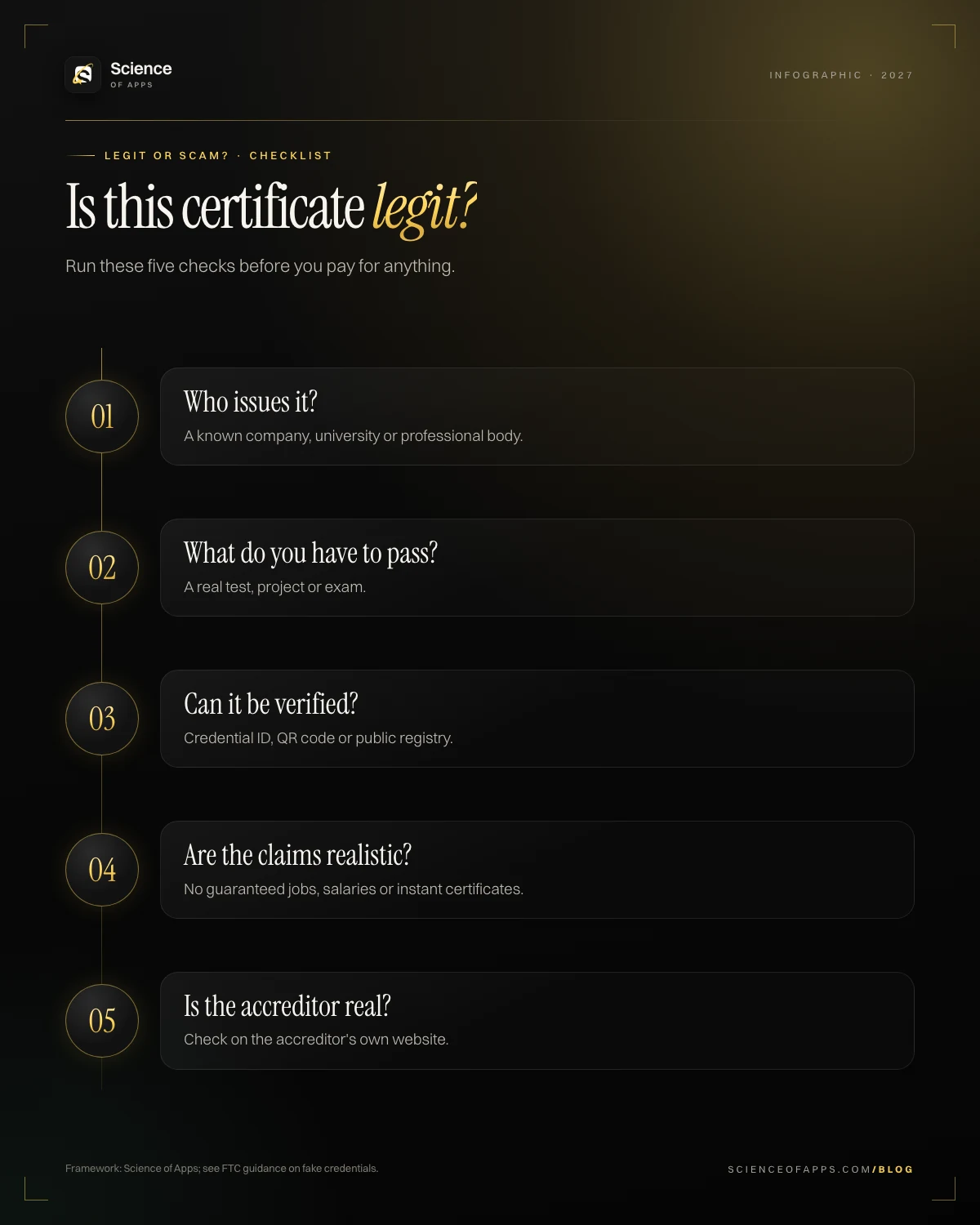
Quick answer: How do I know if an online certificate is legit?
- Real issuer — a known company, university or professional body.
- Real assessment — a test, project or exam.
- Verifiable — credential ID, QR code or registry.
- Honest claims — no guaranteed jobs or salaries.
- Check accreditation — against the accreditor's own website.
Key takeaways
- Most online certificates from known platforms are legit; their value varies.
- Legit ≠ valuable: a real course certificate may still carry little hiring weight.
- Scam signals: no assessment, no verification, guaranteed jobs, pressure to pay.
- Diploma and certificate mills sell credentials without real study; the FTC warns about them.
- Verify any credential through the issuer's own registry or verification page.
5 checks for any online certificate

| Check | Legit | Red flag |
|---|---|---|
| Issuer | Known company, university or body | Unknown site, no address or team |
| Assessment | Exam, project or scenario test | Pay and download instantly |
| Verification | Credential ID, QR, public registry | PDF only |
| Claims | Realistic outcomes | Guaranteed jobs or income |
| Accreditation | Named, checkable accreditor | Vague "internationally accredited" |
Legit vs valuable
A Udemy certificate is legit (you really completed the course) but carries less hiring weight than an assessed certification like AWS or PMP. A free Science of Apps certification is legit and verifiable; its value comes from the scenario test behind it and how relevant it is to the job.
Common online certificate scams
- Certificate mills that sell credentials with no study. See certificate mills.
- Fake "government-approved" courses using official-looking logos.
- Job-guarantee schemes charging large upfront fees.
- Task scams that ask you to pay to "unlock" work.
The U.S. FTC publishes guidance on spotting fake degree and certificate offers1.
Are online degrees legit?
Online degrees from accredited universities are as legitimate as on-campus degrees. Check accreditation through official databases such as CHEA in the U.S.2.
What learners report
A common warning in learner communities: if a course promises a certificate in minutes with no test, or a job in weeks with no experience, assume it's marketing until proven otherwise.
Types of online certificates, from strongest to weakest
- Proctored professional certifications (PMP, Security+, AWS): strongest signal.
- University and platform professional certificates (Coursera, edX): good evidence of structured learning.
- Free verifiable skill certifications (Science of Apps, Google Skillshop, HubSpot): quick, verifiable proof of specific skills.
- Course completion certificates (Udemy, YouTube-style courses): show effort, carry little hiring weight.
- Unverifiable certificates from unknown sites: ignore.
Prove it free: the tests that match this guide
Want a legit certificate? SOA certificates pass all five checks: real issuer, real test, verifiable ID and QR. (Disclosure: Science of Apps publishes these tests.)
- AI Literacy CertificationFree, graded and verifiable by credential ID.Start free test →
- Security Awareness Certification Test (Phishing Detection)Learn to spot scams, including fake certificate offers.Start free test →
- Privacy Certification Test (Fundamentals)Know how to protect your data online.Start free test →
How employers view online certificates
Employers increasingly accept online learning, especially for technical skills, but they read certificates as evidence, not proof. A recruiter will look at who issued it, whether it's relevant, and whether the rest of your profile backs it up. Interviews then test the skill directly.
Protect yourself before paying
- Search the provider's name plus "reviews" and "scam".
- Check the refund policy before paying.
- Never pay with gift cards or crypto for a course.
- Be wary of unsolicited messages offering courses with job guarantees.
Fake certificate websites
Some sites let anyone generate a certificate with any name and title. These are novelty or fraud tools, not credentials, and using them to mislead an employer can have serious consequences. Real credentials always link back to an issuer that can confirm them.
Frequently asked questions
Are online certificates legit?
Most from known platforms and issuers are legit, but they vary in value. Check the issuer, assessment and verification before relying on one.
Do online certificates mean anything?
They mean most when they're assessed, verifiable and relevant to the job; completion-only certificates mean less.
Are online courses legit?
Courses from established platforms and universities are legit; be wary of unknown sites promising guaranteed jobs or instant certificates.
Is an online degree legit?
Yes, if the university is properly accredited; check official accreditation databases.
How do employers view online certificates?
Employers increasingly accept online learning, especially for technical skills, but they read certificates as evidence, not proof. A recruiter will look at who issued it, whether it's relevant, and whether the rest of your profile backs it up. Interviews then test the skill directly.
Sources
- FTC: diploma mills and fake credentials
- CHEA: database of accredited institutions
- U.S. Department of Education: accreditation
- Science of Apps: free online certifications
- Checked November 11, 2026. Figures that change — fees, salaries, prices — are reviewed every six months; if something is out of date, tell us.
Where to go from here
- Accredited vs non-accredited — what does 'accredited' really mean for a certification? how accreditation works
- Certificate mills & fake certifications — how certificate mills work, red flags of fake certification websites and how to
- Certificate verification — how employers verify certificates online, which databases they use and how to ma
- CertificationsValuable vs useless certificationsNot all certifications are worth it. How to tell valuable certifications from useless ones before you spend money.
- CertificationsCertificate verificationHow employers verify certificates online, which databases they use and how to make your credentials easy to verify.
- CertificationsAccredited vs non-accreditedWhat does 'accredited' really mean for a certification? How accreditation works and why it matters to employers.
- CertificationsMicro-credentials vs degreesWhat micro-credentials are, how they compare with degrees on cost, time and recognition, and whether they will replace traditional college.
- CertificationsCertificate mills & fake certificationsHow certificate mills work, red flags of fake certification websites and how to verify any credential before you enrol.
- CertificationsAI in educationHow AI is transforming education and online certification, from AI tutors to adaptive exams and skills verification.
Get the ideas, not the noise.
Sign up with Google and we’ll send you short UX psychology tips by email — why people tap, stall and leave, and what to do about it. Unsubscribe anytime. Prefer something to keep? Get the free Laws of UX guide as a PDF.
Prove the skill before you pay for the exam.
1,200+ free, test-based certifications graded on our server. Pass and get a founder-signed certificate with a credential ID employers can verify.