 By
Quick answer: How do I spot a fake certificate?
- Instant for a fee — no real study or exam.
- Fake accreditation — accreditor only exists on their site.
- No registry — can't be verified independently.
- Verify directly — with the issuer, using official contact details.
- Report — to the FTC or local consumer protection.
Key takeaways
- Certificate mills sell credentials without real study, assessment or legitimate accreditation.
- The U.S. FTC warns about fake degree and certificate schemes.
- Verify any certificate through the issuer's official registry or verification page.
- Real issuers (PMI, AWS, Microsoft, SOA) provide credential IDs or public registries.
- Employers can face legal and reputational risk from hiring on fake credentials.
What is a certificate mill?

A certificate mill is an organization that issues credentials for payment with little or no learning or assessment. Like diploma mills, they often invent accreditors and use official-sounding names. The FTC advises checking accreditation independently and being suspicious of credentials based on "life experience" alone1.
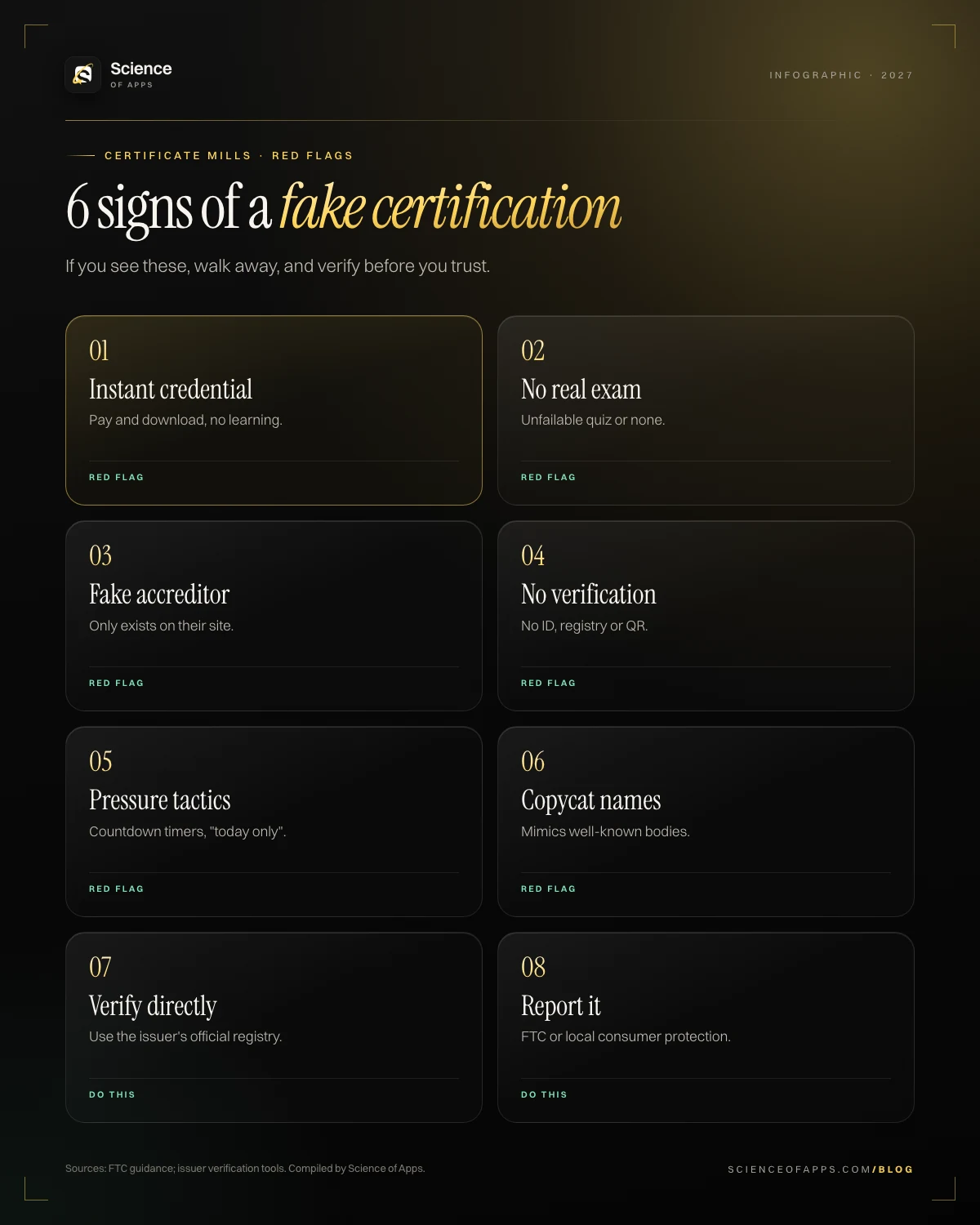
Red flags of fake certification websites
| Red flag | What it looks like |
|---|---|
| Instant credential | "Get certified today" with payment only |
| No real exam | Quiz you can't fail, or none at all |
| Fake accreditation | Accreditor can't be found independently |
| No verification | No credential ID, registry or QR code |
| Pressure & discounts | Countdown timers, "today only" prices |
| Copycat names | Names similar to well-known bodies |
How to detect a fake certificate
- Find the issuer's official website independently (don't use links or phone numbers on the certificate).
- Use the issuer's verification tool or registry with the credential ID.
- Check accreditation claims on the accreditor's own website.
- Look for inconsistencies: fonts, dates, signatures, misspellings.
Official verification registries
PMI has an online certification registry2; AWS offers credential validation3; Microsoft credentials are shareable and verifiable through Microsoft Learn; Science of Apps certificates carry a credential ID and QR code. See certificate verification.
Why employers should care
Hiring on fake credentials creates safety, compliance and reputational risk, especially in regulated roles. Verification takes minutes.
How certificate mills operate
Mills usually follow a pattern: a professional-looking website, a name similar to a known institution, claims of "international accreditation", flexible "credit for experience", and fast delivery of a printed certificate, transcript and even verification letters. Some run fake verification websites so employers who check are fooled too, which is why you must find the issuer's official website independently.
Prove it free: the tests that match this guide
Protect yourself from scams with these free certifications. (Disclosure: Science of Apps publishes these tests.)
- Security Awareness Certification Test (Phishing Detection)Certificate scams often arrive as phishing emails and fake offers.Start free test →
- Privacy Certification Test (Fundamentals)Never hand personal data to a certificate mill.Start free test →
- Information and Media Literacy CertificationEvaluate sources and spot misleading claims, like fake accreditation.Start free test →
The consequences of using a fake certificate
Using a fake credential to get a job can lead to dismissal, reputational damage and, in some jurisdictions and regulated professions, legal action. Even buying one innocently wastes money and time. Real, free alternatives exist for proving skills.
Employer checklist for spotting fakes
- Does the credential appear in the issuer's official registry?
- Do the dates make sense against the candidate's work history?
- Is the issuer's accreditation listed by a recognized accreditor?
- Can the candidate discuss what the certification covered?
Where to report certificate scams
In the U.S., report scams to the FTC at ReportFraud.ftc.gov. In the UK, use Action Fraud; in India, the National Cyber Crime Reporting Portal. Reporting helps protect other learners.
Frequently asked questions
What is a certificate mill?
An organization that sells certificates for payment with little or no real study or assessment, often with fake accreditation.
How do I spot a fake certificate?
Look for instant credentials, no real exam, unverifiable accreditation and no registry; verify directly with the issuer.
How can employers detect fake certificates?
Use the issuer's official verification tool or registry with the credential ID, contacting the issuer through independently found details.
How do certificate mills operate?
Mills usually follow a pattern: a professional-looking website, a name similar to a known institution, claims of "international accreditation", flexible "credit for experience", and fast delivery of a printed certificate, transcript and even verification letters. Some run fake verification websites so employers who check are fooled too, which is why you must find the issuer's official website independently.
What happens if you use a fake certificate?
Using a fake credential to get a job can lead to dismissal, reputational damage and, in some jurisdictions and regulated professions, legal action. Even buying one innocently wastes money and time. Real, free alternatives exist for proving skills.
Sources
- FTC: diploma mills and fake credentials
- PMI: online certification registry
- AWS: validate an AWS certification
- CHEA: database of accredited institutions
- Science of Apps: free online certifications
- Checked November 11, 2026. Figures that change — fees, salaries, prices — are reviewed every six months; if something is out of date, tell us.
Where to go from here
- Accredited vs non-accredited — what does 'accredited' really mean for a certification? how accreditation works
- Certificate verification — how employers verify certificates online, which databases they use and how to ma
- Are online certificates legit? — are online certificates legit? a checklist for telling real credentials from sca
- CertificationsAre online certificates legit?Are online certificates legit? How to tell real credentials from scams: verification, real assessments, accreditation claims and red flags to check.
- CertificationsCertificate verificationHow employers verify certificates online, which databases they use and how to make your credentials easy to verify.
- Career guidesAI research and fact-checking skills employers want in 2027: primary sources, citation checks, lateral reading and documented verificationAI research and fact-checking skills employers want in 2027: primary sources, citation checks, lateral reading, media verification and evidence logs.
- Career guidesAI hallucination detection skills employers want in 2027: spotting invented facts, citations, quotes, numbers and code — and preventing themAI hallucination detection skills employers want in 2027: spotting fake citations, numbers, quotes and code APIs, and the workflows that prevent them.
- Product managementProduct management courses in India: which are worth the money — and how to judge themAre product management courses in India worth it? The course types, what each is good for, red flags, a checklist to judge any course, and free alternatives.
- App developmentHow to hire an app developer in India without getting burnedHow to hire an app developer in India safely: where to find them, how to vet them, a paid test task, contracts that give you the IP, and red flags.
Get the ideas, not the noise.
Sign up with Google and we’ll send you short UX psychology tips by email — why people tap, stall and leave, and what to do about it. Unsubscribe anytime. Prefer something to keep? Get the free Laws of UX guide as a PDF.
Prove the skill before you pay for the exam.
1,200+ free, test-based certifications graded on our server. Pass and get a founder-signed certificate with a credential ID employers can verify.