 By
Quick answer: How is AI changing online learning?
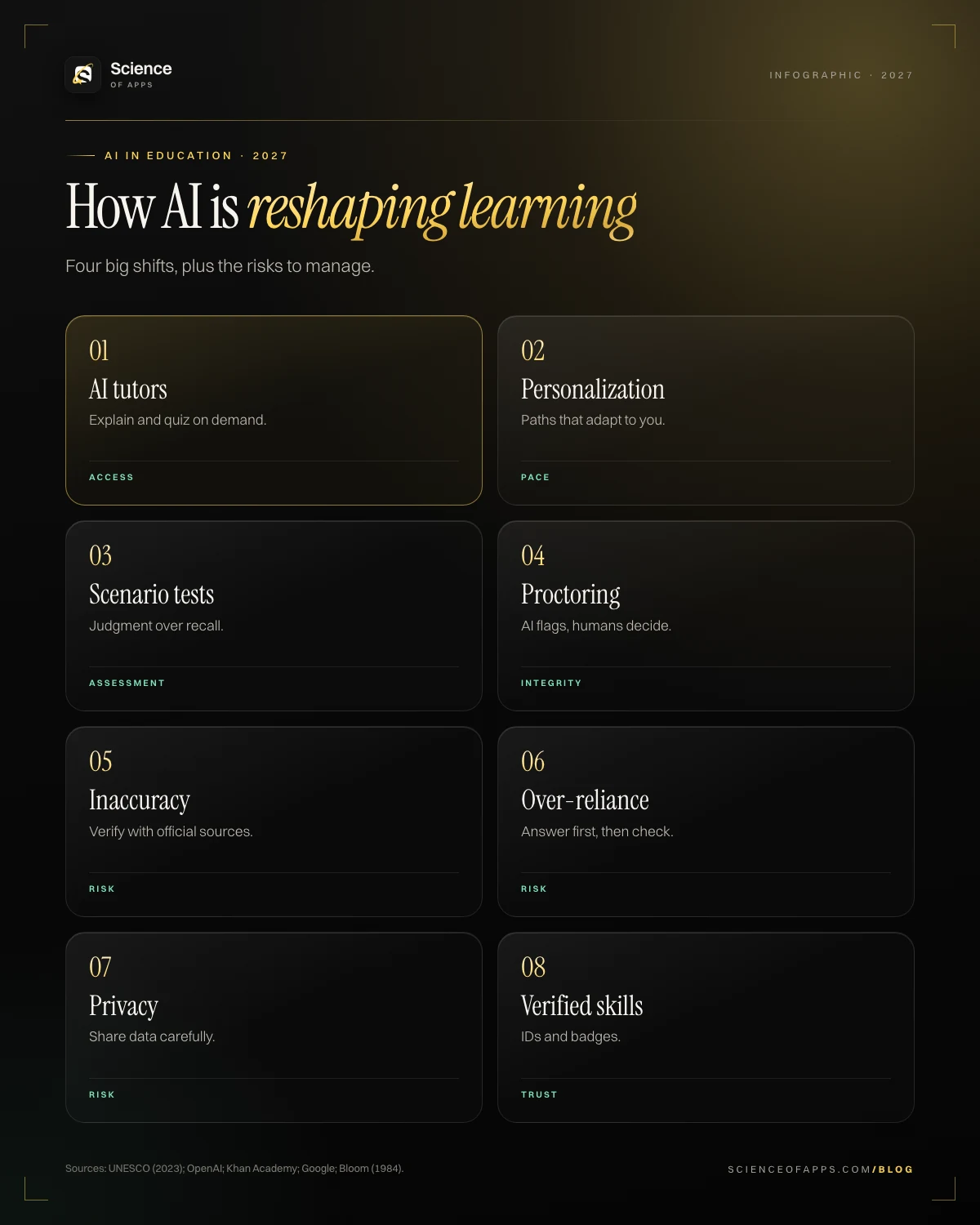
- Tutors — ChatGPT Study Mode, Khanmigo, Gemini.
- Personalization — paths that adapt to each learner.
- Assessment — scenario-based tests, not trivia.
- Proctoring — AI flags plus human review.
- Risks — errors, over-reliance, privacy.
Key takeaways
- AI tutors make one-to-one explanation available to anyone, anytime.
- Personalized learning adapts pace and content to each learner.
- Assessment is shifting toward scenarios that AI can't simply answer for you.
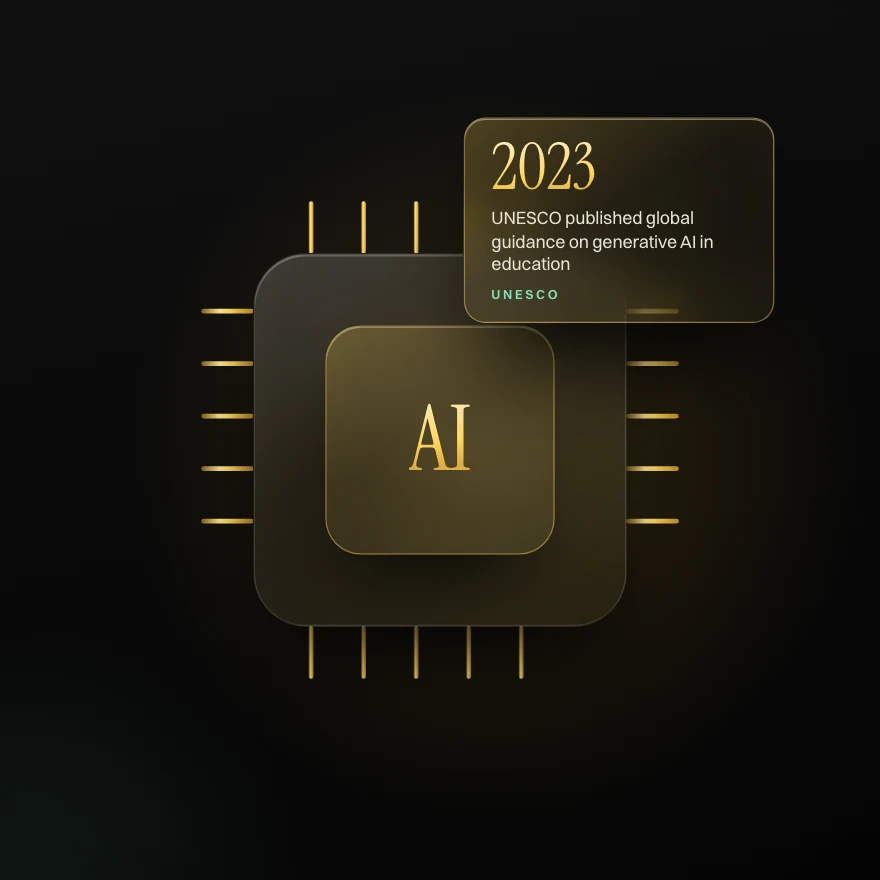
- UNESCO's 2023 guidance urges human-centred, age-appropriate AI use.
- The future of online learning: shorter, personalized, verified.
Four ways AI is changing online learning

| Change | What it looks like | Examples |
|---|---|---|
| AI tutors | Step-by-step explanations and quizzes | ChatGPT Study Mode1, Khanmigo2, Gemini Guided Learning3, Claude learning mode4 |
| Personalized learning | Content and pace adapt to the learner | Adaptive courses, AI study planners |
| Smarter assessment | Scenario and performance tasks | Case-based exams, labs, SOA scenario tests |
| Online proctoring | AI flags suspicious behaviour for human review | Pearson VUE OnVUE, PSI |
Why AI tutors matter
In 1984, Benjamin Bloom reported that students tutored one-to-one performed about two standard deviations better than students in conventional classes, the famous "2 sigma problem"5. One-to-one tutoring was too expensive to scale. AI tutors are the first serious attempt to make tutoring-like support affordable for everyone, though the evidence on outcomes is still developing.
How AI is changing certification
- Questions become scenarios: when AI can recall facts instantly, good exams test judgment.
- Performance-based tasks: labs and simulations prove real skills.
- More frequent, smaller credentials: skills change faster, so credentials do too.
- Verification: credential IDs and digital badges counter fakes.
Science of Apps designs every certification as scenario questions based on published standards, which is how we think certification should work in the AI era.
Prove it free: the tests that match this guide
Prove you're ready for AI in learning and work. (Disclosure: Science of Apps publishes these tests.)
Risks and how to manage them
- Inaccuracy: AI can be confidently wrong; verify with official sources.
- Over-reliance: letting AI think for you weakens learning; answer first, then check.
- Privacy: be careful what data you share.
- Equity: access to devices and connectivity still varies.
UNESCO's guidance recommends a human-centred approach, data protection and age limits for generative AI in education6.
The future of online learning
Expect shorter, personalized learning paths, AI tutors built into every course, and verified skills credentials that update as skills change. Read more: best AI tutors, AI study tools and micro-credentials vs degrees.
Frequently asked questions
How is AI used in education?
As tutors that explain and quiz, for personalized learning paths, for assessment design, for feedback on writing, and in online exam proctoring.
What is the future of online learning?
Shorter, personalized courses with built-in AI tutors and verified, frequently updated skills credentials.
Is AI good or bad for education?
It can widen access to tutoring-like support, but risks include inaccurate answers, over-reliance and privacy; UNESCO recommends a human-centred approach.
Why do AI tutors matter?
In 1984, Benjamin Bloom reported that students tutored one-to-one performed about two standard deviations better than students in conventional classes, the famous "2 sigma problem". One-to-one tutoring was too expensive to scale. AI tutors are the first serious attempt to make tutoring-like support affordable for everyone, though the evidence on outcomes is still developing.
How is AI changing certification?
Science of Apps designs every certification as scenario questions based on published standards, which is how we think certification should work in the AI era.
Sources
- OpenAI: Introducing study mode in ChatGPT
- Khan Academy: Khanmigo
- Google: Guided Learning in Gemini
- Anthropic: Claude for Education and learning modes
- Bloom (1984): The 2 Sigma Problem
- UNESCO: Guidance for generative AI in education and research (2023)
- Science of Apps: free online certifications
- Checked November 11, 2026. Figures that change — fees, salaries, prices — are reviewed every six months; if something is out of date, tell us.
Where to go from here
- Online proctored exams — how online proctored exams work, what ai proctoring checks for and the rules to
- Micro-credentials vs degrees — what micro-credentials are, how they compare to degrees and whether they'll repl
- Stackable credentials — what stackable credentials are, how they build toward degrees and real examples
- CertificationsAre online certificates legit?Are online certificates legit? How to tell real credentials from scams: verification, real assessments, accreditation claims and red flags to check.
- CertificationsBest AI study toolsThe best free AI study tools for certification exams, including ChatGPT prompts, flashcard generators and AI tutors.
- Career guides by Science of Apps for 2027The best AI certifications of 2027: ten ranked by what they do for your career, from first exam to AI engineerThe 10 best AI certifications of 2027, ranked by career impact: AWS AI Practitioner, Azure AI-102, Google's AI exams and more, with costs and enrol links.
- CertificationsMicrolearning & mobile learningWhy microlearning and mobile learning work: short 2–15 minute lessons, spaced repetition and retrieval practice, and where bite-sized learning falls short.
- Career guides by Science of Apps for 2027Free AI certifications in 2027: seven that cost nothing and still teach you something real7 free AI certifications for 2027: Elements of AI, Harvard CS50 AI, Kaggle, Anthropic, OpenAI Academy, Microsoft Learn and AI For Everyone, with what's free.
- CertificationsCertifications to get a job fastThe best certifications to get a job fast in the USA: CompTIA A+, Google certificates, CDL, CNA, AWS and more, with time to complete, cost and demand.
Get the ideas, not the noise.
Sign up with Google and we’ll send you short UX psychology tips by email — why people tap, stall and leave, and what to do about it. Unsubscribe anytime. Prefer something to keep? Get the free Laws of UX guide as a PDF.
Prove the skill before you pay for the exam.
1,200+ free, test-based certifications graded on our server. Pass and get a founder-signed certificate with a credential ID employers can verify.