 By
Quick answer: What is the best AI tutor?
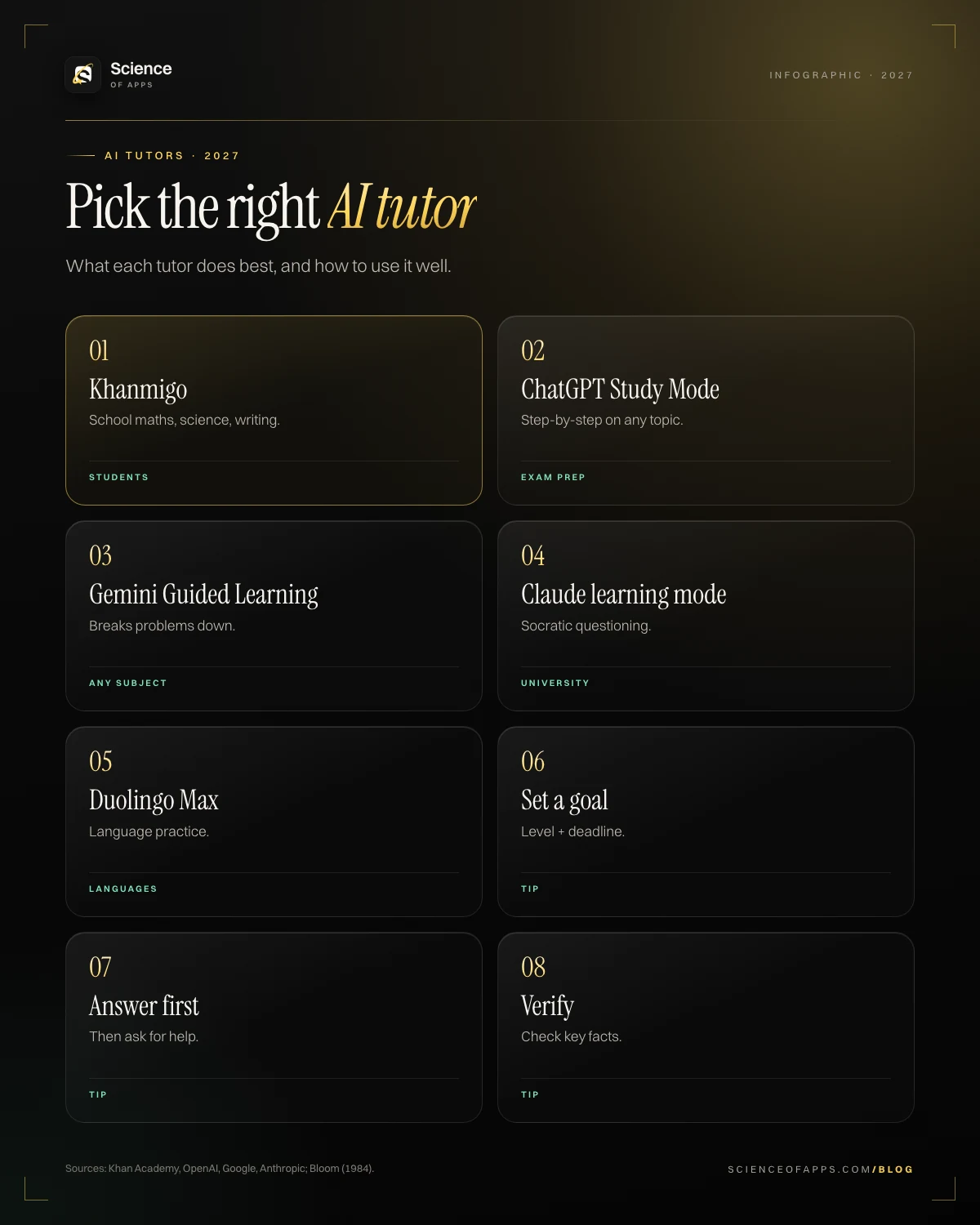
- School subjects — Khanmigo.
- Any topic — ChatGPT Study Mode, Gemini Guided Learning.
- Socratic style — Claude learning mode.
- Languages — Duolingo Max.
- Look for — questions, adaptation, quizzes, accuracy.
Key takeaways
- AI tutors aim to bring one-to-one tutoring to everyone (Bloom's "2 sigma" idea).
- The best ones guide with questions rather than handing over answers.
- Khanmigo suits school learners; ChatGPT, Gemini and Claude cover any topic.
- Personalized learning works best when you set goals and answer first.
- AI tutors can be wrong: verify with official materials.
AI tutors compared

| AI tutor | Best for | Style |
|---|---|---|
| Khanmigo1 | School maths, science, writing | Guides without giving answers |
| ChatGPT Study Mode2 | Any subject, exam prep | Step-by-step questions, checks understanding |
| Gemini Guided Learning3 | Any subject, Google users | Breaks problems down, visuals |
| Claude learning mode4 | University and professional topics | Socratic questioning |
| Duolingo Max | Languages | Explanations and role-play |
Why AI tutoring matters
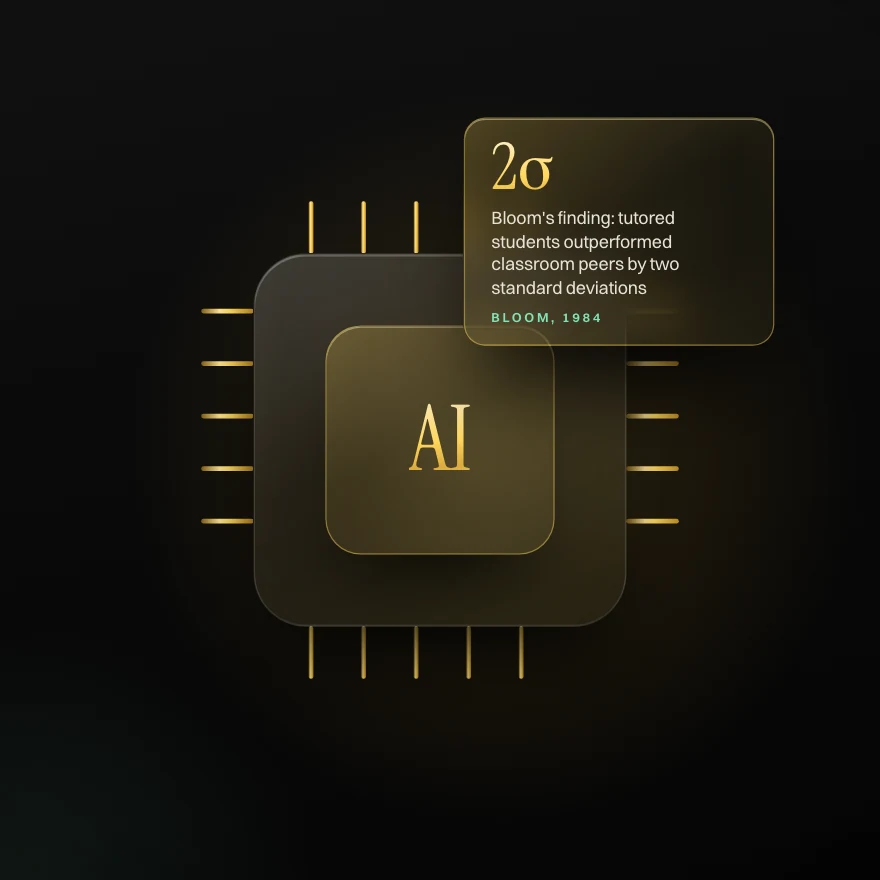
Benjamin Bloom's 1984 research found that students who received one-to-one tutoring performed about two standard deviations better than those in conventional classrooms5. Human tutoring is expensive; AI tutors offer a scalable approximation. Early evidence is promising but mixed, and tutors work best alongside practice and feedback.
Personalized learning with AI: examples
- Diagnosing your level with a few questions, then adjusting difficulty.
- Explaining the same concept in different ways until it clicks.
- Generating practice questions on your weak topics.
- Building a study plan around your exam date.
Prove it free: the tests that match this guide
Learn to work with AI tutors effectively. (Disclosure: Science of Apps publishes these tests.)
- AI Literacy CertificationUnderstand AI tutors' limits before relying on them.Start free test →
- Prompt Engineering CertificationAsk AI tutors better questions and get better answers.Start free test →
- AI for Teachers and Educators CertificationFor teachers guiding students who use AI tutors.Start free test →
The critique of AI personalized learning
Critics point to inaccurate answers, learners outsourcing thinking, privacy concerns and unequal access. UNESCO recommends human-centred use with teacher oversight6. The practical answer: use AI tutors to ask you questions, and verify important facts.
How to get the most from an AI tutor
- Tell it your goal and level ("I'm preparing for AZ-900 in three weeks").
- Ask it to quiz you one question at a time.
- Answer before asking for help.
- Ask "why" after every correction.
- Check readiness with an independent test, such as a free SOA scenario certification.
Related: AI study tools and AI in education.
Frequently asked questions
What is the best AI tutor?
Khanmigo for school subjects; ChatGPT Study Mode, Gemini Guided Learning and Claude's learning mode for any topic; Duolingo Max for languages.
Are AI tutors effective?
They can help, especially when they guide with questions and you practise actively; evidence is still developing.
What is personalized learning with AI?
AI adapting content, difficulty and pace to each learner, for example by diagnosing level and generating targeted practice.
Are AI tutors free?
Several have free tiers, including ChatGPT, Gemini and Claude; Khanmigo is free for teachers and available to learners through Khan Academy.
What are the criticisms of AI personalized learning?
Critics point to inaccurate answers, learners outsourcing thinking, privacy concerns and unequal access. UNESCO recommends human-centred use with teacher oversight. The practical answer: use AI tutors to ask you questions, and verify important facts.
Sources
- Khan Academy: Khanmigo
- OpenAI: Introducing study mode in ChatGPT
- Google: Guided Learning in Gemini
- Anthropic: Claude for Education and learning modes
- Bloom (1984): The 2 Sigma Problem
- UNESCO: Guidance for generative AI in education and research (2023)
- Science of Apps: free online certifications
- Checked November 11, 2026. Figures that change — fees, salaries, prices — are reviewed every six months; if something is out of date, tell us.
Where to go from here
- Stackable credentials — what stackable credentials are, how they build toward degrees and real examples
- Skills for the future — the top skills to learn for the future of work by 2030, according to the wef, jo
- Micro-credentials vs degrees — what micro-credentials are, how they compare to degrees and whether they'll repl
- CertificationsThe best certification appsThe best apps for learning on your phone and earning real certificates, compared on content, price and certificate value.
- ComparisonsFigma vs Canva: which design tool should you use — and when do you need both?Figma vs Canva compared for product teams, marketers and founders: what each is built for, collaboration, AI features, pricing models and a clear verdict.
- CertificationsAI in educationHow AI is transforming education and online certification, from AI tutors to adaptive exams and skills verification.
- CertificationsCertification costs comparedHow much do Coursera, Udemy, edX, LinkedIn Learning and other platforms really cost? Full pricing comparison for 2027.
- CertificationsLinkedIn Learning vs UdemyLinkedIn Learning vs Udemy compared on price, quality and certificates, plus 8 alternatives with stronger credentials for career growth in 2027.
- AI & vibe codingWhat is vibe coding? A plain-English guide — and when it's a good ideaWhat vibe coding is, where the term came from, how it works, what it's good and bad for, and how to vibe code safely.
Get the ideas, not the noise.
Sign up with Google and we’ll send you short UX psychology tips by email — why people tap, stall and leave, and what to do about it. Unsubscribe anytime. Prefer something to keep? Get the free Laws of UX guide as a PDF.
Prove the skill before you pay for the exam.
1,200+ free, test-based certifications graded on our server. Pass and get a founder-signed certificate with a credential ID employers can verify.