 By
Quick answer: What are micro-credentials?
- Definition — short credentials certifying specific skills.
- Examples — Google Career Certificates, AWS, SOA.
- Vs degree — faster, cheaper, narrower.
- Recognition — EU (2022), Australia frameworks.
- Replace college? — complement, not replace.
Key takeaways
- Micro-credentials certify specific skills in weeks or months.
- The EU (2022) and Australia have official micro-credential frameworks.
- They're best for upskilling, career changes and proving tool skills.
- Degrees still matter for regulated professions and broad foundations.
- Many micro-credentials stack toward larger qualifications.
What does micro-credentials mean?

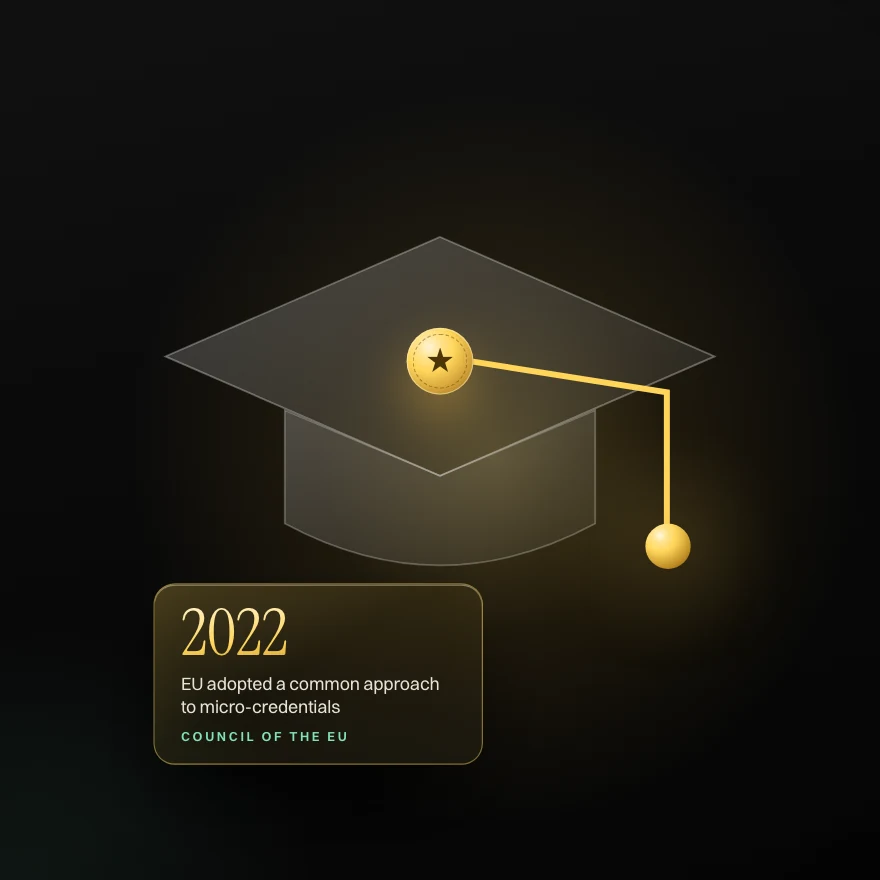
The Council of the EU defines a micro-credential as a record of learning outcomes from a small volume of learning, assessed against transparent standards1. In practice, it's any short, assessed credential for a specific skill. Australia's National Microcredentials Framework sets similar expectations for quality and transparency2.
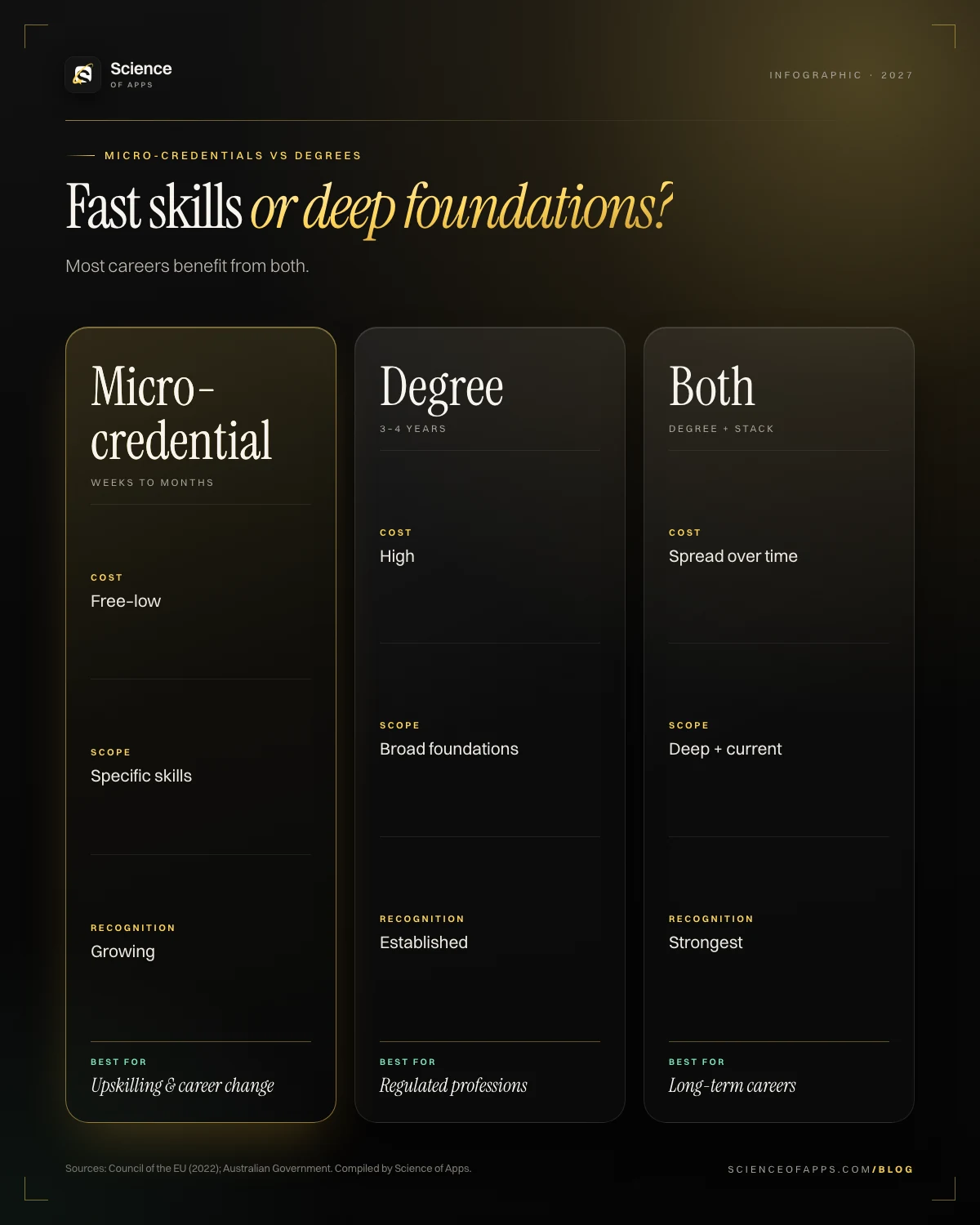
| Micro-credentials | Degrees | |
|---|---|---|
| Time | Days to months | 3–4 years |
| Cost | Free to a few thousand | High |
| Scope | Specific skills | Broad foundations |
| Best for | Upskilling, career change | Regulated professions, entry to many careers |
| Recognition | Growing; varies by issuer | Long established |
Are micro-credentials worth it?
They're worth it when they're assessed, recognized in your field and verifiable. A cloud or data micro-credential named in job ads is valuable; an unassessed badge from an unknown provider isn't. Learners in online forums often say micro-credentials helped most when paired with a project or experience.
Will micro-credentials replace college?
Not for most people. Degrees remain required for regulated professions (medicine, law, nursing, teaching) and still correlate with higher average earnings. But micro-credentials are changing how people keep skills current after college and how career changers enter fields like tech. The likely future is "degree + stack of micro-credentials" rather than one or the other.
Prove it free: the tests that match this guide
SOA certifications are free micro-credentials. Start with these. (Disclosure: Science of Apps publishes these tests.)
- AI Literacy CertificationA 10-minute AI micro-credential with a verifiable certificate.Start free test →
- Project Management Fundamentals CertificationProject management micro-credential.Start free test →
- SQL Certification Test (Fundamentals)A SQL micro-credential, one of the most job-relevant.Start free test →
Examples of micro-credentials
Stacking micro-credentials
Many micro-credentials stack: a series can lead to a larger certificate or count toward a degree. See stackable credentials explained.
Frequently asked questions
What does micro-credentials mean?
Short, assessed credentials that certify specific skills, such as Google Career Certificates or AWS certifications.
Are micro-credentials worth it?
Yes, when they're assessed, recognized in your field and verifiable; pair them with projects or experience.
Will micro-credentials replace degrees?
Not for most careers; they complement degrees, especially for upskilling and career changes.
Is it micro-credentials or microcredentials?
Both spellings are used; 'micro-credentials' is common in the EU and 'microcredentials' in Australia.
Can micro-credentials be stacked?
Many micro-credentials stack: a series can lead to a larger certificate or count toward a degree. See stackable credentials explained.
Sources
- Council of the EU: Recommendation on micro-credentials (2022)
- Australian Government: National Microcredentials Framework
- Google Career Certificates
- edX: MicroMasters programs
- Science of Apps: free online certifications
- Checked November 11, 2026. Figures that change — fees, salaries, prices — are reviewed every six months; if something is out of date, tell us.
Where to go from here
- Online proctored exams — how online proctored exams work, what ai proctoring checks for and the rules to
- Stackable credentials — what stackable credentials are, how they build toward degrees and real examples
- AI in education — how ai is transforming education and online certification, from ai tutors to ada
- CertificationsCertifications to get a job fastThe best certifications to get a job fast in the USA: CompTIA A+, Google certificates, CDL, CNA, AWS and more, with time to complete, cost and demand.
- CertificationsStackable credentialsWhat stackable credentials are, how they build toward degrees and real examples of stackable certificate paths.
- CertificationsAre online certificates legit?Are online certificates legit? How to tell real credentials from scams: verification, real assessments, accreditation claims and red flags to check.
- CertificationsCertificate vs diploma vs degreeCertificate vs diploma vs degree: cost, time, salary and employer perception compared, so you can choose the right path.
- CertificationsAre certifications worth it?Do certifications help you get hired? What recruiters and hiring data say about when certifications are worth it, and when they aren't.
- CertificationsGoogle UX Design Certificate vs the restIs the Google UX Design Certificate worth it? Compare it with other top UX/UI certifications on cost, portfolio value and jobs.
Get the ideas, not the noise.
Sign up with Google and we’ll send you short UX psychology tips by email — why people tap, stall and leave, and what to do about it. Unsubscribe anytime. Prefer something to keep? Get the free Laws of UX guide as a PDF.
Prove the skill before you pay for the exam.
1,200+ free, test-based certifications graded on our server. Pass and get a founder-signed certificate with a credential ID employers can verify.