 By
Quick answer: What are stackable credentials?
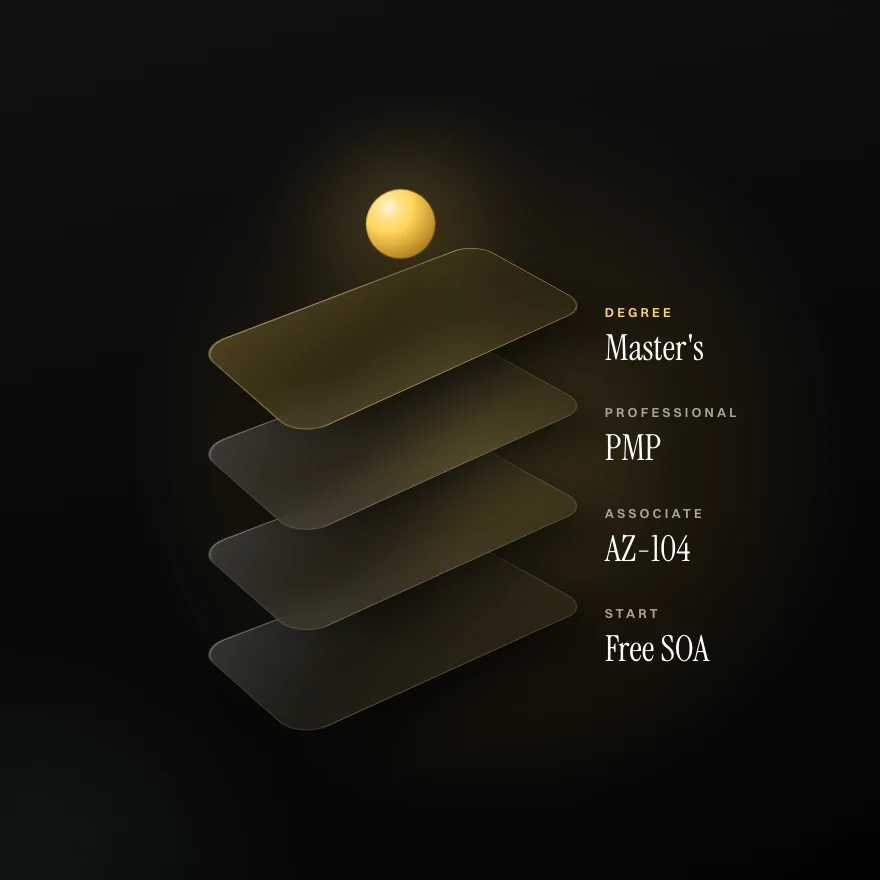
- Definition — credentials that build on each other.
- Tech — AWS: foundational → associate → professional.
- Higher ed — MicroMasters → master's credit.
- Healthcare — CNA → LPN → RN.
- Benefit — earn, work, keep progressing.
Key takeaways
- Stackable credentials let you earn and work before finishing a big qualification.
- Vendor certification paths are the most common stacks in tech.
- Some university certificates stack into master's degrees.
- Healthcare career ladders are classic stackable pathways.
- Plan your stack from the end goal backward.
What are stackable credentials?

Stackable credentials are part of a sequence that can be accumulated over time to build qualifications and move along a career pathway. U.S. federal career-pathway initiatives promote them to help adults combine work and learning1.
Stackable credential examples
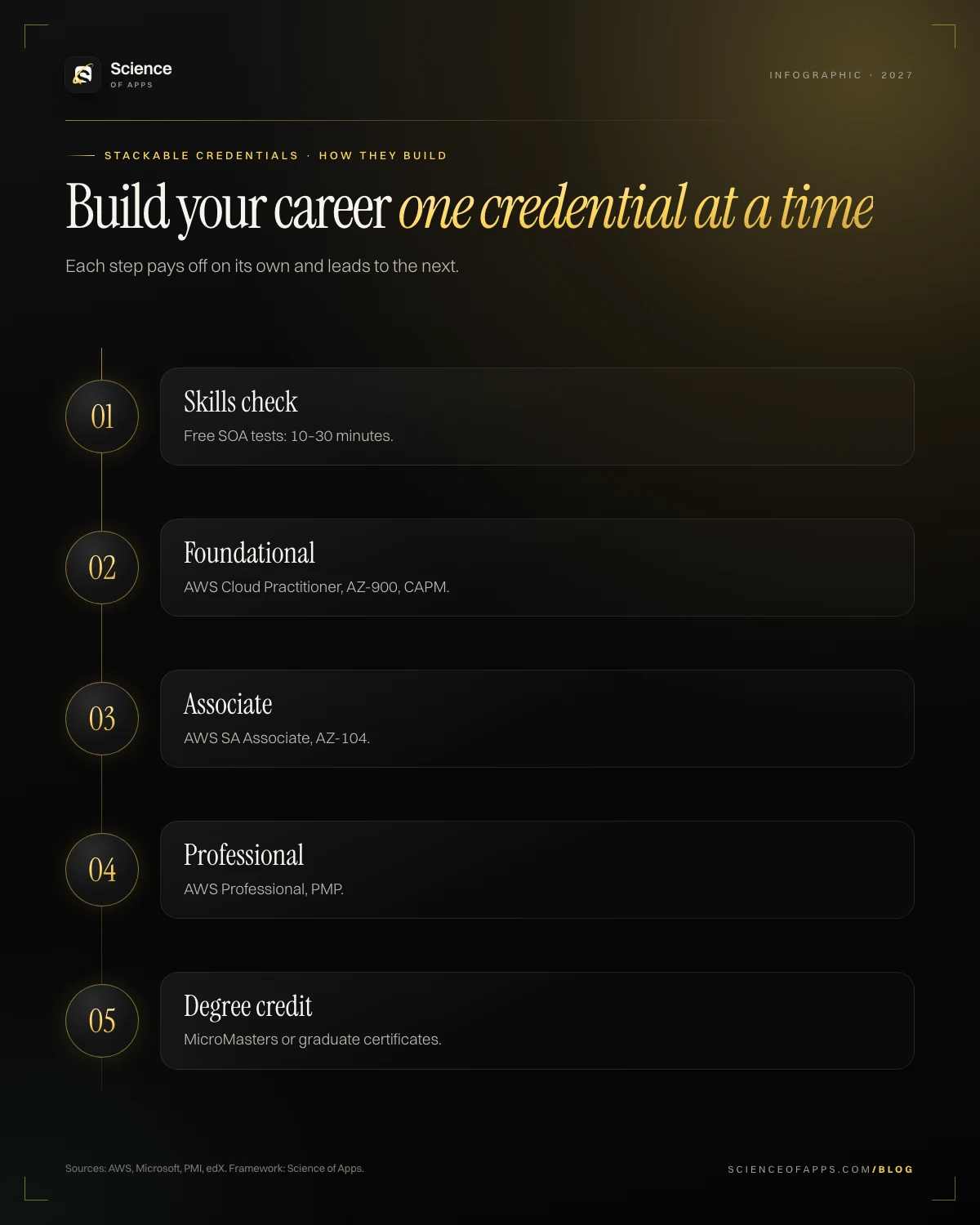
| Field | Stack |
|---|---|
| Cloud | AWS Cloud Practitioner → Solutions Architect – Associate → Professional |
| Microsoft | AZ-900 → AZ-104 → AZ-305 (Expert) |
| Higher education | edX MicroMasters → credit toward a master's2 |
| Healthcare | CNA → LPN/LVN → RN → specialty certification |
| Project management | CAPM → PMP → PgMP |
| Data | Google Data Analytics → PL-300 → cloud data engineer |
| Skills profile | Several SOA skill certifications → role certification |
Stackable credentials in higher education
Universities increasingly design certificates that stack: two or three graduate certificates may combine into a master's degree, and some accept MicroMasters or professional certificates for credit. Always confirm credit policies before enrolling.
Stackable credentials in healthcare
Healthcare has long-established ladders: certified nursing assistant (CNA) to licensed practical nurse (LPN) to registered nurse (RN), or pharmacy technician to further specializations. Each step adds pay and responsibility.
Prove it free: the tests that match this guide
Start your stack free with an SOA skills check, then step up. (Disclosure: Science of Apps publishes these tests.)
- Cloud Computing Certification Test (Fundamentals)Start your stack: cloud fundamentals in 10 minutes.Start free test →
- AWS Cloud Practitioner Practice ExamNext layer: practise for AWS's foundational exam.Start free test →
- AWS Solutions Architect Associate Practice ExamNext layer: practise for the AWS associate exam.Start free test →
- Product Manager CertificationA role certification to top off a product stack.Start free test →
Benefits of stacking
- Earn sooner: get a job after the first credential.
- Lower risk: test a field before committing years.
- Flexibility: pause and resume.
- Employer support: later stages are often employer-funded.
How to plan your stack
- Define your end role.
- List the credentials job ads ask for at each level.
- Start with a quick, free skills check (SOA tests take 10–30 minutes).
- Earn the first recognized credential and start applying.
- Add the next level once you have experience.
Related: micro-credentials vs degrees.
Frequently asked questions
What are stackable credentials?
Certificates and certifications designed to build on each other toward higher qualifications and career progression.
What are examples of stackable credentials?
AWS Cloud Practitioner → Associate → Professional; edX MicroMasters → master's credit; CNA → LPN → RN.
What are stackable micro-credentials?
Short credentials that combine into a larger certificate or count toward a degree.
Can stackable certificates lead to a master's degree?
Yes, at some universities graduate certificates or MicroMasters programs count toward a master's.
How do stackable credentials work in higher education?
Universities increasingly design certificates that stack: two or three graduate certificates may combine into a master's degree, and some accept MicroMasters or professional certificates for credit. Always confirm credit policies before enrolling.
Sources
- U.S. Department of Labor / Education: career pathways and stackable credentials
- edX: MicroMasters programs
- AWS Certification paths
- PMI certifications
- Science of Apps: free online certifications
- Checked November 11, 2026. Figures that change — fees, salaries, prices — are reviewed every six months; if something is out of date, tell us.
Where to go from here
- Micro-credentials vs degrees — what micro-credentials are, how they compare to degrees and whether they'll repl
- Best AI tutors 2027 — the best ai tutors for personalized learning and certification prep, compared on
- Online proctored exams — how online proctored exams work, what ai proctoring checks for and the rules to
- CertificationsMicro-credentials vs degreesWhat micro-credentials are, how they compare with degrees on cost, time and recognition, and whether they will replace traditional college.
- CertificationsCertifications that increase your salaryWhich certifications actually increase your salary? Real raise data by credential, field and experience level.
- CertificationsAre online certificates legit?Are online certificates legit? How to tell real credentials from scams: verification, real assessments, accreditation claims and red flags to check.
- CertificationsJobs that only need a certification30 well-paying jobs that need only a certification or licence, not a degree: IT support, coding, trades, healthcare and more, with time, cost and pay.
- CertificationsThe highest-paying certificationsThe 25 highest-paying certifications for 2027, with salary data, cost, time to complete and whether you need a degree.
- Templates & toolsUser persona template: what to include, two filled examples, and how to build personas from researchA user persona template with the fields that matter, two filled Indian app examples, and a step-by-step method to build personas from real research.
Get the ideas, not the noise.
Sign up with Google and we’ll send you short UX psychology tips by email — why people tap, stall and leave, and what to do about it. Unsubscribe anytime. Prefer something to keep? Get the free Laws of UX guide as a PDF.
Prove the skill before you pay for the exam.
1,200+ free, test-based certifications graded on our server. Pass and get a founder-signed certificate with a credential ID employers can verify.