 By
Quick answer: What is microlearning?
- Definition — short, focused lessons (2–15 min).
- Why it works — easy to start, fits spaced practice.
- Best for — reinforcement, habits, quick skills.
- Limits — not enough alone for complex topics.
- Apps — Duolingo, Anki, Headway, SOA tests.
Key takeaways
- Microlearning = short units focused on one objective.
- It pairs naturally with spaced repetition and retrieval practice.
- Mobile learning lets people learn in gaps: commutes, breaks, queues.
- Microlearning apps are worth it when they include practice, not just reading.
- Combine micro-lessons with longer study for complex certifications.
What is microlearning?

Microlearning breaks content into small, focused units, each with a single objective: a 3-minute video, a 10-question quiz, a flashcard set, a short scenario. Mobile learning delivers these on phones so learning fits into everyday life.
Why bite-sized learning works
- Lower barrier: five minutes is easy to start.
- Spacing: short sessions across days use the spacing effect1.
- Retrieval: micro-quizzes are retrieval practice, rated high utility2.
- Completion: short units are more likely to be finished than long courses.
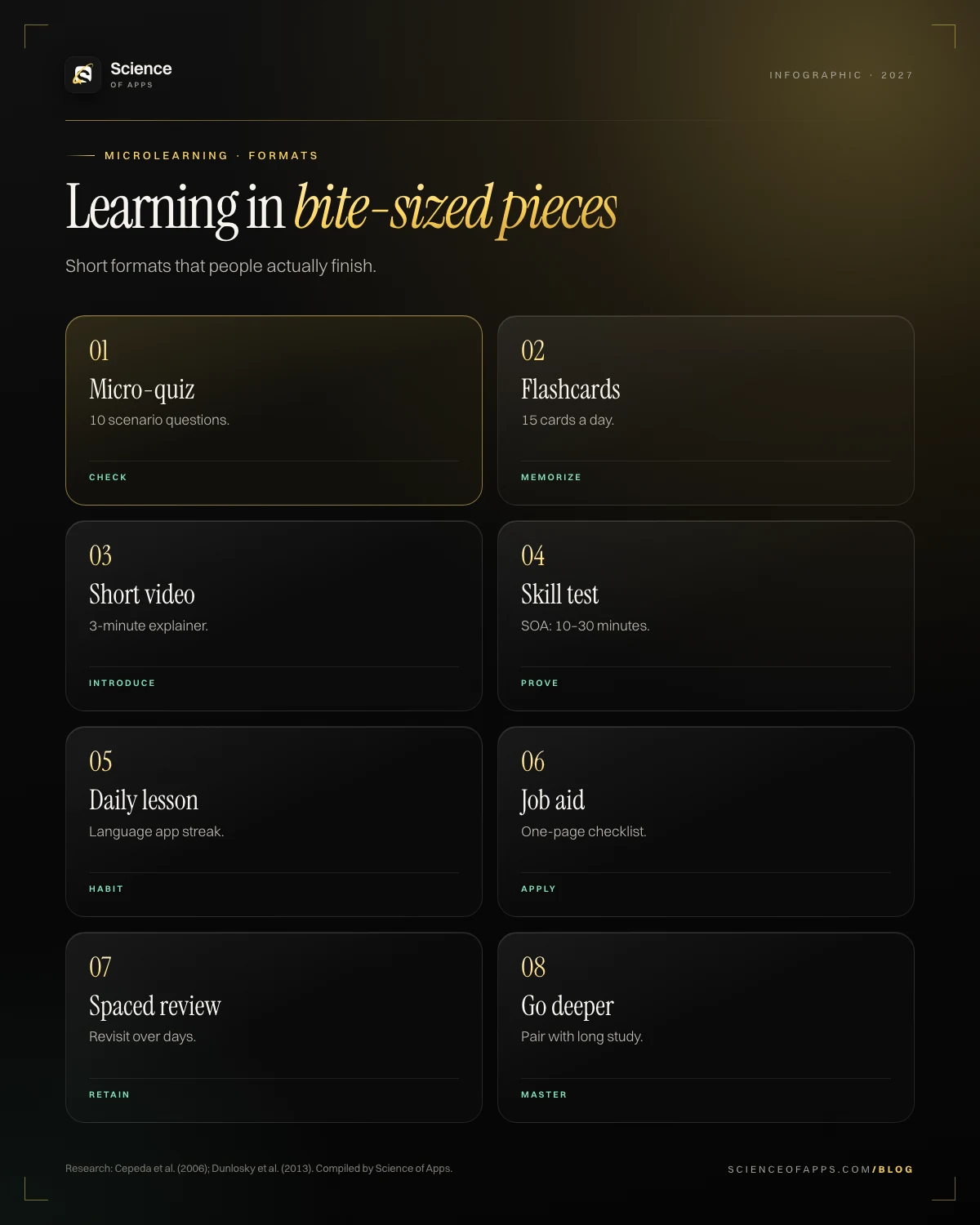
Bite-sized learning examples
| Format | Example | Best for |
|---|---|---|
| Micro-quiz | 10 scenario questions | Checking understanding |
| Flashcards | Anki deck, 15 cards a day | Memorizing terms |
| Short video | 3-minute concept explainer | Introducing ideas |
| Skill test | SOA certification (10–30 min) | Proving a specific skill |
| Daily lesson | Language app lesson | Habit building |
| Job aid | One-page checklist | Applying at work |
Are microlearning apps worth it?
They're worth it when they make you practise (quizzes, recall, speaking), not just consume summaries. Language apps and flashcard apps fit well; book-summary apps such as Headway or Blinkist are good for discovering ideas but weak for retention unless you add recall. Learners in online forums often say the same: summaries feel productive, practice actually sticks.
Prove it free: the tests that match this guide
Every SOA certification is microlearning: 10–30 minutes, instant results. (Disclosure: Science of Apps publishes these tests.)
- AI Literacy CertificationMicrolearning in practice: a 10-minute certification.Start free test →
- Time Management and Prioritization CertificationAnother 10-minute certification you can take on your phone.Start free test →
- Study Skills Test15 minutes on the study habits behind microlearning.Start free test →
Microlearning for corporate training
Companies use microlearning for compliance refreshers, product updates, onboarding and reinforcing longer training. Short modules fit around work and give managers frequent data on progress. See LMS for corporate training.
Limits of microlearning
Complex skills (cloud architecture, financial modelling) need deeper study and hands-on practice. Use microlearning to start, reinforce and test, alongside longer sessions. The 30-day study plan combines both.
Microlearning at Science of Apps
Every SOA certification is a microlearning unit: 10–30 minutes of scenario questions, instant grading and a verifiable certificate. It's the fastest way to prove a skill and decide what to learn next.
Frequently asked questions
What is microlearning?
Learning delivered in short, focused units, usually 2–15 minutes, each with one objective.
Are microlearning apps worth it?
Yes, when they make you practise (quizzes, recall); summary-only apps are weaker for long-term retention.
What is mobile learning?
Learning on smartphones and tablets, often using microlearning formats that fit into short gaps in the day.
Is Headway microlearning worth it?
It's useful for discovering ideas from books; add your own recall practice if you want to remember them.
What are the limits of microlearning?
Complex skills (cloud architecture, financial modelling) need deeper study and hands-on practice. Use microlearning to start, reinforce and test, alongside longer sessions. The 30-day study plan combines both.
Sources
- Cepeda et al. (2006): Distributed practice
- Dunlosky et al. (2013): effective learning techniques
- Anki
- Science of Apps: free online certifications
- Checked November 11, 2026. Figures that change — fees, salaries, prices — are reviewed every six months; if something is out of date, tell us.
Where to go from here
- Skills for the future — the top skills to learn for the future of work by 2030, according to the wef, jo
- Best AI tutors 2027 — the best ai tutors for personalized learning and certification prep, compared on
- Stackable credentials — what stackable credentials are, how they build toward degrees and real examples
- How to make an appHow to build an app like Duolingo: features, psychology, stack and costWhat makes Duolingo work — short lessons, streaks, leagues, adaptive practice — and how to build a learning app like it: MVP, tech stack and cost.
- CertificationsActive recall & spaced repetitionHow active recall and spaced repetition work, why they beat re-reading and how to use them for certification prep.
- CertificationsAI in educationHow AI is transforming education and online certification, from AI tutors to adaptive exams and skills verification.
- CertificationsMicro-credentials vs degreesWhat micro-credentials are, how they compare with degrees on cost, time and recognition, and whether they will replace traditional college.
- CertificationsThe science of learningWhat the science of learning says about memory: retrieval practice, spacing, feedback and small chunks, and how Science of Apps builds them into its tests.
- CertificationsBest AI tutors 2027The best AI tutors for personalized learning and certification prep, compared on features, price and accuracy.
Get the ideas, not the noise.
Sign up with Google and we’ll send you short UX psychology tips by email — why people tap, stall and leave, and what to do about it. Unsubscribe anytime. Prefer something to keep? Get the free Laws of UX guide as a PDF.
Prove the skill before you pay for the exam.
1,200+ free, test-based certifications graded on our server. Pass and get a founder-signed certificate with a credential ID employers can verify.