 By
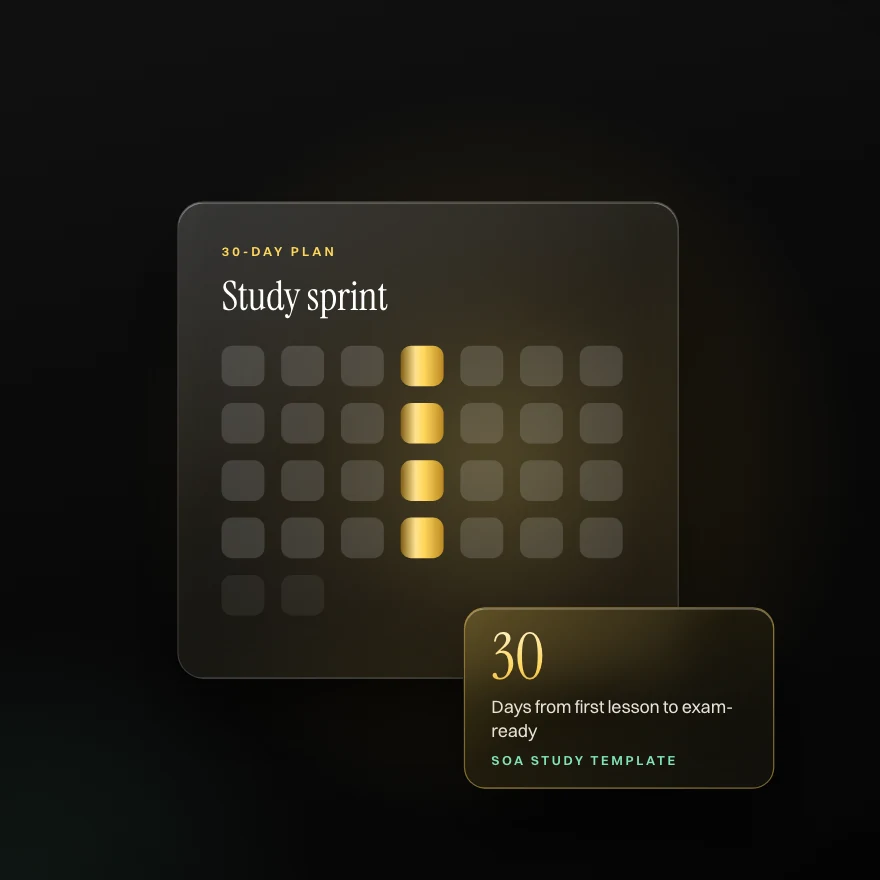
Quick answer: How do I make an exam study plan?
- Week 1 — learn the highest-weighted domains.
- Week 2 — remaining domains + daily questions.
- Week 3 — full practice tests, fix gaps.
- Week 4 — spaced review, two mocks, rest.
- Daily time — 60–90 min weekdays, 2–3 h weekends.
Key takeaways
- Plan backwards from a booked exam date.
- Front-load the highest-weighted domains.
- Do practice questions every day from week 1, not just at the end.
- Week 3 is for full practice tests and fixing weak areas.
- Rest the day before the exam; sleep consolidates memory.
The 30-day study plan template

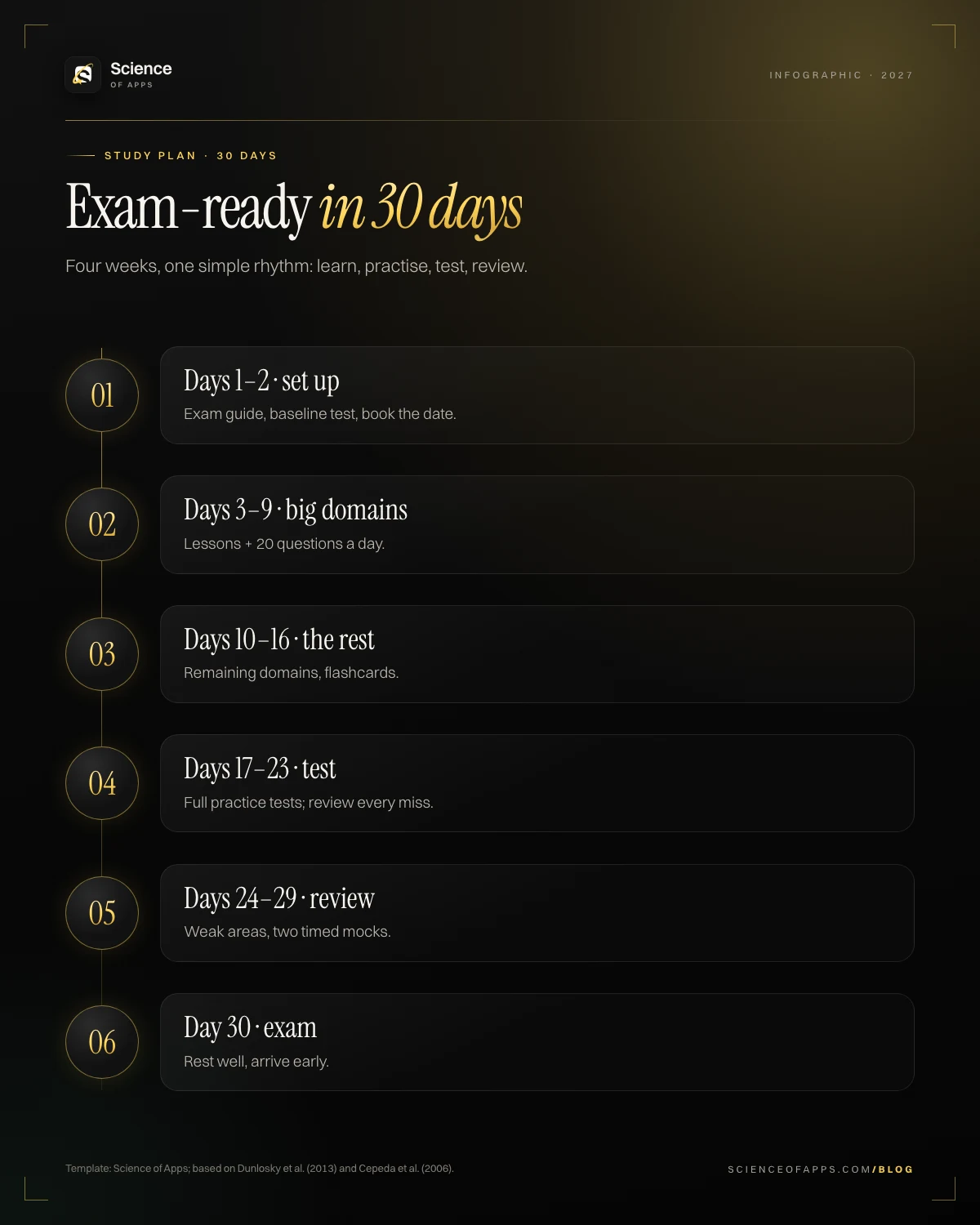
| Days | Focus | Daily tasks |
|---|---|---|
| 1–2 | Set up | Read exam guide, take a baseline test, book the exam |
| 3–9 | Highest-weighted domains | Lessons + 20 practice questions/day |
| 10–16 | Remaining domains | Lessons + 25 questions/day; flashcards |
| 17–23 | Practice tests | Full-length test every other day; review every wrong answer |
| 24–28 | Spaced review | Weak domains, flashcards, two timed mock exams |
| 29 | Light review | Summary notes only; prepare ID and logistics |
| 30 | Exam day | Breakfast, arrive early, read carefully |
Example study schedule for working professionals
- Weekdays (60–90 min): 40 minutes of lessons, 30 minutes of practice questions, 10 minutes of flashcards.
- Weekends (2–3 h): one full practice test plus review, or a deep dive into a weak domain.
- Commute: flashcards or audio summaries.
Why this plan works
It's built on the two most effective learning techniques: practice testing and spaced practice1. Spreading study over weeks improves long-term retention compared with cramming the same hours together2. Daily practice questions from week 1 make retrieval a habit, not a last-minute panic.
Prove it free: the tests that match this guide
Use a free SOA test as the day 1–2 baseline in your 30-day plan. (Disclosure: Science of Apps publishes these tests.)
Adjusting the plan for your exam
| Exam | Suggested length |
|---|---|
| AZ-900, AWS Cloud Practitioner, PSM I | 2–4 weeks |
| AWS Associate, AZ-104, PL-300 | 6–8 weeks |
| CompTIA Security+ | 6–10 weeks |
| PMP, CSCP | 8–12 weeks (CSCP often 3–6 months) |

For longer exams, stretch each phase proportionally: keep the order (learn, practise, test, review), just give each phase more days.
How to use a study planner
- Write your exam date at the top.
- List domains with their weightings.
- Block study sessions in your calendar like meetings.
- Track practice-test scores by domain each week.
- Move time towards your two weakest domains every Sunday.
Studying around a job? See how to study while working full-time.
Frequently asked questions
How do I make a 30-day study plan for an exam?
Book the exam, then spend week 1 on the biggest domains, week 2 on the rest, week 3 on full practice tests and week 4 on spaced review and timed mocks.
How many hours a day should I study for a certification?
60–90 minutes on weekdays and 2–3 hours on weekend days works for most part-time learners.
How long should I study for the CSCP exam?
Many candidates prepare for three to six months part-time because the ASCM CSCP covers a broad supply chain body of knowledge.
Is 30 days enough to pass a certification?
For fundamentals and many associate exams, yes; larger exams like PMP usually need 8–12 weeks.
Why does a structured exam study plan work?
It's built on the two most effective learning techniques: practice testing and spaced practice. Spreading study over weeks improves long-term retention compared with cramming the same hours together. Daily practice questions from week 1 make retrieval a habit, not a last-minute panic.
Sources
- Dunlosky et al. (2013): Improving students' learning with effective learning techniques
- Cepeda et al. (2006): Distributed practice in verbal recall tasks
- ASCM: CSCP
- Science of Apps: free online certifications
- Checked November 11, 2026. Figures that change — fees, salaries, prices — are reviewed every six months; if something is out of date, tell us.
Where to go from here
- Pass any certification exam first time — proven strategies to pass any certification exam on your first attempt, from stu
- Study while working full-time — how to study for a certification while working full-time
- The 7 best note-taking methods — Cornell, mind maps, charting and more
- CertificationsPass any certification exam first timeHow to pass any certification exam on the first attempt: the official exam guide, practice testing, spaced review, a booking date and exam-day tactics.
- Career guides by Science of Apps for 2027Your New Year 2027 upskilling plan: ten certifications to start in January, by goalA New Year 2027 upskilling plan: 10 certifications to start in January, from Google AI Essentials and AWS to PMP and Security+, with a 90-day schedule.
- Career guides by Science of Apps for 2027Self-paced certifications for 2027: nine you can start any day and finish on your schedule9 self-paced certifications for 2027 you can start any day: Google career certificates, AWS, Microsoft, CS50, freeCodeCamp, Kaggle, HubSpot and more.
- CertificationsYour 2027 certification roadmapPlan your career with SOA's certification roadmap: which certifications to take, in what order, for your goal.
- Career guidesHow to get an enterprise sales job in 2027: complex buying committees, long sales cycles, business cases, security and procurement reviews, mutual action plans and forecastingHow to get an enterprise sales job in 2027: buying committees, long cycles, business cases, security and procurement reviews, mutual action plans and pay.
- CertificationsPower BI PL-300 & Excel certificationHow to earn the Power BI PL-300 and Microsoft Excel certifications: exam format, cost, study plan and career value.




Get the ideas, not the noise.
Sign up with Google and we’ll send you short UX psychology tips by email — why people tap, stall and leave, and what to do about it. Unsubscribe anytime. Prefer something to keep? Get the free Laws of UX guide as a PDF.
Prove the skill before you pay for the exam.
1,200+ free, test-based certifications graded on our server. Pass and get a founder-signed certificate with a credential ID employers can verify.