 By
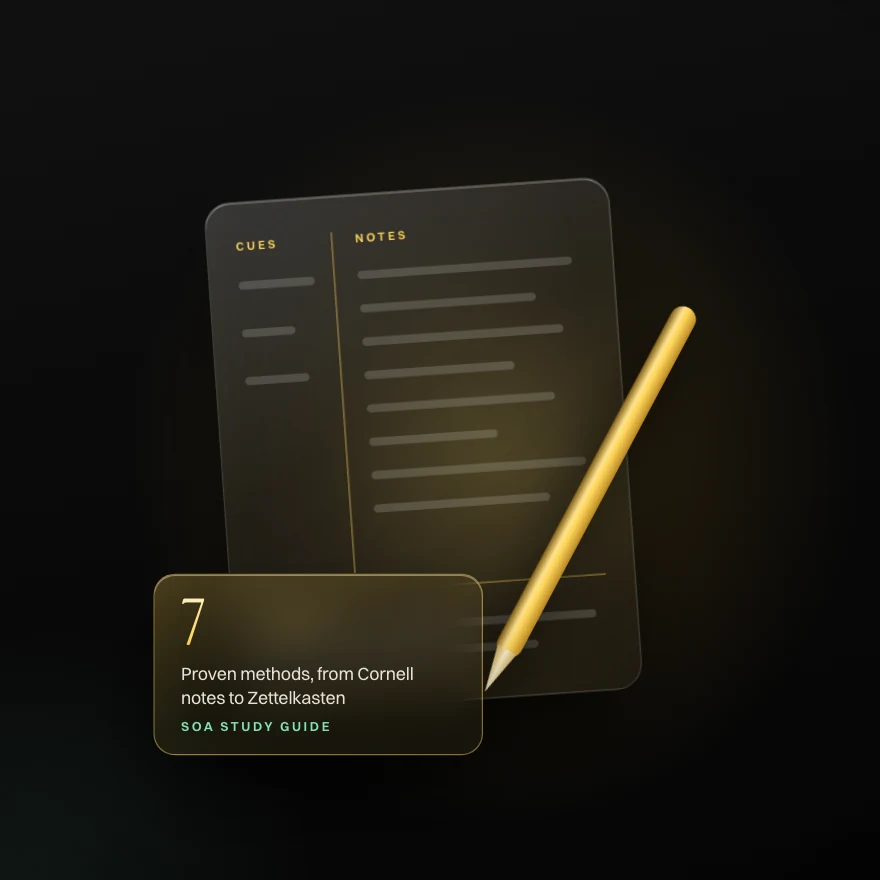
Quick answer: What is the best note-taking method?
- Cornell — the best all-rounder for exams. The cue column becomes a self-test.
- Charting — for anything you'll have to compare side by side.
- Mind maps — for seeing how ideas connect.
- Boxing — for ADHD and tablets: small, separate visual chunks.
- Then recall — quiz yourself from your notes. Testing beats re-reading.
Key takeaways
- No single method wins everywhere. Match the method to the subject and to how you'll be tested.
- Cornell notes are the best all-rounder for exams because they build in self-testing and summarizing.
- Taking notes in your own words beats copying word for word. Paraphrasing forces understanding.
- What you do after matters most: retrieval practice (quizzing yourself) strongly improves long-term recall.
- Digital or paper both work. Choose the tool that lets you review and quiz yourself most easily.
What are the different types of note-taking methods?

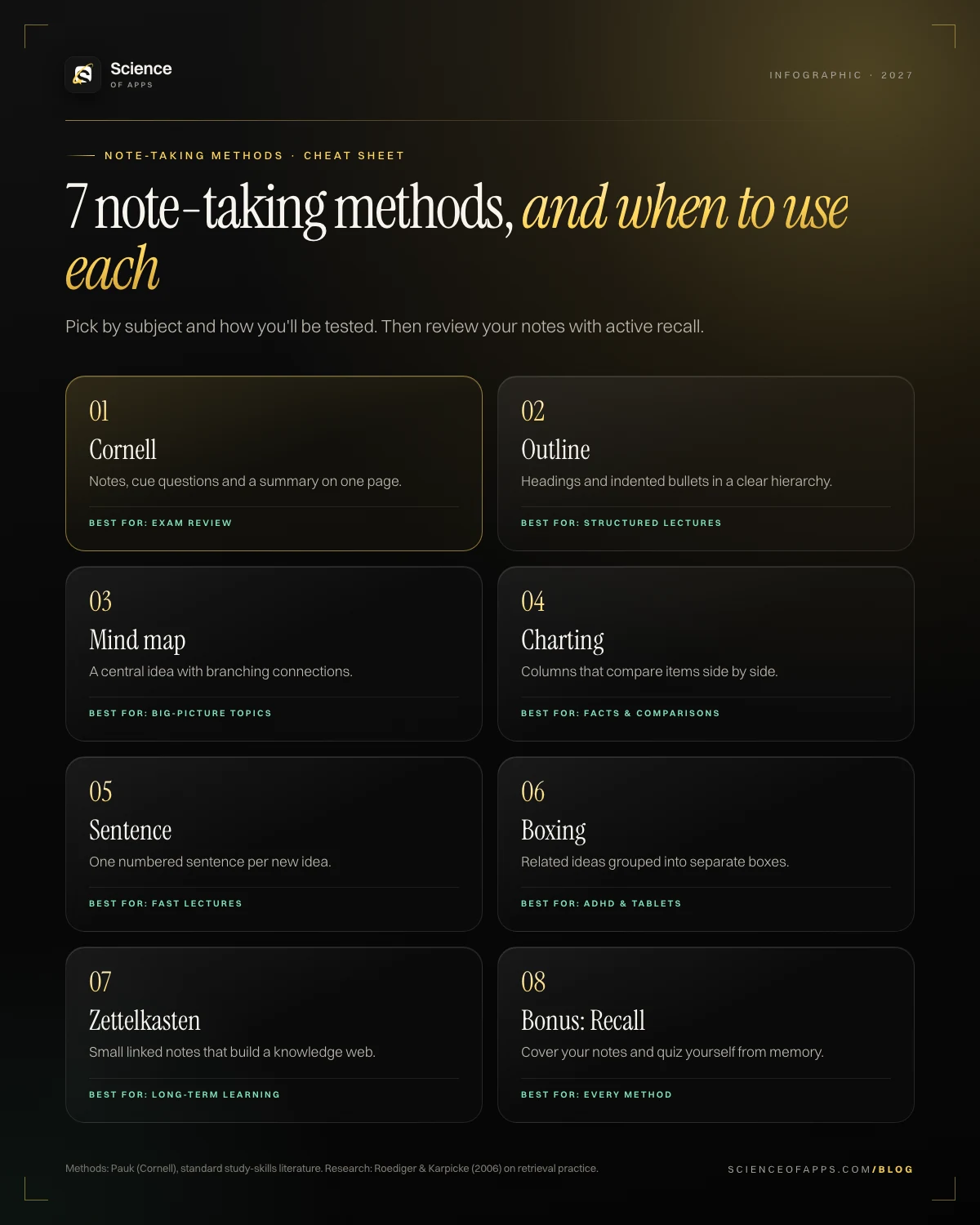
Here are the seven methods students and professionals use most, with when each one shines:
| Method | How it works | Best for | Weak spot |
|---|---|---|---|
| Cornell | Page split into notes, cue column and summary | Exam review, any subject | Needs a few minutes of setup and review |
| Outline | Hierarchy of headings and indented bullets | Well-organized lectures, textbooks | Hard to keep up with fast, unstructured talks |
| Mind mapping | Central topic with branches and links | Brainstorming, connected concepts | Not ideal for detailed facts or formulas |
| Charting | Table with columns for categories | Comparisons, dates, drugs, frameworks | You need to know the categories in advance |
| Sentence | New line, one sentence per idea | Fast lectures with lots of content | Little structure; needs rewriting later |
| Boxing | Group related notes inside boxes | Tablets, visual learners, ADHD | Can get messy on small pages |
| Zettelkasten | Atomic notes linked by IDs or links | Long-term learning, research, writing | Slow to build; overkill for one exam |
1. Cornell notes: the best for exam prep
The Cornell method was developed by education professor Walter Pauk at Cornell University and popularized in his book How to Study in College1. It's still the most widely taught note-taking system because it builds review into the page itself.
Cornell notes format
- Right column (notes, ~70% of the page): write the lecture or reading notes in short phrases.
- Left column (cues, ~30%): after class, write questions or keywords that the notes answer.
- Bottom strip (summary): write a 2–3 sentence summary in your own words.
Cornell notes example
Cue: "What does the AWS shared responsibility model split?" → Notes: "AWS secures the cloud (hardware, facilities); customer secures what's in the cloud (data, IAM, configs)." → Summary: "Security is shared: AWS owns infrastructure, I own my data and access."
To review, cover the notes column and answer each cue from memory. That turns your notes into a ready-made practice test.
2. The outline method
Write main topics at the left margin and indent supporting points beneath them. It's fast and tidy when the speaker is organized, and it converts easily into flashcards: each heading becomes a question.
3. Mind mapping
Put the main topic in the center and branch out to subtopics, using colors and short keywords. Mind maps are excellent for seeing how ideas connect, for example how cloud services relate or how causes lead to effects in history.
4. The charting method
Create columns (e.g. Certification | Cost | Eligibility | Best for) and fill in rows. Charting is the fastest way to study anything you'll have to compare: drugs in pharmacology, frameworks in project management, services in cloud exams.
5. The sentence method
Write every new fact or idea as a separate, numbered sentence. It keeps up with fast speakers. Rewrite into Cornell or outline form the same day, while you still remember the context.
6. The boxing method
Draw a box around each group of related notes. Boxing is popular on tablets (GoodNotes, Notability, OneNote) and works well for ADHD because each box is a small, visually separate chunk you can review one at a time.
Prove it free: the tests that match this guide
Check your note-taking and study habits. (Disclosure: Science of Apps publishes these tests.)
7. Zettelkasten
A system of small "atomic" notes, each with one idea, linked to related notes. Apps such as Obsidian make it easy. It shines for long-term learning across many certifications or a whole career, rather than cramming for one exam.
Which note-taking method is best for you?
| Situation | Best method | Why |
|---|---|---|
| Certification exams (AWS, PMP, CompTIA) | Cornell + charting | Cue questions mirror exam questions; charts handle comparisons |
| Math & physics | Two-column worked examples (problem / steps & why) | You learn the method, not just the answer |
| Biology, anatomy, nursing | Charting + labelled diagrams + Cornell | Lots of structured facts and relationships |
| History, law, humanities | Outline + timeline + mind map | Chronology and cause-effect links |
| ADHD | Boxing or mind mapping, with color | Short visual chunks, less wall-of-text |
| Fast-paced lectures | Sentence, rewritten into Cornell | Capture first, organize later |
| Research & lifelong learning | Zettelkasten | Knowledge compounds over time |
What does the research say?
- Write in your own words. In a well-known 2014 study, Mueller and Oppenheimer found laptop note-takers tended to transcribe word for word and did worse on conceptual questions2. Later replication work (Morehead, Dunlosky & Rawson, 2019) found the laptop-vs-longhand gap smaller than first reported3. The lasting lesson is to paraphrase rather than transcribe, whatever the device.
- Testing beats re-reading. Roediger and Karpicke (2006) showed that practicing retrieval leads to much better long-term retention than restudying4. That's why the Cornell cue column works so well.
- Space your reviews. Reviewing notes after 1 day, 1 week and 1 month (spaced repetition) consolidates memory far better than one long cram session.
Best free note-taking apps
On Android, iOS and desktop, Microsoft OneNote, Google Keep and Obsidian are free and work well with these methods: OneNote for boxing and Cornell templates, Keep for quick sentence notes, Obsidian for Zettelkasten. For handwriting on tablets, GoodNotes and Notability are popular paid options.
How we checked this
Method descriptions follow standard study-skills sources (Cornell Learning Strategies Center). Research claims cite the peer-reviewed papers listed below.
Frequently asked questions
What is the best note-taking method?
For most exams, the Cornell method is the best all-rounder because its cue column turns notes into self-test questions and its summary forces understanding. The best method ultimately depends on your subject and how you're assessed.
What are the different types of note-taking methods?
The main types are Cornell, outline, mind mapping, charting, sentence, boxing and Zettelkasten. Each suits a different kind of content, from comparisons (charting) to connected ideas (mind maps).
What is the best note-taking method for ADHD?
Many learners with ADHD prefer boxing or mind mapping with color, because information is split into small, visually distinct chunks. Short review sessions with active recall also help.
What is the best note-taking method for math?
A two-column worked-example layout: the problem on the left and each step with a short 'why' on the right. Add a summary of the general method underneath, like a Cornell summary.
How do you make Cornell notes?
Split the page into a wide right column for notes, a narrow left column for cue questions, and a bottom strip for a 2–3 sentence summary. After class, write cues, then cover the notes and answer them from memory.
What is the best free note-taking app for Android?
Microsoft OneNote, Google Keep and Obsidian are all free on Android. OneNote suits Cornell and boxing layouts, Keep is great for quick notes, and Obsidian is ideal for linked Zettelkasten notes.
Sources
- Pauk, W. & Owens, R. — How to Study in College (Cornell note-taking system)
- Mueller, P. & Oppenheimer, D. (2014) The Pen Is Mightier Than the Keyboard, Psychological Science
- Morehead, K., Dunlosky, J. & Rawson, K. (2019) How Much Mightier Is the Pen than the Keyboard?, Educational Psychology Review
- Roediger, H. & Karpicke, J. (2006) Test-Enhanced Learning, Psychological Science
- Checked November 11, 2026. Figures that change — fees, salaries, prices — are reviewed every six months; if something is out of date, tell us.
Where to go from here
- The AWS certification path, 2027 edition — all 12 certifications, costs and the right order
- PMP vs CAPM vs PRINCE2 — eligibility, fees and where each one counts
- Career change at 40: start over, smarter — a 6-step plan and the best certifications
- CertificationsStudy motivation that lastsHow to stay motivated and focused when studying for a long certification program, with tips that actually work.
- CertificationsCertifications for nurses, teachers & accountantsThe most valuable certifications for nurses (BLS, ACLS, CCRN), teachers (CTET, TEFL, CELTA) and accountants (CPA, CMA, ACCA), and what each one costs.
- CertificationsThe 30-day exam study planA free 30-day exam study plan template for any certification, with daily goals, review cycles and mock-test checkpoints.
- Product managementWhat is a product roadmap? Types, examples and a free templateWhat a product roadmap is, the main formats (now–next–later, outcome-based, timeline), examples, a free template and how to present one honestly.
- Architecture & engineeringUNESCO World Heritage Sites in India: all 45, with a map, dates and what makes each one specialIndia has 45 UNESCO World Heritage Sites as of 2026, after Sarnath: 37 cultural, 7 natural, 1 mixed. All of them on one map, with dates and design notes.
- CertificationsFree courses for high school studentsFree online courses and certifications high school students can earn to stand out on college and job applications.



Get the ideas, not the noise.
Sign up with Google and we’ll send you short UX psychology tips by email — why people tap, stall and leave, and what to do about it. Unsubscribe anytime. Prefer something to keep? Get the free Laws of UX guide as a PDF.
Prove the skill before you pay for the exam.
1,200+ free, test-based certifications graded on our server. Pass and get a founder-signed certificate with a credential ID employers can verify.